This is the title of a magisterial review
by Rob Young of GlaxoSmithKline in Top.
Med. Chem. At 68 pages it is not a quick read, but it does provide ample
evidence that physical properties are ignored at one’s peril. It also offers a
robust defense of metrics such as ligand efficiency.
The monograph begins with a restatement of
the problem of molecular obesity: the tendency of drug leads to be too
lipophilic. I think everyone – even Pete Kenny – agrees that lipophilicity is a
quality best served in moderation. After this introduction Young provides a
thorough review of physical properties including lipophilicity/hydrophobicity,
pKa, and solubility. This is a great resource for people new to the field or
those looking for a refresher.
In particular, Young notes the challenges
of actually measuring qualities such
as lipophilicity. Most people use log P, the partition coefficient of a molecule
between water and 1-octanol. However, it turns out that it is difficult to
experimentally measure log P for highly lipophilic and/or insoluble compounds.
Also, as Kenny has pointed out, the choice of octanol is somewhat arbitrary.
Young argues that chromatographic methods for determining lipophilicity are
operationally easier, more accurate, and more relevant. The idea is to measure
the retention times of a series of compounds on a C-18 column eluted with
buffer/acetonitrile at various pH conditions to generate “Chrom log D” values.
Although a stickler could argue this relies on arbitrary choices (why
acetonitrile? Why a C-18 column?) it seems like a reasonable approach for
rapidly assessing lipophilicity.
Next, Young discusses the influence of
aromatic ring count on various properties. Although the strength of the
correlation between Fsp3 and solubility has been questioned, what’s
not up for debate is the fact that the majority of approved oral drugs have 3
or fewer aromatic rings.
Given that 1) lipophilicity should be
minimized and 2) most drugs contain at most just a few aromatic rings,
researchers at GlaxoSmithKline came up with what they call the Property
Forecast Index, or PFI:
PFI = (Chrom log D7.4) + (# of
aromatic rings)
An examination of internal programs
suggested that molecules with PFI > 7 were much more likely to be
problematic in terms of solubility, promiscuity, and overall development. PFI
looks particularly predictive of solubility, whereas there is no correlation
between molecular weight and solubility. In fact, a study of 240 oral drugs
(all with bioavailability > 30%) revealed that 89% of them have PFI < 7.
Young summarizes: the simple mantra should be to “escape from flatlands” in addition to
minimising lipophilicity.
The next two sections discuss how the
pharmacokinetic (PK) profile of a drug is affected by its physical properties.
There is a nice summary of how various types of molecules are treated by relevant
organs, plus a handy diagram of the human digestive track, complete with
volumes, transit times, and pH values. There is also an extensive discussion of
the correlation between physical properties and permeability, metabolism, hERG
binding, promiscuity, serum albumin binding, and intrinsic clearance. The
literature is sometimes contradictory (see for example the recent discussion
here), but in general higher lipophilicity and more aromatic rings are
deleterious. Overall, PFI seems to be a good predictor.
The work concludes with a discussion of
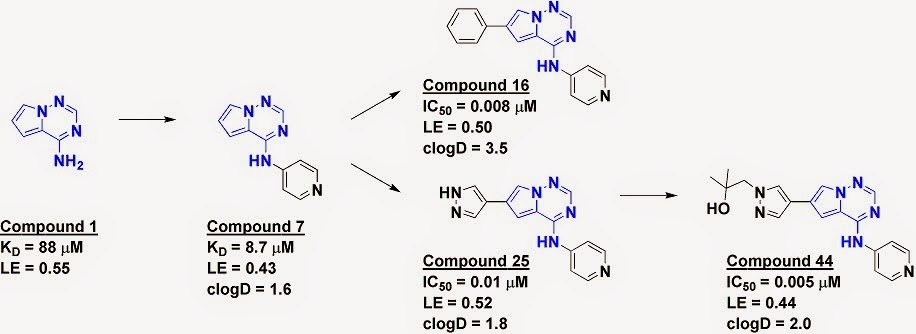
various metrics, arguing that drugs tend to have better ligand efficiency (LE)
and LLE values than other inhibitors for a given target. For example, in an
analysis of 46 oral drugs against 25 targets, only 2.7% of non-kinase
inhibitors have better LE and LLE values than the drugs (the value is 22% for
kinases). Similarly, the three approved Factor Xa inhibitors have among the
highest LLEAT values of any compounds reported.
Some of the criticism of metrics has
focused on their arbitrary nature; for example, the choice of standard state.
However, if metrics correlate with a molecule's potential to become a drug, it
doesn’t really matter precisely how they are defined.
The first word in the name of this blog is Practical. The statistician George Box
once wrote, “essentially, all models are wrong, but some are useful.” Young
provides compelling arguments that accounting for physical properties – even
with imperfect models and metrics – is both practical and useful.
Young says essentially this as one sentence
in a caveat-filled paragraph:
The
complex requirements for the discovery of an efficacious drug molecule mean
that it is necessary to maintain activity during the optimisation of
pharmacokinetics, pharmacodynamics and toxicology; these are all
multi-factorial processes. It is thus perhaps unlikely that a simple
correlation between properties might be established; good properties alone are
not a guarantee of success and some effective drugs have what might be described
as sub-optimal properties. However, it is clear that the chances of success
are much greater with better physical properties (solubility, shape and lower
lipophilicity). These principles are evident in both the broader analyses
with attrition/progression as a marker and also in the particular risk/activity
values in various developability screens.
In other words, metrics and rules should
not be viewed as laws of nature, but they can be useful guidelines to control physical
properties.




 . Then I mentioned that the blog was Practical Fragments and her attitude changed. So, this blog has "


 Posts


