Showing posts with label viral protease. Show all posts

06 April 2026

From noncovalent fragment to (non)covalent leads against PLPro

The most successful drug against COVID-19, nirmatrelvir, targets the main protease of SARS-CoV-2. As we discussed just last year, this protein has received considerable attention. But the genome for SARS-CoV-2 also encodes a second cysteine protease, papain-like protease, or PLPro. Despite this enzyme being essential for viral replication, the only previously disclosed chemical series targeting it dates from 2008 efforts against the original SARS. Two new papers in J. Med. Chem. from Stephen Fesik and colleagues at Vanderbilt University introduce new molecules, covalent and non-covalent.
 
One reason progress has been slow against PLPro is that it is inherently challenging. It recognizes the sequence LXGG, where X = Arg, Lys, or Asn. The two glycine residues thread a narrow channel to access the catalytic cysteine, while leucine and the “X” residue bind in solvent-exposed subsites. In 2024 the Fesik group published an open-access paper in ACS Med. Chem. Lett. describing the results of a protein-observed NMR fragment screen. Out of 13,824 fragments screened in pools of 12 at 0.8 mM each, 77 confirmed when tested individually, and 22 had affinities better than 1 mM.
 
An attractive feature of protein-observed NMR is that it tells you where the fragments bind, and in this case there were two main binding sites. One set of fragments bound in the S3 and S4 pockets, where the leucine and lysine residues of the substrate would normally fit, while another group of fragments bound some distance from the active site. Representatives from both groups were tested for inhibition of enzymatic activity. Only those in the first group were active, so these were prioritized.
 
In the first open-access J. Med. Chem. paper this year, the researchers started with compound 11, which fulfills rule-of-three fragment criteria, binds in the S4 pocket, and inhibits the enzyme with high-micromolar activity. Adding a couple methyl groups (compound 15) improved the potency by roughly 10-fold, and building towards the S3 pocket yielded compound 37, with low micromolar activity. Addition of a basic nitrogen, as in compound 46, improved the potency to submicromolar activity, and crystallography revealed that the basic nitrogen interacts with a glutamic acid side chain. This molecule was active in a cellular assay at submicromolar concentration.
 

An increasingly popular strategy for addressing difficult targets is through covalent inhibitors, and this is the subject of the second open-access J. Med. Chem. paper this year. The researchers synthesized and tested 25 analogs based on molecules such as compound 37 in which various warheads were appended by flexible linkers. Although some of these were active at low micromolar concentrations, only a few showed time-dependent activity as would be expected for an irreversible covalent inhibitor.
 
These few were optimized with the aid of molecular dynamics and structure-based design to molecules such as compound 45. Interestingly, despite being nearly 10-fold more potent than the best non-covalent molecule, it was less active in cells; the researchers attribute lower-than-hoped activity to the two hydrogen-bond donors in the diacetylhydrzaine linker. Unfortunately, these turned out to be essential for covalent binding; crystallography revealed that the compound forms four hydrogen bonds in the glycine channel. Indeed, this particular linker-warhead combination had been previously reported, and the inability to improve on it emphasizes the restrictive requirements for this particular protein.
 
This is a nice series of papers that shows how a single fragment can lead to multiple leads. The last paper is also a useful reminder that adding a warhead to a high-affinity binder is not always easy, nor does it necessarily lead to superior molecules. Indeed, neither the covalent nor the noncovalent leads have any reported in vitro ADME or pharmacokinetic data. It would be fun to screen PLPro against a library of covalent fragments to look for even more starting points.

18 November 2024

Covalent fragments vs chikungunya nsP2

Perhaps because it sounds like “chicken,” when I first heard of chikungunya I thought it was a joke. But there’s nothing funny about a disease whose name comes from a word meaning “to become contorted,” referring to contortion caused by pain, which can last for months. The mosquito-borne alphavirus was first identified in 1952 in West Africa, introduced to the Americas in 2013, and is now spreading rapidly worldwide. There is no specific treatment. In three recent papers, a large group of researchers mostly from the Structural Genomics Consortium take the first steps towards one.
 
Like many viruses, the chikungunya genome encodes polyproteins that are cleaved by viral proteases, in this case a domain of the nonstructural protein 2 (nsP2). This cysteine protease is essential for viral replication, and the three papers collectively describe finding and exploring selective probes against it.  
 
In Proc. Nat. Acad. Sci. USA, Kenneth Pearce (University of North Carolina at Chapel Hill) and collaborators describe a screen of 6120 covalent fragments from Enamine against this target. Compounds were preincubated in a FRET-based functional assay at 20 µM for 30 minutes, resulting in 153 hits that inhibited activity by at least 50%. 43 of these were repurchased for full-dose response curves, and 20 of these had IC50 values < 20 µM. Of these, compound RA-0002034 was the most potent, with IC50 = 180 nM.


The proper way to assess irreversible covalent inhibitors is not the time-dependent IC50, but rather the (theoretically) invariant kinact/KI ratio. The researchers measured this for the best hits and found the value for RA-0002034 to be 6400 M-1s-1, which is not far below that for the approved covalent drug sotorasib for its target.
 
Mass spectrometry experiments after tryptic digestion revealed the compound binds to the catalytic cysteine of nsP2, as expected, and not to other cysteines. RA-0002034 contains a potentially reactive vinyl sulfone warhead, but the half-life against the biologically relevant nucleophile glutathione is a respectable 130 minutes. A screen against 13 other cysteine proteases was also quite clean, as was chemoproteomic profiling in human cells.
 
The compound was also tested in cellular viral replication assays and found to be remarkably potent, with a low nanomolar EC50 value. Encouragingly, it was also potent against three other alphaviruses, Ross River virus, Venezuelan Equine Encephalitis virus, and Mayaro virus.
 
RA-0002034 appears to be an attractive chemical probe for exploring the biology of chikungunya. Best practices are to also have an inactive control molecule, and the researchers made a substitution off the central pyrazole ring to produce RA-0003161, which is 500-fold less active.
 
The paper includes some SAR-by-catalog, and the chemistry is more extensively explored in an open-access J. Med. Chem. paper by Timothy Willson (UNC Chapel Hill) and collaborators. Although no crystal structures of the compounds bound to nsP2 were available, the researchers used modeling to guide modification of all portions of the molecule. The most potent molecule was 8d, which is slightly more active than RA-0002034. Also, methyl substitution near the electrophilic center is tolerated, which could improve stability, as seen with the covalent WRN inhibitor from Vividion which we wrote about here.
 
One annoying feature of RA-0002034 is its tendency to cyclize to inactive compound 2, a process explored in an open-access Pharmaceuticals paper by Timothy Willson and collaborators. This occurs even at neutral pH. However, replacing the central pyrazole with an isoxazole (compound 10) fixes this problem.
 
Collectively these three publications provide new insights and tools for investigating chikungunya. RA-0002034 is a far more attractive starting point than a molecule Teddy described on Practical Fragments back in 2015. The pharmacokinetics of RA-0002034 need to be improved before in vivo experiments are warranted, but this seems achievable, and I look forward to watching this story develop.

13 June 2022

Fragments vs HIV-1 Protease: Pocket-to-Lead

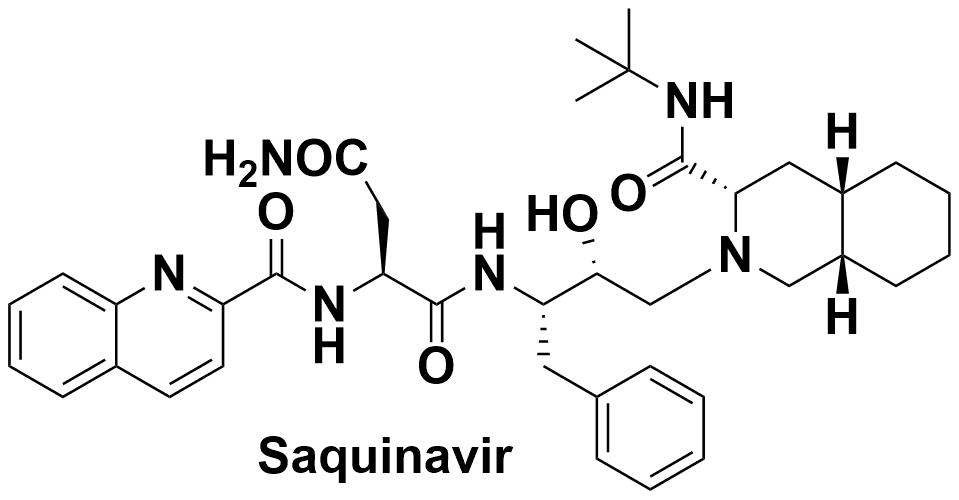
The drugging of HIV-1 protease is a classic structure-based design success story, as discussed in a guest post by Glyn Williams from the early days of the SARS-CoV-2 pandemic. The peptide origins of approved inhibitors such as saquinavir are obvious, and the residual structural features can present problems for oral bioavailability. Although there have been fragment screens against the enzyme, the hits do not seem to have been pursued, perhaps in part to the number of approved drugs. But viruses never stop mutating, and developing new chemical matter is prudent. In a recent J. Med. Chem. paper, Yuki Tachibana and colleagues at Shionogi describe a fragment-based approach.
 
The researchers started by performing a virtual screen, but none of the hits were active when tested in a biochemical assay. The active site of HIV-1 protease contains four hydrophobic subsites, and none of the virtual hits filled all four of them. Thus, the researchers chose to focus on fragments that could make some of the interactions while providing growth vectors to additional subsites. They call this a “pocket-to-lead” strategy.
 
Fragment 5 docked nicely into the active site; the hydroxyl group makes interactions with the catalytic aspartic acid residues, while the phenyl ring tucks into the S2 pocket. Growing into the S2’ and S1’ pockets led to molecules such as compound 9, which showed weak but detectable activity. (Astute readers will notice that the stereochemistry around the hydroxyl moiety has changed; both diastereomers are active.) A crystal structure of compound 9 bound to HIV-1 protease confirmed the predicted binding mode

 
Examination of the crystal structure revealed that the parafluorobenzyl substituent was not completely filling the S1’ pocket, and was also in a strained conformation. Replacing this with an alkyl substituent led to low micromolar compound 12. Finally, growing into the S1 subsite led to compound 14, a low nanomolar inhibitor with sub-micromolar antiviral activity.
 
This is a nice example of structure-guided, computationally-enabled fragment-based lead discovery that bears some similarity to the V-SYNTHES method we highlighted earlier this year. As the researchers note, the cyclic lactam found in fragment 5 had been used previously in HIV-1 protease inhibitors. It might have been possible to get to something similar to compound 14 from that earlier molecule. But regardless, compound 14 is emphatically non-peptidic. Whether it will lead to superior drugs remains to be seen, but the paper does say that further optimization is underway.

19 April 2020

Back to the Future: HIV protease offers lessons for SARS-CoV-2

Today’s guest post is by Glyn Williams (University of Cambridge). Fragment aficionados will recognize Glyn as the former VP of Biophysics at Astex, but before that he worked at Roche. His experiences there in the 1990s have lessons for today. -Dan Erlanson

In two recent Practical Fragments posts (here and here), Dan Erlanson noted efforts which will allow the scientific community to contribute to drug design efforts against the SARS-CoV-2 main protease (Mpro). Leading the charge at the moment is the COVID Moonshot consortium who have already received design proposals for covalent inhibitors, based on the structures of fragments bound to Mpro that have been generated by researchers at the Diamond Light Source. At the same time, more information about Mpro, including its substrate preferences, is being published. Soon there will be an urgent need to define a selection procedure which will allow valuable drug candidates to be progressed.

A similar situation was faced in 1985 when HIV protease was being considered as a drug target for AIDS. An excellent description of a pragmatic, and ultimately successful, procedure was published in 1993 by Noel Roberts and Sally Redshaw of Roche in The Search for Antiviral Drugs:Case Histories from Concept to Clinic.

When the project began there was no definitive proof that this aspartyl protease was essential for viral replication in human cells and that it could not be substituted by a cellular protease. However, its in vitro ability to cleave a Phe-Pro or Tyr-Pro peptide bond (amongst others) marked it out as unusual, and that was sufficient encouragement for Roche to initiate a discovery programme. Inhibitor design then took advantage of this feature to build in selectivity over human aspartyl proteases, ultimately giving a high therapeutic index while also improving inhibitor absorption after oral administration. 
 
Critical issues, such as the decision to target the HIV-1 viral strain, access to suitable protease constructs and clear criteria for project progression, were defined early on. Novel protease and anti-viral assays were then developed in parallel with transition-state mimetic leads. From the start, it was recognised that the low aqueous solubility of the optimal peptide substrates could imply that peptidomimetic inhibitors were also likely to have poor physico-chemical properties. At the time there was no structural information on the enzyme or its complexes, so there was little opportunity to avoid these shortcomings.

As with COVID-19, the worldwide health implications of HIV were obvious and scientific interactions between different research groups were driven by a spirit of cooperation. Public laboratories contributed clinical data and provided access to assays for viral activity. In 2020 the ability to share data has improved beyond recognition but the ability to interpret and act on it is still subject to political and commercial pressures. At Roche, a series of hydroxyethylene inhibitors was not pursued due to its prior inclusion in multiple patents for renin inhibitors. In addition, sensitivity to criticism from AIDS activist groups during the project discouraged Roche from developing follow-up candidates later.

Many current predictions and public expectations about COVID-19 now depend on the availability of vaccines in 2021. After more than three decades of research, no preventative vaccine is yet available for HIV. However, the ability to treat a viral infection, even with a drug that contains and controls the infection rather than eliminates it, should not be undervalued. In 1993 the Roche HIV protease clinical candidate, Ro 31-8959, was in Phase 2 evaluation. Roberts and Redshaw pointed out then that lowering a patient’s viral load would reduce the risk of further infections amongst health-care workers and social contacts, while the persistence of immature and non-infectious viral material in cells could stimulate the patient’s own immune system to eliminate the virus.

Roberts and Redshaw concluded their 1993 analysis with the statement that "although there is still much work to be done, we remain very hopeful that Ro 31-8959 will make a positive contribution to the therapy of AIDS". Two years later Ro-31-8959, as Saquinavir, was approved by the FDA and, with Ritonavir, a second protease inhibitor from Abbott Labs, led to a 64% reduction in deaths from AIDS in the US over the next 2 years. Let us now hope for the same degree of success from new COVID-19 treatments.

30 March 2015

Politburo Approved

Viral, tropical diseases are really cool because they have great names. e.g. Dengue or Breakbone Fever or Chikungunya ("that which breaks up").  The great thing about many viral diseases is that they are dependent upon proteases for many things. (And yes, I know how that sounds.)  Proteases have nice, well defined active sites that you can fill quite well and shut them down. In this paper, the authors use fragment-peptide merging to inhibit Dengue protease.  

This is really an extension of previous work.  The original work used capped peptides with a warhead with very good potency (down to 43 nM).  They then investigated retro, retro-inverse, semiretro-inverse, and nonretro di- and tri-peptides.  This lead them to use a tri-peptide (Arg-Lys-Nle) in two generations: first an arylcyanoacrylamide and then to N-substituted 5-arylidenethiazolidinone (thiazolidinediones and rhodanines).  These second generation hybrids had increased membrane permeability, in vitro binding, in cellulo antiviral activity.  Based on docking, they decided to investigate Nle sitting in P1', in contrast to previous site preferences and then merge it with fragments from an optimized capping moiety. 
1.  Starting Point Hybrid Peptide
The investigation of Nle replacements led to the phenylglycine molecule, with 4x greater affinity:
9.  Phenyl-glycine hybrid
They, then chose three hybrids (including 9) and put two different caps on them:
Rhodanine Cap
Acrylamide cap

Compared to the benzoyl cap, the acrylamide was 2x better while the rhodanine was 5x better.  But, wait, doesn't the Politburo condemn all uses of rhodanines?  Of course not.  In this case, the rhodanine was selected through rigorous analysis: and they have selectivity (this assay is fluorogenic).  They are perfectly aware of the general distaste people have for rhodanines and address the concerns. All of this together, leads to the final compound (below).
This is a really nice piece of starting with a tool (covalent peptides) and working to generate drug like molecules with favorable properties.