Showing posts with label Astex. Show all posts

29 September 2014

FBLD 2014

FBLD 2014, the fifth in an illustrious series of conferences, took place in Basel, Switzerland last week. Organizers Wolfgang Jahnke (Novartis), Michael Hennig (Roche), and Rod Hubbard (University of York & Vernalis) put together a fantastic event. With 35 talks, 45 posters, and more than 200 delegates, I won’t attempt to give more than a few impressions here. In addition to Teddy’s (and others’) Tweets, Derek Lowe put up several posts (see here, here, and here); please share your thoughts below.

Harren Jhoti delivered a lively and wide-ranging opening keynote summarizing the past 15 years of FBLD as viewed from Astex. Among many other innovations, researchers there are responsible for the Rule of 3, which has been the subject of some debate. Harren emphasized that the “Voldemort Rule” should not be a strait-jacket. Like the Kobayashi Maru, rules are there to be broken, though you need to be something of a James T. Kirk to do so effectively.

Astex has produced what is likely the largest collection of protein-fragment crystal structures, and Harren noted that many proteins appear to have fragment binding sites outside the active site: across 25 different proteins, the average number of total sites is slightly greater than 2. Astex is increasingly targeting these sites for allosteric lead discovery.

The theme of crystallography carried through the conference. As Armin Ruf (Roche) exhorted, “more crystals, more structures.” One challenge is that not all crystal forms are suitable for fragments, and it is not always clear from the outset which forms will work. Armin described their chymase project in which an initial crystal form gave 8 fragment structures, but additional crystal forms allowed them to obtain 6 more. Without the different crystal forms these later fragments would have been crystallographic false negatives, yet the potential of different crystal forms to reveal more hits is under-appreciated: Armin noted that the majority of recent fragment papers reported using only a single crystal form.

The importance of crystallography was emphasized again by Nick Skelton (Genentech), who discussed their NAMPT program (which we covered here). In this project, which utilized dozens of crystal structures, a single atom change to a fragment could completely and unpredictably alter the binding mode.

Obtaining a good crystal is not necessarily easy, though. Andreas Lingel (Novartis) described their efforts to produce a form of B-RAF that would diffract to higher resolution and allow fragment soaks (as opposed to co-crystallization). They tried reducing the “surface entropy” by mutating glutamate and lysine residues to alanine, but only one of a dozen or so mutants expressed well and gave superior crystals. Although this turned out to be useful, the team is still at a loss to explain why the specific mutants are effective.

Continuing the theme of crystallography, Matt Clifton (Beryllium) described what looks to be a significant advance for the protein MCL-1. (This is a collaboration with the Broad Institute, and we previously noted some of their progress here.) The researchers have developed a maltose-binding protein (MBP) fusion of this oncology target that diffracts to 1.9 Å in the absence of any ligand. (MBP fusions are used to help crystallize challenging proteins.) Since they developed this construct in May of this year, the researchers have already solved more crystal structures than had been reported publicly to date, and uncovered some interesting findings. For example, the initial fragment that Steve Fesik’s group found binds in a similar manner to one of his more potent later leads, as does one of the AbbVie fragments; however another AbbVie fragment binds in a somewhat different fashion than the elaborated lead.

The subject of how to effectively sample chemical space was another theme, and to this end Alison Woolford (Astex) proposed the concept of a “minimal pharmacophore”: the minimal interactions necessary to drive fragment binding. Researchers at Astex have systematically cataloged several dozen of these, which include such simple entities as amines, acids, aromatic chlorides, and more abstract concepts such as a 1-bond donor-acceptor (think pyrazole). Alison showed an interesting graph with targets on the y-axis and minimal pharmacophores on the x-axis which revealed some obvious patterns such as the preference of donor-acceptor minimal pharmacophores by kinases, but there were unexpected features as well. In a sense, this is an empirical realization of early docking studies, but it also has interesting implications for library design. For example, Alison suggested avoiding fragments with more than one minimal pharmacophore, as these will not be able to effectively sample as many different sites on a protein: with two pharmacophores, a fragment would be limited to binding sites having matching recognition elements to both rather than just one. This idea ties in with the concept of molecular complexity, but from a more chemocentric point of view.

On the subject of chemistry, Dalia Hammoudeh (St Jude’s Hospital) gave a lovely talk on her experiences developing allosteric inhibitors of DHPS, an antibiotic target. Among other fragment hits from the Maybridge library, one was ostensibly 4-trifluoromethylbenzylamine, but turned out to actually be the Schiff base of this with the corresponding aldehyde. Yet another reminder to always carefully check what you think you have.

Practical Fragments has previously discussed the Genentech MAP4K4 program (here and here), and Terry Crawford gave a nice summary. One of the challenges they faced was that their initial leads had excellent brain penetration, leading to animal toxicity. This forced them to increase size and polar surface area. Although it was problematic in this case, this emphasizes how small and drug-like fragment-derived leads can be. Indeed Vicki Nienaber, who was a prime mover behind the original FBLD 2008 meeting, has devoted much of her efforts at Zenobia to CNS targets.

Finally, Derek Lowe (Vertex) gave a rollicking history of the drug industry, ending with his view of where fragments fit in. He noted that chemists – Valinor not withstanding – play a central role, and in that sense the field is a departure from the general trend of the past decade or so. It still remains to be seen how many of the 30+molecules FBLD has delivered to the clinic will come out the other side, but at least for now the field is thriving. As Chris Lipinski stated last year, “if I had to single out one technology that really took me by surprise and has been very successful, it has been fragment screening.”

09 September 2013

More thoughts on the Astex-Otsuka marriage

Teddy already highlighted the planned $866 million acquisition of Astex by Otsuka, and I thought I’d add a bit of context. Astex Therapeutics was founded in 1999, just three years after publication of the Abbott SAR by NMR paper that arguably launched widespread interest in fragment-based lead discovery. From the outset, Astex focused heavily on crystallography, which was somewhat unusual at the time; Vicki Nienaber’s seminal SAR by Crystallography paper only came out in 2000.

Astex researchers have made many practical contributions to FBLD, from the (sometimes controversial) rule of three to the LLEAT metric to the Astex Viewer familiar to anyone who has seen a presentation from the company. More than 100 publications have come from Astex, including one of the earliest comprehensive reviews of the field. And the company has also delivered: of 28 fragment-derived compounds to make it into the clinic, Astex has had a role in nearly a quarter, including AT13387, AT7519, AT9283, JNJ-42756493 (with J&J), LEE011 (with Novartis), AT13148, and AZD5363 (with AstraZeneca and ICR).

In terms of price, $866 million is indeed a tidy sum, more than the up-front Daiichi Sankyo paid for Plexxikon (though a bit under the total deal value of $935 million) and more than an order of magnitude higher than the $64 million Lilly paid for SGX back in the dark days of 2008. Even with close to a billion dollars on the table, some are calling the price too low, with one analyst suggesting Astex is worth $13 per share rather than the $8.50 offered by Otsuka.

Of course, the Astex pipeline is not entirely fragment-based; a merger with SuperGen in 2011 brought in a marketed product (decitabine) as well as other clinical compounds. Still, from what Otsuka has said publicly, it does appear that the FBLD technology was a major driver: it is the first item mentioned under the heading “Objectives of the Acquisition.”

As Derek Lowe pointed out over at In the Pipeline, Japanese firms have a good track record of not breaking or shuttering acquired companies; last I checked Plexxikon was still going strong. Hopefully this will hold true for Astex as well. Practical Fragments offers congratulations and wishes continued success to everyone involved.

05 September 2013

What Do Fragments Get you?

Parroting In the Pipeline, what do fragments get you?  886 Million dollars, that's what!  As pointed out by the buying company:
"Astex's unique fragment-based drug discovery technology [Ed: emphasis added] and clinical oncology research and development capabilities, born out of the passion of its researchers, exemplify our corporate mottos and belief in "Sozosei (Creativity) and Jissho (Proof through Execution). I would like Otsuka Pharmaceutical to continue to respect Astex's uniqueness and leverage it to bring further growth for Otsuka Pharmaceutical."
Congratulations to the folks at Astex, the next time you see them at a conference, make sure they pick up the check.

17 July 2013

The rule of three at ten

One of the rewards of following a field for years is being able to revisit classic papers to see how they’ve held up. Two years ago we re-examined molecular complexity. This year marks the tenth anniversary of the publication of the “rule of three”, and Harren Jhoti and colleagues from Astex have marked the occasion with a brief but trenchant letter in Nature Reviews Drug Discovery.

Think back, if you will, to 2003. Abbott researchers had published their seminal SAR by NMR paper seven years previously, but fragment-based efforts were still widely scattered, with each organization more or less figuring things out on its own. It was in this primordial environment that Jhoti and colleagues published a short “discussion forum” in Drug Discovery Today. It framed its premise as a question (A ‘rule of three’ for fragment-based lead discovery?) and suggested that fragments have the following characteristics:
  • Molecular weight (MW) < 300
  • ClogP ≤ 3
  • # of hydrogen bond donors ≤ 3
  • # of hydrogen bond acceptors ≤ 3

In the new publication, the researchers note that most of the focus has been on the first two critera. Indeed, as has been pointed out, there is some ambiguity as to how one defines hydrogen bond donors and acceptors.

Since proposing the Rule of Three, Astex has been moving towards ever smaller compounds; the majority of their fragments now have fewer than 17 non-hydrogen atoms, with a molecular weight < 230 Da. One consequence is that the other properties automatically fall into line: a quick search of ~100,000 compounds with ≤ 16 heavy atoms reveals that 86% have ClogP ≤ 3, while out of 370,000 compounds with MW ≤ 300, only 72% have ClogP ≤ 3.

This push towards smallness has been questioned, particularly in the context of protein-protein interactions, where some have suggested that larger fragments may be required. Jhoti (and others) counter with two arguments.

On a theoretical level, all proteins are made up of amino acids, so there shouldn’t be anything special about protein-protein interactions:

Fragments are – or should be – simple enough to probe the basic architecture of all proteins yet have sufficient complexity to allow them to be elaborated into lead compounds.

On a practical level, after screening more than 30 targets, the researchers find that many fragments that hit protein-protein interactions also hit other targets.

The researchers are in favor of “three-dimensional” fragments, but not at the cost of increased size. They note that the perception that fragment libraries are dominated by “flat molecules” may be distorted by the fact that many fragment success stories (including nearly half of clinical-stage compounds) involve kinases, which have a predilection for planar adenine-like fragments. That said, they acknowledge that many fragment libraries are sub-optimal, leading to heartbreak during optimization. As they note with restraint, “not all fragment libraries are alike.”

Finally, there is a nice analysis of what to do with fragments that don’t reproduce in orthogonal assays. They typically observe 30%-40% correlation between fragment hits from ligand-observed NMR and X-ray crystallography, but note that this isn’t bad given that an NMR hit can be detected at just 5% binding, while crystallography typically needs at least 70% occupancy. Thus, NMR can detect fragments with solubilities less than their dissociation constants, which is unlikely in the case of crystallography. Although it is reassuring when multiple techniques confirm, the danger is that:

This strategy implicitly places a reliance on the least sensitive technique. This is of particular concern as the most potent fragment is often not the best starting point for hit-to-lead chemistry.

Not surprisingly to those familiar with Astex, the researchers put a premium on crystallographic information.

Closing with the rule of three, I think part of what bothers some folks is the notion of “rules” in general; nature has never read an issue of Nature, and drug discovery will never be as reductionist as physics is. Indeed, the researchers acknowledge that the rule of three “is just a guideline that should not be overemphasized.” The rule of three is a play on Chris Lipinski’s (equally contentious) rule of five; perhaps the “guideline of three” would have been less controversial. But the spirited discussion ensuing over the years has generated light as well as heat, which the authors welcome:

We trust that our comments, some of which are deliberately provocative, on these many facets of FBDD will generate active discussion and might assist in improving the success of this approach for the broader drug discovery community.

The comments are open for those who would like to continue the discussion here!

14 April 2013

Fragments in the clinic: AZD5363

As illustrated earlier this year, kinases have been a fertile field for fragments. In a recent issue of J. Med. Chem., Jason Kettle and colleagues at AstraZeneca describe the discovery of AZD5363, a protein kinase B (PKB) inhibitor currently in multiple phase I clinical trials for solid tumors.

The story actually starts a decade ago, with a collaboration between Astex and the Institute of Cancer Research. The two organizations were interested in PKB (also known as Akt1), which has a central role in the PI3K signaling cascade. Virtual, biochemical, and crystallographic screens identified small fragments such as substituted pyrazoles and 7-azaindole (which astute readers will recognize as the starting point for vemurafenib) that bind to the so-called hinge region of PKB. Structure-guided fragment-growing ultimately led to compound 2.


This compound, while potent against PKB, was unselective against the related protein kinase A (PKA), so further crystallographically-enabled medicinal chemistry led to CCT128930, with 30-fold selectivity against PKA. This compound had limited oral bioavailability, so further optimization led to compound 3.

In 2005, Astex partnered this program with AstraZeneca, which is presumably where the current paper picks up. Although compound 3 had good pharmacokinetics and was selective against PKA, it inhibited the kinase ROCK2, which regulates blood pressure; it was also a modest hERG inhibitor. Extensive SAR explorations around the hinge-binding element, the amine, and the aromatic group were not productive, but substitution off the benzylic position was tolerated. Adding a basic substituent dramatically reduced hERG binding, but at the cost of oral bioavailability. However, adding a variety of neutral, polar substituents led ultimately to AZD5363, which has no detectable hERG inhibition, good selectivity against ROCK2, and improved solubility and cell activity.

This paper nicely illustrates some of the challenges in drug discovery: high-affinity molecules were obtained relatively quickly, but these still required a huge amount of effort to achieve selectivity, oral bioavailability, and other properties. Indeed, only three heavy atoms differentiate compound 3 from AZD5363, but it took a heroic effort to get there.

Finally, it is worth noting that this research was done at Alderley Park, which attendees of Fragments 2009 will remember fondly. Sadly, AstraZeneca has announced that they will be closing this site. There are many very talented scientists there, and Practical Fragments wishes all of them the best of luck.

09 October 2012

Fragments vs Hepatitis C NS3 protein

Hepatitis C is the target of numerous drug discovery programs, so it was only a matter of time before fragments were used to tackle it. In a paper just published online in Nature Chemical Biology, Harren Jhoti and colleagues at Astex Pharmaceuticals describe a particularly elegant example of fragment optimization against an unusual allosteric site.

The NS3 protein contains two functional domains, both of which are essential for viral function. Two drugs have recently been approved that target the serine protease domain, and the helicase domain has also been extensively studied. However, much of the effort has focused on truncated proteins consisting of only one domain without the other; in the cell, the protein remains intact and also complexes with another viral polypeptide, NS4a. It was this full-length protein complex that the Astex researchers went after.

In the full-length form of the protein, the protease is auto-inhibited by the C-terminus of the helicase domain, which binds in the active site of the protease domain. A crystallographic fragment screen identified fragments such as Compound 2 (below) that bind in a pocket near the protease active site, and the researchers wondered whether these might trap the protein in the inactive state. Compound 2 binds in a hydrophobic pocket and weakly inhibits the protease activity of the full-length protein. Initial optimization focused on improving hydrophobic contacts and restricting the conformational mobility of the molecules, leading to compound 4, with low micromolar activity. Further optimization to pick up additional polar contacts led to compound 6, with nanomolar biochemical and cell-based activity.


As is often (though not always) the case in fragment optimization, the optimized compound 6 shows a similar binding mode to the initial compound 2.


If the compounds truly act by keeping the NS3-NS4a protein complex in the “closed,” or auto-inhibited state, this should be detectable by various biophysical measurements, and in fact sedimentation velocity analysis, size exclusion chromatography, and dynamic light-scattering were all consistent with this mechanism.

The binding energetics of the identified molecules were also studied by isothermal titration calorimetry. In general, enthalpy played the major role in improving free energy of binding, with entropy playing an increasingly deleterious role as affinities improved. Though interpreting thermodynamic data is tricky, the contribution of enthalpy versus entropy is consistent with the molecules locking the protein into a single conformation, thereby decreasing its conformational freedom (and entropy).

This paper is a beautiful illustration of anti-reductionism: the compounds are not active against the isolated protease domain commonly studied; only by looking at the full-length protein complex could the allosteric site be identified. Molecules such as compound 6 should prove useful reagents for exploring, and ultimately preventing, hepatitis C replication.

29 December 2011

Fragments vs Pharma

As the year winds down I’ve been catching up on some reading, and finally got to the study that Paul Leeson and Stephen St-Gallay published a couple months ago in Nature Reviews Drug Discovery. They analyzed compounds disclosed in patent applications from 18 large companies (mostly pharmaceutical companies, but also Amgen and Vertex) between 2000 and 2010. Even controlling for different targets, the companies differed considerably in the drug-likeness of their compounds, with some companies producing compounds that are considerably larger and more lipophilic than other companies. In the Pipeline has an excellent summary of the paper overall.

But what caught my eye as being of special interest to readers here is a small part of the main paper. In addition to analyzing large companies, Leeson and St-Gallay dug into the patent applications of a fragment-focused company, Astex Therapeutics (now Astex Pharmaceuticals). A dozen of the kinase targets pursued by Astex were also pursued by one or more of the large companies, and by analyzing the inhibitors from each organization, the authors could compare leads derived from fragments with leads derived using conventional approaches. The results were striking:
With the exception of chirality and sp3 measures, molecular properties are more drug-like in the compounds patented by Astex Therapeutics. This specific application of fragment-based drug design is perhaps the most compelling realization to date of the principle of lead-like chemical starting points that was first proposed more than a decade ago.
This does not mean that FBDD is a panacea: as noted previously, it is all too easy to take a perfectly good fragment and turn it into an obese grease-ball. But an attractive fragment, combined with adept medicinal chemistry and intolerance for unnecessary lipophilicity, can be a powerful combination.

And with that, Practical Fragments says goodbye to 2011. Thanks to all of you for reading, and special thanks for posting comments. May you all have a happy and successful 2012!

10 November 2011

Pushing the Rule of 3

The Rule of 3 (Ro3) is commonly used to design fragment libraries. First published as a brief 450-word (shorter than this post!) “update” in the discussion forum of Drug Discovery Today in 2003 by researchers at Astex, it has become the fragment equivalent of Chris Lipinski’s famous Rule of 5. Like that rule, it has its critics, notably our friends at FBDD and Molecular Design. A key point of contention is whether the Ro3 is too restrictive. A new paper in J. Med. Chem. from Gerhard Klebe’s group at Philipps University Marburg addresses this question.

The definition of the Rule of 3 provided by Astex is as follows:

The study indicated that such hits seem to obey, on average, a ‘Rule of Three’, in which molecular weight is <300, the number of hydrogen bond donors is ≤3, the number of hydrogen bond acceptors is ≤3 and ClogP is ≤3. In addition, the results suggested NROT (≤3) and PSA (≤60) might also be useful criteria for fragment selection.

One of the criticisms leveled at the Ro3 is that it is vague in terms of what constitutes a hydrogen bond acceptor. For example, does the nitrogen in an amide count? What about the nitrogen in an indolizine? Presumably for simplicity Lipinski assumed that any nitrogen or oxygen atom would count as a hydrogen bond acceptor. At the risk of engaging in exegesis, I propose that only oxygen or nitrogen atoms most medicinal chemists would consider as acceptors should be counted as acceptors, and that the limits on the number of rotatable bonds (NROT) and polar surface area (PSA) are optional.

In the recent paper, which is also discussed at FBDD and Molecular Design, Klebe and colleagues assembled a library of 364 fragments in which the average properties of the fragments were within Ro3 guidelines (with the exception of “Lipinski acceptors,” which would include the nitrogen of a tertiary amide), but there were some outliers. They then performed a fluorescence-based competition screen against the model protein endothiapepsin, resulting in 55 fragments that inhibited at least 40% at 0.5 or 1 mM concentration. These fragments were taken into crystallography trials, resulting in 11 structures. The paper presents lots of nice analysis of how these fragments bind to the protein. It also notes that:

Only 4 of the 11 fragments are consistent with the rule of 3. Restriction to this rule would have limited the fragment hits to a strongly reduced variety of chemotypes.

This may be an overstatement. Looking at the fragment hits more closely, all of them have molecular weights less than 300, and only one has ClogP > 3. Personally, given the problems of molecular obesity and the dangers of lipophilicity, I’d say that these aspects of the Ro3 are the most important, and find it notable that the hits were so compliant given that the library did contain larger, more lipophlic members.

All 11 of the crystallographically characterized fragments also have 3 or fewer hydrogen bond donors and TPSA < 60 Å2. Only two of the fragments have more than 3 rotatable bonds, but where the majority of the fragments fail to pass Ro3 is in the number of “Lipinski acceptors,” where 6 of the 11 have > 3. However, if you count hydrogen bond acceptors more judiciously (ie, compound 291 would have 3 acceptors rather than 4, since the aniline nitrogen would not be counted), only 1 of the 11 fragments has more than 3 acceptors.

Like most rules, the Rule of 3 should never be treated as a strait-jacket. That said, given the number of possible small fragment-sized molecules, and the necessarily limited size of any fragment collection, there seems to be plenty of room within the Rule of 3 for attractive chemical diversity.

20 June 2011

Ligand Lipophilicity Efficiency AT Astex Therapeutics

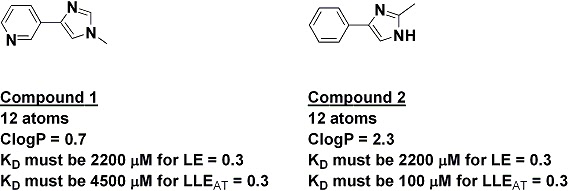
Our last post discussed the growing plague of molecular obesity, and how numerous metrics have been designed to control it. In a paper published online in J. Comput. Aided Mol. Des. Paul Mortenson and Chris Murray of Astex describe a new one: LLEAT.

Although ligand efficiency (LE) is probably the most widely used and intuitive metric, it does not take into account lipophilicity. Other indices do, notably ligand lipophilicity efficiency (LLE) and ligand-efficiency-dependent lipophilicity (LELP), but these both have drawbacks for evaluating fragments. LLE (defined as pIC50 – log P) is not normalized for size; for a fragment to have an (attractive) LLE ≥ 5 it would need an exceptionally low log P or an exceptionally high affinity. LELP, defined as log P / ligand efficiency, is also potentially misleading since a compound could have an acceptable LELP value even with a low ligand efficiency if the log P is also very low.

To address these problems, Mortenson and Murray have tried to strip out the non-specific binding a lipophilic molecule experiences when going from water to a binding site in a protein. They define this modified free energy of binding as:

ΔG* = ΔG - ΔGlipo
        ≈ RT ln (IC50) + RT ln (P)
        ≈ ln (10) * RT (log P - pIC50)

In order to put values coming out of this metric on the same scale as those from ligand efficiency, they add a constant, such that:

LLEAT = 0.11 – ΔG* / (number of heavy atoms)

Thus, just as in ligand efficiency, the goal is for molecules to have LLEAT ≥ 0.3 kcal/mol per heavy atom.

The index has some interesting implications. For example, the two fragments below have the same number of heavy atoms, and thus if they had the same activity they would have the same ligand efficiency; on this measure alone, neither would be preferred as a starting point for further work. However, because of their very different lipophilicities, fragment 2 would need to be 45 times more potent than fragment 1 in order to have the same LLEAT of at least 0.3.

A similar analysis can be done during optimization. For example, adding either a phenyl or a piperazinyl substituent should produce a 20-fold boost in potency in order to maintain ligand efficiency at 0.3, since both have 6 atoms. However, in order to maintain LLEAT at 0.3, the phenyl would need to produce a 460-fold boost in potency while the piperazinyl would need to improve potency only 3-fold. This is consistent with what other folks have reported qualitatively, but it’s nice to have a simple quantitative measure.

Although some people may groan at yet another index, and no metric is perfect, I like the fact that this one is intuitive and has the same range of “acceptable” values as ligand efficiency. What do you think – is it useful?

03 September 2010

Fragments in the Clinic: AT13387

We recently discussed BACE, a target that has been tackled by FBDD due to its intractability to other methods. The subject of this post is quite the opposite: the anticancer target Hsp90 has proven very amenable to a variety of approaches, including fragment methods (see here and here); close to a dozen compounds targeting Hsp90 are in the clinic. Now Astex has detailed their work in this area with two back-to-back papers in a recent issue of J. Med. Chem. describing the discovery of AT13387.

The first paper, by Christopher Murray and colleagues, actually presents the discovery of two separate series of inhibitors. The researchers started with a library of about 1600 fragments and used NMR techniques (water LOGSY) to identify hits against Hsp90. Competition with ADP allowed them to identify molecules that bind to the nucleotide binding site. In all, 125 fragments were taken into crystallography, using both co-crystallography and soaking, resulting in 26 co-crystal structures. Four of these structures are described in some detail, with two leading to potent inhibitors. Throughout the process, isothermal titration calorimetry was used to measure dissociation constants.

In the first series, compound 1 was identified as a weak hit (see Figure 1). Virtual screening led to the purchase of a few variants, including compound 5, with roughly 100-fold improved affinity. Interestingly, the crystal structure of compound 1 bound to Hsp90 showed that the molecule was twisted around the bond connecting the two aromatic rings, despite this not being energetically optimal for the unbound molecule. By substituting the phenyl ring of compound 5 to stabilize this twisted conformation the researchers were able to improve the potency another 20-fold (compound 9), along with a boost in ligand efficiency. Further structural work suggested adding another chlorine to fill a lipophilic site as well as adding a solubilizing group, ultimately leading to compound 14, with low nanomolar binding affinity and low micromolar cell activity.
Figure 1


In the second series, compound 3 (which is actually itself a drug, ethamivan) had only modest ligand efficiency, but crystallography suggested that replacing the methoxy group with something slightly larger and more lipophilic would improve the interactions, a hypothesis borne out by the increased activity of compound 17 (see Figure 2). Increasing the lipophilicity of the amide side chain to take advantage of protein flexibility led to a further two orders of magnitude increase in potency (compound 28). Finally, the researchers were able to use the known binding mode of a natural product to add an additional hydroxyl group, leading to compound 31, with sub-nanomolar affinity (more than a million-fold more potent than the initial fragment!) and mid-nanomolar cell activity.
Figure 2


An impressive feature of both these examples is that, through the use of elegant medicinal chemistry, the researchers were able to improve ligand efficiency throughout the course of affinity improvement. Of course, it helps that they were working on a crystallographically friendly target for which several other groups had published extensive SAR, but these are nonetheless beautiful case studies. As the researchers point out, “in terms of the efficiency of the added groups, the two fragment to lead campaigns… are among the most efficient ever reported.”

But the story doesn’t end there. The second paper, by Andrew Woodhead and colleagues, describes the further optimization of compound 31 to the clinical candidate AT13387. Despite its impressive biochemical and cell potency, compound 31 had only modest activity in a mouse xenograft model, as well as a short plasma half-life. Not surprisingly the hydroxyl groups were found to be points of metabolism, but initial efforts at capping these or changing their electronics either proved detrimental to activity or did not improve the pharmacokinetics. This led to a medicinal chemistry focus on the isoindoline portion of the molecule: a number of positively charged moieties were added at various positions to try to change the overall properties of the molecule. Several substituents were tolerated, and seven related molecules were taken into preclinical candidate selection to look for optimal in vivo properties, solubility, and selectivity against P450 and hERG. AT13387 (see Figure 2) was chosen as the molecule having the best overall profile and entered human clinical trials for solid tumors.

This second paper is a valuable companion to the first: it is particularly notable that, on the simple measures of biochemical and cell potency, AT13387 is no better than compound 31. This emphasizes yet again that affinity is only the first step in drug discovery – it’s a long road from a good lead to the clinic, and an even longer road from there to a marketed drug.

26 March 2010

ACS Spring Meeting 2010

The spring national meeting of the American Chemical Society has just concluded in (uncharacteristically sunny) San Francisco. The main fragment event was a full day session organized by Rachelle Bienstock of the NIH. The theme was “Fragment based drug discovery: success stories due to novel computational methods applications.” Rachelle is planning on getting some of the speakers to write chapters for a book, so I won’t do more than give a very brief overview here.

The session was very multinational, with speakers from France, Germany, Russia, and the UK, in addition to the US, and a good mix of companies and academics. On the computational corporate side John MacCuish from Mesa Analytics described the molecular shape fingerprints approach, Carsten Detering of BioSolveIT provided several examples of applying his company’s methods for fragment linking and scaffold hopping, and Francois Delfaud of MEDIT described mining the pdb for protein-fragment interactions and applying this to Eg5 inhibitors. On the computational academic side, Tobias Lippert of the Center for Bioinformatics in Hamburg discussed the Qsearch program, Vladimer Poroikov of the Institute of Biomedical Chemistry in Moscow discussed PASS, which relies on a large training set to predict actives and inactives, and Dima Kozakov of Boston University presented the FTMap approach for predicting fragment-binding pockets in protein-protein interactions.

Moving away from the purely computational, Yongjin Xu of Novartis described the application of virtual fragment screening to identify p38 and BRaf inhibitors, Vicki Nienaber of Zenobia described iterative fragment screening to identify potent and selective LRRK2 inhibitors, and I presented Carmot’s Chemotype Evolution approach. Finally, GPCRs appear to be increasingly amenable to FBLD; Richard Law of Evotec presented a number of applications of computational methods to various programs including histamine receptors, while Miles Congreve of Heptares presented their StaR Technology for generating stabilized GPCRs suitable for SPR, NMR, and crystallography and discussed applications to the adenosine A2A receptor and the beta-1 adrenoreceptor. In the later case, the researchers were able to obtain 9 co-crystal structures and found that agonists and antagonists bound somewhat differently.

There were also a few other relevant posters and talks throughout the conference. For example, I learned that Locus Pharmaceuticals has transformed itself into Ansaris; Fouzia Machrouhi presented a poster on developing nanomolar inhibitors of the protein kinase AMPK.

Finally, Andrew Woodhead presented an update on Astex’s CDK2 program. One of the earliest posts on Practical Fragments described Astex’s fragment-based discovery of AT7519, which is in clinical trials for cancer. However, with an oral bioavailability of less than 1%, this compound is administered intravenously. Extensive medicinal chemistry ultimately revealed that a relatively minor change – capping the secondary amine with a methyl sulfonamide – led to a molecule with dramatically improved oral bioavailabilty. This molecule, AT9311, also retains good activity in mouse xenograft models. This is a useful reminder that fragment-based methods are not a replacement for solid (and inevitably subsequent) medicinal chemistry.

12 November 2009

A tale of two deals

Two deals involving companies in the fragment space were announced today. I don’t have inside information on either of these, but superficially they are strikingly different.

In the first, Australia’s Biota has agreed to acquire UK-based Prolysis Limited, which previously published some nice work on using FBLD to discover new antibiotic leads (see here and here). The price? Just $10.8 million. However, Biota did say it plans to invest up to $25 million over the next three years on programs Prolysis started.

At the same time, UK-based Astex Therapeutics announced a new partnership with GlaxoSmithKline. The deal is for multiple targets in multiple therapeutic areas, with Astex focused on fragment screening and lead discovery and GSK focused on optimization of the resulting leads as well as preclinical and clinical development. The price? $33 million in up-front cash and equity, with a total potential of more than $500 million (BioBucks).

Astex of course is one of the few intact survivors of the first wave of fragment-based companies and has put several compounds into the clinic, including AT9283, AT7519, and others. It’s encouraging to see that deals of this size are still being done for what look to be fairly early stage collaborations.

26 July 2009

Is FBDD a FADD?

Two reviews in the July issue of Drug Discovery Today provide an update on the state of FBDD.

The first, from researchers at the VU University, Amsterdam, and IOTA Pharmaceuticals, discusses 23 examples. Many of these have been reviewed elsewhere, but the paper also describes some studies that are unpublished or just reported at meetings. It’s a nice, thorough introduction to the field, and the organization of the review, by institution, gives a flavor of the diversity of approaches.

The second review, from researchers at Astex Therapeutics, provides a historical perspective and clinical focus. There are also useful tables of commercial suppliers of fragments as well as FBDD-derived compounds that have made it into clinical development.

In an accompanying editorial, Mark Whittaker of Evotec asks whether fragment-based drug discovery (FBDD) should really be called fragment-assisted drug discovery (FADD):

This is more than just a difference in semantics, but is, in fact, a broader question of when and how to apply fragment approaches to lead generation, either on their own or in concert with other hit finding techniques.

He goes on to explain that although fragment-based methods can be used by themselves to generate leads, they can also be complementary to other approaches to assess target druggability or focus later hit-finding. This conclusion is consistent with Practical Fragments’ latest poll, in which 85% of respondents reported that, far from being a fad, FBDD (or, if you like, FADD) is integrated in the hit finding stage at their company.

06 August 2008

Pharmacopeia to lay off 40% of workforce

According to MarketWatch, Pharmacopeia announced yesterday (Tuesday) that it "plans to lay off approximately 40% of its workforce through termination of positions. The move adds to a reduction of about 15% of employees at the Princeton, N.J., biotech firm in May, made through both attrition and terminations. The firm said it expects a $3 million charge in the third quarter related to serverance payments. As a result of its reductions in operating expenditures, Pharmacopeia said it expects cash burn for the quarter ending Dec. 31 to be approximately $10 million, excluding severance-related costs."

As the money markets dry up, more companies will seek to cut their running costs, to make their cash reserves last that bit longer. Biotech companies (few of whom post profits) will be particularly at risk from the "credit crunch". Products, early revenues and profits are now the order of the day. In our sector, early licencing candidates will be key, and companies such as Vitae, Astex, Incyte, Onyx and OSI, with optimized candidates in hand, will be the ones to watch.