Showing posts with label lead discovery. Show all posts

23 March 2026

Ligand reactivity efficiency (LRE)

As covalent drug discovery continues to rise, the demand for metrics to help guide lead optimization is increasing. Last year we discussed covalent ligand efficiency (CLE). In an open-access paper just published in J. Med. Chem., Benjamin Horning, Brian Cook, and colleagues at Vividion Therapeutics describe ligand reactivity efficiency (LRE). (Benjamin presented LRE at the DDC meeting in 2024.)
 
A key challenge when developing covalent ligands is maximizing specific reactivity towards the target of interest while minimizing intrinsic reactivity towards other proteins; the two types of reactivity are not the same, as we wrote about last year. For molecules that target cysteine residues, intrinsic reactivity is usually determined by assessing reactivity against the small molecule glutathione, which is abundant in cells.
 
For lead optimization more generally, a common metric is lipophilic efficiency (LLE or LipE, see here and here), in which the logP of a molecule is subtracted from the negative log of the IC50 (pIC50). More lipophilic molecules have higher logP values, so maximizing LLE helps to minimize increases in lipophilicity.
 
By analogy, the researchers defined LRE to help minimize increases in intrinsic reactivity. However, distinguishing specific from intrinsic activity is not necessarily straightforward. As we previously discussed, IC50 alone is an inappropriate measurement for covalent inhibitors; the incubation time before the IC50 is measured is an essential variable. The most rigorous value is kinact/KI, and although this ratio has been historically time-consuming to determine, we described an easier method earlier this year. Yet an even simpler measurement is the TE50(target, 1h), the concentration of compound necessary to label 50% of a target after one hour, which is a function of kinact/KI. The researchers thus defined LRE as:
 
    LRE = pTE50(target, 1h) – pTE50(GSH, 1h)
 
The variable in the second term, pTE50(GSH, 1h), is calculated from the reaction rate of the ligand with glutathione; intrinsically reactive ligands have higher rates.
 
In the case of LLE, values above 5 or 6 are generally considered acceptable for advanced leads, and the same is true for LRE. For example, a molecule with TE50(target, 1h) = 10 nM and a (low) GSH reactivity of 0.01 M-1s-1 would have an LRE = 6.3. Also analogous to LLE, one can generate plots with pTE50(GSH, 1h) on the x-axis and pTE50(target, 1h) on the y-axis to assess whether LRE values are improving during a lead optimization campaign.
 
In my view, LRE is superior to previously discussed CLE because it explicitly considers the time component. A one hour incubation is practical; a ligand with kinact/KI = 10,000 M-1s-1 would have TE50(target, 1h) = 19 nM. Also, LRE is more intuitive for medicinal chemists than CLE due to its similarity to LLE.
 
On the minus side, the researchers note that some of the assumptions break down for ligands with high non-covalent affinity (low KI). Also, some folks may take issue with metrics that take the logarithm of a measurement that has units.
 
The researchers note another alternative metric, the reactivity enhancement factor (REF), which I briefly discussed here. REF is simply the ratio of the specific reactivity to the intrinsic reactivity, which is conceptually simpler to me than LRE. Nonetheless, the researchers state that LRE is commonly used at Vividion, which has put several covalent drugs into the clinic, so clearly it can be useful. Whether REF, LRE, or CLE, ultimately the choice of metric is less important than the ultimate goal: maximizing specific reactivity while minimizing intrinsic reactivity.

14 July 2025

The importance of specific reactivity for covalent drugs

As we noted in our thousandth post, covalent drugs are becoming increasingly popular, particularly for tackling tough targets. But finding and optimizing covalent ligands entails unique challenges, as discussed in a new paper by Bharath Srinivasan at Cancer Research UK. (Derek Lowe also recently blogged about this.)
 
Interactions between noncovalent drugs and their targets are characterized by dissociation or inhibition constants KD or KI , where lower numbers mean stronger binding. In contrast, irreversible covalent drugs are characterized by a ratio we discussed last year, kinact/KI, where the rate constant kinact represents the covalent modification step. (Side note: although the term kinact is commonly used, covalent modulators can also be activators; my company Frontier Medicines recently announced a covalent activator of p53Y220C. Perhaps kcov would be more general?)
 
To explain kinact/KI, Srinivasan draws a useful analogy to enzymes, which are mechanistically described by the specificity constant kcat/Km in Michaelis-Menten kinetics. In both cases, higher numbers mean more rapid modification or greater catalytic efficiency. A study of several thousand enzymes found the median kcat/Km to be around 100,000 M-1s-1, with 60% between 1,000 and 1,000,000 M-1s-1. Enzymes operate by stabilizing the transition state of the reaction, which means that the affinities for the substrates do not necessarily have to be high, particularly if the structures of the substrates differ from the transition states.
 
Just as catalytic efficiency for enzymes can be increased either by increasing kcat or lowering Km, the inactivation efficiency of covalent drugs can be optimized either by increasing kinact or by decreasing KI. Historically, drug hunters have focused on the latter; we previously described the discovery of TAK-020 in which the affinity of a fragment for the kinase BTK was first optimized and then a covalent warhead was appended.
 
However, focusing on kinact can also be productive, and Srinivasan argues this is particularly true for challenging targets with shallow pockets where noncovalent affinity is difficult to obtain. As a case in point he discusses covalent KRASG12C inhibitors such as sotorasib, which I wrote about here. Just as residues within enzyme active sites stabilize the transition state of a reaction, a lysine residue in KRAS forms a hydrogen bond to the carbonyl of the acrylamide electrophile, thereby increasing its reactivity for the protein.
 
Srinivasan emphasizes that kinact is specific for each particular protein-ligand pair as well as distinct from intrinsic or chemical reactivity. This is a critical point. Newcomers to the field often worry that a high kinact value means a molecule is generically reactive and thus likely to react with many proteins, but this is not necessarily true. For example, sotorasib’s favorable kinact/KI is driven by a high kinact for KRASG12C but it is still quite specific. Indeed, Srinivasan points out that even a chemically reactive molecule may not react with a protein if the geometry isn’t right.
 
A nice way of assessing specific reactivity (which unfortunately is not cited) is the reactivity enhancement factor, or REF, as defined by Alan Armstrong, David Mann, and colleagues at Imperial College London in an (open-access) 2020 ChemBioChem paper. Akin to the kcat/kuncat ratio used to assess rate enhancement for enzymes, REF is defined as the rate of reaction for a specific protein divided by the rate of reaction for glutathione, an abundant cellular thiol. The higher the REF score, the higher the specific reactivity for the protein of interest.
 
Srinivasan also considers tradeoffs between kinact and KI as kinact/KI approaches the rate of diffusion, suggesting that above 1,000,000 M-1s-1 or so any further improvement in affinity will come at the cost of specific reactivity. While this is theoretically interesting, from a practical perspective you can have a perfectly fine drug with a kinact/KI of just 10,000 M-1s-1.
 
Covalent drugs will only become more important as we pursue increasingly hard targets that have resisted previous efforts. For these targets in particular, focusing on specific reactivity will be rewarding.

13 November 2023

An update on the COVID Moonshot

On March 18, 2020, a group called the COVID Moonshot released crystal structures of 71 fragments bound to the SARS-CoV2 Mpro protein. The same day, they launched an online crowdsourcing initiative seeking ideas for how to advance these fragments, none of which had activity in an enzymatic assay. The results of this experiment in open science have just been published in Science, appropriately open-access.
 
Within the first week, the group received more than 2000 submissions. Ultimately more than 20,000 molecules were submitted, and all of these were evaluated in “alchemical free-energy calculations.” These are computationally intensive, requiring ~80 GPU hours per compound, so the consortium used the volunteer-based distributed computing network Folding@home. Compounds were evaluated not just for potency but also synthetic accessibility, and those that passed were synthesized at Enamine and tested in various functional assays.
 
In addition to accepting submissions for how to advance fragments, a core group of researchers proposed their own ideas. Interestingly, at least in the early stages of the project, this elite group did no better at coming up with more potent or synthetically accessible molecules, despite being intimately involved with the project. This finding validates the open-sourcing of ideas from the larger scientific community.
 
Ultimately more than 2400 compounds were synthesized, and more than 500 crystal structures were determined. All experimental results were posted online to help guide the synthesis of additional compounds. Speed was consistently prioritized, not just with high-throughput crystallography but also high-throughput chemistry and "direct-to-biology" screening of crude reaction mixtures.
 
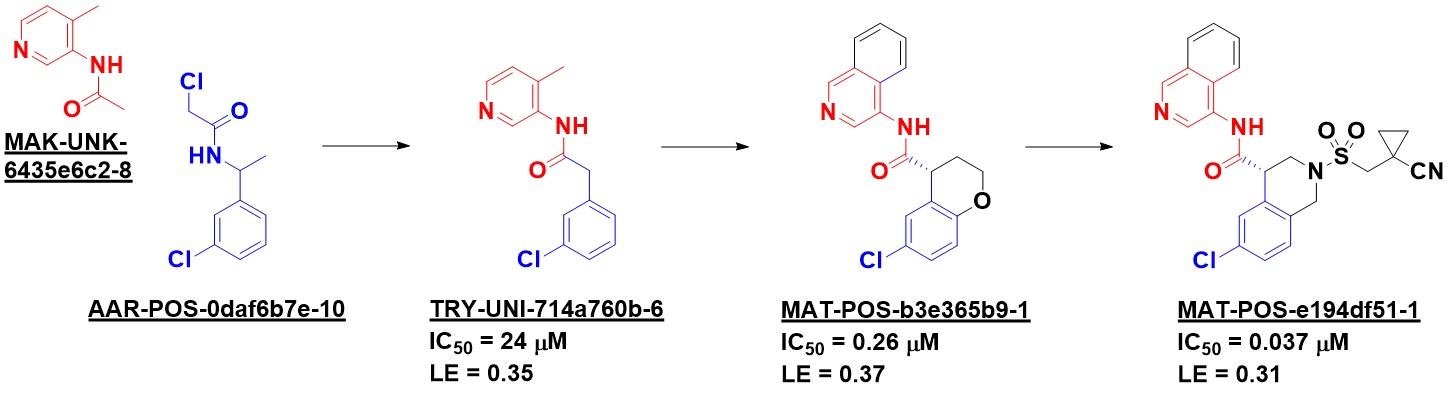
The paper highlights one lead series, which originated from a community submission (TRY-UNI-714a760b-6, itself fragment-sized) inspired by merging overlapping fragments. This mid micromolar inhibitor was ultimately optimized to MAT-POS-e194df51-1, with mid-nanomolar activity in both biochemical and cell assays. (Despite a chloroacetamide in one of the original fragments and a nitrile in the final molecule, which is the warhead found in the approved covalent Mpro inhibitor nirmatrelvir, MAT-POS-e194df51-1 is non-covalent.) 
 

The molecule is potent against known SARS-CoV-2 variants, including recent ones such as Omicron. A crystal structure of the final molecule also overlays remarkably well onto the initial fragments.
 
The paper notes that there is still considerable work to do, particularly optimizing the pharmacokinetics to lower clearance and improve bioavailability. These efforts can take vast sums of time and money, and the lead series has been adopted by the Drugs for Neglected Diseases initiative for further development. Although a handful of drugs are already approved against SARS-CoV-2, there is room for improvement: Derek Lowe posted a vivid personal account of his experience on nirmatrelvir here.
 
When we wrote about the COVID Moonshot in March of 2020, we correctly predicted that vaccines would be approved before drugs from this effort emerged. Fortunately, our warning that “there will be a SARS-CoV-3” has not proven correct – yet. But open science endeavors such as the COVID Moonshot will help us prepare for this eventuality. We may not have made it to the moon yet, but perhaps we’ve learned how to leave Earth’s orbit.

23 November 2020

Massive crystallographic drug screen against SARS-CoV-2 main protease

As of November 23, more than 58 million people worldwide have contracted COVID-19, and more than 1.3 million have died. Each of these numbers is roughly two orders of magnitude higher than in this post published exactly eight months ago. Progress towards vaccines and biological treatments has been stunningly fast, but small molecules could still play a role. Towards this end, Sebastian Günther, Alke Meents, and nearly 100 collaborators from the Center for Free-Electron Laser Science at DESY and multiple other institutions have just posted a preprint on bioRxiv.
 
The researchers were interested in drug repurposing, in which approved or clinical-stage molecules are tested against a new target. Typically this is done in some sort of biochemical or cell-based assay, but in this case the researchers chose crystallographic screening against the main protease (Mpro) from SARS-CoV-2. An independent fragment screen against the same target was published recently in Nat. Comm. (I wrote a companion Comment, and both articles are open-access.)
 
The current screen of 5953 compounds may be the largest crystallographic screen in history, and the first I know of that used drug-sized molecules rather than fragments. Even more impressive, all compounds were co-crystallized with Mpro, a much more tedious process than the usual soaking. The advantage of co-crystallization is that the protein is more able to change conformation in response to compound binding, but the disadvantage is that small molecules may prevent crystallization. Ultimately 3955 compounds allowed crystal formation, of which 3228 produced crystals that diffracted better than 2.5 Å, and 1196 produced usable datasets. The result? Just 37 unique binders, or 0.6%. Comparing this to the 96 fragment hits from the smaller fragment library is complicated by differences in methodologies, but it does seem likely that molecular complexity played a role in the lower hit rate: the median molecular weight of the drugs screened, 366.5 Da, comfortably exceeds fragment space.
 
Among the 37 binders, only 29 gave sufficiently well-resolved electron density to determine binding modes. Of these, ten bound covalently. The catalytic cysteine seems particularly reactive, as evidenced by the fact that seven structures showed maleate – a common pharmaceutical counterion – covalently bound. One of the covalent molecules, calpeptin, is a cysteine protease inhibitor that had previously been reported to be active against SARS-CoV-2, but the others are less predictable. In addition to the active site, some molecules bound to two possibly allosteric sites.
 
Crystallographic hits were tested for inhibition of viral replication in cells. Ten were active, and a few (calpeptin, pelitinib, and isofloxythepin) had single digit micromolar activity. Interestingly, despite being designed as a covalent kinase inhibitor, pelitinib binds noncovalently. In contrast, isofloxythepin, a non-covalent dopamine receptor antagonist, binds covalently.
 
In addition to the cell-based screen, many of the compounds also showed binding by native electrospray ionization mass spectrometry (ESI-MS). However, as we’ve noted previously, the correlation between affinity and ESI-MS binding can be tenuous. It would be nice to see the affinity or activity of the compounds via a more quantitative method. Indeed, the researchers note that none of the non-peptidic molecules had previously been reported as Mpro inhibitors, so they may be quite weak. Another problem is that – in contrast to the crystallographic fragment screen – none of the coordinates seem to have been released yet. Hopefully this will be rectified when the paper is formally published.
 
This campaign is yet more evidence that crystallography has come into its own as a primary screening methodology. The researchers note that they “now routinely measure 450 datasets per day,” with a goal of reaching 1000. Whether or not these results impact the course of COVID-19, the techniques developed will likely impact future drug discovery efforts.

19 April 2020

Back to the Future: HIV protease offers lessons for SARS-CoV-2

Today’s guest post is by Glyn Williams (University of Cambridge). Fragment aficionados will recognize Glyn as the former VP of Biophysics at Astex, but before that he worked at Roche. His experiences there in the 1990s have lessons for today. -Dan Erlanson

In two recent Practical Fragments posts (here and here), Dan Erlanson noted efforts which will allow the scientific community to contribute to drug design efforts against the SARS-CoV-2 main protease (Mpro). Leading the charge at the moment is the COVID Moonshot consortium who have already received design proposals for covalent inhibitors, based on the structures of fragments bound to Mpro that have been generated by researchers at the Diamond Light Source. At the same time, more information about Mpro, including its substrate preferences, is being published. Soon there will be an urgent need to define a selection procedure which will allow valuable drug candidates to be progressed.

A similar situation was faced in 1985 when HIV protease was being considered as a drug target for AIDS. An excellent description of a pragmatic, and ultimately successful, procedure was published in 1993 by Noel Roberts and Sally Redshaw of Roche in The Search for Antiviral Drugs:Case Histories from Concept to Clinic.

When the project began there was no definitive proof that this aspartyl protease was essential for viral replication in human cells and that it could not be substituted by a cellular protease. However, its in vitro ability to cleave a Phe-Pro or Tyr-Pro peptide bond (amongst others) marked it out as unusual, and that was sufficient encouragement for Roche to initiate a discovery programme. Inhibitor design then took advantage of this feature to build in selectivity over human aspartyl proteases, ultimately giving a high therapeutic index while also improving inhibitor absorption after oral administration. 
 
Critical issues, such as the decision to target the HIV-1 viral strain, access to suitable protease constructs and clear criteria for project progression, were defined early on. Novel protease and anti-viral assays were then developed in parallel with transition-state mimetic leads. From the start, it was recognised that the low aqueous solubility of the optimal peptide substrates could imply that peptidomimetic inhibitors were also likely to have poor physico-chemical properties. At the time there was no structural information on the enzyme or its complexes, so there was little opportunity to avoid these shortcomings.

As with COVID-19, the worldwide health implications of HIV were obvious and scientific interactions between different research groups were driven by a spirit of cooperation. Public laboratories contributed clinical data and provided access to assays for viral activity. In 2020 the ability to share data has improved beyond recognition but the ability to interpret and act on it is still subject to political and commercial pressures. At Roche, a series of hydroxyethylene inhibitors was not pursued due to its prior inclusion in multiple patents for renin inhibitors. In addition, sensitivity to criticism from AIDS activist groups during the project discouraged Roche from developing follow-up candidates later.

Many current predictions and public expectations about COVID-19 now depend on the availability of vaccines in 2021. After more than three decades of research, no preventative vaccine is yet available for HIV. However, the ability to treat a viral infection, even with a drug that contains and controls the infection rather than eliminates it, should not be undervalued. In 1993 the Roche HIV protease clinical candidate, Ro 31-8959, was in Phase 2 evaluation. Roberts and Redshaw pointed out then that lowering a patient’s viral load would reduce the risk of further infections amongst health-care workers and social contacts, while the persistence of immature and non-infectious viral material in cells could stimulate the patient’s own immune system to eliminate the virus.

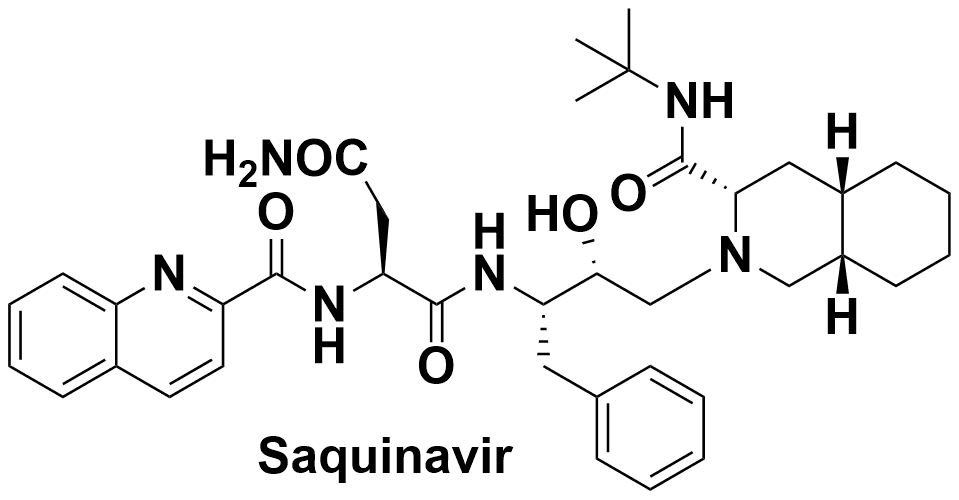
Roberts and Redshaw concluded their 1993 analysis with the statement that "although there is still much work to be done, we remain very hopeful that Ro 31-8959 will make a positive contribution to the therapy of AIDS". Two years later Ro-31-8959, as Saquinavir, was approved by the FDA and, with Ritonavir, a second protease inhibitor from Abbott Labs, led to a 64% reduction in deaths from AIDS in the US over the next 2 years. Let us now hope for the same degree of success from new COVID-19 treatments.

29 March 2020

A crowdsourcing call to action: FBLD vs SARS-CoV-2 Protease

In less than a week the number of cases of COVID-19 worldwide has more than doubled, beyond 720,000, as have the number of deaths, to more than 34,000. For those of us in drug discovery but not on the front lines of clinical care, it is frustrating to watch these numbers climb relentlessly while doing nothing to help other than physical distancing. The temporary closure of so many labs accentuates this feeling.

In early March we highlighted an effort by Dave Stuart, Martin Walsh, Frank von Delft, and others at the Diamond Light Source to screen fragments against crystals of the main protease (MPro) of SARS-CoV-2. The enzyme is a cysteine protease, ideal for covalent fragment screening, and indeed Nir London and coworkers at the Weizmann Institute used intact protein mass-spectrometry to pre-screen 993 fragments. In total, these combined efforts yielded crystal structures of 44 hits bound covalently to the active-site cysteine, 22 non-covalent hits in the active site, and 2 non-covalent hits at the protein dimer interface. Full details and structures can be found here.

In our previous post we showed an overlay of the seven fragments that had been released at the time showing multiple high-quality interactions with the protein. You can look at them all interactively here, and some of the chemical structures are shown below.


This is where crowdsourcing comes in. A group called PostEra (corrected: part of a consortium called COVID MoonShot), consisting of academic and industrial researchers around the world, is trying to use these data and more to develop drugs against SARS-CoV-2. Everyone is invited to contribute, from first year graduate students through industry veterans and emeritus professors.

Do you have ideas how you might grow or merge some of the fragments? If so, you can propose structures, and those that pass a series of filters including synthetic accessibility and toxicity predictions will be synthesized at Enamine and tested at various laboratories (including yours, if you’re interested). We’ve previously highlighted Enamine’s “make on demand” model, which has turnaround times of just a few weeks. At least a couple computational companies, including BioSolveIT and Nanome, are offering free access to their platforms to help you design molecules. Already more than 350 molecule ideas have been submitted.

A cynic could say that these efforts are misguided given the slow pace of drug discovery. Vemurafenib, the first fragment-based drug approved, took six years from the start of the program to approval, and this is lightening speed. However, as Derek Lowe observed, all of the drugs currently being clinically tested against COVID-19 were originally developed for other indications. Stephen Burley suggested recently in Nature that we probably would already have drugs against COVID-19 had we spent more effort fighting SARS.

Hopefully we will have a vaccine long before any drugs coming out of this effort enter the clinic. But there will be a SARS-CoV-3, and a SARS-CoV-4. Having more drugs in our pipeline may prevent those from killing so many people.

01 April 2019

Machines, fixing human disease

Last year we highlighted the secretive juggernaut DREADCO's move into drug discovery. Today they announced the launch of their new division SkyFragNet (not to be confused with the European graduate training program FragNet). Its audacious mission: “to eradicate human disease."

SkyFragNet will automate every aspect of drug discovery. The approach starts with a powerful docking method, in which all 166 billion members of GDB-17 will be docked against a target of interest. Synthetic schemes for the virtual hits will be computationally generated, and the compounds will be synthesized using automated flow synthesis and mass-directed purification.

Fragment hits that confirm in a panel of biophysical techniques will then undergo computational-based growing; SkyFragNet incorporates the latest AI algorithms to maximize the likelihood of success. As with the fragments, designed molecules will be synthesized and tested, first in biochemical and then in cell-based assays.

Although the folks at Mordor State College are trying to make animal testing obsolete, SkyFragNet will still rely on pharmaokinetic and pharmacodynamic studies. However, they have built a fully mechanized vivarium run entirely by robots - think of The Matrix but with mice in place of humans.

Finally, compounds that make it through this gauntlet will be scaled up under GMP conditions (automated, of course) for clinical trials. It remains to be seen how many compounds SkyFragNet will take into the clinic, or whether the success rates will be higher than those of their human counterparts.

Of course, with all this power comes enormous responsibility. If things go wrong, hopefully DREADCO will have the wisdom to Terminate the program. Eradicating human disease could be done in two very different ways.

01 August 2016

Lead Generation: Methods, Strategies, and Case Studies

Lead generation refers to that point in drug discovery when initial screening hits against a target are wrought into compelling chemical matter. This chemical matter is often plagued with deficiencies in terms of potency, pharmacokinetics, or novelty, yet it provides a starting point for further optimization. This is the subject of a massive (800+ pages!) new two-volume work edited by Jörg Holenz (GlaxoSmithKline, formerly AstraZeneca) as part of Wiley’s Methods and Principles in Medicinal Chemistry series. Readers of this blog will not be surprised to find that fragments play a major role; indeed, the molecule on the cover of the book came out of FBLD. I won’t attempt to summarize all 25 chapters here, but will simply highlight those most relevant to FBLD.

Mike Hann (GlaxoSmithKline) sets the stage in chapter 1 by briefly describing the characteristics of successful leads. He emphasizes the importance of physicochemical properties and avoiding molecular obesity, and how judicious use of metrics can help navigate away from perilous chemical space. He also summarizes internal programs that again demonstrate that fragment-derived leads tend to be smaller and less lipophilic than those from other lead discovery techniques.

In chapter 3, Udo Bauer (AstraZeneca) and Alex Breeze (University of Leeds) discuss the concept of ligandability – the ability of a target to bind to a small molecule with high affinity. Fragments are ideally suited for assessing ligandability, and the researchers briefly describe fragment-based experimental and computational approaches to do so. They also include a nice 11-point summary of factors to consider when starting lead generation on a new target, ranging from the presence of small-molecule binding sites to the number of patent applications.

Chapter 6, by Ivan Efremov (Pfizer) and me, is entirely about fragment-based lead generation. I'm undoubtedly biased, but I think it provides a self-contained and fairly detailed guide to FBLD, including topics such as screening methods, hit validation, metrics, hit optimization, fragment growing vs fragment linking, and case studies on vemurafenib, BACE, MMP-2, LDHA, venetoclax, MCL-1, and GPCRs.

Helmut Buschmann and colleagues at RD&C Research, Development, and Consulting, focus in chapter 9 on optimizing side effects of known molecules to develop new drugs, but they also discuss some interesting older work reporting that 418 of 1386 drugs contain other drugs as internal fragments.

Chapter 12, by Dean Brown (AstraZeneca), is devoted to the hit-to-lead stage, and much of his advice is applicable to FBLD. Dean also includes a fantastic metaphor to illustrate the size of chemical space: "if a typical corporate screening collection were to fit on a postcard, the rest of the earth is the amount of available drug-like space." This assumes a million-compound library and a conservative estimate of 1023 drug-sized molecules, so if anything it is an understatement.

Molecular recognition is critical for both FBLD and lead generation in general, and this is the topic Thorsten Nowak (C4X Discovery Holdings) tackles in chapter 13. He covers key areas such as thermodynamics, emphasizing the importance of enthalpy while acknowledging the difficulty of prospectively using thermodynamic data. The role of water and halogen bonds are covered, along with some freakishly high ligand efficiency values. There are a couple errors: one paper is categorized as using dynamic combinatorial chemistry when in fact it actually used static libraries, and Tethering is confused with Chemotype Evolution, but overall there's lots of good stuff here.

Biophysical methods are covered in chapter 14, by Stefan Geschwindner (AstraZeneca). These include NMR, SPR, ITC, thermal shift assays, native mass spectrometry, microscale thermophoresis, and more.

Chapter 16, by Ken Page and colleagues at AstraZeneca, discusses "lead quality." This often entails various metrics, from simple ones such as ligand efficiency and LLE to more complicated attempts to predict clinical dosages. Although it is easy to poke fun at metrics, most thoughtful scientists find them useful for making sense of the reams of data generated in lead optimization campaigns.

Chapter 17, by Steven Wesolowski and Dean Brown (both AstraZeneca), is arguably the most entertaining. Entitled "The strategies and politics of successful design, make, test, and analyze (DMTA) cycles in lead generation," it is replete with pithy quotes and even an original (and highly geeky) cartoon. Along with multiple examples, the chapter formulates plenty of questions to consider during lead optimization, and ends with a particularly relevant quote by Billings Learned Hand: “Life is made up of a series of judgments on insufficient data, and if we waited to run down all our doubts, it would flow past us.”

In chapter 23, Sven Ruf and colleagues at Sanofi-Aventis Deutschland describe a success story generating leads against cathepsin A, a target for cardiovascular disease. HTS yielded three different chemical series with sub-micromolar activities, each with different liabilities. Crystallography revealed their binding modes, and this allowed the team to mix and match fragments across the different series to generate a molecule that ultimately went into the clinic. Although this may not be classic FBLD, it does seem to be a good case of using concepts from the field, or fragment-assisted drug discovery.

A similar, if less directed, approach is the subject of chapter 25, the last in the book. Pravin Iyer and Manoranjan Panda (both AstraZeneca) describe "fragmentation enumeration," in which known drugs or clinical candidates are fragmented into component fragments and recombined. On some level the fragments themselves are likely to be privileged; the researchers cite the famous quote by Sir James Black that "the most fruitful basis of the discovery of a new drug is to start with an old drug." Most of the work is computational, although one molecule derived from the approach has encouraging cellular activity against Mycobacterium tuberculosis.

There's far more to this book than could be listed even in this relatively long post, including multiple case studies, so for those of you who are interested in lead generation definitely check it out!

26 July 2009

Is FBDD a FADD?

Two reviews in the July issue of Drug Discovery Today provide an update on the state of FBDD.

The first, from researchers at the VU University, Amsterdam, and IOTA Pharmaceuticals, discusses 23 examples. Many of these have been reviewed elsewhere, but the paper also describes some studies that are unpublished or just reported at meetings. It’s a nice, thorough introduction to the field, and the organization of the review, by institution, gives a flavor of the diversity of approaches.

The second review, from researchers at Astex Therapeutics, provides a historical perspective and clinical focus. There are also useful tables of commercial suppliers of fragments as well as FBDD-derived compounds that have made it into clinical development.

In an accompanying editorial, Mark Whittaker of Evotec asks whether fragment-based drug discovery (FBDD) should really be called fragment-assisted drug discovery (FADD):

This is more than just a difference in semantics, but is, in fact, a broader question of when and how to apply fragment approaches to lead generation, either on their own or in concert with other hit finding techniques.

He goes on to explain that although fragment-based methods can be used by themselves to generate leads, they can also be complementary to other approaches to assess target druggability or focus later hit-finding. This conclusion is consistent with Practical Fragments’ latest poll, in which 85% of respondents reported that, far from being a fad, FBDD (or, if you like, FADD) is integrated in the hit finding stage at their company.