01 October 2014

Safran Zunft Challenge

Dan has already hit the highlights of FBLD 2014.  I won't do the lowlights.  They were few and far between.  I will try to give some flavor of the conference.  If you missed it, they t-shirts given out had this as a design
This was designed by Lukasz Skora of Novartis.  It is keywords used here at the blog, sized by frequency.  That is pretty cool.  It also gives us an idea of what we are really talking about here.  I have some other "flavor of Basel pictures" posted here.  

The conference was excellent, just the right size to allow people to interact at a high level.  The dinner was especially good for this (and the unending wine/beer didn't hurt!).   I have been lucky this year to be at many conferences with many different people.  Damian Young at the Baylor College of Medicine Center for Drug Discovery (and recently of the Broad) has been speaking at all of them about his Diversity Oriented Synthesis (DOS) approach to generating fragments.  Well, this has bothered me, DOS is not Fragments.  Am I some sort of Luddite?  Am I being too purist?  Could be.  

Well, an eminent group of FBLD-ers was gathered around a table during the conference dinner, including Justin Bower and Martin Drysdale of the Beatson, Chris Smith of Takeda, the aforementioned Dr. Young, myself, Terry Crawford of Genentech, and Beth Thomas of the CCDC.  So, out of this discussion, comes the Safran Zunft Challenge, administered by Dr. Bower.  I bet Damian that his molecules are too complex to be "fragments".  What will this mean?  I am betting that a "bad" interaction is worse than a good one, that is going all the way back to the Hann Model.  

So, this one molecule from Damian's presentation.  I have nothing against it per se, but for illustrative purposes.  I bet that his molecules will not have a LEAN (pIC50/HAC) >0.3.  [This is the metric I like, Pete.  I understand the limitations.]  By FBLD2016, Damian expects to have data on his molecules (and he is looking for partners).  If I lose, I owe the undersigned a beer.  Below we have preserved for posterity the discussion and those who were there (no hopping on the beer bandwagon late people!).  

I also think this is a good way for us to discuss the ontology of a "fragment"?  To me, its not just size, it is more of its "nature".  Fragments rely on simple molecules, adding complexity even with small molecules, strips away the "fragment-ness", IMNSHO

29 September 2014

FBLD 2014

FBLD 2014, the fifth in an illustrious series of conferences, took place in Basel, Switzerland last week. Organizers Wolfgang Jahnke (Novartis), Michael Hennig (Roche), and Rod Hubbard (University of York & Vernalis) put together a fantastic event. With 35 talks, 45 posters, and more than 200 delegates, I won’t attempt to give more than a few impressions here. In addition to Teddy’s (and others’) Tweets, Derek Lowe put up several posts (see here, here, and here); please share your thoughts below.

Harren Jhoti delivered a lively and wide-ranging opening keynote summarizing the past 15 years of FBLD as viewed from Astex. Among many other innovations, researchers there are responsible for the Rule of 3, which has been the subject of some debate. Harren emphasized that the “Voldemort Rule” should not be a strait-jacket. Like the Kobayashi Maru, rules are there to be broken, though you need to be something of a James T. Kirk to do so effectively.

Astex has produced what is likely the largest collection of protein-fragment crystal structures, and Harren noted that many proteins appear to have fragment binding sites outside the active site: across 25 different proteins, the average number of total sites is slightly greater than 2. Astex is increasingly targeting these sites for allosteric lead discovery.

The theme of crystallography carried through the conference. As Armin Ruf (Roche) exhorted, “more crystals, more structures.” One challenge is that not all crystal forms are suitable for fragments, and it is not always clear from the outset which forms will work. Armin described their chymase project in which an initial crystal form gave 8 fragment structures, but additional crystal forms allowed them to obtain 6 more. Without the different crystal forms these later fragments would have been crystallographic false negatives, yet the potential of different crystal forms to reveal more hits is under-appreciated: Armin noted that the majority of recent fragment papers reported using only a single crystal form.

The importance of crystallography was emphasized again by Nick Skelton (Genentech), who discussed their NAMPT program (which we covered here). In this project, which utilized dozens of crystal structures, a single atom change to a fragment could completely and unpredictably alter the binding mode.

Obtaining a good crystal is not necessarily easy, though. Andreas Lingel (Novartis) described their efforts to produce a form of B-RAF that would diffract to higher resolution and allow fragment soaks (as opposed to co-crystallization). They tried reducing the “surface entropy” by mutating glutamate and lysine residues to alanine, but only one of a dozen or so mutants expressed well and gave superior crystals. Although this turned out to be useful, the team is still at a loss to explain why the specific mutants are effective.

Continuing the theme of crystallography, Matt Clifton (Beryllium) described what looks to be a significant advance for the protein MCL-1. (This is a collaboration with the Broad Institute, and we previously noted some of their progress here.) The researchers have developed a maltose-binding protein (MBP) fusion of this oncology target that diffracts to 1.9 Ã… in the absence of any ligand. (MBP fusions are used to help crystallize challenging proteins.) Since they developed this construct in May of this year, the researchers have already solved more crystal structures than had been reported publicly to date, and uncovered some interesting findings. For example, the initial fragment that Steve Fesik’s group found binds in a similar manner to one of his more potent later leads, as does one of the AbbVie fragments; however another AbbVie fragment binds in a somewhat different fashion than the elaborated lead.

The subject of how to effectively sample chemical space was another theme, and to this end Alison Woolford (Astex) proposed the concept of a “minimal pharmacophore”: the minimal interactions necessary to drive fragment binding. Researchers at Astex have systematically cataloged several dozen of these, which include such simple entities as amines, acids, aromatic chlorides, and more abstract concepts such as a 1-bond donor-acceptor (think pyrazole). Alison showed an interesting graph with targets on the y-axis and minimal pharmacophores on the x-axis which revealed some obvious patterns such as the preference of donor-acceptor minimal pharmacophores by kinases, but there were unexpected features as well. In a sense, this is an empirical realization of early docking studies, but it also has interesting implications for library design. For example, Alison suggested avoiding fragments with more than one minimal pharmacophore, as these will not be able to effectively sample as many different sites on a protein: with two pharmacophores, a fragment would be limited to binding sites having matching recognition elements to both rather than just one. This idea ties in with the concept of molecular complexity, but from a more chemocentric point of view.

On the subject of chemistry, Dalia Hammoudeh (St Jude’s Hospital) gave a lovely talk on her experiences developing allosteric inhibitors of DHPS, an antibiotic target. Among other fragment hits from the Maybridge library, one was ostensibly 4-trifluoromethylbenzylamine, but turned out to actually be the Schiff base of this with the corresponding aldehyde. Yet another reminder to always carefully check what you think you have.

Practical Fragments has previously discussed the Genentech MAP4K4 program (here and here), and Terry Crawford gave a nice summary. One of the challenges they faced was that their initial leads had excellent brain penetration, leading to animal toxicity. This forced them to increase size and polar surface area. Although it was problematic in this case, this emphasizes how small and drug-like fragment-derived leads can be. Indeed Vicki Nienaber, who was a prime mover behind the original FBLD 2008 meeting, has devoted much of her efforts at Zenobia to CNS targets.

Finally, Derek Lowe (Vertex) gave a rollicking history of the drug industry, ending with his view of where fragments fit in. He noted that chemists – Valinor not withstanding – play a central role, and in that sense the field is a departure from the general trend of the past decade or so. It still remains to be seen how many of the 30+molecules FBLD has delivered to the clinic will come out the other side, but at least for now the field is thriving. As Chris Lipinski stated last year, “if I had to single out one technology that really took me by surprise and has been very successful, it has been fragment screening.”

24 September 2014

PAINS in Nature

Practical Fragments has previously noted that many pan-assay interference compounds (PAINS) can be found in nature. Indeed, they’ve also found their way – unintentionally – into journals published by Nature Publishing Group. In an effort to educate the scientific community about these artifacts, Jonathan Baell (Monash University) and Mike Walters (University of Minnesota) have just published a Comment in Nature entitled “Chemical con artists foil drug discovery”. This is the clearest discussion I’ve yet seen of PAINS, and it deserves to be widely read.

Since the article is open-access I won’t go into depth here, other than to say that the researchers propose three steps to avoid PAINS.

1) Learn disreputable structures.
As a start, the paper provides a rogue’s gallery of some of the worst molecules, along with memorable interpretations by award-winning New Yorker cartoonist Roz Chast. It would be nice to see this posted in every academic screening center.

2) Check the literature.
This is even easier than having to learn structures, and should prevent people from embarrassing themselves by publishing research that is obviously flawed.

3) Assess assays.
Multiple orthogonal assays are useful for all science, not just FBLD!

Together with the recent C&ENstory and ACS symposium, this article ensures that PAINS are finally reaching the level of recognition such that scientists, reviewers, and editors will no longer be able to claim ignorance. Willful negligence may be another matter, but at least people will be able to recognize it as such.

21 September 2014

Substrate activity screening revisited: substrates as inhibitors

Last year Practical Fragments highlighted substrate activity screening (SAS) as a means for identifying enzyme inhibitors. The idea is to make libraries consisting of potential substrates, modified to reveal interactions: for example, amides that release a fluorescent reporter group when cleaved by a protease. These libraries are then screened against a protein of interest, and any new substrates identified can be transformed into inhibitors by replacing the cleavable bond with some sort of warhead. At the end of that post, we asked why more people weren’t using SAS. In a new paper in ChemBioChem, Pieter Van der Veken and colleagues at the University of Antwerp have partially answered that question, and provided a solution.

The researchers were interested in the oncology target urokinase (uPA), a trypsin-like protease. They built potential substrates from an amino-methylcoumarin designed to fluoresce when cleaved. They used this to assemble a library of 137 molecules, each consisting of the amino-methylcoumarin coupled to a variable fragment. Of these, about 50 contained positively charged moieties likely to interact with the large S1 pocket of uPA, which has a predilection for cationic species. (The rest were diverse molecules.) The library was then screened against the enzyme to look for substrates, but the researchers ran into several difficulties.

First, since all the substrates are poor, the researchers had to use quite a bit of enzyme (about 2.5 micrograms per well) to get a good signal. Second, for the same reason, they had to run the assay for a long time (6 hours). Third, and somewhat unexpectedly, it turns out that SAS is susceptible to an interesting artifact: low levels of contaminating enzymes can cleave substrates, giving false positives. Indeed, the researchers found that commercial uPA isolated from human urine produced a number of hits that did not repeat with recombinant (and presumably purer) enzyme and could not be competed by addition of a potent uPA inhibitor.

Despite these challenges, the researchers identified 11 hits. However, notably absent were some of the fragments known to have affinity for the S1 pocket, such as several guanidines. This is not surprising: for a molecule to be processed as a substrate it needs to be able to fit in the S1 pocket as well as to position the cleavable bond near the catalytic machinery – subtle changes in geometry will prevent processing. This got the researchers thinking about alternative ways to use their library.

The approach they came up with, “modified substrate activity screening” (MSAS), starts by first looking for inhibitors rather than substrates, since a poor substrate can behave as an inhibitor. The idea is to incubate library members with the enzyme and a single potent substrate. This allowed the researchers to reduce the enzyme concentration by 10-fold and run a much shorter assay (10 minutes). It also reduces the risk that contaminating enzymes will be responsible for activity, though of course inhibition assays are susceptible to all sorts of other artifacts.

When the researchers applied MSAS to uPA, not only did they rediscover the 11 hits they had identified as substrates previously, they also identified 17 additional molecules, including all the guanidine-containing fragments.

The researchers propose a flowchart for MSAS in which compounds are first screened for inhibition. These hits are then followed up using SAS to determine whether some of these inhibitors are substrates too. Any substrates thus identified can be readily transformed into inhibitors by adding an appropriate warhead. Inhibitors identified in the first step that aren’t substrates can also be useful to provide structure-activity relationships and new fragments to take forward.

Of course, one could argue that if you are doing inhibition assays, there is no point in going to all the trouble of making custom libraries for MSAS. That said, if you’ve already got the substrate-based libraries, doing an initial inhibition screen is probably a good idea.

17 September 2014

From fragment to lead: just remove (high energy) water

The proverb "well begun is half done" suggests that getting started comprises much of the work. Such is the case for fragments that bind to “hot spots,” sites on a protein that are particularly adept at binding small molecules and other proteins. Though fragment-to-lead efforts can give impressive improvements in potency, much of the binding energy of the final molecule resides in the initial fragment. In a new paper in ChemMedChem, Osamu Ichihara and colleagues at Schrödinger have asked why.

The researchers examined 23 published fragment-to-lead examples for which crystal structures and affinities of the fragment and lead were available and in which the fragment maintained its binding mode. They then used a computational tool called WaterMap to assess the water molecules displaced by both the initial fragment as well as the optimized molecule. They compared the calculated thermodynamic parameters (free energy, enthalpy, and entropy) of the water molecules displaced by the initial fragment (core hydration sites) or the bits added to it in the lead (auxiliary hydration sites).

When a protein is surrounded by water, water molecules bind just about everywhere. However, some of these water molecules may “prefer” to be in bulk solvent rather than, say, confined within a hydrophobic pocket on the protein. Perhaps not surprisingly, most of the water molecules displaced by ligands turned out to be of this “high-energy” or unstable variety. Also, the researchers consistently found that the core hydration sites were more unstable than the auxiliary hydration sites. In other words, fragments appear to displace the most unstable water molecules. Moreover, most of this higher energy was due to unfavorable entropy.

It is important to note that the focus here is on individual water molecules (or hydration sites) assessed computationally. The researchers are careful to stress that these may not correlate with thermodynamic parameters obtained by isothermal titration calorimetry (ITC). This is because ITC measures the entire system – protein, ligand, and all of the water – and factors such as protein flexibility can confound predictions.

The researchers summarize their findings as follows.
1) The presence of hydrogen bond motifs in a well-shaped small hydrophobic cavity is the typical feature of the hot spot surface  
2) Because of these unique surface features, the water molecules at hot spots are entropically destabilized to give high-energy hydration sites 
3) Fragments recognize hot spots by displacing these high-energy hydration sites
This provides a framework for understanding several phenomena. First, it describes the origin of hot spots. Second, it explains why much of the binding energy of an optimized molecule resides in the initial fragment; additional waters displaced are not as unstable as those displaced by the fragment, so they don’t give you as much bang for your atom. As a corollary, this might help explain the leveling off or decline in ligand efficiency often observed as molecules become larger.

The researchers go on to discuss specific examples of high-energy waters, noting that a water molecule involved in one or more hydrogen bonds may be particularly hard to replace because recapitulating the precise interaction(s) may be difficult. This is especially true for fragment-growing efforts (where one is likely to be limited in the choice of vector and distance) that aim to displace a high-energy water. Thus, the researchers suggest focusing on fragments that themselves displace high-energy waters, rather than trying to displace these later.

This seems like sound advice, but it likely reflects what folks already do. Since fragments that displace high-energy waters are likely to bind most effectively, won’t these be prioritized anyway? Regardless, this is an interesting and thought-provoking paper.

15 September 2014

A COMT Tease...

S-adenosyl-methionine (SAM) is a hot molecule; you could probably make a good living selling it these days.  SAM-transferases of all types are "hot" targets, especially in epigenetics.  However, one current target is COMT, or catechol-O-methyl transferase.  COMT lives in a far different space than the epigenetics one, neurodegeneration.  There are several current Parkinson's Disease treatments based upon catechol, but as you would expect, there is toxicity associated with these.  
So, a team at Takeda decided to go after SAM-competitive molecules.  To this end, they screened 11,000 fragments using a enzymatic assay @100 uM.  52 hits (>15% inhibition) were found for a 0.15% hit rate.  They note this is a very low hit rate for what appears to be a very ligandable pocket. They then used LC-MS/MS and SPR to remove reactive moieties and non-SAM competitive molecules.  This led to compounds (4-6) and SAR by Corporate Collection (7). 
They followed up on these four compounds with DSF, STD-NMR, and X-ray.  They were able to co-crystallize 5 with mouse COMT.  This is the first (reported) structure of COMT with a SAM-competitive molecule. 

They mention that they took a "build up" approach, but I presume that is for for future papers. 

10 September 2014

Whatcha Want? Whatcha Really Really Want?

There is a rule in our house: You cannot decorate your room for Christmas until November 1st.  Well, the countdown has begun as my son reminded me that is less than two months away.  So, to help everyone get into the Christmas (Hannukah, Diwali, and so on) spirit, I wanted to ask what cha want?  So what cha want?

Let's divide this in to two lists: Aspirational and Possible.  Below are some that Dan and I came up with.  But this is really your wish list.  Let us know in the comments.

Possible: Aqueous spectra for all commercially available fragments. Maybridge and Key Organics are here/getting here. 
Experimental solubility and 24 hour stability for commercial libraries.  
No PAINS in commercially available libraries.  I believe it is ~8% right now.  
No more rhodanines, anywhere and ever!

Aspirational: I know Peter Kenny wants people to stop using metrics that are arbitrarily defined.
Standard vocabulary for the field.  What's an active, hit, lead, etc.?

08 September 2014

Fragments vs MAP4K4

Mitogen Activated Protein Kinase Kinase Kinase Kinase 4, or MAP4K4, is one of the 500+ human kinases that doesn’t get a whole lot of attention, in part perhaps because there aren’t many good tool compounds out there. A new paper from Genentech in Bioorg. Med. Chem. Lett. reports an attempt to change this.

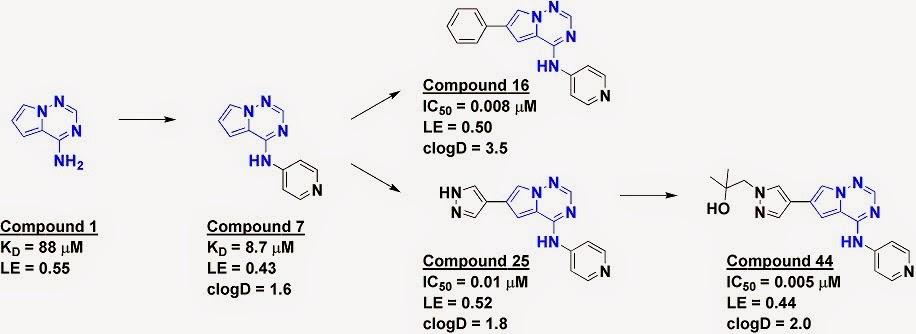
The researchers started with a surface plasmon resonance (SPR) screen of 2361 fragments, yielding 225 confirmed hits with KD values between 10 and 2010 µM, all with ligand efficiency (LE) values above 0.3 kcal/mol/atom. This seems like a good use of LE: with hundreds of hits to choose from, some sort of triage is necessary, and you might as well go with those with the highest LE.

Compound 1 had moderate potency and excellent LE, as well as a structure familiar from other kinase programs. Modeling suggested growing off the amine, and a small set of compounds were made including compound 7, which gave a 10-fold boost in potency, albeit with a loss in LE. Crystallography of a close analog of compound 7 revealed that it bound as expected, and also suggested a fragment growing approach.

A number of substituents were introduced, all with an eye towards keeping lipophilicity low (clogD < 3.5). Compound 16 was the most potent, though the solubility was poor, and adding polar substituents didn’t help much. Compound 25 had similar potency, and in this case adding a polar substituent (compound 44) improved solubility too. The PK profile in mice was also reasonable.

Unfortunately, when tested at 1 µM against 63 kinases, compound 44 inhibited 16 of them by at least 75%, suggesting that it will not make a useful tool compound. The team reported better selectivity earlier this year with a series of compounds derived from a different fragment hit identified in the same SPR screen. Yet despite the outcome, this is a nice case study in using ligand efficiency, calculated hydrophobicity, and structural information to guide fragment growing.

03 September 2014

Fragment growing vs fragment linking

Results from our latest poll are in. As expected, fragment growing is both more successful and (thus) more popular than fragment linking, but there are a few surprises.

First, it was interesting to see that more than a third of the 69 respondents have not tried fragment linking. Actually, the fraction is probably higher since people could vote more than once (though unfortunately Polldaddy does not provide information as to how many did).

Second, despite its reputation for difficulty, roughly half of respondents who tried fragment linking reported that it worked “OK” or “well.” In fact, more people said that it worked well than that it failed outright. Again, these numbers should be taken cautiously since multiple people at the same organization may have voted on the same projects. And of course, one person’s definition of “OK” may be another’s definition of “marginal.” Still, if you have a tough target where fragment linking looks like a way forward, feel free to use these poll results to bolster your case. And please share your experiences in the comments, positive or negative.

01 September 2014

PAINS in C&EN

Just a quick heads-up that Celia Arnaud has a nice story on pan-assay interference compounds (PAINS) in the latest issue of Chemical and Engineering News. Celia attended the PAINS symposium at the ACS meeting last month and spoke with several of the speakers for the piece.

As far as I know this is the first time C&EN has devoted an entire article to PAINS. It’s a fast read so I won’t summarize it here, other than to say that she does pick up on the concept of PAINS-shaming, which Teddy has also advocated. Although Practical Fragments has done some of this, most PAINS are not fragments, so it wouldn’t really be appropriate to do much of it here (though please visit HTSpains).

I do hope Celia’s article is widely read by practicing scientists, journal editors, and reviewers. The need for more PAINS recognition is amply illustrated by this article published in the most recent issue of J. Med. Chem. which reviews reported inhibitors of AP-1, many of them dubious. Let's hope that the C&EN piece cuts down on future pollution.

28 August 2014

The First Protein-Carbohydrate Interaction Inhibitor

Immunomodulation is all the rage, particularly in terms of cancerHyaluronan (HA) is a component of the extracellular matrix.  CD44 is a major cell receptor of HA and its fragments.  Its differential response to HA or HA fragments leads to the different biologies. However, due to the different biologies there are limitations to what can be done with HA fragments.  A selective inhibitor of CD44-HA would prove an invaluable tool. Also, in the grandest of Grant-Application-ese, a small molecule inhibitor could be useful for inflammatory diseases and cancer.  

In this paper, results are presented towards this goal.  The hyaluronan-binding domain (HABD) of CD44 is competent to bind oligosaccharides, and even better has been crystallized. In terms of the binding site:
From the structural data, one might conclude that CD44 is not an easily druggable target. The murine HABD−HA complex reveals an extended HA binding site with surface area exceeding 800 Ã…^2 and molecular binding stabilized by a large number of weak interactions involving at least seven consecutive saccharide units of HA. The HABD has no well formed or deep pockets that would serve as attractive binding sites for small molecule inhibitors and is known to undergo small but important conformational changes upon binding HA. In many respects, the protein−polysaccharide complex resembles protein−protein interactions that are difficult to disrupt effectively with small molecules.

Using SPR, they screened 1000 fragments from the Maybridge Ro3 fragment library at 5 mM resulting in a 4% hit rate. 21 fragments were crystallized (Table 3 in SI), resulting in 5 co-crystals.  Cpds 1 and 2 were deemed worthy based upon their binding site. 
They were poor in terms of blocking HA binding to CD44.  So, they then did some Analog by Catalog and some merging, based upon other scaffolds and ended up with 5a, which has improved affinity for the HABD and had a measurable ability to block HA binding to the HABD.  

This is a interesting paper to me simply because of the target choice:protein-carbohydrate interaction.  I believe this is the first example of FBHG against a PCI. 

25 August 2014

Metallophilic fragments – or PAINS?

Several years ago we described fragment libraries designed to chelate metal ions. The idea is that these could serve as affinity anchors to target metal-containing proteins. However, in designing any fragment library, it is essential to avoid pan-assay interference compounds (PAINS), molecules that act through pathological mechanisms. A new paper in Bioorg. Med. Chem. Lett. by Amy Barrios and collaborators at the University of Utah and University of California San Diego illustrates one of these mechanisms.

The researchers were interested in a protein tyrosine phosphatase (PTP) called LYP. PTPs contain catalytic cysteine residues and are thus particularly prone to false positives caused by oxidation or adventitious metals such as zinc. The researchers screened a library of 96 metal-chelating fragments against LYP in the presence or absence of zinc to find fragments that could either rescue the enzyme or inhibit it, either cooperatively with zinc or on their own. Not surprisingly, they were able to find several fragments that could rescue LYP from added zinc, presumably by coordinating the metal and removing it from the active site.

The most potent inhibitor of the enzyme was 1,2-dihydroxynaphthalene, with an IC50 of 2.5 µM. However, the researchers quickly discovered that it was time-dependent, showing greater potency the longer it was incubated with the enzyme. This is a classic sign of something funny going on, and the researchers realized that molecules like this can oxidize spontaneously. In fact, the oxidized product (1,2-naphthoquinone) is even more potent, and also time-dependent (IC50 = 1.1 µM after 2 hours). Not only can napthoquinones directly modify cysteine residues, they can generate reactive oxygen species that can in turn modify cysteine residues – this very molecule was reported as doing so more than five years ago.


This is the kind of mechanism you want to avoid, and it is likely to rear its ugly head whenever compounds of this ilk are screened, particularly against a protein with an active-site cysteine. Hopefully this publication will serve as a warning to folks who may be using this screening library.

One could argue that this paper falls into the category of “you probably already knew this.” However, even if you knew it, many others likely did not. At the ACS meeting symposium on PAINS earlier this month, Kip Guy urged people to publish their PAINS stories. They may not be the sexiest papers, but if they inform others what to avoid they may be among the most useful.

20 August 2014

Like the Elves to Valinor?

There are some perqs to being a consultant.  I go to work most days in my jammies, I can work from anywhere with WiFi, and get to work with great people.  I also have a lot of freedom with what I can say/do/write.  Back in April at the CHI Drug Discovery Chemistry meeting, I ran into an editor from an ACS publication.  Now, if you have ever been at a conference with me you know I am a social butterfly.  New face, let's chit chat.  This editor was very nice and after some social niceties, I asked who is refereeing your journal?  This was a general query having to do with some poor quality fragment papers recently, and before I even saw this!  She was polite and asked what do you mean?  I said, well I blog on fragments and we come across crap in JMedChem and the like all the time.  Like this.  I think at this point she obviously was thinking of me like this https://blogger.googleusercontent.com/img/b/R29vZ2xl/AVvXsEg2yIXZcOfyuZmAUXfRoOm79lLUDCWrVcDvFEZ7MyeWGhMMwREj8aR5Djtb-lhN6M6ryCTpbRTxA2-ayJIQkBDro-CKCujiSueKL6nqp1kC2KzJibn4bgQTbHOSYA_7oHXXoSyzsYvzqV1D/s1600/basement2.jpg.  Then I mentioned that the blog was Practical Fragments and her attitude changed.  So, this blog has "street cred"!!  She then asked me if I would write a Viewpoint on the future of FBDD.  Sure, I said.  This could be fun.  

At the same time, I was preparing a talk for the Zing FBDD conference.  So, I decided to make that talk (that's a link to SlideShare, I hope it works) a demo for the Viewpoint. Give it a read, its short and sweet (at least I think).  

For those of you without 10 minutes to spare, here are the take home points from the Viewpoint:
  • Fragonomics is a key component of most (all?) hit generation processes
  • It is a fully mature field.  The current debates amount to quibbling about details.
  • It has no future as a stand-alone field.  But there are still challenges for it to tackle.
  • Medchemists no longer rule the field.  
"The age of the medchemist is over; now is the time of the biophysicist." 
 
 This got some serious push back at the conference, and I expect (hope?) it will here too.  Of course, I am paraphrasing this. I am not suggesting that medchemists make like the Elves and sail off to Valinor.  They are still incredibly important and can still play a role in early hit generation.  However, the focus, thanks to Fragonomics, is vastly different.  A chemically trained biophysicist can run a fragment-based hit generation project and you don't have to have engage the most precious resource (medchem) until well into the process.  This is a good thing.  

Well, I have planted my flag.  Now its time for you all to weigh in.

18 August 2014

248th ACS National Meeting

The Fall ACS National Meeting was held in my beautiful city of San Francisco last week, and a number of topics of interest to Practical Fragments were on the agenda.

First up (literally – Sunday morning) was a session on pan-assay interference compounds (PAINS) organized by HTSPAINS-master Mike Walters of the University of Minnesota. Mike developed his interest in PAINS like many – from painful experience. After screening 225,000 compounds against the anti-fungal target Rtt109, he and his group found several hits that they identified as PAINS, but not before spending considerable time and effort, including filing a patent application and preparing a manuscript that had to be pulled. One compound turned out to be a “triple threat”: it is electrophilic, a redox cycler, and unstable in solution.

Mike had some nice phrases that were echoed throughout the following talks, including “subversively reactive compounds” and SIR for “structure-interference relationships,” the evil twin of SAR. To try to break the “PAINS cycle” Mike recommended more carefully checking the literature around screening hits and close analogs (>90% similarity). Of course, it’s better if you don’t include PAINS in your library in the first place.

Jonathan Baell (Monash), who coined the term PAINS back in 2010, estimated that 7-15% of commercial compounds are PAINS, and warned that even though PAINS may be the most potent hits, they are rarely progressable, advice that is particularly needed in academia. For example, the majority of patent applications around the rhodanine moiety come from academia, whereas the majority of patent applications around a more reasonable pharmacophore come from industry. Jonathan also warned about apparent SAR being driven by solubility. Finally, he noted that while it is true that ~6.5% of drugs could be classified as PAINS, these tend to have unusual mechanisms, such as DNA intercalation.

As we discussed last week, anyone thinking about progressing a PAIN needs to make decisions based on sound data. R. Kip Guy (St. Jude) discussed an effort against T. brucei, the causative agent of sleeping sickness. One hit from a cellular screen contained a parafluoronitrophenyl group that presumably reacts covalently with a target in the trypanosome and was initially deemed unprogressable. However, a student picked it up and managed to advance it to a low nanomolar lead that could protect mice against a lethal challenge. It was also well tolerated and orally bioavailable. Kip noted that in this case chemical intuition was too conservative; in the end, empirical evidence is essential. On that note he also urged people to publish their experiences with PAINS, both positive and negative.

There were a scattering of nice fragment talks and posters. Doctoral student Jonathan Macdonald (Institute of Cancer Research) described how very subtle changes to the imidazo[4,5-b]pyridine core could give fragments with wildly different selectivities. I was particularly tickled by his opening statement that he didn’t need to introduce the concept of fragment-based lead discovery in a general session on medicinal chemistry – another indication that FBLD is now mainstream.

Chris Johnson (Astex) told the story of their dual cIAP/XIAP inhibitor, a compound in preclinical development for cancer. As we’ve mentioned previously, most IAP inhibitors are peptidomimetics and are orders of magnitude more potent against cIAP than XIAP. Astex was looking for a molecule with similar potency against both targets. A fragment screen gave several good alanine-based fragments, as found in the natural ligand and most published inhibitors, but these were considerably more potent against cIAP. They also found a non-alanine fragment that was very weak (less than 20% inhibition at 5 mM!) but gave a well-defined crystal structure. The researchers were able to improve the affinity of this by more than six orders of magnitude, ultimately identifying compounds with low or sub-nanomolar activity in cells and only a 10-fold bias towards cIAP. This is a beautiful story that illustrates how important it is to choose a good starting point and not be lured solely by the siren of potency.

Alba Macias (Vernalis) talked about their efforts against the anti-cancer targets tankyrases 1 and 2 (we’ve previously written about this target here). In contrast to most fragment programs at Vernalis, this one started with a crystallographic screen, resulting in 62 structures (of 1563 fragments screened). Various SPR techniques, including off-rate screening, were used to prioritize and further optimize fragments, ultimately leading to sub-nanomolar compounds.

The debate over metrics and properties continued with back-to-back talks by Michael Shultz (Novartis) and Rob Young (GlaxoSmithKline). Michael gave an entertaining talk reprising some of his views (previously discussed here). I was happy to see that he does agree with the recent paper by Murray et al. that ligand efficiency is in fact mathematically valid; his previous criticism was based on use of the word “normalize” rather than “average”. While this is a legitimate point, it does smack of exegesis. Rob discussed the importance of minimizing molecular obesity and aromatic ring count and maximizing solubility, focusing on experimental (as opposed to calculated) properties. However, it is important to do the right kinds of measurements: Rob noted that log D values of greater than 4 are essentially impossible to measure accurately.

Of course, this was just a tiny fraction of the thousands of talks; if you heard something interesting please leave a comment.

13 August 2014

Intentionally dirty fragments

Practical Fragments has tried to publicize the dangers of pan-assay interference compounds, or PAINS. These compounds show up as nuisance hits in lots of assays. So what are we to make of a new paper in Curr. Opin. Microbiol. by Pooja Gopal and Thomas Dick, both at the National University of Singapore, entitled “Reactive dirty fragments: implications for tuberculosis drug discovery”?

As the researchers point out, several approved anti-tuberculosis drugs are fragment-sized and hit multiple targets; they are “dirty drugs”. For example, isoniazid (MW 137, 10 heavy atoms), is an acylhydrazide that is metabolically activated and forms an adduct with an essential cofactor, causing havoc to the pathogen. Ethionamide (MW 166, 11 heavy atoms), a thioamide, works similarly. The fact that these molecules are so small probably allows them easier passage through the microbe’s rather impermeable cell membrane, and the fact that they hit multiple targets may make it more difficult for the organism to develop resistance. The researchers conclude:
The success of small dirty drugs and prodrugs suggests that fragment-based whole cell screens should be re-introduced in our current antimycobacterial drug discovery efforts.
While it is true that many antimicrobials do have reactive warheads, and it is also true that there is a huge need for new antibiotics, I worry about this approach. Not only is there an increased risk of toxicity (isoniazid in particular has a long list of nasty side effects), it can be very hard to determine the mechanism of action for these molecules, complicating optimization and development. As evidence, look no further than pyrazinamide (MW 123, 9 heavy atoms). Despite being used clinically for more than 60 years, the mechanism remains uncertain.

Fragment-based lead discovery is typically more mechanistic: find an ideal molecule for a given target. Indeed, much of modern drug discovery takes this view. Gopal and Dick propose a return to a more phenomenological, black-box approach. This may have value in certain cases, but at the risk of murky or worse misleading mechanisms.

If you do decide to put PAINS into your library, you might want to read a new paper in Bioorg. Med. Chem. by Kim Janda and collaborators at Scripps and Takeda. They were interested in inhibitors of the botunlinum neurotoxin serotype A (BoNT/A), which causes botulism.

Since BoNT/A contains an active-site cysteine, the researchers decided to pursue covalent inhibitors, and the warheads they chose, benzoquinones and napthoquinones, are about as PAINful as they get. However, in contrast to other groups, they went into this project with their eyes wide open to the issue of selectivity and examined the reactivity of their molecules towards glutathione. Reaction with this low molecular weight thiol suggests that a compound is not selective for the protein. Not surprisingly, selectivity was generally low, though a few molecules showed some bias toward the protein.

The researchers also tried building off the benzoquinone moiety to target a nearby zinc atom, and although they were able to get low micromolar inhibitors, these no longer reacted with the cysteine; apparently when the ligand binds to zinc, the protein shifts conformation such that the cysteine residue is no longer accessible.

To return to the premise of Gopal and Dick, there can be a therapeutic role for dirty molecules. The fact that dimethyl fumarate is a highly effective blockbuster drug for multiple sclerosis calls for a certain degree of humility. However, if you do decide to pursue PAINS, you should do so in full awareness that your road to a drug – not to mention a mechanism – will likely be much longer and more difficult.

11 August 2014

Measuring 3D Fragments

3D fragments is still a topic up for discussion/debate.  Of course, determining what is a 3D fragment is also open to debate.  As presented last year, nPMI seems to be the current "best" method.  FOB Chris Swain has done some neat analyses around nPMI and included it in his overview of commercial libraries.  Last year at the NovAliX Biophysics conference, Glyn Williams from Astex presented the "plane of best fit" (PBF) as a superior way to analyze 3D-arity.  At the recent Zing FBDD conference, Chris Murray presented the "plane of best fit" and argued again that it was superior.  So, of course, I asked Chris Swain if he had compared them, and he said, but wait a minute.  

Well, Chris was able to compile it with the help of his son, Matt (obviously the apple does not fall from the tree).  So, go check out his comparison of nPMI with PBF.  He ran 1000 fragments through both and concluded this: 
Whilst both descriptors are intended to provide information on the 3D structure of the molecule it looks like the PBF provides more granularity which may be particularly useful when looking at small fragments.
 So, I present this as a "go get 'em, folks!".  I am particularly interested to know if people are currently using PBF and if their results jibe with Matt's. 

04 August 2014

Hydrogen/Deuterium Exchange Mass Spectrometry (HDX MS)

Mass spectrometry does not come up frequently in the context of fragment-based lead discovery (though see here, here, and here). A new paper in Bioorg. Med. Chem. Lett. from Matthew Carson and colleagues at Lilly, with collaborators from Scripps, seeks to change that by describing a technique that can elucidate binding sites for fragment hits.

The researchers were interested in the vitamin D receptor (VDR), an osteoporosis target. Upon binding to ligands such as the D vitamins, this nuclear hormone receptor changes conformation and binds to another receptor, retinoid X receptor (RXR), to control gene expression. The biology quickly gets complicated, but suffice it to say that there is a need for ligands that behave differently than the D vitamins. Enter fragments.

The researchers assembled a collection of about 10,000 compounds, most of which had fewer than 23 non-hydrogen atoms. These were screened at 0.1 or 1 mM concentration in a fluorescence polarization binding assay, resulting in 417 hits. These were then tested in an AlphaScreen assay for compounds that would enhance or decrease binding to RXR (ie, agonists or antagonists). The screen came up empty for agonists. VDR is a member of the same family as the PPARs, for which fragment screens have delivered agonists, so this result was a bit disappointing. The researchers speculate that the fragments may not be large enough to induce the required conformational changes in VDR.

The researchers were more successful finding antagonists: 247 fragments with “lean values” > 0.25 (corresponding to ligand efficiencies > 0.35 kcal/mol/atom). About 2000 analogs of these were then tested, leading to more hits, some of which were quite potent, and 13 of which are shown in the paper. Although some of these look structurally reasonable, one is a toxoflavin-type molecule with a catechol attached that looks disconcertingly similar to a molecule I proposed as an April Fools’ joke. Presumably they are keeping the more interesting structures confidential.

The ultimate goal is to find agonists. Antagonists could potentially be grown into agonists, and to do so it would be helpful to know how they bind. Unfortunately, co-crystallography proved unsuccessful, so the researchers turned to hydrogen deuterium exchange mass spectrometry (HDX MS).

In HDX MS, a protein-ligand complex is exchanged into D2O for seconds to minutes, allowing exchangeable protons (such as those in the amide backbone of the protein) to exchange with deuterium. The reaction is stopped by lowering the pH, the protein is digested into individual peptides, and these are analyzed by mass spectrometry to assess the extent of exchange. If an amide makes a hydrogen bond in a highly structured region of the protein it will be less prone to exchange than if it is in an unstructured region of the protein. Therefore, if a ligand induces structural changes in the protein these should manifest themselves by altering the exchange rates, and if the crystal structure is known this provides a rough map of which regions of the protein are affected by ligand binding.

The 13 fragment hits were tested in HDX MS with a 200-fold excess of fragment to protein. Of these, 6 stabilized the protein, as assessed by decreased H-D exchange. The stabilized regions overlap with the regions stabilized by the natural ligand, vitamin D3, though the extent of the regions and degree of stabilization is considerably less, consistent with the fragments binding within a smaller footprint.

Of course, since we don’t have co-crystal structures, it is difficult to interpret the HDX data precisely. Still, it is nice that fragments can produce a signal in this type of assay. It will be interesting to apply this technique to better characterized systems to see how general it is.

30 July 2014

Fragments in the Caribbean

Last week saw the inaugural Zing FBDD conference in Punta Cana, Dominican Republic. Zing has been around only since 2007, and seems to focus on small conferences in exotic locales. The benefit is that they are able to attract high-profile speakers, as illustrated by the group photo below. However, in an era of shrinking travel budgets, getting approval to attend a conference at a resort is becoming a bit more challenging. That said, participants enjoyed nearly 30 presentations and great discussion – think of a Gordon Conference without the dorms, and breaks on the beach.


My favorite “equation” from the conference comes from Mike Serrano-Wu of the Broad Institute:
Undruggable = Undone
This was supported by some nice work on the anti-cancer target MCL-1, which makes a protein-protein interaction that was widely consider undruggable just a few years ago. An 19F NMR fragment screen gave a hit-rate of around 10%, leading eventually to low nanomolar leads. Fragment optimization was facilitated by a new crystal form of the protein that allowed the team to rapidly generate over a dozen protein-ligand co-crystal structures. Rumor has it that more details on this will be disclosed at FBLD 2014 in Basel in September (there are still a few openings available, but register soon.)

MCL-1 also figured heavily in talks by Andrew Petros (AbbVie, see also here) and Steve Fesik (Vanderbilt, see also here), who described cell-permeable molecules with high picomolar activity in biochemical assays. Steve also discussed programs against Ras and RPA, both also using SAR by NMR. As Mike Shapiro (Pfizer) pointed out in his opening presentation, one of the breakthrough ideas of SAR by NMR was to screen a library more than once per target, the second time in the presence of a first ligand to identify another. It is nice to see this strategy continuing to deliver against difficult targets, though preliminary results of our current poll (right hand side of page) indicate that linking is not necessarily easy.

One of the payoffs of doing fragment screens for many years on dozens of targets is a rich internal dataset. Chris Murray (Astex) mentioned that company researchers have solved close to 7000 protein crystal structures, more than a third of them with fragment ligands. A cross-target analysis found that hits tended to be more planar (ie, less “three-dimensional”, with apologies to Pete Kenny) than non-hits. This was particularly true for kinases; for six protein-protein interactions (PPIs) there was no correlation between shape and hit rate. Although defining complexity is difficult, Chris provided evidence that 3D fragments tend to be both larger and more complex.

Rod Hubbard (University of York and Vernalis) mentioned that Vernalis has determined more than 4000 protein crystal structures. Since 2002, 2050 fragments have been screened against more than 30 targets. Based on “sphericality” – the distance from the rod-sphere principle component axis – hits against kinases are marginally less spherical, while PPI hits reflect the shape of the overall library. So, despite the current push for more three-dimensional fragments, it remains to be seen whether this will be useful.

Jonathan Mason (Heptares) described how successful fragment approaches can be against membrane proteins such as GPCRs. Anyone who has worked on these targets will know that the SAR can be razor sharp, and their surfeit of structures is helping to explain this. For example, although many of the protein-ligand interactions appear merely hydrophobic, some displace high-energy water molecules, which can be revealed by crystal structures of both the free and bound forms of the protein. Displacement of high energy water molecules also helps to explain some “magic methyl” effects.

Fragment-finding methods were not neglected. Jonathan mentioned that, for the A2A receptor, SPR identified only orthosteric ligands, while TINS identified only allosteric ligands – the orthosteric ligands were actually too potent to be detected by this technique. John Quinn (Takeda, formerly SensiQ) and Aaron Martin (SensiQ) also discussed SPR, and in particular how variable temperature SPR analyses could be used to rank ligands based on their enthalpic binding, though as Chris Murray warned, this information can be difficult to use prospectively.

I also learned that a selective BCL-2 inhibitor from Vernalis and Servier has just entered into Phase 1 clinical trials. This has been the result of a long-running collaboration that has required creativity on the part of the scientists and patience on the part of management.

There is much more to tell – for example Teddy's extended metaphor of the Silk Road (this one, not this one!) – but in the interest of space I’ll stop here. Feel free to comment if you were there (or even if you weren’t!)

20 July 2014

Poll: fragment linking and growing

A seminal paper in the fragment field is the 1996 SAR by NMR report in which two fragments were linked together. In theory, linking fragments can give a massive improvement in affinity beyond simple additivity, but in practice this is rare. The challenges of linking were not obvious in the early days, and led to much hair-pulling. Indeed, partially for this reason, Teddy has asserted that the 1996 paper is not just the most impactful paper in the field but also the most destructive.

Nonetheless, there are successful examples of linking, particularly for challenging targets (such as here and here). So how often does it really work?

Our latest poll has two questions: one on fragment linking, the other on fragment growing (see sidebars on right side of page). Tell us whether, in your experience, fragment linking didn’t work at all, worked marginally (ie, perhaps a modest boost in potency), worked OK (perhaps additivity), or worked well (synergy). You can vote multiple times, so if you’ve worked on multiple projects with different outcomes, please vote early and often. We’re asking the same questions for fragment growing since these two strategies are often compared.

Admittedly the categories are somewhat fungible: one person’s “OK” may be another person’s “well,” and some may see merging where others see linking. Still, hopefully we’ll get enough votes to discern some trends.

16 July 2014

You Probably Already Knew This...

Academics can spend time and resources doing, and publishing, things that people in the industry already "know".  This keeps the grants, the students, the invitations to speak rolling in.  It also allows you to cite their work when proposing something.  This is key for the FBHG community.  There are many luminaries in the FBHG field, and we highlight their work here all the time. Sometimes, they work together as a supergroup.  Sometimes, Cream is the result.

Brian Shoichet and Gregg Siegal/ZoBio have combined to work together.  In this work, they propose to combine empirical screening (TINS and SPR) with in silico screening against AmpC (a well studied target).  They ran a portion of the ZoBio 1281 fragment library against AmpC.  They got a 3.2% active rate, 41 fragments bound.  6 of these were competitive in the active site against a known inhibitor.  35 of 41 NMR actives were studied by NMR; 19 could have Kds determined (0.4 to 5.8 mM).  13 fragments had weak, but uncharacterizable binding; 3 were true non-binders. That's a 90% confirmation rate.  34 of 35 were then tested in a biochemical assay.  9 fragments had Ki below 10 mM.  Of the 25 with Ki > 10mM, one was found to bind to target by X-ray, but 25A from the active site.  They then did an in silico screen with 300,000 fragments and tested 18 of the top ranked ones in a biochemical assay.  

So, what did they find? 
"The correspondence of the ZoBio inhibitor structures with the predicted docking poses was spotty. "  and "There was better correspondence between the crystal structures of the docking-derived fragments and their predicted poses."
So, this isn't shocking, but it is good to know.  This is also consistent with this comment.  So, the take home from this paper is that in silico screening can help explore chemical space that the experimentally much smaller libraries miss.  To that end, the authors then do a a virtual experiment to determine how big a fragment library you would need to cover the "biorelevant" fragment space [I'll save my ranting on this for some other forum].  Their answer is here [Link currently not working, so the answer is 32,000.]


14 July 2014

Getting misled by crystal structures: part 4

A picture is worth a thousand words, but words can mislead as easily as inform. So it is with crystal structures, as Charles Reynolds discusses in the July issue of ACS Med. Chem. Lett. We’ve touched on this issue before (for example, here and here), but this is a nice update.

He starts with a cringe-worthy catalog of horrors found in the protein data bank (pdb):

Just to give a few examples: 1xqd contains three planar oxygens as part of a phosphate group; 1pme features a planar sulfur in the sulfoxide; 1tnk, a 1.8 Ã… resolution structure, contains a nonplanar tetrahedral aromatic carbon as part of a substituted aniline; and 4g93 contains an olefin that is twisted nearly 90° out of the plane.

Of course, with 100,000 structures, it is inevitable some dross will slip through, but Reynolds argues that around a quarter of all co-crystal structures contain errors so severe that they could lead to misinterpretations.

Why is the situation so dire? Reynolds suggests a number of reasons. First, there’s the push for quantity over quality: fully refining a structure may not be as valued as solving a new one. Second, small molecules comprise only a small portion of the overall structure and thus make minimal contributions to the metrics crystallographers use to assess quality during refinement. Third, with the exception of very high resolution structures, the quality of the electron density maps are such that properly placing the small molecule requires a fair bit of modeling. This challenge is complicated by the fact that most crystallographers were not trained as chemists and thus may not immediately recoil from a tetrahedral aromatic carbon atom. Also, much of the off-the-shelf software used for refining structures is not optimized for small molecules.

Nonetheless, there is good software available that properly accounts for small molecules. Hopefully publicizing errors will encourage more crystallographers to use it. In the meantime, caveat viewor!

09 July 2014

EthR revisited: fragment growing this time

A few months ago we described a fragment linking approach against the protein EthR, a transcriptional repressor from Mycobacterium tubercuolosis responsible for resistance to the second-line tuberculosis drug ethionamide. In a new paper in J. Med. Chem., a different team led by Benoit Deprez and Nicolas Willand (Université Lille Nord de France and Institut Pasteur) describe work on the same target using fragment growing and merging.

The researchers started with a fragment (compound 3) they had previously made as part of an in-situ click chemistry effort. A thermal shift assay revealed that this compound marginally stabilized EthR. More convincingly, it displayed mid-micromolar inhibition of EthR binding to DNA, with respectable ligand efficiency.

Interestingly, when compound 3 was cocrystallized with the protein, it bound at two different locations within the binding site. (In the work we highlighted previously this year, a different fragment also bound at two sites, and in that case the researchers linked fragments bound at each site to create a tighter binder.) In the current paper, the researchers focused on fragment growing.

Compound 3 is a sulfonamide that can be readily constructed from amines and sulfonyl chlorides, and the researchers started by constructing a 976-member virtual library of larger sulfonamides. These were then screened in silico against the protein, and many of the top-scoring hits resulted from an isopentylamine building block (such as compound 4). Ten of these were made and tested, and indeed, compounds 4 and 8 were more effective than compound 3 at stabilizing EthR in the thermal shift assay. Moreover, not only did compound 8 show low micromolar activity in the DNA-binding assay (IC50 = 4.9 µM), it also showed low micromolar activity in sensitizing M. tubercuolosis to ethionamide (EC50 = 5.7 µM).


Crystallography of compound 8 bound to EthR revealed that the isopentyl substituent was binding in a hydrophobic part of the pocket, and adding a few fluorine atoms (compound 17) gave a satisfying increase in potency as well as solubility. Replacing the sulfonamide with an amide (compound 19) further improved potency.

The researchers also made a couple compounds in which a second copy of compound 3 was merged with compound 19, and although this approach did produce a compound with nearly the same potency, it was also larger and less soluble.

This team has been pursuing EthR for some time, and they were able to use information from previous structures both in the computational screening as well as in the optimization. In that sense, this is an example of fragment-assisted drug discovery. It is also another nice example of fragment work in academia.

07 July 2014

Halogen Hydrogen Bonding...Designable or Not?

The use of brominated fragments for X-ray screening is well known; it was the basis for former company SGX (now part of Lilly).  The purported advantage of brominated fragment is that you can identify the fragment unambiguously using anomolous dispersion.  In this paper, they are focused on using fragments to identify surface binding sites on HIV protease.  Prior work has focused on creating a new crystal form (complexed with TL-3, a known active site inhibitor) that has four solvent accesible sites: the exosite, the flap, and the two previous identified sites.  They took 68 brominated fragments and soaked these crystals: 23 fragments were found.  However, most of these actives were uninteresting.  Two compounds were found to be interesting, one bound in the exosite and one in the flap site. 
So, what's interesting in this paper?  Well, they (re)discover that brominated fragments can bind all over with a variety of affinities.  However, the bromine allows you to unambiguously identify those fragments through anomolous dispersion.  This is NOT interesting.  They discover that although it is a subject of much debate lately: specific interactions of the ligand with the target dominate the "bromine interaction".  This IS interesting.  They do not discuss this in much detail, but their grand extrapolations of this method to general applicability I don't buy. 

 I think the key take away from this paper is whether the halogen hydrogen bond undesignable and just a subject of serendipity?