25 May 2020

Machine learning for two-dimensional NMR

Among the many methods to find fragments, only two – X-ray crystallography and protein-observed NMR – can routinely provide detailed structural information. Indeed, the first SAR by NMR paper arguably launched the field of fragment-based lead discovery nearly a quarter century ago. However, whereas crystallography has steadily increased in popularity, protein-observed NMR has lagged. A new paper in Comp. Struct. Biotech. J. by Grzegorz Popowicz and collaborators at Helmholtz Zentrum München, Technical University of Munich, and the ETH seeks to change this.

Two-dimensional NMR techniques, such as 1H-15N HSQC, produce two-dimensional plots with the chemical shift of the proton on one axis and the chemical shift of the nitrogen on the other. Different amide groups in a protein have different chemical shifts, and these can change in position or intensity when a ligand binds. Ideally these chemical shift perturbations (CSPs) can be used to tell exactly where on the protein a ligand binds, but even unassigned perturbations can give qualitative information on whether or not the protein is interacting with a fragment.

Unfortunately, analyzing hundreds of two-dimensional spectra is a tedious manual process; think of spending several hours playing Where’s Wally with blobs instead of people. And with only two colors. Thus, the process is subject to error and human bias. To make life easier for NMR spectroscopists, and to make analysis more objective, the researchers developed an automated software package called the CSP Analyzer.

The process started with 1611 spectra taken from fragment screens against four different proteins, of which 176 had a bound ligand. From the total, a training set was assembled of 32 actives along with 68 inactive or noisy spectra. These training spectra were fed into a machine learning algorithm similar to those used for computer image processing. Building the model required quite a bit of tweaking; because inactives outnumbered actives, a simple algorithm would do better by returning more false negatives than false positives. However, when looking for a fragment needle in a haystack of spectra, you really don’t want to miss anything useful, and the researchers used strategies to minimize this problem. In the end CSP Analyzer performed quite well, with an accuracy of 87% across the entire data set. Importantly, while it returned 10.3% spectra as false positives, it only missed 3.1% of spectra as false negatives.

Teddy would often end his posts by asking whether a new technique was practical. I’m no NMR spectroscopist, so I’ll leave it to readers to weigh in with their opinions. Happily, the software is freely available here, so you can download and try it yourself. Moreover, the researchers have ambitious future plans, such as extending CSP Analyzer to other types of NMR experiments and inputs. The rise of the machines continues, in a benevolent fashion. At least thus far.

18 May 2020

Merging two of the same fragments for FABP4

The fatty acid binding proteins (FABPs) are a family of 10 proteins that – as their name suggests – shuttle fatty acids around cells. FABP4 has been implicated in a host of diseases, from atherosclerosis to nonalcoholic steatohepatitis. A recent paper in J. Med. Chem. by Yechun Xu and collaborators mostly at Shanghai Institute of Materia Medica describes how a fragment led to a compound with in vivo efficacy. It is a lesson in both recognizing and capitalizing on the fact that fragments often have multiple binding modes.

The researchers screened just 500 fragments, each at 1 mM, looking for displacement of a fluorescent ligand. Two hits were identified, of which compound 1 was by far the most potent. The researchers characterized the binding mode using crystallography, which itself was challenging because the protein co-purified with bound fatty acids. They had to denature the protein, strip fatty acids, and then refold it to obtain the apo form. When they were finally able to determine the crystal structure, they were surprised to find that compound 1 adopted three different binding modes under two different conditions (pH 6.5 and 7.5). These experimental results were supported by molecular dynamics calculations.

It is not uncommon for fragments to assume different binding modes. Indeed, the 7-azaindole fragment that led to vemurafenib, pexidartinib, and other clinical compounds has been found to bind in multiple orientations. In this case, the researchers recognized that the three binding modes put the two phenyl rings in three positions, suggesting that grafting a third phenyl ring onto compound 1 could improve affinity. This proved successful, and the resulting compound 3 had an affinity more than two orders of magnitude better as assessed both in the displacement assay and by isothermal titration calorimetry. Crystallography revealed that the molecule bound as expected.


Further structure-based design ultimately led to compound 17, with low nanomolar affinity. This molecule is also active in a cellular assay and has surprisingly good pharmacokinetic properties in mice. Given these encouraging results, the researchers tested whether the molecule could protect mice from multiorgan damage promoted by inflammatory lipopolysaccharides. The results were positive.

Unfortunately, compound 17 does show low micromolar activity against FABP3, whose inhibition would likely cause cardiac toxicity. Still, this is a nice example of fragment “self-merging”. Although merging two different fragments is common, merging a fragment onto itself is relatively rare, and – as shown here – not necessarily easy. It is an approach worth keeping in mind the next time you encounter a fragment with multiple binding orientations.

11 May 2020

Broadening the scope of 19F NMR

Over the past decade, fluorine NMR has established itself as a powerful fragment-finding method due to the advantages Teddy laid out in his classic “fluorine fetish” post. One feature of 19F NMR is that the chemical shifts of organofluorine molecules span a very wide range, in theory allowing large mixtures to be screened. However, existing NMR methods do not work across such large spectral windows, thereby requiring multiple experiments to screen an entire library. This limitation has now been overcome as described in a paper just published in Angew. Chem. by Andreas Lingel, Andreas Frank, and collaborators at Novartis and Karlsruhe Institute of Technology.

The researchers developed an experiment based on “broadband universal rotation by optimized pulses” (BURBOP). I confess that the details evade me (though they are all there in the supporting information if you wish to try it at home), but the upshot is a type of CPMG experiment in which fluorine-containing fragments bound to a protein show decreased peak intensities. Crucially, a single experiment can cover the full frequency range of pharmacologically relevant fluorine-containing molecules, spanning about 210 ppm. Previously, this required four two separate experiments.

Such increased throughput led the researchers to revamp their library, increasing the size from 1600 to 4000 fragments in an augmented library dubbed LEF4000. The paper has a nice, broadly applicable description of their curation process. Candidate members were brought in from both commercial and in-house sources and chosen to complement existing library members in terms of diversity. A modified rule of three was applied, with trifluoromethyl-containing fragments allowed to go up to 350 Da.

An in-house analysis of 25,000 fragments revealed that only about half of those with a clogD7.4 greater than 3 were soluble above 0.5 mM, so this was applied as an upper limit. Fragment solubilities were experimentally measured, and only compounds with solubilities above 0.2 mM were kept. (Although fluorine NMR is often done at low concentrations, complementary biophysical experiments are not.) Additional quality control measures included NMR and LC-MS purity assessments and removal of compounds that formed soluble aggregates as assessed by CPMG. Ultimately, 3969 of 5600 candidate molecules passed the gauntlet, and were combined in 131 mixtures of about 30 compounds each.

Having built their library, the researchers screened it against the antibacterial target CoaD, which is involved in coenzyme A synthesis. The screen took just two days, and automated hit identification took only a few hours on a standard laptop. The overall hit rate was ~6%, and some of the hits were confirmed using two-dimensional protein-observed NMR methods, revealing that they bind in the enzyme active site with affinities in the mid micromolar to low millimolar range.

Pushing the technique further, the researchers built a “Supermixture” of 152 compounds, including five of the hits spanning a wide range of chemical shifts, from -50 to -220 ppm. Even under these conditions the binders were readily identifiable, and the paper states that libraries exceeding 20,000 fragments could in principle be screened in a few days.

In 2009 I wondered why 19F NMR was not used more widely. How things change! At Novartis the LEF4000 library has been screened against “a wide variety of disease-related targets” and identified “tractable hits for each of the screened targets, among them many considered undruggable by small molecules such as transcription factors, a cytokine, a nuclear receptor, and a repeat RNA.” Practical Fragments looks forward to seeing some of these appear in the growing list of FBDD-derived clinical candidates.

04 May 2020

Fragment merging on the WBM site of scaffold protein WDR5

Two years ago we highlighted work out of Stephen Fesik’s lab at Vanderbilt University describing potent binders of WDR5, a molecular scaffold that interacts with dozens of other proteins. Those molecules bind at the so-called WIN site, disrupting interactions with proteins such as MLL1. Other proteins, such as the famous anticancer target MYC, bind at a completely different location – the WBM site. This is the focus of a new paper from the same group in J. Med. Chem.

The researchers had previously completed a traditional high-throughput screen and identified molecules such as compound 1. These were further optimized, but, as one might expect looking at the chemical structure, the best molecules had “challenging physicochemical profiles.” The researchers turned to fragments for help.

A two-dimensional (1H-15N HMQC) NMR screen of ~14,000 fragments yielded 43 hits, all of them quite weak, with dissociation constants in the millimolar range. The tetrapeptide portion of MYC that binds to the WBM site, Ile-Asp-Val-Val, contains a carboxylic acid flanked by lipophilic residues, and as one would expect many hits were hydrophobic acids. Crystal structures were determined for five, and these suggested a fragment merging opportunity.


The carboxylic acid moiety of fragment F2 makes similar interactions with an asparagine residue in WBM as the sulfonamide moiety of compound 1. The resulting merged compound 2a showed improved potency. More than a dozen replacements for the cyclohexyl ring were attempted but none improved potency significantly. Similarly, moving the cycloalkyl group around the 5-membered heterocycle was not productive. However, introducing a methyl sulfone moiety to engage a lysine residue led to a ten-fold boost in potency for compound 12. The molecule disrupted WDR5-MYC complex formation in cell lysates and also reduced MYC binding to target genes in cells.

This is another nice example of using fragment merging to fix problems across early lead series. Of course, compound 12 still has a long way to go; as the researchers note, the phenol is a likely site of glucuronidation. Still, this and the 2018 paper demonstrate the power of fragments to target two separate protein-protein interfaces on the same protein.

27 April 2020

PhABits: photoaffinity-based fragment screening

Three years ago we highlighted work out of Ben Cravatt’s lab describing “fully-functionalized fragments” that – in addition to a variable portion – contain a photoreactive diazirine moiety and an alkyne moiety. These were incubated with cells and irradiated with UV light to crosslink the fragments to bound proteins. The alkyne was then used in click chemistry to isolate and identify the bound proteins. Cell-based screening is not for the faint of heart, but as demonstrated in a paper recently posted on ChemRxiv by Jacob Bush and collaborators at GlaxoSmithKline and University of Strathclyde, the functionalized fragments can also be used in biophysical screening. (Emma Grant presented a nice poster on some of this work at FBLD 2018.)

A small library of 556 fragments, rebranded as PhotoAffinity Bits (or PhABits), was synthesized by coupling the alkyne- and diazirine-containing carboxylic acid with a diverse set of amines (each with < 16 heavy atoms). These were then screened at 200 µM against six pure recombinant proteins, irradiated with UV light, and analyzed using intact protein mass spectrometry as in Tethering and other forms of covalent FBLD. Hit rates varied tremendously, from less than 3% for myoglobin to 47% for lysozyme. It would be interesting to see whether this approach, like other fragment finding methods, is able to assess protein ligandability.

Most of the PhABits did not react with the proteins tested, though 58 crosslinked to at least four, and 10 crosslinked to all six. For one of the proteins screened, the bromodomain BRD4-BD1, a known high-affinity ligand could compete 68 of the 89 fragment hits, suggesting a specific interaction at the acetyl lysine pocket. Of the 21 fragments that were not competed, 19 bound to at least three other proteins. Interestingly, the physicochemical properties and solubilities of these fragments were not notably different from the rest, and the researchers speculate that their non-specificity may be due to a longer-lived reactive intermediate generated after UV irradiation.

Several of the BRD4-BD1 fragments were confirmed as binders using a TR-FRET assay, some with low micromolar affinities, though the tighter ones tended to contain known bromodomain binding motifs such as isoxazoles. A couple of these were successfully used to generate PROTACs, as suggested here. Protein digestion and LC-MS/MS sequencing revealed that the fragments crosslinked residues near the acetyl lysine binding site, and this binding mode was confirmed using X-ray crystallography for one of the fragments.

In addition to BRD4-BD1, another target the researchers highlight is KRAS4BG12D. Of the 11 unique hits, some resembled previously reported molecules, and LC-MS/MS studies suggested that they do in fact bind in the same pocket. Competition studies confirmed this, and the resulting IC50 values were similar to those previously determined using HSQC NMR.

As the researchers point out, this photoaffinity-based screening approach is limited to homogenous proteins that are suitable for mass spectrometry. Also, the crosslinking efficiency is not necessarily related to the affinity of the fragment. Still, this is an interesting approach to both find fragments and identify their binding sites. It will be fun to see how it develops.

19 April 2020

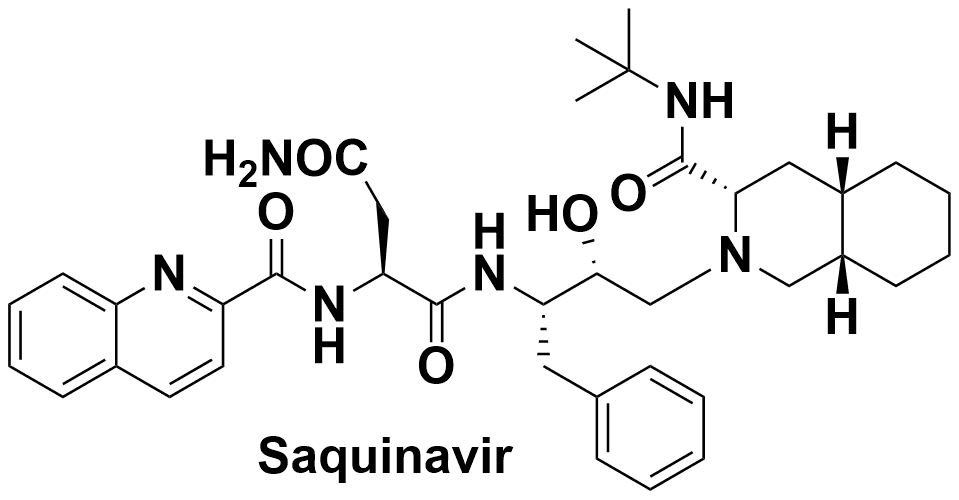
Back to the Future: HIV protease offers lessons for SARS-CoV-2

Today’s guest post is by Glyn Williams (University of Cambridge). Fragment aficionados will recognize Glyn as the former VP of Biophysics at Astex, but before that he worked at Roche. His experiences there in the 1990s have lessons for today. -Dan Erlanson

In two recent Practical Fragments posts (here and here), Dan Erlanson noted efforts which will allow the scientific community to contribute to drug design efforts against the SARS-CoV-2 main protease (Mpro). Leading the charge at the moment is the COVID Moonshot consortium who have already received design proposals for covalent inhibitors, based on the structures of fragments bound to Mpro that have been generated by researchers at the Diamond Light Source. At the same time, more information about Mpro, including its substrate preferences, is being published. Soon there will be an urgent need to define a selection procedure which will allow valuable drug candidates to be progressed.

A similar situation was faced in 1985 when HIV protease was being considered as a drug target for AIDS. An excellent description of a pragmatic, and ultimately successful, procedure was published in 1993 by Noel Roberts and Sally Redshaw of Roche in The Search for Antiviral Drugs:Case Histories from Concept to Clinic.

When the project began there was no definitive proof that this aspartyl protease was essential for viral replication in human cells and that it could not be substituted by a cellular protease. However, its in vitro ability to cleave a Phe-Pro or Tyr-Pro peptide bond (amongst others) marked it out as unusual, and that was sufficient encouragement for Roche to initiate a discovery programme. Inhibitor design then took advantage of this feature to build in selectivity over human aspartyl proteases, ultimately giving a high therapeutic index while also improving inhibitor absorption after oral administration. 
 
Critical issues, such as the decision to target the HIV-1 viral strain, access to suitable protease constructs and clear criteria for project progression, were defined early on. Novel protease and anti-viral assays were then developed in parallel with transition-state mimetic leads. From the start, it was recognised that the low aqueous solubility of the optimal peptide substrates could imply that peptidomimetic inhibitors were also likely to have poor physico-chemical properties. At the time there was no structural information on the enzyme or its complexes, so there was little opportunity to avoid these shortcomings.

As with COVID-19, the worldwide health implications of HIV were obvious and scientific interactions between different research groups were driven by a spirit of cooperation. Public laboratories contributed clinical data and provided access to assays for viral activity. In 2020 the ability to share data has improved beyond recognition but the ability to interpret and act on it is still subject to political and commercial pressures. At Roche, a series of hydroxyethylene inhibitors was not pursued due to its prior inclusion in multiple patents for renin inhibitors. In addition, sensitivity to criticism from AIDS activist groups during the project discouraged Roche from developing follow-up candidates later.

Many current predictions and public expectations about COVID-19 now depend on the availability of vaccines in 2021. After more than three decades of research, no preventative vaccine is yet available for HIV. However, the ability to treat a viral infection, even with a drug that contains and controls the infection rather than eliminates it, should not be undervalued. In 1993 the Roche HIV protease clinical candidate, Ro 31-8959, was in Phase 2 evaluation. Roberts and Redshaw pointed out then that lowering a patient’s viral load would reduce the risk of further infections amongst health-care workers and social contacts, while the persistence of immature and non-infectious viral material in cells could stimulate the patient’s own immune system to eliminate the virus.

Roberts and Redshaw concluded their 1993 analysis with the statement that "although there is still much work to be done, we remain very hopeful that Ro 31-8959 will make a positive contribution to the therapy of AIDS". Two years later Ro-31-8959, as Saquinavir, was approved by the FDA and, with Ritonavir, a second protease inhibitor from Abbott Labs, led to a 64% reduction in deaths from AIDS in the US over the next 2 years. Let us now hope for the same degree of success from new COVID-19 treatments.

13 April 2020

Fragment chemistry roundup part 3

Last week’s post discussed three papers describing new chemistries for building fragment libraries. The theme continues this week with three more.

The first, in ACS Med. Chem. Lett. from Philip Garner (Washington State University Pullman), Philip Cox (AbbVie), and colleagues describes the synthesis of a library of pyrrolidine-based fragments in just three steps. A chiral auxiliary, which is subsequently removed, enables an asymmetric cycloaddition reaction to generate pyrrolidine rings containing three defined stereocenters. Using this method, the researchers made 48 fragments from simple starting materials.


As one might predict looking at the structures, the fragments have low lipophilicity (average AlogP = 0.12) and high levels of saturation (Fsp3 = 0.47), though with an average MW = 225 they are a bit portly.

The fragments are also quite shapely, as assessed both by principal moments of inertia (PMI) or plane of best fit (PBF). The researchers acknowledge that this shapeliness increases the fragments’ molecular complexity, and they also note the difficulty of quantifying this, “as current estimates do not take into consideration 3D, let alone the multidimensional descriptors of chemical space.” Thus, they may have lower hit rates. Hopefully we’ll see screening data from this set at some point in future.

Diversity oriented synthesis (DOS) has only been occasionally applied to fragments, perhaps in part due to issues Teddy raised in his Safran Zunft Challenge. In an (open access) Bioorg. Med. Chem. Lett. paper, Nicola Luise and Paul Wyatt (University of Dundee) describe a set of 22 fragments in 12 scaffolds starting from just 3 precursors; a few examples are shown.


Although the embedded pyrazine, pyridine, and pyrimidine moieties are found in many drugs, some of the bicyclic cores are novel or rarely found in commercial sets.

In both these papers, the chemistry is sufficiently straightforward that a hit could rapidly lead to numerous analogs, which is a selling point for including them in a library. But in advancing other fragments a common problem is that the analog you most want to make is synthetically difficult. A crystal structure may reveal that an otherwise useful synthetic handle is making intimate contacts with the protein, while a hard-to-functionalize aliphatic ring is situated next to an attractive subpocket. A clear example of this is the phase 2 IAP inhibitor ASTX660 from Astex, whose fragment starting point consisted of a piperidine linked to a piperazine.

Perhaps building on this experience, Rachel Grainger, Chris Johnson, and collaborators from Astex, University of Cambridge, and Novartis have published in Chem. Sci. a high-throughput experimentation method to functionalize cyclic amines. The researchers used nanomole-scale reactions run in 1536-well plates to explore and optimize photoredox-mediated cross-dehydrogenative heteroarylation.


After optimizing conditions, the researchers moved to larger (milligram) scale to couple 64 different protected amines against heteroarene 3a and 48 heteroarenes against N-Boc-morpholine, thereby obtaining a variety of interesting molecules, many of which contain polar functionalities. Finally, they used flow chemistry to generate more than a gram of product 5g, demonstrating scalability. The paper ends with a half dozen examples of fragments taken from recent reviews, noting how the cross-dehydrogenative coupling could be used to elaborate them.

Progress often comes from expanded possibilities. By facilitating new chemistries, this paper lowers the barriers for drug hunters to make the most promising molecules. And taken together, all six of these papers advance the field of fragment chemistry.

06 April 2020

Fragment chemistry roundup part 2

It has been more than a year since we devoted a post solely to fragment library synthesis (though see here for an example describing library synthesis and screening). Since you can’t screen fragments without a library, Practical Fragments will spend the next two posts focusing on recent library design papers.

The first, from David Spring (University of Cambridge) and collaborators at the Technical University of Denmark, California State Polytechnic University Pomona, and University of Leeds, was published earlier this year in Chem. Commun. David Spring has long been interested in fragments that resemble natural products (NPs), such as those with multiple sp3 stereocenters.

The researchers focus on 3-hydroxy-2,2-disubstituted-cyclopentan-1-ones, which are found in natural products and derived drugs. The two building blocks syn-1 and anti-1 were elaborated in fewer than six synthetic steps into a total of 38 small molecules in 20 scaffolds, a few of which are shown.
 
Close attention was paid to physicochemical properties, and consequently the library is rule-of-three compliant, with a mean molecular weight of just 208 Da. The library is also quite shapely, as judged either by a high (0.70) mean Fsp3 or by individual members' principal moments of inertia (PMI).


Another paper from David Spring’s lab was published last year in Eur. J. Org. Chem. In it, the researchers describe the synthesis of nine heterocyclic spirocycles, a couple of which are shown here.


As with the newer paper, the physicochemical properties conform to the rule of three, and the molecules are quite shapely as assessed by their Fsp3 values.

Wrapping up this week’s installment is a paper in Chem. Eur. J. from Richard Bayliss, Stuart Warriner, Adam Nelson (all at University of Leeds) along with collaborators at University of Leicester, Diamond Light Source, University of Oxford, and University of Johannesburg. The researchers set out to assemble a diverse set of 80 shapely fragments for general use. Several rounds of computational pruning arrived at 60 commercial compounds and 20 that were synthesized de novo. Both approaches ran into problems: some “commercially available” compounds proved “difficult to obtain in practice,” while several synthetic approaches that looked good on paper turned out to be anything but. The final library is quite shapely though: all the synthesized compounds have at least one stereocenter, and only two fragments in the entire set are “close to the rod-disk axis” of a PMI plot.

Usefully, this paper presents screening data, in this case a high-concentration (80-200 mM) crystallographic screen against Aurora A kinase. This yielded just four hits, a 5% hit rate much lower than some other crystallographic screens. Interestingly none of these bound at the kinase hinge region where fragments often bind but instead were found at an allosteric site. The authors do not speculate on the low hit rate, which could be due either to the shapeliness of the fragments or their portliness, with 18-22 heavy atoms, considerably above the optimum suggested by Astex. The fragments are available for screening at Diamond’s XChem, though they don’t seem to have been used in the recent SARS-CoV-2 main protease screen.

We’ll cover three more papers next week. In the meantime, stay safe and please leave comments!

01 April 2020

Fragment screening in cells with cryo-EM

Of all the biophysical advances so far this century, cryogenic electron microscopy (cryo-EM) has probably made the most impressive strides. Frequently dismissed as “blobology” just a few years ago, the technique now regularly produces three-dimensional structural models that rival those from X-ray crystallography. Indeed, it is rare to pick up an issue of Science or Nature that doesn’t contain a cryo-EM structure. Earlier this year, researchers from Astex described the structures of fragment hits against two proteins determined using cryo-EM. Now, the boffins from DREADCO (who previously brought us universal crystallography) have begun fragment screening in cells using cryo-EM.

Fragment screening in cells is not new: we previously highlighted work using either covalent or non-covalent fragments. However, figuring out which proteins the fragments bind can be challenging, which is one of the reasons structural information is so useful.

The researchers from DREADCO incubate their fragment library against cells – human or otherwise – for varying lengths of time. They then flash-freeze the cells in liquid ethane, collect, and process the data, using standard cryo-EM workflows. Of course, given the complexity of cells, the computational processing power needed is enormous – but nothing their SkyFragNet platform can’t handle.

One of the advantages of cryo-EM is that larger structures are more easily solved, so the researchers are focusing on organelles such as mitochondria, as well as ribosomes. Already they’ve found dozens of hits that resolve to high resolution, and they are in active fragment-to-lead optimization. Surely it is only a matter of time before our list of fragment-derived drugs includes one discovered with the aid of cryo-EM.

29 March 2020

A crowdsourcing call to action: FBLD vs SARS-CoV-2 Protease

In less than a week the number of cases of COVID-19 worldwide has more than doubled, beyond 720,000, as have the number of deaths, to more than 34,000. For those of us in drug discovery but not on the front lines of clinical care, it is frustrating to watch these numbers climb relentlessly while doing nothing to help other than physical distancing. The temporary closure of so many labs accentuates this feeling.

In early March we highlighted an effort by Dave Stuart, Martin Walsh, Frank von Delft, and others at the Diamond Light Source to screen fragments against crystals of the main protease (MPro) of SARS-CoV-2. The enzyme is a cysteine protease, ideal for covalent fragment screening, and indeed Nir London and coworkers at the Weizmann Institute used intact protein mass-spectrometry to pre-screen 993 fragments. In total, these combined efforts yielded crystal structures of 44 hits bound covalently to the active-site cysteine, 22 non-covalent hits in the active site, and 2 non-covalent hits at the protein dimer interface. Full details and structures can be found here.

In our previous post we showed an overlay of the seven fragments that had been released at the time showing multiple high-quality interactions with the protein. You can look at them all interactively here, and some of the chemical structures are shown below.


This is where crowdsourcing comes in. A group called PostEra (corrected: part of a consortium called COVID MoonShot), consisting of academic and industrial researchers around the world, is trying to use these data and more to develop drugs against SARS-CoV-2. Everyone is invited to contribute, from first year graduate students through industry veterans and emeritus professors.

Do you have ideas how you might grow or merge some of the fragments? If so, you can propose structures, and those that pass a series of filters including synthetic accessibility and toxicity predictions will be synthesized at Enamine and tested at various laboratories (including yours, if you’re interested). We’ve previously highlighted Enamine’s “make on demand” model, which has turnaround times of just a few weeks. At least a couple computational companies, including BioSolveIT and Nanome, are offering free access to their platforms to help you design molecules. Already more than 350 molecule ideas have been submitted.

A cynic could say that these efforts are misguided given the slow pace of drug discovery. Vemurafenib, the first fragment-based drug approved, took six years from the start of the program to approval, and this is lightening speed. However, as Derek Lowe observed, all of the drugs currently being clinically tested against COVID-19 were originally developed for other indications. Stephen Burley suggested recently in Nature that we probably would already have drugs against COVID-19 had we spent more effort fighting SARS.

Hopefully we will have a vaccine long before any drugs coming out of this effort enter the clinic. But there will be a SARS-CoV-3, and a SARS-CoV-4. Having more drugs in our pipeline may prevent those from killing so many people.

23 March 2020

Fragments in the clinic: 2020 edition

As I write this, more than 350,000 people worldwide have tested positive for SARS-CoV-2. More than 15,000 of them have died.

It is important to stay aware of what's going on and take appropriate measures to stop the spread of COVID-19. But to paraphrase Nietzsche, one can spend too much time staring into the abyss. In the spirit of hope, Practical Fragments offers an updated list of FBLD-derived drugs.

The current list contains 47 molecules, 7 more than the last compilation, with 4 approved. As always, this table includes compounds whether or not they are still in development (indeed, some of the companies no longer even exist). Because of this, the Phase 1 list contains a higher proportion of compounds that are no longer progressing. Drugs reported as still active in clinicaltrials.gov, company websites, or other sources are in bold, and those that have been discussed on Practical Fragments are hyperlinked to the most relevant post. The list is almost certainly incomplete, particularly for Phase 1 compounds. If you know of any others (and can mention them) please leave a comment.

DrugCompanyTarget
Approved!

ErdafitinibAstex/J&JFGFR1-4
PexidartinibPlexxikonCSF1R, KIT
VemurafenibPlexxikonB-RAFV600E
VenetoclaxAbbVie/GenentechSelective BCL-2
Phase 3

AsciminibNovartisBCR-ABL
LanabecestatAstex/AstraZeneca/LillyBACE1
VerubecestatMerckBACE1
Phase 2

AMG 510Amgen KRASG12C
ASTX660AstexXIAP/cIAP1
AT7519AstexCDK1,2,4,5,9
AT9283 AstexAurora, JAK2
AUY-922Vernalis/NovartisHSP90
AZD5363AstraZeneca/Astex/CR-UKAKT
AZD5991AstraZenecaMCL1
CPI-0610ConstellationBET
DG-051deCODELTA4H
eFT508eFFECTORMNK1/2
IndeglitazarPlexxikonpan-PPAR agonist
LY2886721LillyBACE1
LY3202626LillyBACE1
LY517717Lilly/ProthericsFXa
MAK683NovartisPRC2 EED
Navitoclax (ABT-263)AbbottBCL-2/BCLxL
OnalespibAstexHSP90
PF-06650833PfizerIRAK4
PF-06835919PfizerKHK
Phase 1

ABBV-744AbbottBD2-selective BET
ABT-518AbbottMMP-2 & 9
ABT-737AbbottBCL-2/BCLxL
ASTX029AstexERK1,2
AT13148AstexAKT, p70S6K, ROCK
AZD3839AstraZenecaBACE1
AZD5099AstraZenecaBacterial topoisomerase II
BI 691751Boehringer IngelheimLTA4H
ETC-206D3MNK1/2
GDC-0994Genentech/ArrayERK2
HTL0014242Sosei HeptaresmGlu5 NAM
IC-776Lilly/ICOSLFA-1
LP-261LocusTubulin
LY2811376LillyBACE1
MivebresibAbbVieBRD2-4
NavoximodNew Link/GenentechIDO1
PLX5568PlexxikonRAF
S64315Vernalis/Servier/NovartisMCL1
SGX-393SGXBCR-ABL
SGX-523SGXMET
SNS-314SunesisAurora

We live in scary times. But, as this list demonstrates, by working together we can still achieve marvels.

16 March 2020

Fragments vs a Pseudomonas aeruginosa virulence factor

The world is understandably focused on SARS-CoV-2; see for example last week’s post. But there are many other threats out there, including infectious Pseudomonas aeruginosa, which is particularly problematic for immunocompromised people. A recent (open access!) ChemMedChem paper by Martin Empting and collaborators at the Helmholtz Centre for Infection Research and elsewhere describes a clever approach to tackle this pathogen.

An age-old problem for antibiotics is that they provoke resistance: nothing like death to kick evolution into high gear. One way to sidestep this is to develop drugs that target virulence rather than essential microbial pathways. The protein PqsR is part of the Pseudomonas Quinolone Signal Quorum Sensing system, and is important for pathogenicity.

A previously published screen of 720 fragments by SPR yielded about 40 hits, including compound 3. Not only does this compound have impressive ligand efficiency, it also has high enthalpic efficiency; the binding is largely enthalpy-driven. Although the utility of thermodynamics for lead optimization is questionable, the researchers were cognizant of the hydrophobic nature of the ligand binding site for PqsR, and sought molecules that would make polar interactions from the start rather than having to engineer them; a similar strategy proved successful for Astex.


Crystallography with compound 3 was unsuccessful, but SAR by catalog led to compound 7, which has higher affinity for PqsR as assessed by isothermal titration calorimetry (ITC) and also shows activity in a reporter gene assay. Fragment growing led to compound 11, which the researchers were able to characterize crystallographically. The two aromatic rings are at a sharp angle to one another, and attempts at rigidifying the linker proved unsuccessful. But further growing led to compound 20, with submicromolar activity in the reporter assay. This molecule also reduced release of a toxic virulence factor from a clinical isolate of P. aeruginosa.

Interestingly, despite the increased activity of compound 20 over compound 11 in the reporter assay, it seems to have lower affinity for PqsR by ITC. The researchers suggest that the full protein in cells likely behaves differently than the truncated version studied in the biophysical assays.

The researchers also emphasize that flexible linkers were more successful than rigid linkers in improving potency – a phenomenon we’ve previously highlighted here and here. Intuitively a more flexible linker is likely to be more forgiving, as a fraction of an ångström can make the difference between binding or not.

There is still much to do: in particular, activity will need to be improved further, and no pharmacokinetic or other animal data are provided. Moreover, a clinical trial with an anti-virulence strategy would be difficult to design. Still, this is an interesting approach, and I hope the authors or others will follow up on it.

07 March 2020

Fragments vs SARS-CoV-2 Protease: open science in action

Last year we highlighted work done by a consortium called Open Source Antibiotics to find fragment hits against antibacterial targets. A similar effort has now launched to discover leads for COVID-19. And those involved have done so with breathtaking speed and openness.

A group of researchers including Dave Stuart, Martin Walsh, and Frank von Delft (Diamond Light Source) has performed a fragment screen against crystals of the main protease (MPro) of SARS-CoV-2, the virus that causes COVID-19. Even before fully analyzing all of the data, let alone publishing it on bioRxiv, they are making it available here, with promises of frequent updates.

MPro is a cysteine protease essential for viral viability. The first crystal structure of the protein was solved in January and posted on bioRxiv late last month. The Diamond researchers synthesized the gene and used it to produce protein that crystallized and diffracted to high (1.39 Å) resolution. Importantly, they found a crystal form in which the active site was empty and thus well-suited to fragment soaking. In just three days the XChem researchers grew, soaked and analyzed 600 crystals. Since then they have screened over 1000 fragments and found 7 that bind in the active site. These will be released in the protein data bank on March 11, though the coordinates and electron density maps can already be downloaded from XChem and viewed interactively here. An overlay shows a large and attractive pocket with multiple opportunities for protein-ligand interactions.


Frank sent an email on March 6 describing this achievement to a number of researchers, and within minutes Brian Shoichet (UCSF) said that he would be using the fragments as controls in a large library docking screen he is doing. Just a few hours later Andrew Hopkins (Exscientia) said that he has SPR and enzymatic assays up and running and is willing to screen compounds sent to him. Then John Chodera (Memorial Sloan-Kettering Cancer Center) volunteered to do free-energy calculations.

As anyone who has worked in drug discovery, fragment-based or not, will recognize, there is still a long road ahead to turn these fragments into effective drugs. But this global team has sprinted off the starting line. Please join them in the race if you can.

02 March 2020

FBLD meets DEL

FBLD, of course, starts with small libraries of small fragments. DNA-encoded chemical libraries (DEL) usually start from the opposite extreme. Massive numbers of molecules are combinatorially synthesized attached to DNA, screened against a target using affinity selection, and hits identified by sequencing the DNA. A recent paper in J. Med. Chem. by Christopher Wellaway and colleagues at GlaxoSmithKline uses information from both approaches to generate a high-quality candidate.

The researchers were interested in bromodomain and extraterminal (BET) family proteins – the same targets we discussed last week. GlaxoSmithKline had already put molecules into the clinic, but they were looking for structurally different backup candidates, so they performed a DEL screen on the BD1 domain of BRD4. A library of 117 million compounds yielded potent compound 10, and crystallography revealed that the 2,6-dimethylphenol moiety bound in the acetyl-lysine-binding pocket.


Phenols are often metabolic liabilities, and indeed compound 10 was rapidly cleared in mice. However, GlaxoSmithKline has a long and successful history of fragment screening against bromodomains; Teddy first described some of their seminal work back in 2012, when the world didn’t end. Compound 16 had been found in a previous screen as a hit against BRD4, and crystallography revealed that the pyridone binds in a similar fashion to the phenol moiety. (Similar pyridones had been reported by others, for example this one.) Merging the molecules led – after a bit of tweaking – to compound 20a. In addition to BRD4, this molecule binds another bromodomain, BAZ2A, which the researchers wanted to avoid. Structure-based design led them to the more selective compound 20i.

Although compound 20i is potent in cells, it still has moderate clearance in rats. Unsubstituted benzimidazole rings have been reported to be unstable, so the researchers systematically explored a series of substitutions, ultimately arriving at compound 24 (I-BET469). Not only is this compound potent and soluble, it is remarkably stable, with “no detectable turnover in rat, dog, and human microsomal and hepatocyte preparations.” Oral bioavailabilities approach 100%, and the compound proved to be effective in acute and chronic mouse inflammation models. Although selectivity against non-BET family bromodomains members is good, compound 24 does strongly bind to both BD1 and BD2 domains of all four BET family members, and as we saw last week this may lead to toxicity.

Nonetheless, this is a lovely example of using a fragment to replace a problematic moiety in a larger molecule, as we’ve seen previously for chymase, Factor VIIa, and Factor XIa. Throughout the optimization the researchers paid close attention to molecular properties such as lipohilicity and molecular weight, and this resulted in a molecule with excellent pharmacokinetics despite the presence of potentially unstable moieties such as the morpholine. If nothing else, this will be a useful in vivo chemical probe.

24 February 2020

Fragments in the clinic: ABBV-744

Bromodomains, which recognize acetylated lysine residues, are popular cancer targets due to their role in gene regulation. A plethora of potent inhibitors have been reported, many of them derived from fragments, and some have even gone into the clinic. The story behind one of these, ABBV-744, was recently published in Nature by Yu Shen and colleagues at AbbVie.

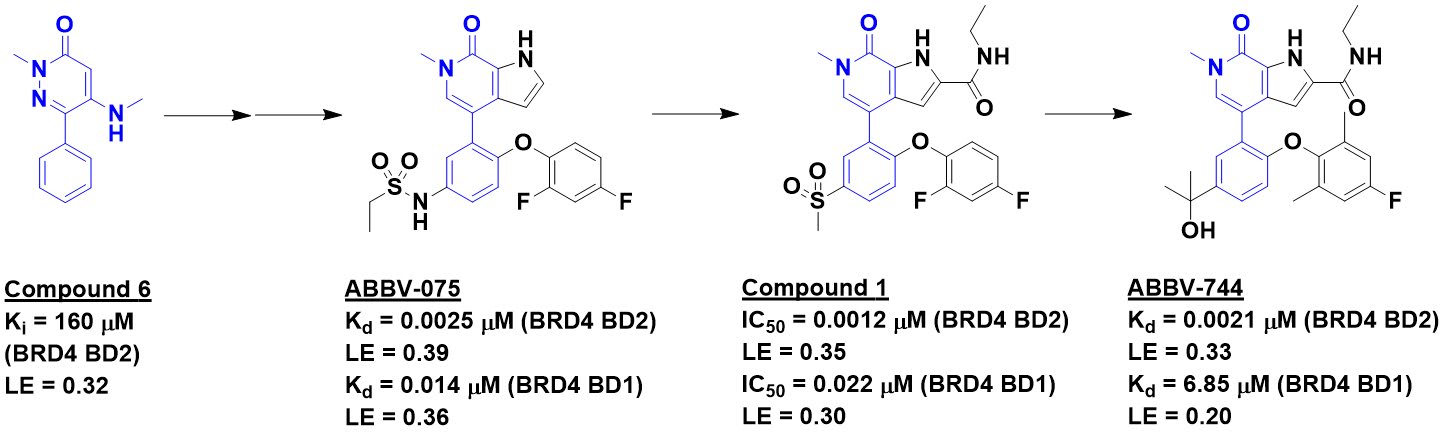
The story starts with a protein-detected NMR screen (highlighted here), which ultimately led to ABBV-075 (highlighted here). This molecule binds tightly to the four BET-domain family members (BRD1, BRD3, BRD4, and BRDt). However, ABBV-075 causes gastrointestinal toxicity as well as a reduction in platelets when tested in mice. Indeed, these effects are seen when BRD4 alone is genetically silenced in mice, suggesting on-target toxicity. However, each of the BET proteins has two separate bromodomains, called BD1 and BD2, and the researchers thought that a selective inhibitor of the BD2 domain might be better tolerated.

Screening about 2500 compounds from the ABBV-075 program revealed that compound 1 was still quite potent against the BD1 domain of BRD4 but lost activity against the BD2 domain. Further optimization ultimately led to ABBV-744, which is at least two orders of magnitude more selective against the BD2 domains of all four BET-domain proteins over the respective BD1 domains. It also shows no activity against a panel of kinases and other bromodomains, and is orally bioavailable. A crystal structure of the molecule bound to either BD1 or BD2 reveals that the key interactions seen in ABBV-075 are maintained, but that the added amide moiety makes interactions only available in BD2, while the larger diphenylmethyl ether moiety is better accommodated in BD2 due to a slightly larger pocket (containing a valine rather than an isolueucine residue).


ABBV-744 is active against multiple acute myeloid leukemia and prostate cancer cell lines, and the paper thoroughly explores the biology of a selective BD2 inhibitor. Most striking is that in a mouse xenograft model, ABBV-744 shows similar activity at 1/16 of its maximum tolerated dose (MTD) as ABBV-075 shows at its MTD. Even at doses well above efficacious exposure levels, ABBV-744 shows only limited platelet reduction and no gastrointestinal toxicity in mice. As mentioned at FBLD 2018, this molecule has entered clinical development, while ABBV-075 has quietly been dropped from AbbVie’s pipeline.

This is a lovely example of biology-guided medicinal chemistry that is reminiscent of the BCL-family inhibitors, which started with less specific molecules and culminated with the approval of BCL2-selective venetoclax. Although the fragment origins of ABBV-744 are clear, they are not mentioned in the paper and – like the KRAS inhibitors and AZD5991 – could be easily overlooked. In all these cases small starting points have delivered potentially huge drugs, and Practical Fragments wishes everyone involved the best of luck.

17 February 2020

Fragments vs MNK1 and MNK2: take three

Mitogen-activating protein kinase-interacting kinases 1 and 2, or MNK1 and MNK2, are implicated in several cancers while seeming to be dispensable for normal cells, making them attractive oncology targets. Indeed, we’ve previously written about two FBDD-derived clinical compounds against these kinases, eFT508 and ETC-206. In a J. Med. Chem. paper published last month, Alvin Hung and colleagues at A*STAR describe a third series.

The researchers started by screening 1700 fragments in a biochemical assay, resulting in 11 molecules that inhibited both MNK1 and MNK2 with decent ligand efficiency. Four of these had a meta-substituted pyridine, as in compound 6. Making a few analogs led to compound 13, with low micromolar potency against both enzymes.


Crystallography proved unsuccessful, but making the reasonable assumption that the pyridyl nitrogen binds to the kinase hinge region led to two models, only one of which was consistent with the SAR. Decoration of the phenyl ring led to compound 21, with submicromolar activity. Although still early, the researchers collected both in vitro and in vivo ADME data on this molecule, which turned out to be quite promising.

Next the researchers turned to the pyridyl ring and found that appending small (5-membered) heterocycles could also boost potency, as in compound 36. At this point, after multiple attempts with previous compounds, crystallography finally yielded a structure that confirmed the proposed binding mode. Combining elements from compounds 21 and 36 directly led to only a slight boost in activity, but further tweaking ultimately led to compound 47, the most potent member of the series. Unfortunately this molecule was unstable in mouse liver microsomes, but a related compound showed good mouse pharmacokinetics as well as impressive selectivity in a panel of 104 kinases.

No pharmacodynamic studies are described, and perhaps this series was deprioritized to focus on ETC-206, which was also developed at A*STAR. Indeed, the later compounds in this paper reveal a frustrating struggle between potency and stability often seen in medicinal chemistry. This is captured in a nice timeline that shows a rapid improvement in potency over about 8 months, followed by a slight drop as the researchers tried to improve exposure. Although no Goldilocks molecule is reported, this paper is nonetheless a lovely example of fragment to lead optimization done for the most part without the aid of crystallography.

10 February 2020

Toward SAR by SFX

As our poll last year revealed, X-ray crystallography has inched out ligand-detected NMR to become the most popular fragment-finding method. One criticism often leveled at crystallography is biological relevance: very few proteins in nature are found in the crystalline state. Moreover, crystallography is a dish usually served cold, with crystals typically frozen in liquid nitrogen. The reason for this is that the powerful X-ray beams used to elucidate the structure of molecules also rip them apart, and freezing them slows the damage. But protein-ligand complexes at low temperature may not always reflect our more temperate world.

One approach to collecting crystallographic data at room temperature is to do so very quickly, before radiation damage can occur. This is done using serial femtosecond crystallography (SFX), in which many crystals are individually examined using brief, intense beams from X-ray free-electron lasers (XFELs). The X-ray pulses last less than 20 femtoseconds, a time so breathtakingly short that light only travels the width of a typical human cell. In a recent IUCrJ paper, Robin Owen, Michael Hough, and collaborators at the Diamond Light Source, the University of Essex, and elsewhere describe a high-throughput version.

The protein crystals themselves can be quite small, just 1-20 µm across, compared with the > 50 µm crystals typically used in crystallography. These microcrystals are mounted in silicon “chips” containing 25,600 little apertures; the X-ray beam can then be swept across each of the positions.

The researchers demonstrated that they could collect high-quality data for three proteins that are particularly sensitive to radiation damage: two heme peroxidases and a copper nitrite reductase. For all three proteins, they were able to determine high-quality structures of bound fragment-sized ligands. Indeed, some of the ligands were even smaller than all but the smallest fragments: imidazole (five non-hydrogen atoms) and nitrite (three non-hydrogen atoms). The latter case was particularly impressive given that the nitrite displaces a bound water molecule, so the difference between empty and liganded protein is even more subtle.

The first word of this blog is “Practical,” so how does this technique stack up? The researchers used 2-4 chips for each structure, and data collection took about 14 minutes per chip. Despite the miniaturization, sample consumption is not trivial: 1.4 to 6 mg of protein and 4-40 µmol of ligand for each data set. However, the researchers showed that could get by with less data – in some cases significantly so – and state that a 4-5-fold improvement in throughput would be straightforward. Using processing software such as PanDDa could further improve results. I suspect it is only a matter of time before we see the first FBLD by SFX screen. It will be fun to see how useful it turns out to be compared with established methods.

03 February 2020

Fragments vs RIP2: from flat fragment to shapely selectivity

Last week we highlighted the utility of shapely fragments. However, as the latest review of fragment-to-lead success stories again shows, starting with a “flat” fragment does not condemn a lead to flatland. This is illustrated in a recent J. Med. Chem. publication by Adam Charnley and colleagues at GlaxoSmithKline.

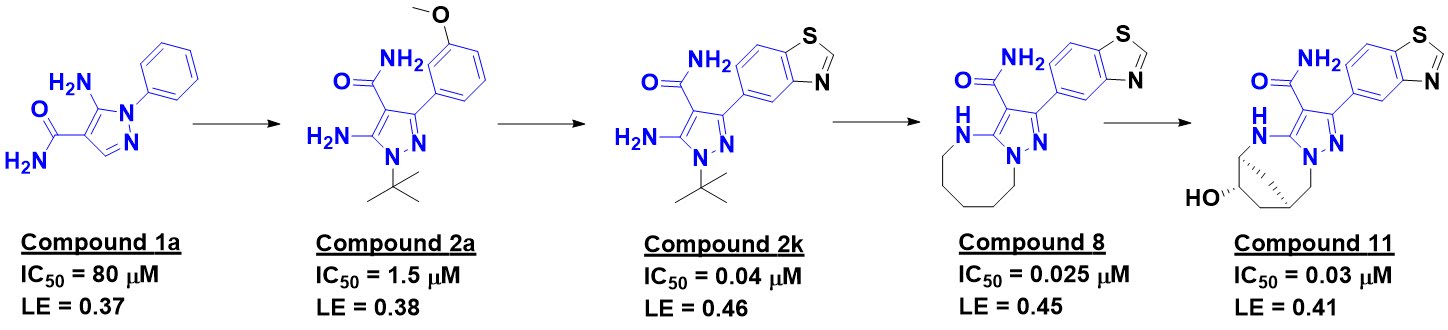
The researchers were interested in receptor interacting protein 2 kinase (RIP2), which is implicated in various inflammatory diseases. A fluorescence polarization screen of 1000 fragments at 400 µM yielded 49 hits with inhibition constants ranging from 5-500 µM. Thirty of these confirmed in a thermal shift assay, and 20 were characterized crystallographically bound to the enzyme. Hit-to-lead chemistry was pursued for five series; the most successful started with compound 1a.


The crystal structure revealed that the carboxamide of compound 1a makes interactions with the hinge region of the kinase, with the phenyl group in the back pocket. A search of related molecules available in-house led to compound 2a, with a satisfying boost in potency. Interestingly, the crystal structure of this molecule bound to RIP2 revealed that the binding mode of the pyrazole moiety had flipped to keep the phenyl ring in the back pocket (compound 1a in cyan, 2a in gray). Enlarging the phenyl group to better fill the pocket led to compound 2k.


This molecule had relatively poor selectivity against several other kinases, but introducing a ring as in compound 8 improved the situation. Crystallography suggested that installing a bridged ring would pick up further interactions with the protein, and although the resulting molecule did not have better affinity, selectivity improved. Finally, a hydroxyl group was introduced (compound 11) to try to pick up interactions with a non-conserved serine residue. This addition did not improve biochemical activity, and in fact a crystal structure revealed that the hydroxyl group was pointing towards solvent, but the activity in human whole blood improved. Importantly, compound 11 was remarkably selective for RIP2: just 1 of 366 other kinases tested at 1 µM showed >70% inhibition.

This is a lovely fragment-to-lead success story that reiterates several important lessons. First, a generic (in this case commercial) and nonselective fragment can lead to novel, selective series. Second, as has been seen multiple times, fragment binding modes can flip unexpectedly, especially during early optimization. Finally, despite the relative flatness of fragment 1a (Fsp3 = 0, though the two aromatic rings are slightly twisted), it could be optimized to a more shapely lead, and the increased complexity is likely responsible for the impressive selectivity. Left unreported is the stability and pharmacokinetics of compound 11: the hydroxyl and all those sp3-hybridized carbons are likely metabolic hotspots. As is so often the case in lead discovery, what solves one problem can too often create another.

27 January 2020

Three dimensional fragments revisited

A long-running debate in the fragment world centers on the utility of “three dimensional” fragments. Proponents argue that these (often aliphatic) fragments may be more novel, have better physicochemical properties, and have more vectors for elaboration than “flatter” (mostly aromatic) molecules. Skeptics retort that hit rates are likely to be lower for these more complex molecules, and good luck making analogs. Two papers published late last year add more data to the debate.

The first paper, published in J. Med. Chem. by William Pomerantz and collaborators at the University of Minnesota and Eli Lilly, describes the results of a fragment screen against the bromodomain BRD4(D1), a popular member of the BET family. The 467 fragment library was enriched for shapely fragments as assessed by plane of best fit (PBF), which is the “average distance of a non-hydrogen atom from a plane drawn through the compound such as to minimize the average.” For example, "flat" benzene has a PBF of 0 while the cofactor NADPH has a PBF of 1.53.

The library was screened using ligand-observed (CPMG) NMR, and 34 hits were confirmed using protein-observed fluorine (PrOF) NMR. All of these were competitive with the known ligand (+)-JQ1, consistent with binding at the acetylated lysine recognition site. The average PBF of the hits was 0.44, essentially the same as the library itself (0.46). This is higher than the average PBF (0.36) of all fragments crystallized with BRD4 in the protein data bank.

Structures of all the hits are provided, and some of them are indeed quite unusual. The researchers characterized a substituted thiazepane crystallographically and were able to optimize this to a 32 µM binder with good ligand efficiency. This fragment was also selective against a handful of other bromodomains.

The researchers had previously screened BRD4(D1) under identical conditions with a more traditional, “flatter” library with an average PBF of 0.26. Interestingly, in that case the hits were less shapely than the library as a whole, with an average PBF of 0.17. The confirmed hit rate was also higher: 20% vs 7%. That said, the fragments in the traditional library tended to be smaller (averaging 180 Da vs 241 Da), so the molecular complexity of this library was likely to be lower, which could account for the higher hit rate.

The second paper, published in Bioorg. Med. Chem. Lett. by Ulrich Grädler and collaborators at Merck KGaA, EMD Serono, Edelris, and Proteros, focuses on cyclophilin D (CypD), which has been implicated in cardiovascular disease and multiple sclerosis. Unlike BRD4, this is a tough target: an HTS screen of 650,000 compounds in a biochemical assay yielded just 178 hits, none of which confirmed. Undeterred, the researchers screened 2688 fragments by SPR at 2 mM, resulting in 58 confirmed hits, all quite weak (millimolar). Crystallography was attempted on most of them, yielding six structures, including such shapely specimens as compounds 3 and 7.


Compound 3 binds in the lipophilic S2 pocket of CypD, overlapping with the aniline moiety of previously reported compound 2. Fragment merging led to compound 14, with nearly 40-fold improved affinity over compound 2. A similar strategy merging compound 3 with fragment 8 led to low micromolar compound 27, two orders of magnitude more potent than the starting fragments. Perhaps most impressively, fragment linking compound 3 with compound 7, a shapely fragment which binds in the S1’ pocket, led to submicromolar compound 39, with affinity more than 10,000-fold higher than either fragment.

So in the end, fanciers of shapely fragments and detractors alike can feel vindicated by these papers. Hit rates might be lower for three dimensional fragments, but the resulting hits are likely to be less precedented. In the case of CypD, a shapely fragment led to three different series for a target that had resisted HTS. Of course, there is still some way to go: no cell, permeability, or stability data are provided for any of the molecules, and medicinal chemists may blanch at the seven stereocenters in compound 39. But these are interesting starting points, and it will be fun to see where they end up.