27 February 2023

A cell-active fragment targets the microRNA-372 hairpin precursor

Fragment-based lead discovery against RNA has been a theme on Practical Fragments for well over a decade. Unfortunately, most of the resulting hits are either weak or non-druglike. A paper published late last year in J. Am Chem. Soc. by Matthew Disney and collaborators at the Scripps Research Institute in Florida provides a nice counter example.
 
The researchers started by building a new fragment library based on known RNA-binding molecules – a venerable approach we first described back in 2009. The most common scaffolds differ somewhat from the most common scaffolds found in drugs (see here), with pyrimidines, triazoles, furans, and benzimidazoles over-represented. A set of 2500 fragments mostly conforming to the rule of three was purchased from ChemDiv, and the structures of all of them are helpfully provided in the supporting information.
 
Most fragment screening efforts start with a target of interest, but here the researchers chose a “library-versus-library” format, in which they screened all 2500 fragments against 5120 different RNAs. Each RNA molecule consisted of an identical 40-nucleotide hairpin containing randomized 3 x 2 or 3 x 3 internal nucleotide loops. Fragments were immobilized onto an agarose-coated microarray and radiolabeled RNA was added. Interestingly, only 19 fragments were found to bind the RNA. Competition experiments with other RNA sequences and DNA reduced the number of specific binders down to three. RNA sequencing experiments revealed that two of these fragments were fairly promiscuous, each binding over 100 different RNAs, but compound 3 bound just 28 RNAs with the 3 x 2 internal loop and none with the 3 x 3 internal loop.
 
Having identified specific RNA sequences bound by compound 3, the researchers searched human microRNAs (miRNAs) and found that the pre-miR-372 contains a bulge predicted to bind. When this RNA is processed it produces miR-372, which represses translation of the tumor suppressor LATS2, thereby increasing cellular proliferation. Perhaps the binding of compound 3 to the pre-miRNA would impede its processing.
 
The affinity of compound 3 for pre-miR-372 was measured to be 300 nM, giving it an impressively high ligand efficiency. In vitro experiments showed that the compound blocked processing by the enzyme Dicer. The researchers conducted a series of cellular experiments showing that compound 3 decreased levels of miR-372 and increased pre-miR-372m while having no effect on 379 other miRNAs. Encouragingly, compound 3 also increased levels of LATS2 mRNA and protein and decreased cell proliferation. Additional experiments with siRNA, mutated versions of pre-miR-372, and cell lines with lower levels of miR-372 all support the on-target mechanism.
 
This is a lovely paper, and compound 3 appears to be a good starting point for further optimization. However, the work also suggests why finding lead-like RNA binders may be so difficult. In the library-vs-library approach described, the researchers studied 12,800,000 different molecular interactions and came up with just three (somewhat) specific binders. The ligandability of RNA – or at least the small internal loops studied here – appears to be low. To prospectively find hits against specific RNAs may require much larger fragment libraries than are typically used. Perhaps this could be an application for DNA-encoded fragment libraries, which we wrote about here.

20 February 2023

FragLites and PepLites meet bromodomains

The last two Practical Fragments posts focused on bromodomains, epigenetic readers that recognize acetylated lysine residues. Today’s post could thus be considered part of a trilogy, though the focus is less on bromodomains themselves than a specific type of fragment library.
 
In 2019 we highlighted FragLites, small fragments containing pairs of hydrogen bond acceptors and/or donors along with a bromine or iodine atom. FragLites were designed to assess ligandability as well as identify what types of interactions would be favorable at various sites. The original test protein was the kinase CDK2. In an open-access paper published late last year in J. Med. Chem. by Martin Noble, Michael Waring, and colleagues at Newcastle University, FragLites are screened against two members of the bromodomain family.
 
The first bromodomain (BD1) of BRD4 is considered highly ligandable, with multiple inhibitors disclosed (see for example here). In contrast, ATAD2, a bromodomain in another subfamily, is more challenging, in part because it lacks a hydrophobic region useful for increasing affinity for small molecules. Thirty-three FragLites were individually soaked at 50 mM into crystals of either bromodomain. The halogen atom on each FragLite facilitates analysis by anomalous dispersion, allowing more sensitive detection of low-occupancy binders. This, along with Pan-Dataset Density Analysis (PanDDA), was used to identify specific protein-ligand “binding events.”
 
In total, 26 binding events at five sites were identified for BRD4; four ligands bound at more than one site. Of these, 17 FragLites bound at the orthosteric site of BRD4 (which recognizes N-acetyl lysine). In contrast, ATAD2 displayed 16 binding events total over seven sites; only three bound at the orthosteric site, consistent with its lower ligandability. ATAD2 had previously been screened crystallographically against the 776-membered DSI-poised fragment library, and this effort also identified seven ligand-binding sites, six of which were common to those discovered here, suggesting that the small FragLite set is able to identify most pockets.
 
As far as specific types of interactions, the average FragLite made 1.1 hydrogen bond, suggesting that the second donor or acceptor is often not engaged. In contrast, the bromine or iodine atom makes protein contacts in 33 of 42 binding events. In half a dozen cases no hydrogen bond to the protein was observed, with the primary interaction being a halogen bond.
 
The FragLites are small, relatively “flat” aromatic molecules, but of course most proteins interact with other proteins. To try to explore such interactions, the researchers developed a library of “PepLites:” N-terminally acetylated amino acid residues with a C-terminal bromopropargyl group. These were also screened crystallographically against the two bromodomains and produced considerably lower hit rates, with six bound to BRD4 (all at the orthosteric site) and nine bound to ATAD2 (of which five bound to the orthosteric site). Reassuringly, the N-acetylated lysine PepLite bound to both proteins in a similar manner as seen in larger peptides.
 
The researchers conclude that FragLites and PepLites “represent highly valuable components of a larger crystallographic screen, and we anticipate that this is where they will fit into most drug discovery programs.” Indeed, this is already happening; last year we wrote about how FragLites were screened against the bromodomain PHIP2 as part of a larger screen, and I was surprised this paper was not mentioned here. Laudably, all the atomic coordinates have been deposited in the Protein Data Bank, so folks are able to do their own analyses.
 
As FragLites and PepLites are screened against ever more targets, it will be fun to see what they can teach us about intermolecular interactions and starting points for new leads.

13 February 2023

Fragments vs PBRM1 bromodomains revisited, more selectively

Last week we highlighted the discovery of a selective inhibitor for the BET family of bromodomains. The 61 human bromodomains fall into eight subfamilies, of which the BET family has probably been most heavily studied. In contrast, family VIII has received less attention, in part due to the lack of selective inhibitors. This deficit is beginning to be addressed by Shifali Shishodia, Brian Smith, and collaborators at Medical College of Wisconsin and Purdue University in J. Med. Chem.
 
The researchers were particularly interested in the aptly-named protein Polybromo-1 (PBRM1), which contains six of the 10 family VIII bromodomains. The protein has normally been considered a tumor suppressor, but it has also been implicated as a tumor promoter in prostate cancer. Chemical probes would be very useful to unravel the complicated biology. A few pan-inhibitors of family VIII have been developed, one of which we wrote about back in 2016, but none of these are selective for the PBRM1 protein.
 
The researchers started with an NMR screen of the second bromodomain of PBRM1, BD2, the structure of which had previously been solved by NMR. A 1H-15N SOFAST-HMQC screen of 1968 fragments (all rule of three compliant, from Maybridge and Zenobia) in pools of 12 ultimately yielded a dozen hits, all of which are shown in the paper. Of these, compound 5 was the most potent, with dissociation constants of 45 µM by NMR titration and 18 µM by isothermal titration calorimetry (ITC). 
 
 
One of the previous pan-family VIII inhibitors described in the literature was structurally similar to compound 5, and borrowing a chlorine atom from this led to compound 11, with improved affinity. Further exploration around both phenyl rings ultimately led to compound 16, which displayed low micromolar affinity by ITC and high nanomolar activity in an inhibition assay.
 
Differential scanning fluorimetry (DSF) is commonly used to measure binding of small molecules to bromodomains, and the researchers tested some of their best compounds in a panel of bromodomains that included 9 of the 10 family VIII members. Encouragingly, compound 16 only showed a strong thermal shift (ΔTm = 5.4 °C) to PBRM1-BD2 and moderate shifts (ΔTm = 1.8 °C) to PBRM1-BD3 and PBRM1-BD5. No significant stabilization of the 18 other bromodomains was observed.
 
A series of shRNA experiments by the researchers revealed that the prostrate cancer cell line LNCaP was dependent on PBRM1, and compound 16 was active against these cells, albeit weakly (EC50 ~ 9 µM). In contrast, the compound did not show activity against two other cancer cell lines that do not seem to be dependent on PBRM1.
 
This work is a nice example of academic fragment-based lead discovery. Although the cell activity of compound 16 is probably insufficient for a serviceable chemical probe, it does show that selectivity is possible. Hopefully these researchers, or others, will continue improving it.

06 February 2023

Efficiency metrics in action for a bromodomain inhibitor

The metrics ligand efficiency (LE) and lipophilic ligand efficiency (LLE or LipE) are frequently used during fragment-to-lead optimization. A recent paper in J. Med. Chem. by Philip Humphreys and colleagues at GSK describes how they were useful in developing an “oral candidate quality” inhibitor of BET-family bromodomains.
 
Practical Fragments has written frequently about bromodomains, which bind to acetyl-lysine residues in histones to epigenetically modulate gene transcription. Some 17 bromodomain inhibitors have entered the clinic, of which at least three (pelabresib, PLX51107, and ABBV-744) came from fragments. GSK was an early pioneer in the field, and researchers there were interested in using fragments to develop a differentiated class of molecules that would inhibit all four members (BRD2, BRD3, BRD4, and BRDT) of the BET family, each of which contains two separate bromodomains designated as either BD1 or BD2.
 
GSK already had BRD4 BD1 binding data for 50,000 compounds, and these were analyzed to find molecules with LE>0.3 kcal/mol per atom that were structurally differentiated from known bromodomain binders. Compound 9 was quite potent and had high LE as well as respectable LipE. (As the researchers note, LE is “the more relevant metric” for fragments, with LipE becoming increasingly important during later optimization.) A crystal structure of this molecule superposed onto another bromodomain inhibitor suggested that adding a methyl group to fill a small pocket could boost affinity, and this was confirmed by compound (R)-10. This molecule showed cell activity and good permeability, although hepatocyte stability was poor, likely due to the two methoxy groups. Removing these led to compound 12, the most ligand-efficient compound that had been seen. (All values in the figure below are for binding to BRD4 BD1.)
 

Compound 12 mimics the N-acetyl lysine residue of the natural ligand, and previous research had revealed two additional regions of the bromodomain that could be targeted for enhanced affinity, the so-called “WPF shelf” and the “ZA channel.” Structure-based design was used to independently explore both areas, leading to compounds such as 24 and 31. In addition to assessing LE and LipE, the researchers paid close attention to other factors such as permeability. Virtually combining the best moieties that bind at the WPF shelf and ZA channel led to 770 potential molecules to make, which were winnowed down to just 40 on the basis of predicted lipophilicity (specifically chromLogDpH7.4), molecular weight, and TPSA. The best of these were more extensively profiled, including in pharmacokinetic studies. I-BET432 emerged as the winner.
 
I-BET432 binds tightly to both bromodomains of the four BET family proteins and is at least 80-fold selective against two dozen other bromodomains. It shows excellent oral bioavailability in rats and dogs, does not inhibit hERG, is not mutagenic in an Ames test, and does not inhibit CYP3A4. The molecule is also clean in a panel of four dozen off-target proteins. Human oral dose predictions come in at 5-18 mg per day. A crystal structure of the molecule bound to BRD2 BD2 showed the expected binding pose, and that the two alcohol substituents may be forming an intra-molecular hydrogen bond, which could explain the high permeability.
 
This is a nice case study in metric-driven optimization. As the researchers note, I-BET432 “has the highest LipE (6.2) and LE (0.43) of the candidate quality GSK pan-BET inhibitors disclosed to date.” Although the molecule does not seem to have gone forward into development, the story is nonetheless worth reading to see how metrics can yield quality molecules.

30 January 2023

Fragments in the clinic: MK-8189

Just over seven years ago Practical Fragments highlighted work out of Merck describing the discovery and optimization of potent, selective inhibitors of phosphodiesterase 10A (PDE10A), a potential target for schizophrenia (see here and here). An open-access paper in the latest issue of J. Med. Chem. by Mark Layton and colleagues tells how these were ultimately advanced to a clinical compound.
 
To recap, a biochemical fragment screen identified the highly ligand-efficient compound 1, which was optimized to the potent compound 2. However, this molecule had poor pharmacokinetics and multiple other liabilities. Further optimization led to Pyp-1, which we noted at the time would make a good chemical probe.
 

The new paper continues SAR around the central ring, in particular to try to reduce lipophilicity. Also, the methyl-pyrazole in Pyp-1 was associated with high clearance in rats, so this substituent was replaced with a methyl-1,3,4-thiadiazole moiety. To cut a long story short, this ultimately led to MK-8189.
 
Not only is MK-8189 a picomolar biochemical inhibitor of PDE10A, it is a low nanomolar inhibitor in cells. Moreover, it shows excellent pharmacokinetics in rats and rhesus monkeys as well as selectivity against various off-targets such as CYPs and hERG. Importantly for a drug intended to reach the brain, the molecule is permeable, not effluxed, and achieves relevant concentrations in the rat striatum after oral dosing. Finally, it decreased psychomotor activity and improved episodic memory in rat models of schizophrenia. With all these positives, MK-8189 has been taken into the clinic.
 
Several lessons emerge from this story. First, as experienced drug hunters will recognize, systematic exploration of multiple positions is important to generate a molecule with the right balance of properties to become an investigational drug. Second, as the researchers note, ligand efficiency was roughly maintained throughout the optimization process. Finally, this publication is a reminder of the long lag that can occur between research and publication. We already mentioned that the first papers describing this series appeared in 2015, but according to ClinicalTrials.gov MK-8189 first entered the clinic a year earlier, in 2014. Our list of fragment-derived clinical compounds will forever be incomplete and out of date. But on a positive note, this means that fragments may be having even more of an impact than the list shows.

23 January 2023

The Chemical Probes Portal at Eight

Back in 2015, Practical Fragments highlighted a new resource calling itself “The Chemical Probes Portal.” At the time it included just seven probes, and my post concluded, “I hope this takes off. Understanding the natural world is hard enough even with well-behaved reagents and carefully controlled experiments.”
 
Well, take off it has, as illustrated by a new (open access) paper in Nucleic Acids Res. by Susanne Müller (Goethe University Frankfurt), Bissan Al-Lazikani (MD Anderson Cancer Center), Paul Workman (Institute of Cancer Research), and collaborators.
 
The paper notes that “the widespread use of small molecule compounds that are claimed as chemical probes but are lacking sufficient quality, especially being inadequately selective for the desired target or even broadly promiscuous in behavior, has resulted in many erroneous conclusions in the biomedical literature.” As an antidote, the Portal is an “expert review-based public resource to empower chemical probe assessment, selection, and use.”
 
Any scientist can suggest a potential probe, and these are then internally reviewed and curated. Assuming enough public information is available about the molecule, probes are then sent to three members of a Scientific Expert Review Panel for further vetting. Reviewers rate probes from one to four stars for use in cellular and/or animal models and recommend relevant concentration ranges. Importantly, reviewers can also include comments to highlight off-targets, lack of certain data, oral bioavailability, or anything else.
 
From a mere seven probes in 2015 the Portal has grown to include more than 500 molecules covering more than 400 protein targets in about 100 protein families. About two thirds of the probes have three or more stars, meaning they are recommended. The Portal is very easy to use and can be searched by probe or protein. Laudably, all the data can also be easily downloaded in bulk.
 
In addition to the chemical probes, the Portal also contains around 250 “Historical Compounds” that have been described in the literature but “are not recommended to be used to study the function of specific proteins as they are seriously flawed.” These include molecules such as gossypol, a known aggregator that has been reported as an inhibitor of multiple proteins, and curcumin. If you see a molecule used as a probe in the literature, it’s worth checking to see whether it shows up in the Portal.
 
The Chemical Probes Portal features heavily in a Conversation between Cheryl Arrowsmith (Structural Genomics Consortium) and Paul Workman published (open access) last year in Nat. Commun. The researchers concisely define chemical probes as “small-molecule modulators to interrogate the functions of their target proteins, as opposed to protein location, or other physical properties.” Importantly, they differentiate chemical probes from drugs. “Drugs don’t necessarily need to be as selective as high-quality chemical probes. They just need to get the job done on the disease and be safe to use. In fact, many drugs act on multiple targets as part of their therapeutic mechanism.” I have frequently heard people make comments such as, “this is just a probe, not a drug,” but a good probe should actually be more selective than many drugs.
 
That said, you do want a drug to actually hit the target of interest. The researchers highlight iniparib, a putative PARP inhibitor that made it all the way to phase 3 clinical trials for breast cancer and was tested in >2500 cancer patients. It failed. Moreover, that failure cast a pall over the field which likely delayed the development of actual PARP inhibitor drugs.
 
The researchers also discuss aggregators, which are still being reported uncritically in the literature, along with PAINS. “Such compounds should never be considered further or used as chemical probes. They should be excluded from compound libraries. Yet many are sold by commercial vendors as chemical probes and widely used.”
 
This statement raised the hackles of Pete Kenny. In a recently published critique, he states: “it is asserted in the conversation that commercial vendors are selling compounds as chemical probes that are unfit for purpose and I strongly recommend that anybody making such assertions should carefully examine the supporting evidence.”
 
Dear reader, please try the following experiment. Enter “iniparib supplier” in your favorite search engine and see what comes up. For me, the first 10 results include several that describe it as a PARP inhibitor. I won’t link to them here because I don’t want to encourage traffic to their sites. (This is also part of the reason Practical Fragments has discontinued PAINS shaming, as it only increases the profile of sloppy or harmful papers.)
 
Pete goes on to write: “I would strongly advise against making statements that a compound is unfit for use as a chemical probe unless the assertion is supported by measured data in the public domain for the compound in question.”
 
Frankly, I don’t understand Pete’s position, which I parodied here. Life is short and biology is complicated, so why waste time with dirty or inadequately characterized reagents? For me, everything is an artifact until proven otherwise. And the Chemical Probes Portal goes a long way towards demonstrating whether a particular probe is fit for purpose.

16 January 2023

Fragments vs SARS-CoV-2: the whole proteome

More than three years have passed since SARS-CoV-2 first entered human airways, and it looks set to stay despite the rapid development of remarkably protective vaccines. Drugs such as nirmatrelvir are effective, but as with any infectious agent we’ll need lots more to counteract inevitable mutational resistance. Practical Fragments has previously discussed virtual and experimental screens against individual SARS-CoV-2 viral proteins and RNA. In Angew. Chem., Harald Schwalbe at Goethe University Frankfurt and more than six dozen collaborators in ten countries describe (open access) the results of NMR screens against most of the viral proteome.
 
The researchers, all part of the COVID19-NMR project, used ligand-detected NMR methods to screen the DSI-PL library against 25 of the 28 viral proteins. As we’ve written previously, the DSI-PL library consists of 768 diverse fragments designed for rapid chemistry follow-up. Fragments were mostly screened in mixtures of twelve, with spectra visually inspected to identify hits for confirmation.
 
Fragments were classified as binders if they passed any of these four criteria: “chemical shift perturbations (CSPs) or severe line broadening, sign change in the waterLOGSY (wLOGSY), STD signal or significant decrease of signal intensity in a T2-relaxation experiment.”
 
A total of 311 hits were identified, with between 2 and 154 hits per protein. In some cases multiple forms of the protein were screened. For example, three forms of the main protease (called by various groups nsp5, Mpro, and CLpro) were screened, yielding from 12 to 78 binders, only 8 of which were common to all three screens. One of the protein constructs forms the biologically relevant dimer (the others are monomers), and the researchers suggest this could account for the differences. True, but I suspect many of the “hits” against some of these proteins are artifacts or non-specific binders: researchers at Vernalis, for example, prioritize fragments that hit in two or three different NMR assays over those that hit in just one.
 
Crystal structures were available for 18 of the proteins screened, and these were computationally analyzed using FTMap to identify between one and three potential small-molecule binding hot spots on each protein. FTMap uses 16 very small probe molecules (such as benzene and urea) to interrogate the protein surface, and a comparison between the NMR hits with those from FTMap was comfortingly good. For example, a protein with a hot spot preferring benzene and urea also bound a fragment containing those moieties. While this by no means proves that the fragments are binding at a given hot spot, it is suggestive.
 
Not surprisingly, most of the fragments are weak binders: titration experiments revealed that five of ten tested had dissociation constants > 5 mM, though one came in at double-digit micromolar. This result is consistent with work last year that found that most of the crystallographic hits against Mpro were also weak binders, and also consistent with an independent NMR study of Mpro.
 
Despite these limitations, this campaign provides multiple starting points to develop chemical probes. Laudably, the chemical structures of all the DSI-PL library compounds and the targets hit by each are provided in the supporting information. Last week we highlighted how fragment hits against the SARS-CoV-2 Nsp3 macrodomain were advanced to sub-micromolar inhibitors. The Angew. Chem. work provides fragment starting points against two dozen more targets.

09 January 2023

From fragments to inhibitors of the SARS-CoV-2 Nsp3 macrodomain

Two years ago we highlighted what was likely the largest crystallographic fragment screen against any target, the macrodomain (Mac1) of the nonstructural protein 3 (Nsp3) of SARS-CoV-2. Mac1 dampens the cellular immune response to viral infection by removing ADP-ribose from various proteins. Separate mutational studies suggested this enzyme could be a good target for treating COVID-19.
 
The 234 fragment hits identified in 2021 could serve as good starting points. This has proven to be true, as demonstrated in a paper just published (open access) in Proc. Nat. Acad. Sci. USA by Brian Shoichet, James Fraser, and collaborators at University of California San Francisco, University of Oxford, Diamond Light Source, Enamine, and Chemspace. Despite the wealth of fragment hits, none of them were particularly potent; the best had an IC50 value of 180 µM in a homogenous time-resolved fluorescence (HTRF) competition assay. In the new paper, the researchers leveraged computational methods to advance these fragments.
 
First, they explored a fragment-linking approach termed Fragmentstein. This entailed choosing pairs of fragments that bound in close proximity to one another, merging or linking them, docking them to ensure the new molecule would bind in a similar manner to the component fragments, and then searching make-on-demand libraries in Enamine’s REAL database. Four pairs of fragments were evaluated, and 13 of 16 designed compounds were synthesized. Eight of these confirmed crystallographically, and two showed low micromolar activity in the HTRF assay. Interestingly, both of these came from the same fragment pair, ZINC922 and ZINC337835. The best molecule was a mixture of diastereomers, and one of the pure stereoisomers turned out to be submicromolar.
 
The potency of this fragment is all the more impressive given the low affinity of the initial fragments, which could only be crystallographically characterized using PanDDA, a method to find low-occupancy ligands that we wrote about here. Unfortunately, the compound has low cell permeability, likely due to the carboxylic acid moiety.
 
In addition to the linking approach via Fragmentstein, the researchers also conducted two virtual docking campaigns with more than 400 million molecules with molecular weights between 250-350 amu. Of 124 molecules purchased and tested, 47 confirmed crystallographically and 13 confirmed by HTRF, with IC50 values from 42 to 504 µM. (Ten of the 13 HTRF hits were also crystallographic hits. The researchers suggest the difference in confirmation rate is due at least in part to compound concentrations, which were 10-40 higher in the crystallographic screens.) In general the crystal structures confirmed the computationally predicted binding modes, particularly for fragments with measurable activity. Structure-based optimization of some of these fragments led to multiple low micromolar inhibitors, such as LRH-0021. Despite the carboxylic acid, this molecule is cell permeable.

This paper nicely illustrates how even very weak fragments can lead to multiple and very different series of inhibitors. The researchers acknowledge that the molecules are still at an early stage of development; indeed, they note that there are currently no good cellular assays to even assess the effect of Mac1 inhibition. Laudably, all the structures are deposited in the Protein Data Bank, which should provide a useful resource not just for further efforts on this protein but for understanding molecular interactions more generally.

02 January 2023

Fragment events in 2023

Happy New Year!

Several good conferences are scheduled for this year, and while the organizers are hoping for robust in-person attendance there will still be virtual options. Hope to see you at one.

April 11-12: CHI’s Eighteenth Annual Fragment-Based Drug Discovery, the longest-running fragment event, is set for sunny San Diego. This is part of the larger Drug Discovery Chemistry meeting. You can read impressions of the 2022 event here, the 2021 virtual meeting here, the 2020 virtual meeting here, the 2019 meeting here, the 2018 meeting here, the 2017 meeting here, the 2016 meeting here; the 2015 meeting here, here, and here; the 2014 meeting here and here; the 2013 meeting here and here; the 2012 meeting here; the 2011 meeting here; and 2010 here. 
 
April 26-28:  While not exclusively fragment-focused, the Ninth NovAliX Conference on Biophysics in Drug Discovery will have several relevant talks. For the first time in five years the event returns to the US (Philadelphia) and and will also offer virtual participation. You can read my impressions of the 2018 Boston event here, the 2017 Strasbourg event here, and Teddy's impressions of the 2013 event here, here, and here.

September 25-28: CHI’s Twenty-first Annual Discovery on Target will be held in Boston, as it was last year. As the name implies this event is more target-focused than chemistry-focused, but there are always plenty of FBDD-related talks. You can read my impressions of the 2021 event here, the 2020 virtual event here, the 2019 event here, and the 2018 event here.
 
Know of anything else? Please leave a comment or drop me a note.

22 December 2022

Review of 2022 reviews

The winter solstice is behind us in the Northern Hemisphere, which means 2022 is rapidly drawing to a close. As we have done for the past decade, Practical Fragments will spend this last post of the year summarizing conferences and reviews.
 
The remarkable progress in vaccines against SARS-CoV-2 allowed the full return of in-person conferences, and it was nice to see folks at CHI’s Discovery on Target in Boston and Drug Discovery Chemistry in San Diego. Nearly twenty reviews of interest to this readership were published, and these are covered thematically.
 
Targets
Several reviews cover the use of FBLD to target antiviral and antibacterial targets. Sangeeta Tiwari and colleagues at University of Texas El Paso cover both in an open access Pharmaceuticals review, focusing on tuberculosis and HIV, which often afflict the same individuals, leading to worse outcomes. The paper includes several tables with chemical structures, though the fragment origins of some molecules are not apparent.
 
Tuberculosis is caused by Mycobacterium tuberculosis, but there are more than 170 known members of the Mycobacteriaceae family. In an open access Int J. Mol. Sci. paper, the Tiwari group describes fragment-based approaches against these bugs. In addition to multiple examples, the review provides summaries of fragment finding methods and some of the challenges the field faces.
 
Another organism, Pseudomonas aeruginosa, infects the lungs of people with cystic fibrosis. In an open access Front. Mol. Biosci. paper, Tom Blundell and collaborators at University of Cambridge summarize fragment-based campaigns against this organism and its enzymes. The authors focus on structure-guided methods and note that the work is “at an early stage” but encouraging.
 
Switching to mammalian targets, Katrin Rittinger and colleagues at The Francis Crick Institute review (open access) applications of FBLD for targeting the ubiquitin system in Front. Mol. Biosci. The paper includes a nice table summarizing 15 examples that includes target, enzyme class, fragment binding mode, detection methods, and chemical structures of the fragment hit and optimized compound where applicable. Many of these are covalent modifiers; more on that topic below.
 
Finally, Tarun Jha, Shovanlal Gayen, and collaborators at Jadavpur University discuss “recent trends in fragment-based anticancer drug design strategies” in Biochem. Pharm. In addition to case studies (with chemical structures) of FBLD approaches against 18 oncology targets, the review covers fragment libraries, screening methods, optimization, and challenges.
 
Methods
Many of the targets above are challenging, and it’s always nice to be able to assess how challenging a project might be at the outset. In Curr. Opin. Struct. Biol., Sandor Vajda and collaborators at Boston University and Stony Brook University discuss (open access) “mapping the binding sites of challenging drug targets.” This is a brief, readable account of computational methods to identify hot spots, including allosteric ones. The authors examine the various small-molecule binding sites on KRAS and conclude that, due to “limited druggability,” the “other G12 oncogenic mutants will be very challenging.” Perhaps, but not impossible, as researchers at Mirati demonstrated earlier this year with the (open access) publication of a low (or sub) nanomolar KRASG12D inhibitor.
 
Among experimental methods used in FBDD, NMR is a mainstay, as demonstrated by Luca Mureddu and Geerten Vuister (University of Leicester) in Front. Mol. Biosci. (open access). The paper covers methods, successes, and challenges, focusing on three compounds that reached the clinic: AZD3839, venetoclax, and S64315.
 
In contrast to NMR, dynamic combinatorial chemistry (DCC) and DNA-encoded libraries (DEL) are used less frequently in FBLD. In RSC Chem. Biol., Xiaoyu Li and collaborators at University of Hong Kong and Jining Medical University discuss “recent advances in DNA-encoded dynamic libraries.” This concise paper covers lots of ground and does not understate the challenges.
 
Libraries
“The importance of high-quality molecule libraries” is emphasized by Justin Bower and colleagues at the Beatson Institute in Mol. Oncol. This highly readable and wide-ranging open access review covers all aspects of library design and use and includes comparisons of some of the major commercial vendors. An important point is that the “hit rate does not define the success of a library as it is more important to identify ligand-efficient and chemically tractable start points.”
 
Thus, even though shapely fragments may have lower hit rates than more planar aromatic fragments, they may still be worth including – if you can make them. In Drug Discov. Today (open access), Peter O’Brien and collaborators at University of York and Vrije Universiteit Amsterdam review synthetic strategies behind 25 “3D” fragment libraries. The tabular summary showing all the scaffolds emphasizes that most of these libraries are modest in size, with the largest being 102 members. Chemists will particularly enjoy the multiple synthetic schemes. The authors note the importance of “fragment sociability” to facilitate SAR and elaboration.
 
Covalent fragments
Special libraries are required for covalent fragment-based drug discovery, the most notable feature being the “warhead” that reacts with the protein target. These are the focus of a chapter in Adv. Chem. Prot. by Péter Ábrányi-Balogh and György Keserű of the Hungarian Research Centre for Natural Sciences. The review includes a table containing more than 100 warheads with associated mechanisms and amino acid selectivity.
 
The “reactivity of covalent fragments and their role in fragment-based drug design” is the focus in an (open access) Pharmaceuticals review by Kirsten McAulay and colleagues at the Beatson Institute. This is a nice overview of the field and contains several case studies. The authors conclude that “striking a balance between reactivity, potency and selectivity is key to identifying potential candidates.”
 
“Advances in covalent drug discovery” are reviewed (open access) by Dan Nomura and colleagues at University of California Berkeley in Nat. Rev. Drug Disc. This is a highly readable and comprehensive overview of the field. The authors differentiate between “ligand-first” approaches, in which a covalent warhead is appended to a known binder (such as here) and “electrophile-first,” in which “the initial discovery process is rooted in finding a covalent ligand from the outset,” such as for KRASG12C inhibitors.
 
Another broad overview of covalent inhibitors is provided by Juswinder Singh (Ankaa Therapeutics) in J. Med. Chem. Jus is a pioneer in the field, having published the first targeted covalent inhibitor in 1997. Of 1673 small molecules approved as drugs by the US FDA, only about 7% are covalent, and it wasn’t until recently that these have been intensively pursued. Part of the reluctance has been concerns over toxicity, but the paper suggests that – at least among kinase inhibitors – covalent drugs may actually be safer, perhaps due to conjugation of glutathione to the warhead and rapid clearance rather than formation of reactive metabolites.
 
Other
Whether covalent or not, thermodynamics plays a fundamental role in protein-ligand interactions, and this is the topic of an (open access) review in Life by Conceição Minetti and David Remeta of the State University of New Jersey. The paper covers a lot of ground, including drug discovery approaches, metrics (such as LE, LLE, etc.), isothermal titration calorimetry, case studies, and more. Importantly, the authors acknowledge the many challenges of applying thermodynamics to drug discovery, some of which we highlighted here.
 
Thermodynamics explains the potency increases longed for when doing fragment-linking, the subject of two reviews. In Chem. Biol. Drug Des. Anthony Coyne and colleagues at University of Cambridge provide a broad overview, starting with the historical theoretical background and newer developments. The bulk of the paper surveys published examples of fragment linking, with structure-based methods (whether X-ray, NMR, or computational) separated from target-guided methods such as DCC.
 
The second review, published in Bioorg. Chem. by Junmei Peng and colleagues at University of South China, is broader in scope, encompassing not just FBLD but also linkers used in PROTACs and even antibody-drug conjugates. The paper is organized by chemical structure of the linker.
 
Finally, in J. Med. Chem., Peter Dragovich, Wolfgang Happ, and colleagues at Genentech and Roche examine “small-molecule lead-finding trends” at their organizations between 2009 and 2020. (Although Genentech is fully owned by Roche, its research organization operates independently.) Fragment-based approaches led to only a small fraction of chemical series at Genentech and none at Roche. The authors note that leads derived from public sources such as patent applications were often found and pursued earlier, and that “purposeful dedication” of resources to fragment approaches may be necessary. Another major source of leads at Genentech is in-licensing, and some of these are fragment-derived.
 
And that’s it for 2022, year three of COVID-19. Thanks for reading and special thanks for commenting. May the coming year bring health, peace, and significant scientific progress.

12 December 2022

Fragments vs PRMT5/MTA: the runners-up

In January this year we highlighted the discovery of MRTX1719, Mirati’s clinical-stage inhibitor of the PRMT5/MTA complex which is being tested in patients with solid tumors bearing a homozygous MTAP deletion. In a recent article, Chris Smith, Svitlana Kulyk, and collaborators at Mirati and ZoBio discuss some of the other series that came from this campaign. (This article is part of a RSC Med. Chem. special issue on FBDD; more on that early next year.)
 
The researchers note that they chose FBLD “based on timelines” and the fact that they had the capability to “rapidly run a fragment screen.” FBLD is sometimes relegated to second place after other approaches fail, so it is refreshing to see the technique, pushed to the forefront, succeed. Details of the fragment screen are described in the earlier paper; this paper focuses on fragment optimization and elaboration.
 
Of the top 24 fragment hits, five yielded co-crystal structures with PRMT5/MTA. All bound in a similar region and participated in a hydrogen-bond network with the protein as well as van der Waals interactions with MTA. Fragment 2 was structurally unique and was ultimately advanced to MRTX1719, while the other four fragments contained a 2-amino substituent next to an aromatic nitrogen, and these are the focus of this paper. The researchers paid close attention to lipophilic ligand efficiency (LLE) to ensure that increases in potency were being driven by polar interactions rather than hydrophobic interactions that might negatively impact the physicochemical properties of the molecules.
 
Fragment 1 was the most potent, with high nanomolar affinity. Unfortunately, the molecule was not very synthetically tractable. Nonetheless, by merging this fragment with a previously reported PRMT5 inhibitor the researchers were able to obtain low nanomolar compound 9. Interestingly, crystallography revealed that while the fragment maintained its binding mode, the bit taken from the previous molecule bound quite differently than expected.

Fragment 3 was the most lipophilic of the hits, so before diving into serious chemistry the researchers sought to optimize the fragment. This led to compound 13, with lower clogP and improved LLE (as well as LE). Fragment growing quickly led to 150 analogs, with compound 27 showing low nanomolar potency.
 

Fragments 4 and 5, which differ only in the position of a methyl group, were the weakest of the five hits. Like fragment 3 they were also synthetically tractable, and the researchers were able to make 50 analogs, with compound 36 coming in at mid-nanomolar with improved LLE.
 
The paper is a nice case study in fragment- and structure-based design. The use of LLE as an explicit SAR driver is notable, as is the optimization of fragments before beginning growing efforts. The importance of chemical tractability is reflected in the fact that the most potent fragment did not ultimately lead to the clinical compound. It would have been nice to see more discussion on what factors led to the prioritization of the series derived from fragment 2: cell activity, DMPK properties, or other considerations. But at the end of the day the message is that fragments can provide multiple starting points for lead optimization.

05 December 2022

Fragments win in a virtual screen against the 5-HT2A receptor

Virtual screening is continuing to make impressive strides. The latest example, in Nature, comes from William Wetsel (Duke), John Irwin (UCSF), Georgios Skiniotis (Stanford), Brian Shoichet (UCSF), Bryan Roth (UNC Chapel Hill), Jonathan Ellman (Yale), and a large group of collaborators. The paper has received considerable attention (for example In the Pipeline), but in my opinion the connection to FBLD has been understated.
 
The researchers were interested in finding new agonists for the 5-HT2A receptor (5-HT2AR). This GPCR is the target for LSD and psilocybin, both of which have been shown to reduce depression and anxiety. Is it possible to find molecules with similar therapeutic activity but without the accompanying psychedelic properties?
 
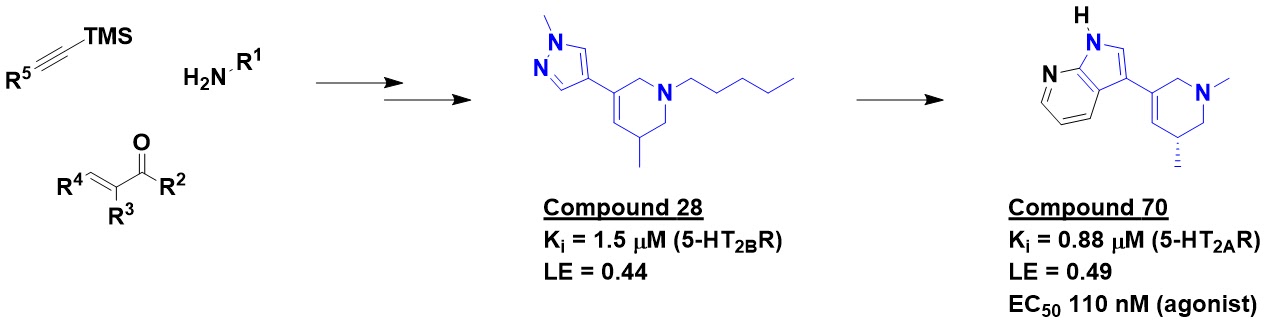
LSD contains a tetrahydropyridine (THP) moiety, which is relatively rare in screening libraries. The researchers developed convergent routes to THPs in which they could independently and efficiently vary multiple substituents. Using this chemistry, they constructed a virtual library of 4.3 billion compounds, all with molecular weights ≤ 400 Da and cLogP ≤ 3.5.
 
At the time the research began, there were no structures of 5-HT2AR, so the researchers built a homology model based on the closely related 5-HT2BR, which differs by only four amino acid residues in the orthosteric pocket where LSD binds. This model was then screened against a subset of the THP library, those ≤ 350 Da. Despite screening some 7.45 trillion complexes (sampling an average of 92 conformations and 23,000 orientations per molecule), the process took only nine hours on a 1000-core CPU cluster. The result was 300,000 hits in nearly 15,000 families. To ensure novelty, only compounds quite different from known ligands were further considered, and 17 “richly functionalized” THPs were synthesized and tested in radioligand assays. Four were active, including racemic compound 28. Searching the 4.3 billion compound library for analogs ultimately led to compound 70 and a related, slightly more potent molecule lacking the methyl substituent on the amine. A cryo-EM structure subsequently validated the predicted binding mode.
 

The paper spends considerable time characterizing these two compounds. Both are agonists and somewhat selective for 5-HT2AR over 5-HT2BR and 5-HT2CR. They are highly selective over 318 other GPCRs and 45 off-targets. GPCRs can signal through arrestin and/or G-protein, and while LSD works (mainly) through the arrestin pathway, the new molecules work (mainly) through the G-protein route. Importantly, the compounds showed anti-depressive and anti-anxiety effects in mouse models. Although you can’t ask mice if they are tripping, the molecules did not cause “head-twitch responses” and other behavioral effects seen with LSD, suggesting that they may not have hallucinogenic properties.
 
This is a lovely piece of work, and a few observations relevant to FBLD stand out. First, the best molecules are actually rule-of-three compliant, despite the fact that larger molecules were included in the virtual screen. Indeed, the top two molecules are actually smaller than the initial hits. This suggests that choosing more richly functionalized molecules may not have been the most efficient approach. We’ve written previously about V-SYNTHES, which entails stepwise selection and growing of fragments; it would be interesting to retroactively test whether this type of approach would have more quickly gotten to compound 70.
 
Finally, this approach can easily be extended to other scaffolds for which syntheses are readily available. Six years ago we wrote about the synthetic accessibility of dihydroisoquinolines, and last year Practical Fragments published our fifth “fragment library roundup.” The marriage of clever chemistry with virtual screening seems to have a bright future.

29 November 2022

Fragments vs HDAC2: new metal chelators

Histone deacetylases (HDACs) are epigenetic writers that – as their name suggests – remove acetyl groups from lysine residues in histones. They have been pursued as anticancer targets for decades; vorinostat was approved back in 2006 (and arguably has fragment origins). The catalytic site of HDACs contains a zinc ion, and many inhibitors include zinc-binding moieties, often hydroxamic acids. However, the high affinity of these metallophilic fragments leads to inhibition of other zinc-containing enzymes, causing toxicity. In a new ACS Med. Chem. Lett. paper, Emiliano Tamanini, Shin Miyamura, and colleagues at Astex and Otsuka provide alternative chemistries. (Emiliano presented part of this story at Pacifichem last year.)
 
The researchers were specifically interested in HDAC2, which has been implicated in neurodegenerative diseases such as Alzheimer’s. Because of the chronic nature of these conditions, selectivity was all the more important, as was brain penetration. Screens of the Astex fragment library, along with a set of known zinc-binding fragments, yielded 35 crystallographically validated hits. These included compound 3, which forms bidentate interactions with the catalytic zinc through the amine and carbonyl moieties. 
  
An additional fragment (compound 4, not shown) bound in a pocket at the “foot” of the catalytic site, which is normally partially blocked by a side chain residue. Yet another fragment bound near the entrance tunnel. Growing compound 3 in both directions led to compound 7, the first molecule of the series with measurable activity in a fluorescence assay. Rigidification and further growing led to compound 9, with low micromolar activity.
 
 
Interestingly, merging compound 9 directly with foot-pocket binder compound 4 did not improve activity, but adding a chlorine atom to fill a small subpocket increased affinity two-fold (compound 13). Finally, optimization of the moiety at the entrance tunnel (the isoindoline of compound 13) yielded compound 17, with high nanomolar potency.
 
Compound 17 caused increased acetylation of H4K12 in cells. More importantly, it showed good brain exposure when orally dosed in mice, and H4K12 acetylation was observed in mouse brain tissue. The compound hits HDAC1 and HDAC8 with similar potency as HDAC2, and these could be contributing to the biological effect. Nonetheless, while potency and selectivity still need to be improved, compound 17 is an attractive lead for further optimization. 
 
In a comment to the Notum work we highlighted back in May, Daniel Beck wondered whether “fragments are especially good starting points for CNS target campaigns.” This paper suggests the answer is yes.

21 November 2022

Fragments in the clinic: 2022 edition

In the US we're about to celebrate Thanksgiving. One of the things I'm thankful for is the discovery of new medicines, so this seems like an appropriate time to update our tally of fragment-derived drugs.
 
As always, this table includes compounds whether or not they are still in development (indeed, some of the companies no longer even exist). Because of this, the Phase 1 section contains a higher proportion of compounds that are no longer progressing. The full list contains 58 molecules, up from 52 last year, with more than 40% approved or in active trials: not bad given that only about 10% of drugs that make it into the clinic are ultimately approved.
 
Drugs reported as still active in clinicaltrials.gov, company websites, or other sources are in bold, and the 36 that have been discussed on Practical Fragments are hyperlinked to the most relevant post. The list is almost certainly incomplete, particularly for Phase 1 compounds. If you know of others please leave a comment.

DrugCompanyTarget
Approved!

AsciminibNovartisBCR-ABL1
ErdafitinibAstex/J&JFGFR1-4
PexidartinibPlexxikonCSF1R, KIT
Sotorasib
Amgen KRASG12C
VemurafenibPlexxikonB-RAFV600E
VenetoclaxAbbVie/GenentechSelective BCL-2
Phase 3

Capivasertib
AstraZeneca/Astex/CR-UKAKT
LanabecestatAstex/AstraZeneca/LillyBACE1
Navitoclax (ABT-263)AbbottBCL-2/BCLxL
Pelabresib (CP-0610)
ConstellationBET
VerubecestatMerckBACE1
Phase 2

ASTX029AstexERK1,2
ASTX660AstexXIAP/cIAP1
AT7519AstexCDK1,2,4,5,9
AT9283 AstexAurora, JAK2
AUY-922Vernalis/NovartisHSP90
AZD5991AstraZenecaMCL1
DG-051deCODELTA4H
eFT508eFFECTORMNK1/2
IndeglitazarPlexxikonpan-PPAR agonist
LY2886721LillyBACE1
LY3202626LillyBACE1
LY3372689LillyOGA
LY517717Lilly/ProthericsFXa
LYS006Novartis
LTA4H
MAK683NovartisPRC2 EED
OnalespibAstexHSP90
PF-06650833PfizerIRAK4
PF-06835919PfizerKHK
PLX51107PlexxikonBET
S64315Vernalis/Servier/NovartisMCL1
VK-2019
Cullinan Oncology / Wistar
EBNA1
Phase 1

AG-270
Agios/Servier
MAT2A
ABBV-744AbbottBD2-selective BET
ABT-518AbbottMMP-2 & 9
ABT-737AbbottBCL-2/BCLxL
AT13148AstexAKT, p70S6K, ROCK
AZD3839AstraZenecaBACE1
AZD5099AstraZenecaBacterial topoisomerase II
BI 1823911Boehringer IngelheimKRASG12C
BI 691751Boehringer IngelheimLTA4H
CFTX-1554Confo TherapeuticsAT2 receptor
ETC-206D3MNK1/2
GDC-0994Genentech/ArrayERK2
HTL0014242Sosei HeptaresmGlu5 NAM
HTL0018318Sosei HeptaresM1-receptor partial agonist
HTL9936Sosei HeptaresM1-receptor partial agonist
IC-776Lilly/ICOSLFA-1
LP-261LocusTubulin
LY2811376LillyBACE1
MivebresibAbbVieBRD2-4
MRTX1719MiratiPRMT5•MTA
NavoximodNew Link/GenentechIDO1
PLX5568PlexxikonRAF
SGX-393SGXBCR-ABL
SGX-523SGXMET
SNS-314SunesisAurora
TAK-020
Takeda
BTK