Showing posts with label epigenetics. Show all posts

15 December 2025

GAS41 revisited: a chemical probe

The YEATS domain of the protein GAS41 is an epigenetic reader that modulates gene expression by binding to acetylated lysine residues in chromatin. Multiple lines of evidence suggest it could be a useful target for various cancers, in particular non-small cell lung cancer (NSCLC). Four years ago Practical Fragments highlighted a paper from Jolanta Grembecka, Tomasz Cierpicki, and colleagues at the University of Michigan describing a fragment screen and subsequent optimization of a hit to molecules with some cellular activity. In a new J. Med. Chem. paper, the same team now describes molecules with better cell potency, as well as a negative control.
 
Compound 1, the initial fragment hit, had weak affinity for GAS41, but replacing the t-butyl group with a proline led to compound 7, with low micromolar activity in a fluorescence polarization assay. On the other side of the molecule, modification and growth of the amide moiety led to compound 16, also with low micromolar activity. In the 2021 paper, molecules related to compound 16 were dimerized to bind to two YEATS domains in close proximity in the GAS41 dimer. This yielded mid-nanomolar inhibitors, but the molecules were also large, with limited cell permeability. In the new paper, the researchers instead combined medicinal chemistry learnings and used structure-based design to generate monomeric molecules, culminating in DLG-41.
 

The affinity of DLG-41 for GAS41 was measured as 1 µM using isothermal titration calorimetry (ITC). In accordance with best practices for chemical probes, the researchers also developed a negative control by replacing the thiophene moiety with a thiazole; this compound, DLG-41nc, shows negligible activity in two different biochemical assays.
 
DLG-41 showed high nanomolar activity in a NanoBRET assay, demonstrating that the molecule is both permeable and binds to the GAS41 protein in cells. Importantly, the IC50 for the negative control DLG-41nc was > 25 µM in this assay. DLG-41 blocked proliferation in a panel of NSCLC cell lines, though DLG-41nc also showed some activity, albeit at higher concentrations. Gene expression studies in one cell line showed that DLG-41 caused changes in hundreds of genes, while DLG-41nc was inactive.
 
This is a nice example of fragment optimization in academia. With both biochemical and cell-based potency around one micromolar, DLG-41 is hovering on the edge of the 2015 suggestions for a chemical probe. But used alongside the negative control, the compound should be useful for further exploring the biology of GAS41.

24 November 2025

FTO revisited: fragment linking this time

Four years ago we highlighted a fragment-merging approach targeting fat mass and obesity-associated protein (FTO), an RNA demethylase implicated in acute myeloid leukemia (AML). In a new J. Med. Chem. paper, Ze Dong, Cai-Guang Yang, and collaborators at University of Chinese Academy of Sciences Beijing describe a fragment linking approach that arrives at a similar outcome.
 
As we noted in 2021, previous research had revealed that meclofenamic acid (MA) binds in the substrate-binding site, near the binding site for the 2-oxoglutarate (2-OG) cofactor. In the new paper, the researchers synthesized an analog of MA which they then linked to analogs of 2-OG through a variety of linkers. Among the best of these was compound 8a, with low micromolar activity in an assay using PAGE (polyacrylamide gel electrophoresis) as well as mid-nanomolar activity in a different type of assay. This is an improvement over the MA analog itself (which was only tested in the PAGE-based assay, results shown in the figure). Compound 8a was also selective for FTO over two related proteins.
 
 
As is often seen in fragment linking, the SAR is quite sharp. The two-carbon linker was critical; lengthening the linker by one methylene or adding a methyl group abolished activity. The double bond in the 2-OG mimetic was also important; the saturated version of this molecule was inactive.
 
Surprisingly, a crystal structure of FTO bound to a molecule closely related to 8a revealed that while the MA moiety bound as expected, the 2-OG analog adopted a different conformation. But inexplicably, according to the experimental section, 2-OG was added to the crystallization solution, which would compete with compound 8a. Indeed, the structure deposited in the protein data bank shows the 2-OG analog N-oxalylglycine bound to the catalytic metal ion.
 
With two carboxylic acid moieties, it is no surprise that compound 8a showed no antiproliferative activity in AML cell lines. However, ester prodrugs did show low micromolar activity. Further characterization of one of these showed changes in protein levels consistent with FTO inhibition. This molecule also caused tumor growth inhibition after intraperitoneal dosing in a mouse xenograft model.
 
Superficially, compound 8a resembles compound 11b from the 2021 paper. Like that molecule it is probably too weak to serve as an ideal chemical probe. That said, with one fewer aromatic ring, compound 8a may be better suited for further optimization.

20 January 2025

Fragments vs PRC1: toward a chemical probe

E3 ligase proteins conjugate ubiquitin to other proteins, changing their function or targeting them for degradation. Hijacking E3 ligases using PROTACs or molecular glues has become a popular approach for targeted protein degradation, but some E3 ligases can be drug targets themselves. For example, Polycomb Repressive Complex 1 (PRC1) ubiquitylates histone H2A in a process essential for proliferation of acute myeloid leukemia and some other cancer cells. In a new J. Med. Chem. paper, Jolanta Grembecka, Tomasz Cierpicki, and colleagues at University of Michigan Ann Arbor describe their discovery of small molecule inhibitors.
 
As the name implies, PRC1 is a protein complex. The core includes either RING1A or RING1B and one of six other proteins. Thus, the researchers sought to find inhibitors of both RING1A and RING1B. They started with a 1H-15N HSQC NMR screen of 1000 fragments in pools of 20, with each compound at 0.25 mM. (This and some other work was described in an earlier Nat. Chem. Biol. paper by the same authors.) Compound RB-1 was found to bind very weakly to RING1B, and chemical shift mapping revealed that it binds in a region important for E3 ligase activity.
 
Scaffold hopping led to the pyrrole-containing compound 1b, which was slightly more potent as well as more soluble than RB-1. Fragment growing on both rings led to compound 1f, and further optimization yielded low micromolar compound RB-2. Crystallography with this compound revealed conformational changes that opened a hydrophobic pocket in the protein. Although no electron density for RB-2 was observed, the researchers used the crystal structure in combination with NMR experiments to develop a binding model. This facilitated further optimization, ultimately yielding RB-4, the most potent compound reported, with low micromolar affinity as assessed by isothermal titration calorimetry.


As noted above, it is important to block both RING1B as well as RING1A, and the researchers tested their compounds against both proteins using an AlphaScreen competition assay. Most compounds were equipotent against both proteins, though some showed around two-fold greater affinity for RING1A.
 
Subsequent experiments demonstrated that some of the compounds could block ubiquitylation of H2A in an in vitro assay. Importantly, compound RB-4 functionally inhibited three different PRC1 complexes having either RING1A or RING1B along with one of two other protein partners. Treatment of leukemia cells with the compound also led to changes in gene expression and lower levels of ubiquitylated H2A consistent with PRC1 inhibition.
 
This is a nice fragment-to-lead story, particularly given the difficult nature of the protein and the absence of co-crystal structures. While compound RB-4 is insufficiently potent to be called a chemical probe, it is nonetheless a well-characterized starting point for further optimization.

09 October 2023

Fragments finger the BPTF PHD Finger

Plant homeodomain (PHD) fingers, despite their name, are found in nearly 300 human proteins. They are small (50-80 amino acid) domains that typically recognize post-translational modifications such as trimethylated lysine residues in histones. The PHD finger in BPTF is implicated in certain types of acute myeloid leukemia. However, because of the large number of PHD fingers as well as their small binding sites, few attempts have been made to develop corresponding chemical probes. (Indeed, the only mention of them on Practical Fragments was in 2014.) In a just-published ACS Med. Chem. Lett. paper, William Pomerantz and collaborators at University of Minnesota and St. Jude Children’s Research Hospital report the first steps.
 
The researchers started by screening a library of 1056 fragments (from Life Chemicals) against the BPTF PHD finger using ligand-observed (1H CPMG) NMR. Fragments were at 100 µM in pools of up to five. This gave a preliminary hit rate of 5.7%, but only ten compounds (<1%) reproduced when compounds were repurchased and retested individually.
 
These ten fragments were next tested by SPR (at 400 µM), which confirmed six of them. Also, all ten CPMG hits were tested in an AlphaScreen assay in which they competed with a known peptide binder. This confirmed nine, including the six that confirmed by SPR.
 
Interestingly, the most potent fragment in the AlphaScreen assay was the starting point for the KRAS inhibitor we highlighted last year. However, this fragment did not show binding to the BPTF PHD finger by SPR, and the researchers had identified the 2-aminothophene substructure as a hit against an unrelated protein. Whether this fragment is privileged or pathological may be context dependent.
 
This and the top three fragments that confirmed in all assays were used as starting points for SAR by catalog, and a handful of analogs were purchased. The researchers also resynthesized two of the compounds. Oddly, resynthesized F2 turned out to be three-fold more active in the AlphaScreen assay than the commercial material. One analog, compound F2.7, showed mid-micromolar activity.


Docking and two-dimensional protein-observed (1H,15N HSQC) NMR experiments suggest that most of the fragments bind in the “aromatic cage” which normally recognizes methylated lysine residues, but F2 may bind in an adjacent region. Both subpockets were also identified as being ligandable using the program FTMap.

This paper is a nice example of using orthogonal methods to find and carefully validate fragments against an underexplored class of targets. The researchers conclude by stating that “these hits are suitable for further SAR optimization and development into future methyl lysine reader chemical probes.” I look forward to seeing more publications.

13 February 2023

Fragments vs PBRM1 bromodomains revisited, more selectively

Last week we highlighted the discovery of a selective inhibitor for the BET family of bromodomains. The 61 human bromodomains fall into eight subfamilies, of which the BET family has probably been most heavily studied. In contrast, family VIII has received less attention, in part due to the lack of selective inhibitors. This deficit is beginning to be addressed by Shifali Shishodia, Brian Smith, and collaborators at Medical College of Wisconsin and Purdue University in J. Med. Chem.
 
The researchers were particularly interested in the aptly-named protein Polybromo-1 (PBRM1), which contains six of the 10 family VIII bromodomains. The protein has normally been considered a tumor suppressor, but it has also been implicated as a tumor promoter in prostate cancer. Chemical probes would be very useful to unravel the complicated biology. A few pan-inhibitors of family VIII have been developed, one of which we wrote about back in 2016, but none of these are selective for the PBRM1 protein.
 
The researchers started with an NMR screen of the second bromodomain of PBRM1, BD2, the structure of which had previously been solved by NMR. A 1H-15N SOFAST-HMQC screen of 1968 fragments (all rule of three compliant, from Maybridge and Zenobia) in pools of 12 ultimately yielded a dozen hits, all of which are shown in the paper. Of these, compound 5 was the most potent, with dissociation constants of 45 µM by NMR titration and 18 µM by isothermal titration calorimetry (ITC). 
 
 
One of the previous pan-family VIII inhibitors described in the literature was structurally similar to compound 5, and borrowing a chlorine atom from this led to compound 11, with improved affinity. Further exploration around both phenyl rings ultimately led to compound 16, which displayed low micromolar affinity by ITC and high nanomolar activity in an inhibition assay.
 
Differential scanning fluorimetry (DSF) is commonly used to measure binding of small molecules to bromodomains, and the researchers tested some of their best compounds in a panel of bromodomains that included 9 of the 10 family VIII members. Encouragingly, compound 16 only showed a strong thermal shift (ΔTm = 5.4 °C) to PBRM1-BD2 and moderate shifts (ΔTm = 1.8 °C) to PBRM1-BD3 and PBRM1-BD5. No significant stabilization of the 18 other bromodomains was observed.
 
A series of shRNA experiments by the researchers revealed that the prostrate cancer cell line LNCaP was dependent on PBRM1, and compound 16 was active against these cells, albeit weakly (EC50 ~ 9 µM). In contrast, the compound did not show activity against two other cancer cell lines that do not seem to be dependent on PBRM1.
 
This work is a nice example of academic fragment-based lead discovery. Although the cell activity of compound 16 is probably insufficient for a serviceable chemical probe, it does show that selectivity is possible. Hopefully these researchers, or others, will continue improving it.

23 January 2022

Fragments (almost) in the clinic: MRTX1719

Synthetic lethality is a relatively new approach to cancer therapy. The idea is to inhibit a protein that is necessary for cancer cells but dispensable for normal cells, thereby minimizing toxicity. Last year we described one example, and in a just-published open access J. Med. Chem. paper Chris Smith and colleagues at Mirati describe another.
 
The biology gets a bit complicated, so please bear with me. Protein arginine methyl transferase 5 (PRMT5) is an epigenetic writer that adds two methyl groups to arginine residues in a wide variety of proteins. It is essential for cell survival. PRMT5 uses a cofactor, S-adenosyl-L-methionine (SAM), that is converted to methylthioadenosine (MTA) during the reaction. In certain cancers a gene called methylthioadenosine phosphorylase (MTAP) is deleted, causing an accumulation of MTA and – through product inhibition – a decrease in PRMT5 activity. The idea is to develop a drug that binds to and further stabilizes the (inactive) PRMT5•MTA complex, which is abundant in cancer cells, while not interfering with the active form of the protein, which predominates in normal cells. Told you it was complicated! [Note added: as befits the complicated biology I got a couple things wrong, corrected in the comment on 26 Jan.]
 
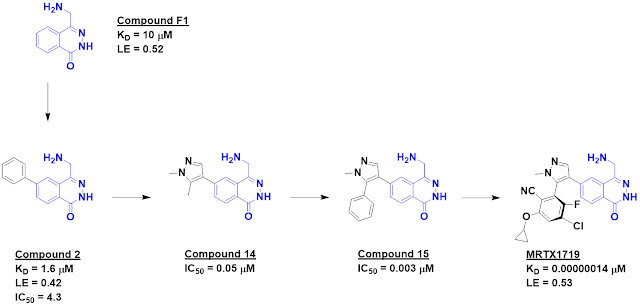
The researchers started with an SPR screen of 1000 commercially available fragments, each at 100 µM. PRMT5 was immobilized on the chip, with MTA added to the buffer to form the PRMT5•MTA complex. This screen yielded 17 hits, and based on this encouraging result a further set of nearly 1900 fragments was screened at 500 µM. The higher concentration yielded significantly more hits, and when these were tested in dose response experiments 100 were found with dissociation constants better than 1 mM. The best 24 of these were then screened against PRMT5 loaded with either MTA or the cofactor SAM. Compound F1 proved to be 5-fold selective for the MTA-bound protein over the SAM-bound protein.
 
Crystallography revealed that this molecule binds in the substrate-binding site in the vicinity of MTA and suggested that it would clash with SAM binding, thus providing an explanation for its selectivity. The crystal structure also revealed a nearby pocket that could be targeted through fragment growing, and this was accomplished with compound 2, which also showed activity in a biochemical assay. Further structure-based design led eventually to compound 14, which was 26-fold selective for the MTA-bound protein.
 

Crystallography revealed another lipophilic pocket, and adding a phenyl group provided a nice increase in potency in the form of compound 15. This molecule also showed low micromolar cell activity. Further structure-based drug design ultimately led to MRTX1719; the medicinal chemistry is elegant but beyond the scope of this post. Chemists will recognize that the final molecule is an atropisomer. This type of stereoisomer is uncommon in drugs in part because they can be difficult to separate; the researchers note assessing 70 different conditions before abandoning one series in favor of a more tractable one.
 
The dissociation constant of MRTX1719 was measured by SPR as 0.14 pM and 9.4 pM for the PRMT5•MTA and PRMT5•SAM complexes, respectively. We don’t encounter femtomolar binders very often; the dissociation half-life for the MTA-bound protein is 14 days! The 67-fold difference in binding was in good agreement with 70-80-fold differences in cells without or with MTAP.
 
MRTX1719 was quite selective in a panel of 42 methyltransferases. Pharmacokinetics and oral bioavailability were good in mice, dogs, and cynomolgus monkeys. The molecule was well tolerated in a mouse tumor model and caused tumor growth inhibition. Based on these results, an IND for the molecule has been submitted to the FDA.
 
This is a lovely fragment-to-candidate story, and Practical Fragments wishes everyone involved good fortune in the clinic!

30 December 2021

Review of 2021 reviews

As the year winds down SARS-CoV-2 continues its relentless drive through Greek letters and the planet. But there is hope: vaccines seem to be holding, for those who have access, and two oral drugs have been granted emergency use authorization by the US FDA, one of which (PF-07321332) is covalent and looks remarkably effective. As is our custom, Practical Fragments ends the year by highlighting conferences and reviews.
 
Conferences started the year online only (CHI’s Sixteenth Annual Fragment-based Drug Discovery), moved to hybrid (CHI’s Nineteenth Annual Discovery on Target) and sadly returned to virtual (Pacifichem 2021).
 
This year produced more than twenty FBLD-related reviews, and these are grouped thematically: NMR and crystallography, computational methods, targets, library design, and covalent fragments. The most general is the sixth installment in a series of annual reviews in J. Med. Chem. covering fragment-to-lead success stories from the previous year. Iwan de Esch (Vrije Universiteit Amsterdam) took the lead (pardon the pun) on the most recent review, which details 21 examples from 2020. In addition to the centerpiece table showing fragment, lead, and key parameters, this open-access paper also includes an analysis on the molecular complexity of fragment hits.
 
NMR and crystallography
Consistent with its central role in FBLD, several reviews covered NMR. Ben Davis (Vernalis), one of the leading practitioners, discusses fragment screening in Methods Mol. Biol. The chapter is written for a non-specialist, so you won’t see detailed pulse sequences. Instead, Ben provides a very accessible and practical guide covering everything from sample preparation through data analysis and validation.
 
A more detailed description of solution NMR in drug discovery by Li Shi and Naixia Zhang (Shanghai Institute of Materia and Medica) is published (open access) in Molecules. With 180 references, this review covers considerable ground, including various ligand-detected and protein-detected methods for screening as well as for hit-to-lead and mechanistic studies. The paper also includes a nice summary of in-cell (!) NMR.
 
The Pacifichem meeting had several talks on fluorine NMR, and speaker Will Pomerantz, together with Caroline Buchholz, has published a thorough, open-access review in RSC Chem. Biol. Will has been a leading developer of protein-observed 19F NMR, so naturally this topic is well-covered, but there is plenty on ligand-observed 19F NMR as well as a good background section and musings on the future of the field.
 
And if you’re looking for a detailed how-to guide for NMR-based fragment screening, Harald Schwalbe and colleagues describe the platform they’ve built at the Center for Biomolecular Magnetic Resonance (BMRZ) at Johann Wolfgang Goethe-University Frankfurt in J. Vis. Exp. This open-access paper also describes quality control experiments of the iNEXT library, which we’ve discussed here.
 
Switching gears to crystallography, J. Vis. Exp. carries a paper by Frank von Delft and collaborators describing the XChem platform at the Diamond Light Source. This high-throughput fragment screening platform has delivered a 95% success rate on more than 150 screens, with hit rates varying from 1-30%. In addition to technical details, this open-access article also provides tips on successfully getting your screening proposal through peer review.
 
XChem has inspired similar efforts at other synchrotrons, including the Fast Fragment and Compound Screening (FFCS) platform at the Swiss Light Source. This is concisely described by May Sharpe and Justyna Wojdyla in Nihon Kessho Gakkaishi (open-access and published in English).
 
Private companies are also moving into high-throughput crystallography. Debanu Das and collaborators describe the platform at Accelero Biostructures, which is capable of screening ~500 fragments in two days. Screens against three nucleases are described in some detail in an open-access article in Prog. Biophys. Mol. Biol.; these and other components of the DNA damage response are the focus of XPose Therapeutics, Accelero’s sister company.
 
Computational methods
In addition to the experimental methods reviewed above, a couple papers describe computational approaches. In Drug Disc. Today: Tech., FragNet alum Moira Rachman and collaborators from UCSF, Universitat de Barcelona, and elsewhere focus on “fragment-to-lead tailored in silico design.” This is a nice review of the recent literature and emphasizes the fact that much of the heavy design lifting is still done by medicinal chemists – at least for now.
 
Predicting the energies of modified fragments has long been a challenge, and one promising approach is free energy perturbation, in which one ligand is “perturbed” into another and the relative energy differences calculated. Barbara Zarzycka and colleagues at Vrije Universiteit Amsterdam provide a concise review for aficionados in Drug Disc. Today: Tech.
 
Targets
Three reviews cover applications of FBLD to various target classes. Kinases have been particularly successful, with four of the six approved fragment-derived drugs targeting these enzymes. In Trends Pharm. Sci., Ge-Fei Hao and collaborators, mostly at Central China Normal University, review the state of the art. In addition to background and several case studies, the paper includes a nice table showing structures and summaries of clinical-stage kinase inhibitors.
 
Epigenetics has been another fruitful area, and in J. Med. Chem. Miguel Vaidergorn, Flavio da Silva Emery (both University of São Paulo) and Ganesan (University of East Anglia) detail the “successful union of epigenetic and fragment based drug discovery (EPIDD + FBDD).” This thorough summary (with 165 structures!) of the literature is particularly detailed when it comes to bromodomains, four inhibitors of which have entered the clinic with the help of fragments. The researchers point out that EPIDD and FBDD both began around the same time, and in fact the oncology drug vorinostat could be described as “a unique case of solvent-based drug discovery.”
 
RNA has long been a target of FBLD, and in ChemMedChem Mads Clausen (Technical University of Denmark) and collaborators review the state of the art. The various established and emerging methods to find fragment hits are covered in depth, and there is also a nice discussion as to whether RNA-focused fragment libraries will be useful.
 
Library design and molecular properties
In Expert Opin. Drug Discov. Zenon Konteatis (Agios) asks “what makes a good fragment in fragment-based drug discovery?” His answers provide a concise summary touching on the rule of three, molecular complexity, “three-dimensionality”, and other topics.
 
The topic of three-dimensional fragments is covered in several other reviews. In Drug Disc. Today: Tech., Iwan de Esch and collaborators at Vrije Universiteit Amsterdam and University of York assess 25 so-called 3D libraries reported in the literature, mostly since 2015. The researchers manually drew all 897 fragments so they could calculate various properties. While most of the molecules are rule-of-three compliant, just under half could be called 3D by both plane of best fit (PBF) and principal moment of inertia (PMI). PBF and PMI measurements correlated with one another, while Fsp3 correlated with neither measurement, leading to the conclusion that “Fsp3 is a poor measure of 3D shape.”
 
Shapely or not, sp3-rich fragments are interesting from a diversity point of view, and in Chem. Sci. Max Caplin and Dan Foley (University of Canterbury) discuss synthetic methods for advancing these. This is an excellent open-access review of the recent literature around C-H bond functionalization and well worth reading for the chemists in the audience.
 
3D fragments are often chiral, and the importance of chirality in drug discovery is the focus of a paper in ACS Med. Chem. Lett. by Ilaria Silvestri and Paul Colbon (University of Liverpool). The researchers note an opportunity for chemical suppliers: only 245 of 9751 heterocyclic building blocks offered by Sigma-Aldrich are chirally pure.
 
“Library design strategies to accelerate fragment-based drug discovery” is the topic of a Chem. Eur. J. review by Nikolaj Troelsen and Mads Clausen (Technical University of Denmark). The researchers provide a highly accessible overview of different libraries appropriate for different fragment-finding methods, including covalent approaches.
 
Covalent fragments
This year saw the approval of sotorasib, the first covalent fragment-derived drug, so it is no surprise that several papers focus on this topic. Sara Buhrlage, Jarrod Marto, and colleagues at Dana-Farber Cancer Institute provide a thorough introduction to “chemoproteomic methods for covalent drug discovery” in Chem. Soc. Rev. The review covers both isolated protein screening as well as proteome-wide methods and includes multiple case studies.
 
Nir London and colleagues at The Weizmann Institute of Science focus on “covalent fragment screening” in Ann. Rep. Med. Chem. This is an excellent review of the recent literature and also includes an analysis of six commercial covalent fragment libraries.
 
And finally, in RSC Chem. Biol. (open access), Nathanael Gray and collaborators mostly at Dana-Farber Cancer Institute discuss strategies for “fragment-based covalent ligand discovery”, including computer-aided approaches, as well as target classes and new modalities such as PROTACs. They end by asking whether sotorasib was “a lucky, one-off case” or “a preview of continued and increased impacts that these approaches will have on drug discovery as the improved methods, larger libraries, and increased focus start to bear fruit.”
 
I’m betting on the latter.
 
And that’s it for 2021. Thanks for reading, special thanks for commenting, and here’s hoping we’ll be able to meet in person in 2022.

06 December 2021

Merging fat fragments for fat mass obesity-associated protein

Despite its name, fat mass obesity-associated protein (FTO) is implicated not just in obesity but also cancer and neurological disorders. The DNA/RNA demethylase is an “epigenetic eraser” that removes methyl groups from nucleic acids, thereby regulating multiple genes. Several inhibitors have been reported, but many of these are weak and nonspecific. In a recent J. Med. Chem. paper, Takayoshi Suzuki and collaborators at Kyoto Prefectural University of Medicine, Osaka University, and Kyoto University describe merging two of these to create a more potent molecule.
 
The researchers started with four known inhibitors, all of which had structures bound to FTO deposited in the Protein Data Bank. These structures were then used to merge HZ (below in red) with the other (sometimes barely) fragment-sized molecules. For two approaches the resulting merged molecules were inactive, but when HZ was merged with MA (below in blue) the resulting molecule was active in a biochemical assay and showed high affinity as assessed by isothermal titration calorimetry (ITC).
 

Modeling studies on compound 11b suggested why it might have better affinity than the starting molecules. Additional modeling also suggested why the other merged molecules were inactive.
 
Given its highly polar nature compound 11b was inactive in cells, but transforming the carboxylic acid into an ester produced a prodrug that caused cell death in a cancer cell line in which FTO is overexpressed. The prodrug also caused an increase in N6-methyladenosine in mRNA and caused changes in transcription consistent with FTO inhibition. Although the potency is too low for a chemical probe, and the molecule contains a number of chemical liabilities, this on-target activity is encouraging.
 
This paper exemplifies that fragment merging is not necessarily easy, and I give plaudits to the researchers for describing designs that did not work – too often papers only trumpet successes. Moreover, as the researchers acknowledge, even the successfully merged compound has a lower ligand efficiency than the parent compounds. This is another illustration of why it is important to start with the best fragments possible – not just in terms of various metrics but in terms of overall chemical attractiveness as well. It will be fun to see follow-up work.

15 November 2021

Fragments vs SETD2: a chemical probe

Among the various epigenetic “writers,” only one is capable of trimethylating lysine 36 of histone H3. SET domain-containing protein 2 (SETD2) is thought to be a tumor suppressor, but some evidence suggests it may have the opposite effect in certain cancers. A chemical probe would be useful to resolve these conflicting ideas, and in an (open access) ACS Med. Chem. Lett. paper Neil Farrow and colleagues at Epizyme describe one.
 
Epizyme has been pursuing epigenetic targets for years and has built a methyltransfersase-biased compound collection. A radiometric screen of this library yielded compound 1 and a related molecule. Both were weak inhibitors, but a co-crystal structure with the enzyme revealed the indole buried deep in the substrate binding pocket. Tweaking this led to compound 4, with low micromolar activity.
 
 
Substitution off the indole and phenyl moieties ultimately led to compound 25, with low nanomolar biochemical and cell activity. However, this molecule also had low aqueous solubility and poor pharmacokinetics in mice. Recognizing that the lipophilic and aromatic nature of the molecule were likely responsible, the researchers returned to the initial hit. Replacing the phenyl with a cyclohexyl moiety and making a few more modifications ultimately led to EPX-719.
 
The pharmacokinetics of EPX-719 in mice are reasonable, and the molecule is >8000-fold selective against a panel of 14 other histone methyltransferases. It is also fairly clean against a panel of 47 off-targets and 45 kinases. EPX-719 showed antiproliferative activity in two multiple myeloma cell lines, and more detailed biological studies are promised in a future paper.
 
This is a nice hit to lead story. As the researchers note, “close attention to the physical chemical properties of the inhibitors, in particular basicity, lipophilicity, and aromatic character, led to compounds with attractive cellular activities and in vivo exposures.” Interestingly though, the word “fragment” does not appear once in the paper. Although compounds 1 and 4 venture a bit beyond the rule of three, I would argue that starting with small, low affinity binders and focusing closely on molecular properties is the very definition of fragment-based lead discovery.
 
A quarter-century of FBLD has influenced the scientific zeitgeist, and a fragment by any other name is still as sweet.

20 September 2021

Chemical couplets inhibit the GAS41 YEATS domain

Practical Fragments has covered bromodomains extensively, most recently just a couple months ago. But these epigenetic readers are not the only proteins that recognize acetylated lysine residues. Two years ago we highlighted fragment hits against one of the four YEATS domain proteins. A paper recently published in Cell Chem. Biol. by Jolanta Grembecka, Tomasz Cierpicki, and colleagues at University of Michigan tackles another member of the family.
 
The researchers were interested in the protein GAS41, which is amplified in multiple forms of cancer. The YEATS domain within this protein binds to acylated lysine residues in histone H3 proteins. However, unlike the deep pockets found in bromodomains, the acyl-lysine binding site in the YEATS domain consists of a partially solvent-exposed channel, making it a more challenging site to drug.
 
Nonetheless, an NMR-based screen of fragments (in pools of 10, each at 500 µM) led to compound 1, which produced multiple chemical shifts in a 1H-15N HSQC experiment. Two different competition assays, fluorescence polarization (FP) and AlphaScreen formats, confirmed that compound 1 could compete with H3-derived peptides. Fragment growing led to compounds 7 and 11. (All IC50 values below are from the FP assay; these are somewhat weaker than those from the AlphaScreen, but they more closely track binding affinities determined by isothermal titration calorimetry.)
 

A crystal structure of a compound closely related to compound 11 revealed that the molecule nearly fills the small binding channel, suggesting that further gains in affinity would be difficult. Indeed, no GAS41 inhibitors have been previously reported. However, the protein is dimeric, so the researchers decided to dimerize their molecule to bind to two YEATS domains simultaneously. This led to nanomolar molecules such as compound 19.
 
Not only was compound 19 potent in biochemical assays, it also disrupted binding of GAS41 to acetylated histone proteins in cells. Moreover, the compound inhibited growth of cancer cell lines with amplified GAS41.
 
This is a nice case study in fragment dimerization, an uncommon but interesting approach. The linking in this case led to a 44-fold improvement in affinity, which though impressive is far from synergistic, and is associated with a considerable loss in ligand efficiency. And although the micromolar potency of compound 19 in cells needs to be improved to generate a chemical probe, let alone a drug lead, these results nonetheless support the notion that targeting GAS41 could be a useful strategy for certain cancers.

01 June 2020

BETting on fast follower fragments

A common approach in drug discovery is to improve a previously reported molecule. An example of such a “fast follower” approach has just been published in J. Med. Chem. by Cheng Luo, Bing Zhou, and colleagues at Shanghai Institute of Materia Medica.

The researchers were specifically interested in bromodomains, which recognize acetylated lysine residues in proteins and play major roles in gene expression. In 2018 we described AbbVie’s fragment-based discovery of ABBV-075, which had entered phase 1 clinical trials. Although reasonably selective for BET-family bromodomains, it also strongly inhibits EP300, which could lead to toxicity. Thus, more selective molecules have been sought.

The new paper starts with a thermal shift assay of 1000 fragments against the two separate bromodomains of BRD4, BD1 and BD2. Hits were validated using an AlphaScreen assay. Compound 47 was found to be active against both BD1 and BD2, with high ligand efficiency (all IC50 values shown are for BD1; values for BD2 are similar). Modeling suggested this fragment could be merged with ABBV-075, and indeed the resulting compound 26 was quite potent. (Note: structures of compounds 26 and 38 were originally drawn incorrectly - now fixed.)


Compound 26 was metabolically unstable, but further optimization, aided by crystallography and modeling, ultimately led to compound 38. This molecule has good oral bioavailability in mice and promising pharmacokinetics in both mice and rats. It inhibits the expression of cancer-driving genes such as c-Myc and BCL-2, inhibits the growth of several cancer cell lines, and demonstrated good tumor growth inhibition in a mouse xenograft study. Compound 26 does not inhibit five cytochrome P450 enzymes or hERG. Finally, it is much more selective than ABBV-075 against EP300 and indeed most other bromodomains aside from BET family members. The researchers conclude that “compound 38 is a highly promising preclinical candidate.”

Unfortunately, selectivity for BET-family bromodomains may not be sufficient to avoid toxicity. Indeed, as we described earlier this year, AbbVie has dropped clinical development of ABBV-075 in favor of ABBV-744, which is selective for BD2 over BD1. Whether or not the same could be done for this series, the paper is still another nice example of appending a fragment onto a previously discovered molecule.

02 March 2020

FBLD meets DEL

FBLD, of course, starts with small libraries of small fragments. DNA-encoded chemical libraries (DEL) usually start from the opposite extreme. Massive numbers of molecules are combinatorially synthesized attached to DNA, screened against a target using affinity selection, and hits identified by sequencing the DNA. A recent paper in J. Med. Chem. by Christopher Wellaway and colleagues at GlaxoSmithKline uses information from both approaches to generate a high-quality candidate.

The researchers were interested in bromodomain and extraterminal (BET) family proteins – the same targets we discussed last week. GlaxoSmithKline had already put molecules into the clinic, but they were looking for structurally different backup candidates, so they performed a DEL screen on the BD1 domain of BRD4. A library of 117 million compounds yielded potent compound 10, and crystallography revealed that the 2,6-dimethylphenol moiety bound in the acetyl-lysine-binding pocket.


Phenols are often metabolic liabilities, and indeed compound 10 was rapidly cleared in mice. However, GlaxoSmithKline has a long and successful history of fragment screening against bromodomains; Teddy first described some of their seminal work back in 2012, when the world didn’t end. Compound 16 had been found in a previous screen as a hit against BRD4, and crystallography revealed that the pyridone binds in a similar fashion to the phenol moiety. (Similar pyridones had been reported by others, for example this one.) Merging the molecules led – after a bit of tweaking – to compound 20a. In addition to BRD4, this molecule binds another bromodomain, BAZ2A, which the researchers wanted to avoid. Structure-based design led them to the more selective compound 20i.

Although compound 20i is potent in cells, it still has moderate clearance in rats. Unsubstituted benzimidazole rings have been reported to be unstable, so the researchers systematically explored a series of substitutions, ultimately arriving at compound 24 (I-BET469). Not only is this compound potent and soluble, it is remarkably stable, with “no detectable turnover in rat, dog, and human microsomal and hepatocyte preparations.” Oral bioavailabilities approach 100%, and the compound proved to be effective in acute and chronic mouse inflammation models. Although selectivity against non-BET family bromodomains members is good, compound 24 does strongly bind to both BD1 and BD2 domains of all four BET family members, and as we saw last week this may lead to toxicity.

Nonetheless, this is a lovely example of using a fragment to replace a problematic moiety in a larger molecule, as we’ve seen previously for chymase, Factor VIIa, and Factor XIa. Throughout the optimization the researchers paid close attention to molecular properties such as lipohilicity and molecular weight, and this resulted in a molecule with excellent pharmacokinetics despite the presence of potentially unstable moieties such as the morpholine. If nothing else, this will be a useful in vivo chemical probe.

24 February 2020

Fragments in the clinic: ABBV-744

Bromodomains, which recognize acetylated lysine residues, are popular cancer targets due to their role in gene regulation. A plethora of potent inhibitors have been reported, many of them derived from fragments, and some have even gone into the clinic. The story behind one of these, ABBV-744, was recently published in Nature by Yu Shen and colleagues at AbbVie.

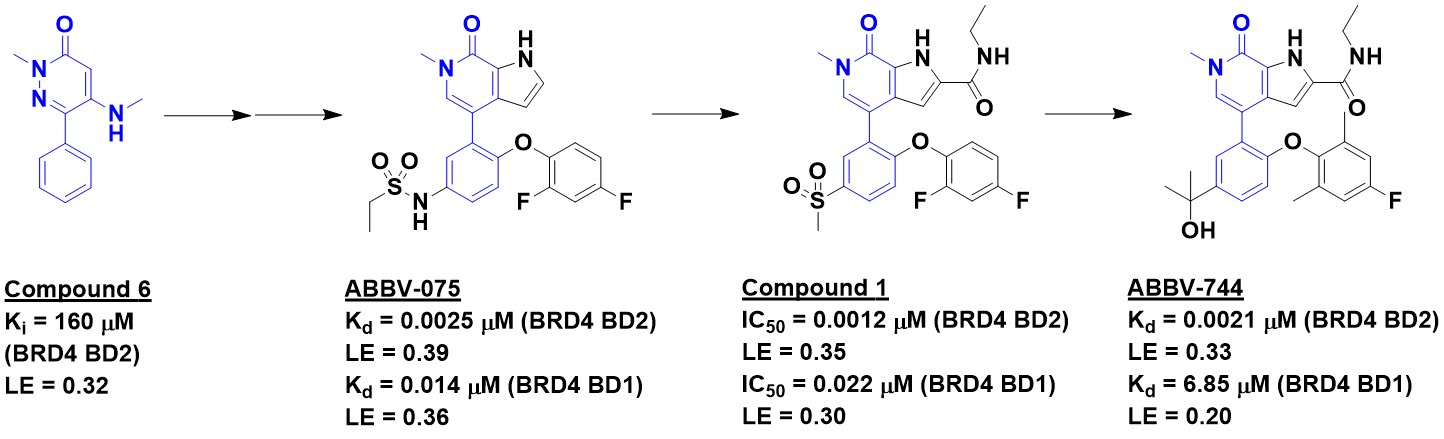
The story starts with a protein-detected NMR screen (highlighted here), which ultimately led to ABBV-075 (highlighted here). This molecule binds tightly to the four BET-domain family members (BRD1, BRD3, BRD4, and BRDt). However, ABBV-075 causes gastrointestinal toxicity as well as a reduction in platelets when tested in mice. Indeed, these effects are seen when BRD4 alone is genetically silenced in mice, suggesting on-target toxicity. However, each of the BET proteins has two separate bromodomains, called BD1 and BD2, and the researchers thought that a selective inhibitor of the BD2 domain might be better tolerated.

Screening about 2500 compounds from the ABBV-075 program revealed that compound 1 was still quite potent against the BD1 domain of BRD4 but lost activity against the BD2 domain. Further optimization ultimately led to ABBV-744, which is at least two orders of magnitude more selective against the BD2 domains of all four BET-domain proteins over the respective BD1 domains. It also shows no activity against a panel of kinases and other bromodomains, and is orally bioavailable. A crystal structure of the molecule bound to either BD1 or BD2 reveals that the key interactions seen in ABBV-075 are maintained, but that the added amide moiety makes interactions only available in BD2, while the larger diphenylmethyl ether moiety is better accommodated in BD2 due to a slightly larger pocket (containing a valine rather than an isolueucine residue).


ABBV-744 is active against multiple acute myeloid leukemia and prostate cancer cell lines, and the paper thoroughly explores the biology of a selective BD2 inhibitor. Most striking is that in a mouse xenograft model, ABBV-744 shows similar activity at 1/16 of its maximum tolerated dose (MTD) as ABBV-075 shows at its MTD. Even at doses well above efficacious exposure levels, ABBV-744 shows only limited platelet reduction and no gastrointestinal toxicity in mice. As mentioned at FBLD 2018, this molecule has entered clinical development, while ABBV-075 has quietly been dropped from AbbVie’s pipeline.

This is a lovely example of biology-guided medicinal chemistry that is reminiscent of the BCL-family inhibitors, which started with less specific molecules and culminated with the approval of BCL2-selective venetoclax. Although the fragment origins of ABBV-744 are clear, they are not mentioned in the paper and – like the KRAS inhibitors and AZD5991 – could be easily overlooked. In all these cases small starting points have delivered potentially huge drugs, and Practical Fragments wishes everyone involved the best of luck.

12 February 2018

Fragments in the clinic: ABBV-075 / Mivebresib

Bromodomains bind to acetylated lysine residues in proteins to control gene transcription. These epigenetic regulators have received considerable attention as drug targets, particularly for oncology. Last year we highlighted work out of AbbVie in which fragments found in an NMR screen were advanced to two series of molecules that potently inhibit the four members of the BET family of bromodomains. A more recent publication in J. Med. Chem. by Keith McDaniel and his colleagues at the company describes how one of the fragments was transformed into the clinical compound ABBV-075, or mivebresib.

Compound 6 was not the most potent fragment identified, but crystallography confirmed that it binds in the acetyl lysine binding pocket. The earlier work described how the pyridazinone moiety was replaced with a pyridone and another phenyl ring was added to make molecules such as compound 9, with sub-micromolar activity.


Further modification of the pyridone led to compound 19, with a nearly 20-fold boost in affinity. Crystallography revealed that the pyrrolopyridone makes a bidentate interaction with a critical asparagine residue in BRD4, and also displaces a “high-energy” water molecule.

Next, the researchers sought to pick up additional interactions, and it turned out that introducing a nitrogen off the central ring was synthetically straightforward and would point substituents towards a pocket in the protein. This led to low nanomolar inhibitors such as compound 25, and crystallography revealed that one of the sulfonamide oxygen atoms makes a hydrogen bond with a backbone amide. Happily, the improvement in potency was also accompanied by an improvement in stability in liver microsome assays.

Unfortunately, although the pharmacokinetics in mice were reasonable, these compounds showed high clearance in rats. Analysis of the metabolites revealed that this was largely due to oxidation of the unsubstituted phenyl ring, so the researchers took the classic route of introducing halogen atoms to both deactivate the ring and block metabolism sites. This ultimately led to ABBV-075.

In addition to excellent potency in biochemical, biophysical, and cell-based assays, ABBV-075 showed excellent antitumor effects in a mouse xenograft assay when dosed orally at the low concentration of just 1 mg/kg. In addition to BRD4, the compound binds tightly to the other BET family members but is selective against most of the other bromodomains. It also demonstrates good pharmacokinetic properties in mice, rats, dogs, monkeys, and humans. ClinicalTrials.gov lists a Phase 1 study currently recruiting.

This is a lovely, textbook example of how structurally-enabled fragment growing combined with careful pharmacokinetic-based optimization can lead to a clinical candidate. Obviously there is a long and uncertain road ahead for the molecule prior to approval, but getting this far is a victory in itself.

28 August 2017

Fragments vs BET Bromodomains: FORMA’s story

Five years ago Teddy highlighted a paper from GlaxoSmithKline that reported the discovery and characterization of several different fragments that bind to members of the BET family of bromodomains, epigenetic readers that recognize acetylated lysine residues in histones. Researchers at FORMA were among those paying attention to these developments. David Millan and his colleagues have now published in ACS Med. Chem. Lett. their account of how they were able to advance one of these fragments to a chemical probe.

As the researchers note, many different BET inhibitors have been reported; we discussed two separate series just a few months ago. Chemical novelty was thus a challenge, particularly as they were starting with a fragment (compound 1) reported by a large company. They thus chose to tweak the fragment slightly to intermediate 2. Importantly, introduction of the second nitrogen also introduces another synthetic vector with potential to pick up interactions with the so-called “WPF shelf”. This explicit consideration of synthetic tractability in fragment design enables rapid progress.


Parallel chemistry led to compound 6, with measurable biochemical activity against BRD4. Further growing from the phenyl ring led to compound 8, with sub-micromolar biochemical and antiproliferative activity. A crystal structure revealed that the newly introduced amide functionality was pointed toward solvent, which would allow modulation of the physicochemical properties.

More medicinal chemistry followed, with considerable effort on improving the plasma and liver microsome stability. This campaign involved a combination of rational design and parallel synthesis along with a keen focus on minimizing lipophilicity. Ultimately the researchers arrived at FT001, with good activity and stability. This compound was also selective for BET family members over other bromodomains and displayed reasonable pharmacokinetics and impressive activity in a mouse xenograft model.

Last week we highlighted a paper that also started from a previously disclosed fragment to generate novel chemical matter. This paper provides another example of how useful public fragments can be in the hands of creative scientists.

20 August 2017

Fragments vs histone KDM4 lysine demethylases: Celgene’s story

Last year we highlighted a paper from academia in which modeling was used to discover potent inhibitors of the lysine demethylase KDM4C, a potential anti-cancer target. In a recent paper in ACS Med. Chem. Lett., Michael Wallace and collaborators at Celgene, the European Institute of Oncology, and the University of Chicago report a chemical probe for KDM4 family members.

The researchers started with a literature screen of fragments known to bind to KDM4, leading them to compound 1, which previous work had shown binds to the catalytic iron through the pyridine ring nitrogen. Researchers from GlaxoSmithKline had also reported that growing off compound 1 could lead to more potent compounds, a strategy that proved successful here in the case of chiral compound 2a, which improved affinity by more than two orders of magnitude. Interestingly, the enantiomer had dramatically lower activity.


Armed with this information but no crystal structure, modeling suggested that further growing off the tetrahydronaphthalene would be productive, which turned out to be the case for compound 3, with similar affinity but improved activity in an antiproliferative cell assay. Further experiments showed that the compound increased levels of trimethyl-lysine on lysines 9 and 36 of histone 3, known substrates of KDM4 family members.

A crystal structure of compound 3 bound to KDM4A, which is closely related to KDM4C, suggested further room to grow. Compound 3 contains a carboxylic acid and has a low cLogD, traits that tend to reduce cell permeability. The researchers thus focused on increasing the lipophilicity of the molecules, leading to QC6352. Despite the fact that this molecule is less potent in the enzymatic assay, it has significantly improved cellular potency. It also has reasonable pharmacokinetics and oral bioavailability, and showed activity in a mouse xenograft model. QC6352 hits KDM4A, 4B, 4C, and 4D, but is quite selective against most other KDMs.

This paper illustrates three important points. First, as discussed previously, you don’t need a novel fragment to get to novel leads – you just need creative scientists. Indeed, the increasing number of fragment hits reported for various targets provides a wealth of starting points even for organizations that don’t do in-house fragment screening. Second, you don’t necessarily need a crystal structure as long as you have good modelers. And finally, while excess lipophilicity is rightly avoided, it is important to remember that compounds can also be too polar. As Oscar Wilde noted, “everything in moderation, including moderation.”

19 June 2017

Fragments vs BRD4, two ways

Bromodomains, epigenetic targets that recognize acetylated lysine residues, have received considerable attention from the fragment community. (I devoted all of last July to the topic, and covered it more recently here.) Of the dozens of bromodomain-containing proteins, the four BET-family members have been highly studied, and the second bromodomain of BRD4 (BRD4-BRDII) in particular has been implicated in cancer and inflammation. In two new papers, researchers from AbbVie describe inhibitors of this target.

In the first Bioorg. Med. Chem. Lett. paper, George Sheppard and colleagues briefly describe a protein-detected (13C-HSQC) NMR screen of BRD4 in which the methyl groups of isoleucine, leucine, valine, and methionine were 13C-labeled. About 18,000 fragments were screened in pools of 30, and hits were then tested individually in NMR and time-resolved fluorescence resonance energy transfer (TR-FRET) assays. Despite extensive work on this target by multiple groups, these screens were able to identify several new fragments, such as the related compounds 1 and 2.


Crystallography of each fragment bound to BRD4 revealed that they bind in the acetyl lysine recognition site and make contacts with the conserved asparagine residue as well as a nearby water molecule. Merging the fragments led to compound 5, with a slight increase in affinity.

Comparison with other BRD4 inhibitors suggested a growth strategy, leading to compound 15, with nanomolar activity in the TR-FRET assay and two cell-based assays. The compound was orally bioavailable but had relatively high clearance, so further medicinal chemistry focused on changing the original core. This ultimately led to compound 38, with improved oral bioavailability, lower clearance, good selectivity against non-BET bromodomains, and activity in a mouse xenograft assay.

The second paper, by Le Wang, John Pratt, and colleagues in J. Med. Chem., starts with a different fragment from the original screen, compound A1. This molecule was even weaker than the fragments described above, but crystallography confirmed that it binds in the same acetyl lysine binding pocket.


Again, comparison with known inhibitors provided ideas for fragment growing, rapidly leading to compound A11. Further medicinal chemistry – which is extensively described in the paper – led to compound A30a, which bears considerable resemblance to the series reported in the previous paper.

Crystal structures of compounds bound to the protein suggested that it might be possible to make a macrocycle, which would in theory increase the affinity by locking the molecule in a low energy conformation. This proved to be synthetically challenging but ultimately worthwhile in the form of compound A74b. (Incidentally, this is the first case I can recall where a fragment led to a macrocycle. It won’t be the last.) Not only was this molecule more potent than the open form, it also showed excellent oral bioavailability and pharmacokinetics, good selectivity against non-BET bromodomains, and even better activity in a mouse xenograft model. 

One lesson from these papers is that fragments can generate new ideas even for heavily pursued targets. A second is that, as we saw in the recent poll, crystallographic information can be critical for advancing fragments to leads. The discovery of new moieties along with clear data on their binding modes can be a powerful combination for creative medicinal chemists.

20 March 2017

DOT1L revisited: fragment linking to picomolar binders

Last September we highlighted two papers out of Novartis in which various fragment-based methods delivered two separate series of low nanomolar inhibitors against the histone methyltransferase DOT1L, an epigenetic anticancer target. The next installment of this story, by Christoph Gaul and Novartis colleagues, has just published in ACS Med. Chem. Lett.

DOT1L uses the cofactor S-adenosylmethionine (SAM), but the previously identified fragments bind in a site adjacent to the cofactor’s binding site. Seeking to gain affinity the researchers decided to look for fragments that bind in the same pocket as SAM. SAM and ATP both contain an adenine ring, and plenty of fragment libraries have been built around the fact that ATP is a kinase cofactor. About 200 kinase-targeted fragments were tested in a high-concentration biochemical screen. Compound 2 was active, and crystallography revealed that it forms multiple hydrogen bonds with DOT1L. More importantly, crystallography also revealed that compound 2 could bind simultaneously with inhibitors occupying the site adjacent to the cofactor binding site.


Modeling suggested that it would be possible to link compound 2 with second-site binder compound 3. This proved successful, with compound 4 having low nanomolar affinity. For aficionados of linking, the free energy of binding for compound 4 is comparable to the sum of the free energies of binding for compounds 2 and 3. This level of additivity is similar to results on different targets at Ariad and Evotec. Interestingly, the two fragments (2 and 3) conform to a previous suggestion from Evotec that – to maximize the likelihood of success in fragment linking – one fragment should be polar and make multiple hydrogen bonds with the protein, while the second fragment should make largely lipophilic interactions.

But the researchers didn’t stop there. Adding a methyl group to the secondary amine on compound 4 improved affinity by more than an order of magnitude, and further tweaking the right-hand side of the molecule led to compound 7, with low picomolar affinity. This compound also showed low nanomolar activity in several different cell-based screens, and was completely inactive against a panel of 21 other methyltransferases. Selectivity against kinases is not shown, and given the origin of the left-hand fragment this could be an issue, potentially complicating the interpretation of biological assays. That said, polypharmacology can be useful, particularly in oncology.

Fragment linking has a reputation for being difficult, but this is another example that it can work. The high affinity of compound 7 is particularly remarkable considering the number of rotatable bonds. Of course, plenty of challenges likely remain: no data are provided for in vitro stability, let alone pharmacokinetics. Although the structure of compound 7 may raise eyebrows, it is worth remembering that even larger, more lipophilic molecules have become successful drugs.