Showing posts with label Fsp3. Show all posts

19 January 2026

How best to assess molecular shapeliness?

The shape of a molecule influences its properties. While this is true on a per-compound level, things get a little more controversial when discussing molecules in general. Back in 2009 researchers argued that “three dimensional” molecules have better drug-like properties, though this assertion has been challenged, repeatedly. But how do you assess the shape of a molecule in the first place? In a recent (open-access) Drug Discov. Today paper, Iwan de Esch and collaborators at Vrije Universiteit Amsterdam compare the main metrics.
 
The researchers focus on three metrics: fraction of sp3-hybridized carbons (FCsp3), which we wrote about here; plane of best fit (PBF), which we wrote about here; and principal moment of inertia (PMI), which we wrote about here. FCsp3, which ranges from 0 to 1, is simple to calculate based on the chemical structure alone, while the other two metrics rely on the three-dimensional shape of the molecule, requiring calculations and indeed choices since many molecules can assume multiple conformations. PBF is measured in angstroms with a minimum of 0 Å and no maximum; a protein, for example, could easily have a PBF above 10 Å. PMI is represented by two normalized PMI ratios, and these are often added to give a number (3D Score or ΣNPR) between 1 and 2.
 
The researchers calculated FCsp3, PBF, and ΣNPR for a set of nearly half a million commercially available fragments which we discussed here; PBF and ΣNPR were calculated based on the single lowest energy conformation for each molecule. As noted above, PBF is somewhat size-dependent. For example, adamantane and buckminsterfullerene have PBF scores of 0.79 and 1.76 Å but identical ΣNPR scores. Nonetheless, the researchers found a correlation between these two metrics, and this correlation increased when PBF was divided by the root of the molecular volume to attempt to normalize for size.
 
In contrast, no correlation was found between FCsp3 and PMI, making the former “a poor descriptor for predicting 3D molecular shape.” Is there a simple alternative? FCsp3 only considers carbon atoms, so the researchers proposed FHAsp3, which includes nitrogen, oxygen, and sulfur atoms. Perhaps not surprisingly, this didn’t improve the correlation.
 
Three years ago we wrote about “spacial scores,” which were developed to assess molecular complexity. The researchers calculated normalized spacial scores (nSPS) for their set of compounds, but these also showed no correlation to PMI.
 
The researchers conclude that, “once corrected for size, PBF captures three-dimensionality similarly to ΣNPR values. However, unlike a PMI analysis, it is not capable of further distinguishing between rod- and disc-shaped molecules, giving PMI a higher resolution in capturing shape diversity.” Interestingly, this is the opposite conclusion of an analysis Teddy wrote about in 2014. My take is that, if you want to assess shapeliness, steer clear of FCsp3, but both PBF and PMI are fine.

03 February 2020

Fragments vs RIP2: from flat fragment to shapely selectivity

Last week we highlighted the utility of shapely fragments. However, as the latest review of fragment-to-lead success stories again shows, starting with a “flat” fragment does not condemn a lead to flatland. This is illustrated in a recent J. Med. Chem. publication by Adam Charnley and colleagues at GlaxoSmithKline.

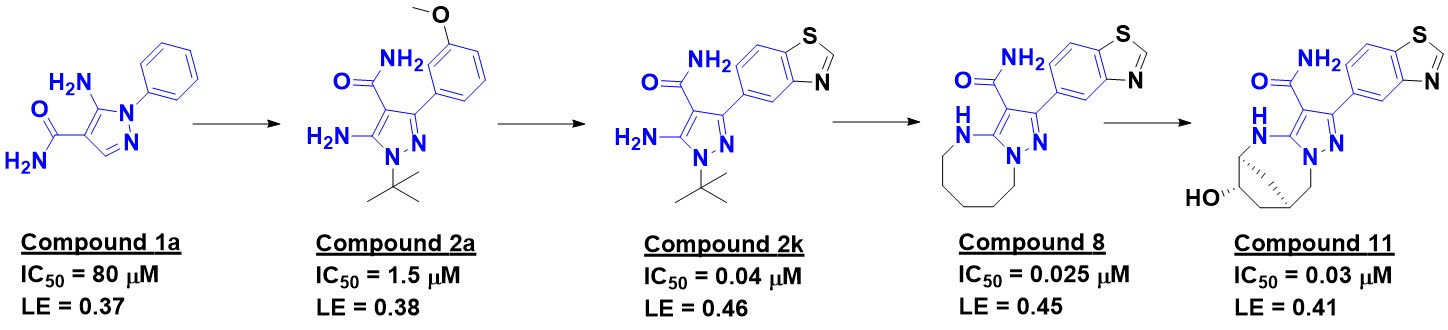
The researchers were interested in receptor interacting protein 2 kinase (RIP2), which is implicated in various inflammatory diseases. A fluorescence polarization screen of 1000 fragments at 400 µM yielded 49 hits with inhibition constants ranging from 5-500 µM. Thirty of these confirmed in a thermal shift assay, and 20 were characterized crystallographically bound to the enzyme. Hit-to-lead chemistry was pursued for five series; the most successful started with compound 1a.


The crystal structure revealed that the carboxamide of compound 1a makes interactions with the hinge region of the kinase, with the phenyl group in the back pocket. A search of related molecules available in-house led to compound 2a, with a satisfying boost in potency. Interestingly, the crystal structure of this molecule bound to RIP2 revealed that the binding mode of the pyrazole moiety had flipped to keep the phenyl ring in the back pocket (compound 1a in cyan, 2a in gray). Enlarging the phenyl group to better fill the pocket led to compound 2k.


This molecule had relatively poor selectivity against several other kinases, but introducing a ring as in compound 8 improved the situation. Crystallography suggested that installing a bridged ring would pick up further interactions with the protein, and although the resulting molecule did not have better affinity, selectivity improved. Finally, a hydroxyl group was introduced (compound 11) to try to pick up interactions with a non-conserved serine residue. This addition did not improve biochemical activity, and in fact a crystal structure revealed that the hydroxyl group was pointing towards solvent, but the activity in human whole blood improved. Importantly, compound 11 was remarkably selective for RIP2: just 1 of 366 other kinases tested at 1 µM showed >70% inhibition.

This is a lovely fragment-to-lead success story that reiterates several important lessons. First, a generic (in this case commercial) and nonselective fragment can lead to novel, selective series. Second, as has been seen multiple times, fragment binding modes can flip unexpectedly, especially during early optimization. Finally, despite the relative flatness of fragment 1a (Fsp3 = 0, though the two aromatic rings are slightly twisted), it could be optimized to a more shapely lead, and the increased complexity is likely responsible for the impressive selectivity. Left unreported is the stability and pharmacokinetics of compound 11: the hydroxyl and all those sp3-hybridized carbons are likely metabolic hotspots. As is so often the case in lead discovery, what solves one problem can too often create another.

09 December 2019

A new library of fluorinated Fsp3-rich fragments

Among fragment-finding methods, ligand-based NMR ranks near the top in terms of popularity. Of its many variations, fluorine (19F) NMR appears to be gaining in popularity. Fluorine NMR has several advantages, including high sensitivity and the fact that many fragments can be screened simultaneously because of the wide chemical shift range for fluorine. Although more commercial fluorine-enriched libraries are available now than when we first wrote about the approach a decade ago, the diversity of these libraries is still somewhat limited. This problem has been tackled by Mads Clausen at the Technical University of Denmark and an international team of collaborators in a new Angew. Chem. Int. Ed. paper.

The researchers wanted to create a fluorinated fragment library that would be not just diverse but also contain a high fraction of sp3-hybridized carbons (high Fsp3). Some of the early claims around “three dimensional” fragments have been questioned, and there seems to be little if any correlation between the shapeliness of fragments and that of derived leads, but if you’re going to make new fragments in academia it makes sense to explore interesting molecular architectures.

Starting from just six simple building blocks, each containing a trifluoromethyl group, the researchers generated nine different cores which were further derivatized at multiple positions to yield 115 diverse fragments. Consistent with diversity-oriented synthesis, no more than five synthetic steps were used for any molecule. All molecules were made as racemates in order to further increase the diversity of the library.

The resulting “3F Library” is mostly rule-of-three compliant, though given that the trifluoromethyl moiety alone adds 69 Da the fragments do tend to be larger, with an average molecular weight of 284 Da. They are, however, less lipophilic than two commercial fluorinated fragment libraries. And with an average Fsp3 = 0.7 and 3.3 chiral centers they are also quite shapely as assessed by principal moment of inertia.

Building a library is nice, but will it provide hits? To find out, the researchers screened the 102 fragments that passed quality control against four targets. They used a transverse (T2) relaxation assay (specifically, CPMG) in which fragments bound to a protein tumble more slowly, causing a reduction in 19F signal intensity. Hit rates ranged from 3% to 11%, and about two thirds of these confirmed in STD or WaterLOGSY assays. As seen by the examples shown here, the fragments are quite diverse.

Whether these hits will lead to more potent molecules remains to be seen. Laudably the paper ends with the statement: “we hope that the 3F library will find use for other researchers and we encourage anyone interested in screening the fragments to contact us.” If you are looking for interesting new fragments that are tailored for follow-up chemistry, I encourage you to take the team up on their offer.

06 October 2014

Physical properties in drug design

This is the title of a magisterial review by Rob Young of GlaxoSmithKline in Top. Med. Chem. At 68 pages it is not a quick read, but it does provide ample evidence that physical properties are ignored at one’s peril. It also offers a robust defense of metrics such as ligand efficiency.

The monograph begins with a restatement of the problem of molecular obesity: the tendency of drug leads to be too lipophilic. I think everyone – even Pete Kenny – agrees that lipophilicity is a quality best served in moderation. After this introduction Young provides a thorough review of physical properties including lipophilicity/hydrophobicity, pKa, and solubility. This is a great resource for people new to the field or those looking for a refresher.

In particular, Young notes the challenges of actually measuring qualities such as lipophilicity. Most people use log P, the partition coefficient of a molecule between water and 1-octanol. However, it turns out that it is difficult to experimentally measure log P for highly lipophilic and/or insoluble compounds. Also, as Kenny has pointed out, the choice of octanol is somewhat arbitrary. Young argues that chromatographic methods for determining lipophilicity are operationally easier, more accurate, and more relevant. The idea is to measure the retention times of a series of compounds on a C-18 column eluted with buffer/acetonitrile at various pH conditions to generate “Chrom log D” values. Although a stickler could argue this relies on arbitrary choices (why acetonitrile? Why a C-18 column?) it seems like a reasonable approach for rapidly assessing lipophilicity.

Next, Young discusses the influence of aromatic ring count on various properties. Although the strength of the correlation between Fsp3 and solubility has been questioned, what’s not up for debate is the fact that the majority of approved oral drugs have 3 or fewer aromatic rings.

Given that 1) lipophilicity should be minimized and 2) most drugs contain at most just a few aromatic rings, researchers at GlaxoSmithKline came up with what they call the Property Forecast Index, or PFI:

PFI = (Chrom log D7.4) + (# of aromatic rings)

An examination of internal programs suggested that molecules with PFI > 7 were much more likely to be problematic in terms of solubility, promiscuity, and overall development. PFI looks particularly predictive of solubility, whereas there is no correlation between molecular weight and solubility. In fact, a study of 240 oral drugs (all with bioavailability > 30%) revealed that 89% of them have PFI < 7.

Young summarizes: the simple mantra should be to “escape from flatlands” in addition to minimising lipophilicity.

The next two sections discuss how the pharmacokinetic (PK) profile of a drug is affected by its physical properties. There is a nice summary of how various types of molecules are treated by relevant organs, plus a handy diagram of the human digestive track, complete with volumes, transit times, and pH values. There is also an extensive discussion of the correlation between physical properties and permeability, metabolism, hERG binding, promiscuity, serum albumin binding, and intrinsic clearance. The literature is sometimes contradictory (see for example the recent discussion here), but in general higher lipophilicity and more aromatic rings are deleterious. Overall, PFI seems to be a good predictor.

The work concludes with a discussion of various metrics, arguing that drugs tend to have better ligand efficiency (LE) and LLE values than other inhibitors for a given target. For example, in an analysis of 46 oral drugs against 25 targets, only 2.7% of non-kinase inhibitors have better LE and LLE values than the drugs (the value is 22% for kinases). Similarly, the three approved Factor Xa inhibitors have among the highest LLEAT values of any compounds reported.

Some of the criticism of metrics has focused on their arbitrary nature; for example, the choice of standard state. However, if metrics correlate with a molecule's potential to become a drug, it doesn’t really matter precisely how they are defined.

The first word in the name of this blog is Practical. The statistician George Box once wrote, “essentially, all models are wrong, but some are useful.” Young provides compelling arguments that accounting for physical properties – even with imperfect models and metrics – is both practical and useful.

Young says essentially this as one sentence in a caveat-filled paragraph:

The complex requirements for the discovery of an efficacious drug molecule mean that it is necessary to maintain activity during the optimisation of pharmacokinetics, pharmacodynamics and toxicology; these are all multi-factorial processes. It is thus perhaps unlikely that a simple correlation between properties might be established; good properties alone are not a guarantee of success and some effective drugs have what might be described as sub-optimal properties. However, it is clear that the chances of success are much greater with better physical properties (solubility, shape and lower lipophilicity). These principles are evident in both the broader analyses with attrition/progression as a marker and also in the particular risk/activity values in various developability screens.

In other words, metrics and rules should not be viewed as laws of nature, but they can be useful guidelines to control physical properties.