Showing posts with label LELP. Show all posts

24 August 2012

ACS Fall Meeting 2012


I recently returned from Philadelphia, where the American Chemical Society held its 244th national fall meeting. As always this was a massive affair, but fragments were well-represented, particularly in a nice session organized by Percy Carter, Debbie Loughney, and Romyr Dominique.

I opened the session by giving an introduction to fragment-screening, as well as an overview of some of the work we’re doing at Carmot. Andrew Good had perhaps the best title (“Fragment fat wobbles too”), and discussed some of the work done at Genzyme on Pim-1 kinase. Eric Manas next described some of the computational tools being used at GlaxoSmithKline, in particular strategies to deal with water. He also discussed the utility of looking for fragment analogs early in a project. In the last talk before the intermission, Chris Abell from the University of Cambridge described a number of projects from his group, starting with antimicrobial targets (such as this one); we’ll cover another in a separate post. Chris is unabashedly going after difficult targets, not just protein-protein interactions, but oligonucleotides – specifically riboswitches. There is only limited precedent for targeting RNA with fragments, so it will be fun to see how this progresses.

Francisco Talamas next described a nice example from Roche using FBLD to discover hepatitis C NS5B Palm I allosteric inhibitors. An HTS campaign of around 900,000 molecules yielded just 3 hits, none of which were advanced. A fragment screen of about 2700 fragments gave a better hit rate (5.9%), but of the 29 co-crystal structures attempted only a single structure was obtained. However, by combining the information from this crystal structure with information from other crystal structures, both proprietary and public, the researchers put together a set of rules to design a de novo fragment library tailored to this protein. This effort ultimately yielded compounds that were optimized to a clinical candidate.

Next, Nick Wurtz from Bristol-Myers Squibb described his company’s approach to discover neutral Factor VIIa inhibitors. The researchers used a combination of computational, functional, and biophysical approaches to find uncharged fragments that would bind in the P1 pocket, leading to a couple dozen crystal structures. Despite the low affinities of these fragments (typically mM), many of them could successfully be merged onto an existing series, replacing a positively charged moiety to yield potent molecules with better permeability. This is the first time I’ve seen a fragment story out of BMS, so I'm glad to see that they’re active in this area. This is also a prime example of what has been described as fragment-assisted drug discovery.

Finally, Prabha Ibrahim of Plexxikon gave a lovely overview of the discovery and development of vemurafenib, including a more detailed description of the SAR than has been presented in their earlier papers.

In addition to this dedicated session, there was a scattering of other talks and posters, including a notable poster from Timothy Rooney at the University of Oxford using fragment-based approaches to discover bromodomain inhibitors, a target class we’ve previously discussed.

A session entitled “A medicinal chemist’s toolbox” ranged over several topics of interest. Ernesto Freire of Johns Hopkins gave a great overview of thermodynamics in drug discovery, a topic we’ve previously covered. Most readers are probably familiar with the concept of enthalpy-entropy compensation, in which (for example) an added hydrogen bond fails to achieve the desired boost in potency due to unfavorable entropy. Recognizing this, he suggested that one should target groups in proteins that are already well-structured, so you don’t have to pay the cost of structuring a disordered part of the protein. He also suggested that if you introduce one hydrogen bond, you might be better off introducing a second one too, as the incremental entropic cost is likely to be low.

György Keserű of Gedeon Richter discussed the importance of avoiding lipophilicity by using tools such as LELP, which we’ve covered here and here. Continuing this theme, Kevin Freeman-Cook of Pfizer described two examples of using LLE in lead discovery programs, in particular calculating LLE values before making compounds. Although this may seem obvious, what was quite striking was the dramatic effect subtle changes in structure could make to ClogP values.

Of course, these are just a few of thousands of presentations. Please feel free to point out any that caught your eye, or expand on some of those mentioned above. And just a reminder, it’s only 4 weeks to FBLD 2012 in San Francisco – the biggest fragment event of the year!

12 March 2012

LLE vs LELP

Besides ligand efficiency (LE), a slew of other metrics has been proposed to help evaluate what compounds to take forward in drug discovery. As seen in our poll and a recent round-table discussion, lipophilic ligand efficiency (LLE) is quite popular:
LLE = pIC50 (or pKi) – ClogP (or logD)
However, because this metric is not size-adjusted, it is not particularly useful for evaluating fragments, which often have low potency. In contrast, the metric LELP accounts for size:
LELP = logP / LE (where LE = ligand efficiency)
In a recent issue of J. Med. Chem., György Keserű and colleagues evaluate how these two metrics compare in a variety of settings.

The authors examine eight different compound sets: fragment hits and derived leads, HTS hits and derived leads, leads that subsequently became drugs (ie, “successful leads”), development candidates, compounds that entered phase II trials, and drugs on the market. Not surprisingly, drugs and phase II compounds had better LLE and LELP scores than other molecules. Also not surprisingly, fragments scored misleadingly poorly on the basis of LLE but well on the basis of LELP. What is perhaps unexpected, though, is that LELP was better at identifying successful leads than was LLE. Moreover, when compounds were evaluated for pharmacokinetic and safety parameters, LELP was more effective at predicting problems than was LLE. The authors state:
In summary, evaluation of pharmacokinetic and safety parameters revealed that LELP has benefits over LLE, as compounds with acceptable in vitro ADMET profiles are discriminated from compounds with significant liabilities.
Despite these potential advantages, LELP doesn’t seem to be widely used, perhaps because it is less intuitive than some of the other metrics. Indeed, it would be interesting to see these studies repeated using LLEAT, which also takes lipophilicity into account but has the same scale as LE.

20 June 2011

Ligand Lipophilicity Efficiency AT Astex Therapeutics

Our last post discussed the growing plague of molecular obesity, and how numerous metrics have been designed to control it. In a paper published online in J. Comput. Aided Mol. Des. Paul Mortenson and Chris Murray of Astex describe a new one: LLEAT.

Although ligand efficiency (LE) is probably the most widely used and intuitive metric, it does not take into account lipophilicity. Other indices do, notably ligand lipophilicity efficiency (LLE) and ligand-efficiency-dependent lipophilicity (LELP), but these both have drawbacks for evaluating fragments. LLE (defined as pIC50 – log P) is not normalized for size; for a fragment to have an (attractive) LLE ≥ 5 it would need an exceptionally low log P or an exceptionally high affinity. LELP, defined as log P / ligand efficiency, is also potentially misleading since a compound could have an acceptable LELP value even with a low ligand efficiency if the log P is also very low.

To address these problems, Mortenson and Murray have tried to strip out the non-specific binding a lipophilic molecule experiences when going from water to a binding site in a protein. They define this modified free energy of binding as:

ΔG* = ΔG - ΔGlipo
        ≈ RT ln (IC50) + RT ln (P)
        ≈ ln (10) * RT (log P - pIC50)

In order to put values coming out of this metric on the same scale as those from ligand efficiency, they add a constant, such that:

LLEAT = 0.11 – ΔG* / (number of heavy atoms)

Thus, just as in ligand efficiency, the goal is for molecules to have LLEAT ≥ 0.3 kcal/mol per heavy atom.

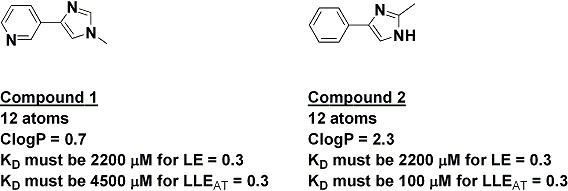
The index has some interesting implications. For example, the two fragments below have the same number of heavy atoms, and thus if they had the same activity they would have the same ligand efficiency; on this measure alone, neither would be preferred as a starting point for further work. However, because of their very different lipophilicities, fragment 2 would need to be 45 times more potent than fragment 1 in order to have the same LLEAT of at least 0.3.

A similar analysis can be done during optimization. For example, adding either a phenyl or a piperazinyl substituent should produce a 20-fold boost in potency in order to maintain ligand efficiency at 0.3, since both have 6 atoms. However, in order to maintain LLEAT at 0.3, the phenyl would need to produce a 460-fold boost in potency while the piperazinyl would need to improve potency only 3-fold. This is consistent with what other folks have reported qualitatively, but it’s nice to have a simple quantitative measure.

Although some people may groan at yet another index, and no metric is perfect, I like the fact that this one is intuitive and has the same range of “acceptable” values as ligand efficiency. What do you think – is it useful?

12 June 2011

Beware molecular obesity

Obesity in humans is a growing problem, and not just aesthetically: the condition may be responsible for millions of premature deaths. In a recent article in Med. Chem. Commun., Mike Hann of GlaxoSmithKline notes that “molecular obesity” is also leading to the untimely demise of far too many drug development programs.

Hann, who is especially known for his work on molecular complexity, defines molecular obesity as the “tendency to build potency into molecules by the inappropriate use of lipohilicity.” This is the result of an unhealthy “addiction” to potency. Hann suggests that since potency is easy to measure it is pursued preferentially to other factors, particularly early in a program. This is all too often achieved by adding mass, much of it lipophilic. The problem is that all this grease decreases solubility and increases the risks of off-target binding and toxic side effects.

Tools such as the Rule of 5 have been developed in part to avoid this problem, and a number of other indices have been introduced more recently. For example, lipophilic ligand efficiency (LLE) is defined as pIC50 – LogP; molecules with an LLE > 5 are likely to be more developable. Other guidelines that Hann mentions and that have been covered here include LELP, number of aromatic rings, and fraction of sp3 hybridized carbon atoms. But this is not to say that metrics will save the day:
The problem with the proliferation of so many “rules” is the trend to slavishly apply them without really understanding their required context for use and subsequent limitations.
Starting a program with the smallest possible lead should in theory lead to smaller drugs, and this is one of the key justifications for fragment-based approaches, though even here it is important that the molecules do not become obese during optimization. One of the themes at the 6th annual FBDD conference was to do a bit of optimization around the fragment itself before growing or linking. On a related note, Rod Hubbard warned in his opening presentation at the conference to “beware the super-sized fragment.” Not only are larger fragments likely to be less complementary to the target, the number of possibilities increases (and thus the coverage of chemical space drops) by roughly ten-fold with each atom added to a fragment.

Hann also argues that potency itself is over-rated: many teams seek single digit nanomolar binders even though approved drugs have average potencies of 20 nM to 200 nM.

The paper is a fun read (and is free after registration too). Also, Hann one-ups Donald Rumsfield’s (in)famous “known knowns, known unknowns, and unknown unknowns” by pointing out that much of this information falls into the category of “unknown knowns”:
Those things that are known but have become unknown, either because we have never learnt them, or forgotten about them, or more dangerously chosen to ignore
This review is an excellent corrective to the first two problems, and a clear warning about the third.

10 April 2009

LELP fragments reach their potential

In last month’s issue of Nature Reviews Drug Discovery, György Keserü of Gedeon Richter and Gergely Makara of Merck published a thought-provoking analysis of recent trends in lead discovery. Their results illustrate the potential of fragment-based methods, but also point out the still sizable gap from current practice.

The authors assembled a database of 335 hit-lead pairs derived from high-throughput screening (HTS) that were published between 2000 and 2007. They also assembled a database of 84 non-HTS hit-lead pairs published between 2000 and February 2008, consisting of fragment-based, virtual screening, natural product, and miscellaneous examples. They then compared properties – such as potency, molecular mass, logP, logS (a calculated measure of solubility), and ligand efficiency – of the initial hits with the resulting leads.

The results for HTS hits are not pretty: the lipophilicity as assessed by logP was considerably higher on average for HTS hits than for hits from any other methods, and this only increased as the hits were progressed to leads. The same goes for (in)solubility (as measured by logS). Even more alarming, the average properties of even the hits are worse than those of a collection of 541 approved drugs.

Fragment hits start out with the lowest lipophilicity and highest predicted solubility, but during hit-to-lead optimization these properties deteriorate to the point where they are similar on average to leads derived from HTS. Also surprisingly, the ligand efficiency of fragment hits and leads are, if anything, lower than their HTS counterparts, contrary to expectations. Even the average molecular weight of fragment-derived leads is not much lower than HTS-derived leads.

So what’s going wrong? The authors point out that, at most larger companies, fragment-based approaches are often only attempted after HTS has failed, suggesting that the targets tackled by fragment-based methods may be inherently more difficult. But they also suggest that in the early stages of hit-to-lead optimization the primary measure of success is how many compounds are delivered to lead optimization, which could encourage rapid hit expansion with simple chemistries to rapidly boost potency by adding grease, leading to more hydrophobic, less soluble molecules that will ultimately struggle in the clinic.

The authors suggest a new metric, ligand-efficiency-dependent lipophilicity, or LELP, to help avoid this trap:

LELP = (log P / LE)

Since a desirable logP range is between 0 and 3, and a desirable ligand efficiency is above 0.4, one should strive for LELP values between 0 and 7.5. There are already lots of metrics out there for evaluating molecules: see, for example, discussions of %LE, antibacterial efficiency, and fit quality (also here and here). Is a new one really necessary? Perhaps, if it gets people to focus on non-lipophilic means of increasing potency.

The authors end on a positive note for fragments:

Bearing in mind the sampling of chemical space, hit properties and synthetic accessibility, we consider that fragment hits are the optimum starting points for lead discovery and optimization.

There is, however, a burden on the team transforming a fragment hit into a viable lead: it is important to focus not merely on improving potency, but on maintaining as many of the fragment-like properties that make fragments attractive starting points in the first place. Although this goes without saying, analyses like this one suggest that it still needs to be said – and heard.