Showing posts with label FBDD. Show all posts

05 October 2026

Twentieth-Fourth Annual Discovery on Target Meeting

Cambridge Healthtech Institute held its annual Discovery on Target (DoT) meeting in Boston last week. Attendance may have set a record, with over 1000 participants. There were sessions on antibodies, conjugates, and radioligands, but I’ll just touch on some of the small molecule themes most relevant to this blog.
 
Covalent approaches
As with last year, covalent approaches to drug discovery were well-represented. Dhirendra Simanshu (Frederick National Laboratory) described several drugs birthed in the NCI RAS Initiative, including ones targeting the G12C mutant of KRAS and C242 on the RAS-binding domain of PI3Kα. He also described how various KRAS mutants cause resistance to drugs, finding that most of them affect the KI term (binding) more than the kinact term (bonding). Continuing on the KRAS theme, Jack Sloan discussed efforts at BMS to discover inhibitors targeting both the on- and off-states of KRAS G12C.
 
Kasia Handing (Tango Therapeutics) presented both covalent and non-covalent approaches against VRK1, a synthetic lethal target for glioblastoma. A biochemical screen yielded covalent inhibitors that were characterized crystallographically, but they turned out to be too non-selective to progress. In the meantime, an in-cell DNA-encoded library (DEL) screen led to more advanceable molecules.
 
DEL was indeed a major topic of the conference, and here too covalent approaches are being explored. Elizabeth D’ambrosio described how GSK is identifying covalent binders from DEL screens, a process which includes testing for time-dependence as well as aggressive washing steps under denaturing conditions to quench unreacted molecules and wash away any sticky, non-covalently bound compounds. And Xiaojie Bruce Lu (Chinese Academy of Sciences) described applying DEL to a variety of targets, including some covalently targeting non-cysteine residues.
 
One of the advantages of DEL is being able to screen large libraries, and increasing throughput is also of interest to Harvard’s Steve Gygi, who is screening covalent fragments against cells and cell lysates. In 2024 we described how he was using tandem mass tag (TMT) multiplexing to analyze 18 samples in a single mass-spectrometry run, and he has now extended this to 35 samples. What’s more, Steve is combining 16 different fragments in each sample and introducing clever deconvolution approaches to further accelerate the process.
 
Not everyone is targeting cysteine residues. Mark Tye described the discovery of Revolution Medicines’ zoldonrasib, which uses an aziridine warhead to target the G12D mutant of KRAS. And Balyn Zaro (University of California San Francisco) described using ninhydrin derivatives to target arginine. Most organic chemists are familiar with ninhydrin’s reaction with primary amines such as the N-termini of peptides, but Balyn has been able to optimize selectivity for arginine and has used the resulting chemical probes to identify more than 7000 arginine residues in cells, about 5% of which are hyperreactive. Interestingly, some cell lines seem to have a greater proportion of reactive arginine residues than others.
 
Direct-to-Biology (D2B) approaches
Another recurring theme was direct-to-biology, in which crude reaction mixtures are screened directly in various assays without purification. Indeed, Nicholas Bland of Domainex said that after looking at the agenda of the meeting he considered skipping the introductory slides – and this was on the first official day of the conference. Nicholas described using D2B for optimizing PROTACs as well as for improving fragment hits against the GPCR A2A receptor.
 
Jack Sadowsky, who also presented at DDC this past spring, described how he and his colleagues at Kimia are using D2B in combination with machine learning to develop selective inhibitors of kinases while also improving their in vitro ADME properties. This effort entailed making and testing tens of thousands of compounds from a virtual space of some 80 million molecules.
 
But even small-scale D2B can be valuable. Trevor Sherwood described how he and his colleagues at BMS used D2B to make and test 663 molecules to improve the potency of an EP4 agonist identified from a high-throughput screen. This involved multiple reaction types, including photoredox chemistry, for which they built a custom-designed reactor to evenly heat and illuminate the microtiter plates. The D2B work was done in parallel with medicinal chemistry, but interestingly the development candidate BMS-986526 came directly from the D2B work and has entered a phase 1/2a trial for rheumatoid arthritis.
 
There were other talks and posters on D2B that I missed, but I did attend two breakfast roundtables on the topic that were quite lively despite happening at 7:30 – a testament to the interest in the topic.
 
“Traditional” fragment-based drug discovery
At a plenary panel moderated by Drug Hunter’s Dennis Hu on drugging difficult targets, Biogen’s Klaus Urbahns asked the other panelists if they were still doing fragment-based lead discovery. John Tallarico of Novartis and Ian Storer of AstraZeneca immediately said yes. And in a separate presentation, Kris Borzilleri described how she and her Pfizer colleagues used fluorine-detected NMR and fragment optimization to identify ligands for an orphan GPCR.
 
Debanu Das described using high-throughput crystallography screening at XPose Therapeutics, now part of Mid-Atlantic BioTherapeutics, to identify inhibitors of DNA damage response pathway proteins. Although the initial hits had no detectable activity, SAR by catalog was able to get to nanomolar inhibitors of the protein APE1, which is overexpressed in ovarian cancer, in a matter of weeks.
 
But perhaps the most robust validation of FBDD was provided by Steve Fesik of Vanderbilt, who described a decades-long effort to drug the MYC pathway, which is probably dysregulated in almost all cancers. We described some of his published work on WDR5 here, but he is now making progress against MYC itself. This has not been easy: MYC is intrinsically disordered, and SAR-by-NMR screens against both the transactivation domain and the DNA-binding domain failed. However, MYC forms a structured leucine-zipper heterodimer with the protein MAX, and screening this complex yielded hits at the DNA binding interface. (Earlier this year we described work from Novartis on a different leucine zipper.) The hits have been optimized to low nanomolar binders that disrupt DNA binding, unlike a slide full of other (alleged) MYC inhibitors, including high-profile commercially available compounds such as MYCi361 and MYCi975.
 
I’ll close – hopefully before you stop reading. If you attended, what talks or posters stood out? And if you wish you had attended, mark your calendar for Oct. 18-21 next year, when DoT returns to Boston in time for peak leaf-peeping season.

29 December 2025

Review of 2025 reviews

Turning and turning in the widening gyre
The falcon cannot hear the falconer…
 
In our small, annual counterweight to Yeats’ “mere anarchy," Practical Fragments looks back on 2025.
 
This year marked the thousandth post on Practical Fragments, a milestone neither Teddy nor I imagined when the blog launched back in 2008. In terms of conferences, I wrote about CHI’s Drug Discovery Chemistry in San Diego here and Discovery on Target in Boston here.
 
For the past decade I’ve participated in annual J. Med. Chem. perspectives covering fragment-to-lead success stories, two of which published this year. The first, spearhead by Rhian Holvey at Astex, covers the year 2023, while Astex’s David Twigg took the lead on covering the year 2024. In addition to the tabular summaries for which these reviews are best known, both also include tables of “near misses,” none of which made the main tables because the starting points were (sometimes just slightly) too large. Four out of six of these heavyweights are covalent fragments, suggesting that the rule of three may need to be relaxed for these. The most recent paper also includes a table showcasing the eight approved FBLD-derived drugs.
 
Two more general publications are also of interest. In a brief (open-access) editorial in J. Med. Chem. Weijun Xu and Congbao Kang at A*STAR summarize fragment-finding methods and approved drugs and discuss future applications of FBLD in PROTACs and targeting RNA. And in Curr. Res. Pharm. Drug Discov., Geoffrey Wells, Exequiel Porta, and colleagues at University College London present a “graphical review” which covers library design, screening strategies, hit validation, fragment optimization, and a few case studies of approved drugs, along with current challenges.
 
In Drug Des. Devel. Ther., Bangjiang Fang and colleagues at Shanghai University of Traditional Chinese Medicine present an open-access bibliometrics analysis of 1301 fragment-based drug design papers published between 2015 and the end of 2024, which includes top ten lists of institutions, authors, and papers as well as keyword trends and analyses. Annual growth has averaged 1.4%, and the field is both global and collaborative, with 35% of publications involving more than one country.
 
Targets
Two reviews focus on oncology. The first, in Bioorg. Chem. by Milind Sindkhedkar and collaborators at Manipal College of Pharmaceutical Sciences and Lupin Ltd., briefly covers the history and practice of FBDD before providing short summaries of seven of the eight approved drugs to come from it. The second, published open-access in Chem. Rev. by Vanderbilt’s Steve Fesik, is a concise and highly readable introduction and account of the author’s groundbreaking work on BCL-2 family proteins, KRAS, and WDR5.
 
A much longer open-access review in Chem. Rev. by Paramjit Arora and colleagues at New York University covers protein-protein interactions (PPIs). Much of the focus is on larger molecules such as cyclic peptides, peptide mimetics, and other macrocycles, but there are summaries of fragment-based approaches against KRAS and 14-3-3 proteins.
 
The topic of 14-3-3 proteins is treated more fully in an open-access Acc. Chem. Res. paper by Michelle Arkin and colleagues at UCSF. While the focus of most efforts against PPIs is to find inhibitors, for 14-3-3 the goal is to find stabilizers, or molecular glues. The Arkin lab and others have been succeeding using various approaches, particularly disulfide tethering. We wrote about these efforts most recently in 2023, and the new review provides a nice update.
 
Fragment finding methods and libraries
Sahra St. John-Campbell and Gurdip Bhalay, both at The Institute of Cancer Research, published a massive open-access perspective on “target engagement assays in early drug discovery” in J. Med. Chem., covering a host of biochemical, biophysical, and cell-based assays. A table lists more than 50 different techniques, almost half of which are applicable to FBLD. Each row shows what characteristic(s) are measured as well as critical requirements for  protein, sample, and equipment. The paper is also beautifully illustrated with dozens of figures: one shows which techniques are most useful for different types of targets, and each method gets its own diagram.
 
A more focused open-access review is provided by Stefanie Freitag-Pohl and colleagues at Durham University in Biophys. Rev. After surveying various biophysical techniques, the researchers focus on spectral shift analysis, and in particular the Dianthus instrument from NanoTemper Instruments. This plate-based, high-throughput microfluidics-free instrument can detect changes in fluorescence caused by environment or temperature. Examples demonstrate affinity measurements across several orders of magnitude, up to double-digit millimolar, and a nice scheme shows use of the Dianthus in a fragment-screening workflow.
 
Moving to specific techniques, Jia Gao, Ke Ruan, and colleagues at University of Science and Technology of China Hefei provide an open-access survey of “the rise of NMR-integrated fragment-based drug discovery in China” in Mag. Res. Lett. After a brief overview of NMR approaches, they cover case studies from China, most of which are focused on fragment screening rather than optimization.
 
A less common biophysical method is native mass spectrometry (nMS), the subject of an open-access opinion in RSC Med. Chem. by Louise Sternicki and Sally-Ann Poulsen at Griffith University. This is a good survey of the approach; we highlighted a more fragment-focused review by the same authors last year.
 
The most common fragment-finding approach, X-ray crystallography, is covered in two open-access reviews. The first, in Acta Cryst. F by Sarah Bowman and collaborators at University of Buffalo and Brookhaven National Laboratory, focuses on critical early stages, from protein characterization to sample preparation and various crystallization approaches. The second, in Curr. Opin. Strut. Biol. by Martin Noble and colleagues at Newcastle University, starts by briefly reviewing crystallographic fragment screening before turning to fragment libraries. The paper includes a nice table summarizing publicly available libraries at major synchrotrons, with the text describing these in more detail.
 
The provider of one of these libraries, EU-OPENSCREEN, is the subject of an open-access review in SLAS Discov. by Robert Harmel and collaborators at EU-OPENSCREEN ERIC and Fraunhover ITMP. As we wrote last year, EU-OPENSCREEN is a broad consortium whose mission is to advance early drug discovery by providing access to technology and expertise. The new paper summarizes the four compound collections, including the European Fragment Screening Library (EFSL), and surveys progress to date. It also lays out ambitious plans, including expanding to >30 sites in nine countries.
 
Computational approaches and cryptic sites
Despite the hype about artificial intelligence in the broader world, AI in fragment-based drug discovery has been less common. In Curr. Opin. Struct. Biol., Woong-Hee Shin and colleagues at Korea University College of Medicine summarize applications to fragment growing, merging, and linking. The open-access paper includes a handy table of 13 programs, and includes GitHub links where available.
 
Cryptic binding sites, defined by Ehmke Pohl and collaborators at Durham University and Cambridge Crystallographic Data Centre “as binding pockets that exist in the ligand-bound state of a protein but not in its apo form,” are the focus of an open-access review in Bioinform. Adv. The researchers cover earlier computational approaches for finding these, especially molecular dynamics (MD) and machine learning (ML). They note that a key challenge for ML is the limited quantity and quality of experimental data: undiscovered cryptic sites would be misclassified as non-binding sites.
 
Yowen Dong, Ge-Fei Hao, and colleagues at Guizhou University review “computational methods for identifying cryptic pockets” in Drug Discov. Today. As with the previous review, these are divided between molecular dynamics and AI-based techniques, which are discussed individually and then compared. The researchers apply six approaches to the model bacterial protein TEM-1 β-lactamase and find that, for this highly studied single protein, the AI-based methods are much faster (seconds instead of days) and just as accurate, though MD-based methods provide more insight into formation mechanisms of cryptic pockets.
 
Covalent ligands
Allosteric sites are an important sub-class of cryptic pockets, and in J. Med. Chem. Jianing Li and colleagues at Purdue University discuss covalent allosteric inhibitors. After briefly discussing advantages of covalent molecules, they review examples targeting protein phosphatases, kinases, and GTPases, such as KRAS.
 
Of course, covalent molecules are not limited to allosteric sites. An open-access review in Bioorg. Med. Chem. Lett. by Walaa Bedewy, John Mulawka, and Marc Adler at Toronto Metropolitan University summarizes published covalent protein ligands, grouping them by target site:  active sites, residues adjacent to an active site, protein-protein interfaces, cofactor binding sites, and allosteric sites.
 
Chem. Rev. published two massive reviews on covalent ligands, each with more than 300 references. The first, by Tomonori Tamura, Masaharu Kawano, and Itaru Hamachi at Kyoto University, covers a wide range of topics, from covalent drugs, to peptide- and protein-based covalent inhibitors, to chemical biology labeling and target engagement strategies, to covalent bifunctional molecules such as PROTACs and radionucleotide-based molecules, and even covalent modification of DNA and RNA. The paper includes 68 figures, many reproduced from the original publications.
 
The second (open-access) Chem. Rev. paper, by Ku-Lung Hsu and colleagues at University of Texas at Austin, focuses on covalent ligands targeting protein residues other than cysteine, particularly lysine and tyrosine; we highlighted some of Hsu’s work recently. The paper also discusses naturally occurring molecules that bind to lysine, such as pyridoxal phosphate and aldose sugars.
 
Methods for finding covalent ligands are the focus on an open-access review in JACS Au by Mengke You, Hong Liu, and Chunpu Li at Shanghai Institute of Materia Medica. Specifically, they review disulfide tethering, activity-based protein profiling (ABPP), covalent DEL, phage and mRNA display, and sulfur(IV) fluoride exchange (SuFEx), with examples for each.
 
The last paper on this topic, in J. Med. Chem., offers a brief but important overview of all covalent FDA-approved small molecule drugs through 2023. Samuel Dalton and collaborators at Isomorphic Laboratories and Merck counted 128 covalent drugs, about 7% of all small molecule drugs. More than half are antibiotics, and more than 85% target serine or cysteine. Only 10% are reversible, but this number is rapidly increasing, with 11 of the 13 reversible covalent drugs approved since 2010. Importantly, the names, chemical structures, indication, target and target residue, warhead, and key references for all the drugs are provided in the supporting information.
 
Miscellaneous
Deconstruction of ligands to smaller fragments that are then “reconstructed” into new leads is a venerable approach in FBLD and the subject of an open-access perspective in J. Med. Chem. by J. Henry Blackwell, Iacovos Michaelidies, and Floriane Gibault at AstraZeneca. Multiple examples dating as far back as the late 1990s are provided, along with appropriate caveats about potential changes in fragment binding modes and protein conformations.
 
Finally, an open-access perspective in J. Med. Chem. by Dean Brown (Jnana Therapeutics) examines the 104 oral drugs approved from 2020 through 2024, including structures, dosing, pharmacokinetics, and safety. Roughly a third of these drugs are dosed more than once per day, and almost a quarter have a black box warning, while 42% have at least one contraindication. Dean warns that “overly prescriptive [development candidate] criteria may inadvertently stifle the development of innovative drugs,” and that it is difficult but important “to be the champion for a compound that others perceive as ‘un-drug like.’” The growing success of covalent drugs illustrates that some organizations are taking this to heart.
 
And that’s it for 2025. Thanks for reading and special thanks for commenting. And in 2026, may the best of us be filled with passionate intensity.

22 December 2022

Review of 2022 reviews

The winter solstice is behind us in the Northern Hemisphere, which means 2022 is rapidly drawing to a close. As we have done for the past decade, Practical Fragments will spend this last post of the year summarizing conferences and reviews.
 
The remarkable progress in vaccines against SARS-CoV-2 allowed the full return of in-person conferences, and it was nice to see folks at CHI’s Discovery on Target in Boston and Drug Discovery Chemistry in San Diego. Nearly twenty reviews of interest to this readership were published, and these are covered thematically.
 
Targets
Several reviews cover the use of FBLD to target antiviral and antibacterial targets. Sangeeta Tiwari and colleagues at University of Texas El Paso cover both in an open access Pharmaceuticals review, focusing on tuberculosis and HIV, which often afflict the same individuals, leading to worse outcomes. The paper includes several tables with chemical structures, though the fragment origins of some molecules are not apparent.
 
Tuberculosis is caused by Mycobacterium tuberculosis, but there are more than 170 known members of the Mycobacteriaceae family. In an open access Int J. Mol. Sci. paper, the Tiwari group describes fragment-based approaches against these bugs. In addition to multiple examples, the review provides summaries of fragment finding methods and some of the challenges the field faces.
 
Another organism, Pseudomonas aeruginosa, infects the lungs of people with cystic fibrosis. In an open access Front. Mol. Biosci. paper, Tom Blundell and collaborators at University of Cambridge summarize fragment-based campaigns against this organism and its enzymes. The authors focus on structure-guided methods and note that the work is “at an early stage” but encouraging.
 
Switching to mammalian targets, Katrin Rittinger and colleagues at The Francis Crick Institute review (open access) applications of FBLD for targeting the ubiquitin system in Front. Mol. Biosci. The paper includes a nice table summarizing 15 examples that includes target, enzyme class, fragment binding mode, detection methods, and chemical structures of the fragment hit and optimized compound where applicable. Many of these are covalent modifiers; more on that topic below.
 
Finally, Tarun Jha, Shovanlal Gayen, and collaborators at Jadavpur University discuss “recent trends in fragment-based anticancer drug design strategies” in Biochem. Pharm. In addition to case studies (with chemical structures) of FBLD approaches against 18 oncology targets, the review covers fragment libraries, screening methods, optimization, and challenges.
 
Methods
Many of the targets above are challenging, and it’s always nice to be able to assess how challenging a project might be at the outset. In Curr. Opin. Struct. Biol., Sandor Vajda and collaborators at Boston University and Stony Brook University discuss (open access) “mapping the binding sites of challenging drug targets.” This is a brief, readable account of computational methods to identify hot spots, including allosteric ones. The authors examine the various small-molecule binding sites on KRAS and conclude that, due to “limited druggability,” the “other G12 oncogenic mutants will be very challenging.” Perhaps, but not impossible, as researchers at Mirati demonstrated earlier this year with the (open access) publication of a low (or sub) nanomolar KRASG12D inhibitor.
 
Among experimental methods used in FBDD, NMR is a mainstay, as demonstrated by Luca Mureddu and Geerten Vuister (University of Leicester) in Front. Mol. Biosci. (open access). The paper covers methods, successes, and challenges, focusing on three compounds that reached the clinic: AZD3839, venetoclax, and S64315.
 
In contrast to NMR, dynamic combinatorial chemistry (DCC) and DNA-encoded libraries (DEL) are used less frequently in FBLD. In RSC Chem. Biol., Xiaoyu Li and collaborators at University of Hong Kong and Jining Medical University discuss “recent advances in DNA-encoded dynamic libraries.” This concise paper covers lots of ground and does not understate the challenges.
 
Libraries
“The importance of high-quality molecule libraries” is emphasized by Justin Bower and colleagues at the Beatson Institute in Mol. Oncol. This highly readable and wide-ranging open access review covers all aspects of library design and use and includes comparisons of some of the major commercial vendors. An important point is that the “hit rate does not define the success of a library as it is more important to identify ligand-efficient and chemically tractable start points.”
 
Thus, even though shapely fragments may have lower hit rates than more planar aromatic fragments, they may still be worth including – if you can make them. In Drug Discov. Today (open access), Peter O’Brien and collaborators at University of York and Vrije Universiteit Amsterdam review synthetic strategies behind 25 “3D” fragment libraries. The tabular summary showing all the scaffolds emphasizes that most of these libraries are modest in size, with the largest being 102 members. Chemists will particularly enjoy the multiple synthetic schemes. The authors note the importance of “fragment sociability” to facilitate SAR and elaboration.
 
Covalent fragments
Special libraries are required for covalent fragment-based drug discovery, the most notable feature being the “warhead” that reacts with the protein target. These are the focus of a chapter in Adv. Chem. Prot. by Péter Ábrányi-Balogh and György Keserű of the Hungarian Research Centre for Natural Sciences. The review includes a table containing more than 100 warheads with associated mechanisms and amino acid selectivity.
 
The “reactivity of covalent fragments and their role in fragment-based drug design” is the focus in an (open access) Pharmaceuticals review by Kirsten McAulay and colleagues at the Beatson Institute. This is a nice overview of the field and contains several case studies. The authors conclude that “striking a balance between reactivity, potency and selectivity is key to identifying potential candidates.”
 
“Advances in covalent drug discovery” are reviewed (open access) by Dan Nomura and colleagues at University of California Berkeley in Nat. Rev. Drug Disc. This is a highly readable and comprehensive overview of the field. The authors differentiate between “ligand-first” approaches, in which a covalent warhead is appended to a known binder (such as here) and “electrophile-first,” in which “the initial discovery process is rooted in finding a covalent ligand from the outset,” such as for KRASG12C inhibitors.
 
Another broad overview of covalent inhibitors is provided by Juswinder Singh (Ankaa Therapeutics) in J. Med. Chem. Jus is a pioneer in the field, having published the first targeted covalent inhibitor in 1997. Of 1673 small molecules approved as drugs by the US FDA, only about 7% are covalent, and it wasn’t until recently that these have been intensively pursued. Part of the reluctance has been concerns over toxicity, but the paper suggests that – at least among kinase inhibitors – covalent drugs may actually be safer, perhaps due to conjugation of glutathione to the warhead and rapid clearance rather than formation of reactive metabolites.
 
Other
Whether covalent or not, thermodynamics plays a fundamental role in protein-ligand interactions, and this is the topic of an (open access) review in Life by Conceição Minetti and David Remeta of the State University of New Jersey. The paper covers a lot of ground, including drug discovery approaches, metrics (such as LE, LLE, etc.), isothermal titration calorimetry, case studies, and more. Importantly, the authors acknowledge the many challenges of applying thermodynamics to drug discovery, some of which we highlighted here.
 
Thermodynamics explains the potency increases longed for when doing fragment-linking, the subject of two reviews. In Chem. Biol. Drug Des. Anthony Coyne and colleagues at University of Cambridge provide a broad overview, starting with the historical theoretical background and newer developments. The bulk of the paper surveys published examples of fragment linking, with structure-based methods (whether X-ray, NMR, or computational) separated from target-guided methods such as DCC.
 
The second review, published in Bioorg. Chem. by Junmei Peng and colleagues at University of South China, is broader in scope, encompassing not just FBLD but also linkers used in PROTACs and even antibody-drug conjugates. The paper is organized by chemical structure of the linker.
 
Finally, in J. Med. Chem., Peter Dragovich, Wolfgang Happ, and colleagues at Genentech and Roche examine “small-molecule lead-finding trends” at their organizations between 2009 and 2020. (Although Genentech is fully owned by Roche, its research organization operates independently.) Fragment-based approaches led to only a small fraction of chemical series at Genentech and none at Roche. The authors note that leads derived from public sources such as patent applications were often found and pursued earlier, and that “purposeful dedication” of resources to fragment approaches may be necessary. Another major source of leads at Genentech is in-licensing, and some of these are fragment-derived.
 
And that’s it for 2022, year three of COVID-19. Thanks for reading and special thanks for commenting. May the coming year bring health, peace, and significant scientific progress.

26 September 2021

Success in drug discovery is not necessarily fast or inevitable

The biotech industry rightly prizes speed: every day people die of diseases we are trying to prevent or cure. And developments can indeed happen quickly. Just eight years elapsed from the demonstration that a mutant form of KRAS was druggable to the approval of sotorasib, with less than three of those years spent in the clinic. Even more dramatically, it took less than a year from the first reports of SARS-CoV-2 to develop effective vaccines. But as two recent pieces in Nature Rev. Drug Disc. demonstrate, such speed is not necessarily the norm.
 
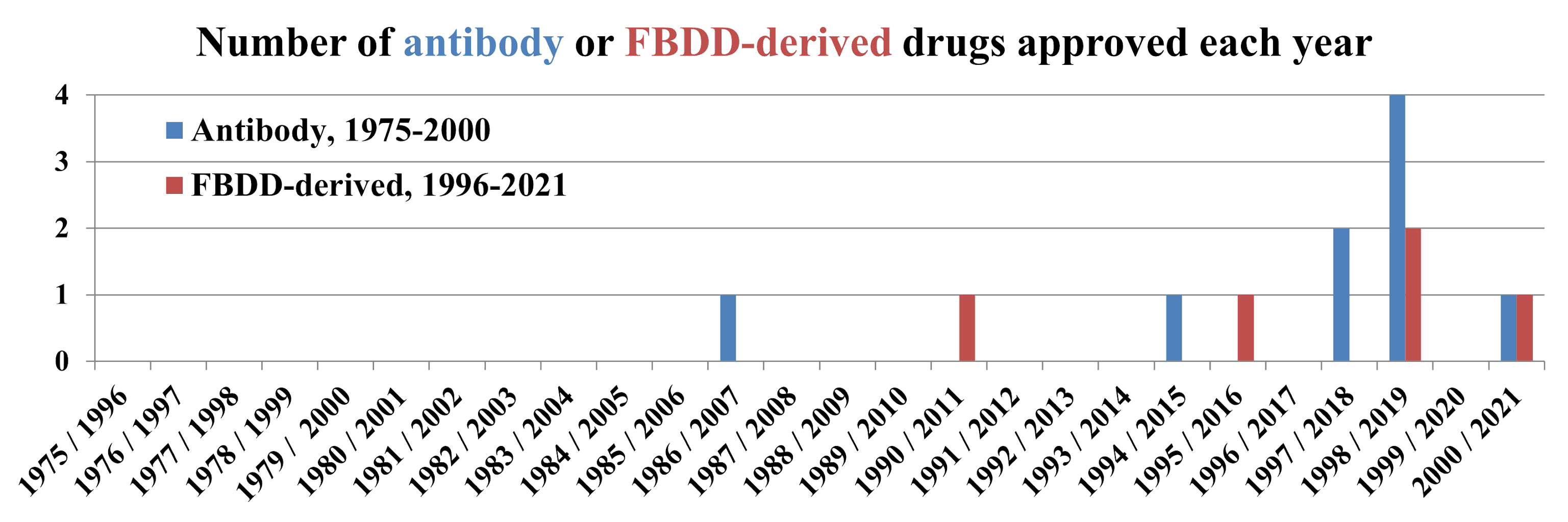
The first, by Asher Mullard, is entitled “FDA approves 100th monoclonal antibody product.” This is a nice review of a remarkably successful therapeutic approach. But this triumph was not a foregone conclusion. Mullard traces the field’s origin to the mid-1970s, and while the first drug was approved in 1986, it took another eight years for the second. The article includes a timeline showing approvals by year, and it is interesting to compare this with FBDD-derived drug approvals since the 1996 publication of the seminal SAR by NMR paper. In the chart below, the first year on the x-axis is for antibody drugs; the second is for FBDD-derived drugs.
 
 
A quarter century after work began, new antibody approvals were still uncommon; Mullard notes that “antibody approvals have only been an annual event since 2006.”
 
Antibody-drug conjugates (ADCs) are an interesting subset that – as their name suggests – comprise an antibody linked to a small molecule, usually a toxin intended to kill cancer cells. Ten of these have been approved in the US, but while the first (gemtuzumab ozogamicin) was approved in 2000 most of the rest are recent, with six of them coming since the beginning of 2019.
 
By these standards the fact that only five fragment-derived drugs have been approved thus far isn’t surprising. Indeed, antibodies have some advantages: “whereas medicinal chemists can toil for years to find small molecules with activity against a given target, antibody discovery can take a matter of months.” Moreover, as the article continues, success in the clinic is roughly double that of small molecules.
 
The second article is by Christopher Austin, until recently Director of the National Center for Advancing Translational Sciences at the US National Institutes of Health. Titled “Translational Misconceptions,” it briefly enumerates and debunks false beliefs about translating new discoveries into drugs, which include:
 
- Translation does not exist 
 
- Translation is a “thermodynamically favored” process 
 
- Translation is straightforward and does not qualify as science 
 
- Translation is a unidirectional process 
 
- Once an investigational therapy gets into humans for the first time, regulatory approval
  and marketing are all but assured 
 
- Regulatory approval is the end of the translational process
 
Those of us in industry would probably dismiss these statements as naïve, but such perceptions are widespread. Indeed, Austin himself acknowledges that he “once believed unquestioningly in all of them.”
 
Each of these misconceptions invites discussion. To take just the last, the first approved ADC was pulled from the US market in 2010 when confirmatory trials showed that patients on the drug actually did worse than those on placebo. It was reapproved in 2017 after a better dosing schedule was established. In other words, it took 17 years after initial approval to figure out how to effectively use gemtuzumab ozogamicin, and 26 years from the beginning of the project.
 
Returning to the two successes mentioned at the top of this post reveals that their apparent rapidity does not tell the full story. The Tethering technology that eventually led to sotorasib was initially published more than twenty years ago, and researchers first used mRNA packaged in liposomes to transfect cells way back in 1989.
 
Amidst rapid visible progress it is easy to lose sight of the fact that much research goes nowhere very slowly. Even when successful, it might take decades to help patients. As Austin concludes, “only by advancing our common understanding of the complexity of translation, translational research and translational science will translational gaps be narrowed and eventually eliminated.”

28 December 2020

Review of 2020 reviews

An old curse runs, "may you live in interesting times." And 2020 has been interesting indeed. Amid all the tumult, Practical Fragments will maintain its tradition of ending the year with a post highlighting conferences and reviews.
 
Despite the travel restrictions caused by COVID-19, some conferences did go ahead, adapted to online formats: I highlighted CHI’s Fifteenth Annual Fragment-based Drug Discovery and their Eighteenth Annual Discovery on Target. Although these were quite successful, I think most of us are looking forward to returning to in-person events sometime in the coming year.
 
Perhaps because so many people were stuck working from home, the number of reviews of potential interest to fragment fans has soared to a record number of more than twenty. I’ve tried to group these thematically.
 
General
If you’re looking for a concise yet thorough review, Harren Jhoti and colleagues at Astex provide one in Biochem. Soc. Trans. Harren is one of the pioneers of FBDD, and the review touches on library design, detection of fragment binding, and fragment to lead strategies. A review in Front. Mol. Biosci. by Qingxin Li (Guangzhou Sugarcane Industry Research Institute) goes into more detail on fragment screening, optimization, and biological targets.
 
For the past five years a few fragment fanciers (myself included) have been writing annual reviews in J. Med. Chem. covering fragment-to-lead success stories from the previous year, each with a handy table showing fragment, lead, and key parameters. The 2018 edition, led by yours truly (Frontier Medicines), was published at the beginning of the year, while the 2019 edition, led by Wolfgang Jahnke (Novartis), just came out a few weeks ago. At the risk of self-promotion, both are well worth perusing to see the growing diversity of targets and emerging trends, such as covalent fragments.
 
Biophysics
Biophysical methods are by far the most commonly used for finding fragments, and an excellent overview of thermal shift, SPR, and NMR by Joe Coyle and Reto Walser (Astex) appears in SLAS Discovery. The goal is “to help the anxious biophysicist withstand the relentless unforeseen,” and the paper provides loads of practical advice. For example, over more than 50 thermal shift screens, “we have never derived anything useful from negative Tm shifts.” The researchers note that “SPR is particularly user-friendly and particularly prone to artifact, overinterpretation, and varying degrees of frustration.” As for validating ligand-observed NMR hits crystallographically, rates range from 5% to 80%.
 
As we noted earlier this year, crystallography is becoming increasingly dominant in fragment screening, and in Molecules Laurent Maveyraud and Lionel Mourey (Université de Toulouse) provide an overview of the process, covering theory, workflow, practical aspects, pitfalls, examples, and other emerging methods. David Stuart and colleagues at Diamond Light Source discuss structural efforts on SARS-CoV-2 proteins in an open-access paper in Biochem. Biophys. Res. Commun. As of late October this included more than 500 released structures of 16 different proteins. Efforts against the main protease (which I reviewed in Nat. Commun.) have led to molecules with mid-nanomolar activity, and the researchers rightly highlight the worldwide collaboration that has led to such rapid progress.
 
NMR
NMR is of course a biophysical technique, but there are so many papers this year that it makes sense to group them into their own section. Ray Norton (Monash Institute of Pharmaceutical Sciences) and Wolfgang Jahnke (Novartis) introduce a special issue of J. Biomol. NMR focused on “NMR in pharmaceutical discovery and development” by briefly summarizing the state of the art and introducing 13 articles, one of which we covered previously and three of which are highlighted below.
 
“NMR in target driven drug discovery, why not?” ask Gregg Siegal and collaborators at ZoBio and Gotham in an (open access) J. Biomol. NMR review. In addition to characterizing small molecules, proteins, and their interactions, the researchers present cases studies in which NMR data has helped clarify a crystallographic protein-ligand structure, or even suggested that the crystal structure represented at most a minor conformation in solution.
 
In other words, NMR is “the swiss army knife of drug discovery,” as Reto Horst and colleagues at Pfizer put it in another J. Biomol. NMR review. The researchers describe successful NMR fragment screens against difficult targets such as an ion channel and a large (145 kDa) trimeric enzyme. They also make a good case for using NMR to determine the solution conformations of small molecules early in a project, a strategy that has paid off in more than 15 Pfizer projects over the past six years.
 
Benjamin Diethelm-Varela (University of Maryland) focuses on using NMR for “fragment-based drug discovery of small-molecule anti-cancer targeted therapies” in ChemMedChem. This is a thorough yet accessible overview of FBDD, ligand- and protein-based NMR methods, plus ten case studies. “A practical perspective on the roles of solution NMR spectroscopy in drug discovery” is provided by Qinxin Li and CongBao Kang (A*STAR) in Molecules. As the title suggests, this review is fairly broad, and includes an interesting section on NMR screening in cells.
 
All these papers might have you thinking that NMR is a “Gold Standard,” and that phrase does indeed appear in the title of another Molecules review by Abdul-Hamid Emwas (King Abdullah University of Science and Technology) and a multinational group of collaborators. This is a large (66 page) monograph with 455 references and is particularly detailed on various NMR techniques; if you want to see the pulse sequence of the HSQC experiment or review the Einstein-Stokes equation this is the place to turn.
 
In addition to the six reviews on NMR above, two specifically cover 19F NMR. The first, from the J. Biomol. NMR special issue by Claudio Dalvit (Lavis) and colleagues, focuses on fluorine NMR functional screening, or n-FABS. This paper provides an excellent theoretical and practical overview of the technique, and includes a handy table of 17 published case studies. And in Prog. Nuc. Mag. Res. Spect. Peter Howe (Syngenta) reviews “recent developments in the use of fluorine NMR in synthesis and characterization.” As the title suggests, much ground is covered, from spectrometer technology to quantum chemistry calculations, and there is a short section on fragment-based screening.
 
Computational
Turning to in silico techniques, Floriano Paes Silva Jr. and collaborators at LaBECFar and several other (mostly) Brazilian institutes provide an open-access overview in Front. Chem. After summarizing FBDD they describe how computational techniques can help along the way, from druggability prediction to docking, de novo design, and assessment of ADMET properties and synthetic accessibility. The review ends with several case studies.
 
In an open-access article in Drug Disc. Today, Stefano Moro and colleagues at University of Padova focus on “the rise of molecular simulations in fragment-based drug design.” This accessible overview covers hotspot identification, hit identification and characterization, and hit to lead optimization, and includes a nice section on free energy perturbation.
 
Other topics
Molecular properties are critical for developing good drugs, and in J. Med. Chem. Christopher Tinworth (GlaxoSmithKline) and Robert Young (Blue Burgundy) “appraise the rule of 5 with measured physicochemical data.” This is packed full of good stuff including a supplementary table with calculated and measured data for hundreds of compounds. The summary is that molecular weight is much less important than (measured) lipophilicity and hydrogen bond donors. “Good practice is all about compromise, aiming to maximize efficacy and efficiency while navigating many potential pitfalls in molecular optimization.” People sometimes obsess over rules vs guidelines, and the researchers close by stating that “rules are for the obedience of fools and guidance of the wise.”
 
As a poll from several years ago suggested, fragment linking tends to be less common than fragment growing, though it can work spectacularly. In J. Med. Chem. Isabelle Krimm and colleagues mostly at Université de Lyon review 45 successful fragment linking case studies (though it would have been appropriate for them to acknowledge Practical Fragments for the clearly borrowed table of clinical compounds). While by no means exhaustive, this is a useful resource. Interestingly, only 20% of the examples display superadditivity.
 
Target-guided synthesis (TGS) can be thought of as a special case of fragment linking. In J. Med. Chem., Rebecca Deprez-Poulain and colleagues at Université de Lille review kinetic TGS, in which two components react irreversibly with one another in the context of a protein to form a higher-affinity binder. Kinetic TGS may have some practical advantages over reversible TGS (or dynamic combinatorial chemistry), but as the researchers note most examples start with compounds larger than fragments, and thus only 38% of examples lead to products with a molecular weight less than 500 Da. This could partly explain why only 6 of the 50 reported examples have gone into animal studies.
 
Finally, György Keserű and collaborators at the Hungarian Research Centre for Natural Sciences review covalent fragment-based drug discovery in Drug Discovery Today (open access). Library design and validation is well-covered, as are various methods for screening covalent fragments, and there is a handy table of some four-dozen published examples. Given the increasing popularity of covalent FBLD, this contribution should be of wide interest.
 
When I wrote my concluding post for 2019, COVID-19 was an obscure and nameless disease, and SARS-CoV-2 had not even been identified. I ended with, "may 2020 bring wisdom, and progress." We've gained both, though the cost has been incalculable. So I'll just close this post by thanking you for reading and commenting.

31 December 2019

Review of 2019 reviews

The year ends, and with it the awkward teenage phase of the twenty-first century. As we have done since 2012, we're using this last post of the year to highlight conferences and reviews over the previous twelve months.

There were some good events, including CHI’s Fourteenth Annual Fragment-based Drug Discovery meeting in San Diego in April, their Discovery on Target meeting in Boston in September, and the third Fragment-based Drug Design Down Under 2019 in Melbourne in November, which also saw the launch of the Centre for Fragment-Based Design. Our updated schedule of 2020 events will publish next week.

Turning to FBLD reviews, Martin Empting (Helmholtz-Institute for Pharmaceutical Research Saarland) and collaborators published a general overview in Molecules. This is a nice up-to-date summary, covering library design, methods to find, confirm, and rank fragments, and optimization approaches. It’s also open access so you can read it anywhere.

Targets
Protein-protein interactions can be particularly challenging drug targets, and these are covered in a Eur. J. Med. Chem. review by Dimitrios Tzalis (Taros Chemicals), Christian Ottmann (Technische Universiteit Eindhoven) and colleagues. The focus is on clinical compounds, and several of these – including venetoclax, ASTX660, mivebresib, onalespib – are discussed in detail. The article is particularly useful in discussing late-stage optimization of pharmacokinetic and pharmacodynamic properties. It also provides a nice summary of physicochemical properties for fragment hits and derived candidates.

Target selectivity is always important, and this is the focus of a review in Exp. Opin. Drug Disc. by Rainer Riedl and collaborators at the Zurich University of Applied Sciences and the Università degli Studi dell’Insubria. Although the broader topic is de novo drug design, fragment-based methods are prominent, and include case studies we’ve discussed on nNOS, pantothenate synthetase, and MMP-13.

In terms of specific targets, Fubao Huang, Kai Wang, and Jianhua Shen at the Shanghai Institute of Materia Medica provide an extensive review of lipoprotein-associated phospholipase A2 (Lp-PLA2) in Med. Res. Rev. This serine hydrolase has been studied for four decades but – as the researchers note – “divergence seems to be ubiquitous among Lp-PLA2 studies.” At least this is not for lack of good chemical tools, fragment-derived (see here, here, and here) and otherwise.

Methods
Although NMR has fallen behind crystallography in our latest poll, that is certainly not reflected in terms of reviews. In particular, 19F NMR is covered in three papers. CongBao Kang (A*STAR) manages to pack a lot (including 261 references!) into a concise review in Curr. Med. Chem. Topics include protein-observed 19F NMR, in which one or more fluorine atoms are introduced into a protein genetically, enzymatically, or chemically, as well as ligand-observed methods, in which fluorine-containing small molecules are directly observed or used as probes that are displaced by non-fluorine-containing molecules.

Protein-observed 19F NMR (PrOF NMR) is covered in Acc. Chem. Res. by William Pomerantz and colleagues at the University of Minnesota. Although the first example was published 45 years ago, only in the past few years has the technique been used for studying protein-ligand interactions. The researchers note that introducing fluorines into aromatic residues is ideal because they are relatively rare, simplifying interpretation, and overrepresented at protein-protein interactions, maximizing utility. Several case studies are described, and even proteins as large as 180 kDa are amenable to the technique.

Ligand-based fluorine NMR screening is simpler and more common than techniques that focus on proteins, and this topic is thoroughly reviewed by Claudio Dalvit (Lavis) and Anna Vulpetti (Novartis) in J. Med. Chem. After a section on theory, the researchers discuss library design, including a long section on quality control (which involves assessing solubility, purity, and aggregation of the molecule in a SPAM filter). Direct and competition-based screening approaches are covered in detail; for the latter, a new method for determining binding constants is provided. The paper concludes with more than a dozen case studies. Clearly much has changed in the ten years since I wondered “why fluorine-labeled fragments are not used more widely.” This perspective is a definitive guide to the topic.

Moving to less common methods for characterizing fragments, György Ferenczy and György Keserű (Research Center for Natural Sciences, Budapest) cover thermodynamic profiling in Expert Opin. Drug Disc. After discussing several case studies, they conclude that “thermodynamic quantities are not suitable endpoints for medicinal chemistry optimizations” due to the complexity of contributing factors. This is consistent with another recent paper on the subject (see here), though the information provided is still interesting for understanding molecular interactions.

And although you might have thought the 2017 VAPID publication was the last word on the limitations of ligand efficiency (LE), Pete Kenny has published a splenetic jeremiad on the topic in J. Cheminform. (see also his blog post on the topic, which includes a sea serpent). This is largely a retread of a 2014 article on the same topic (reviewed by Teddy in his inimitable manner here). Pete also describes a more complicated alternative to LE involving residuals, though unfortunately he provides no evidence that it provides more useful information. Pete is of course correct to remind us that metrics have limitations, but assertions that LE “should not even be considered to be a metric” are overwrought.

Chemistry
Two articles discuss virtual chemical libraries. In J. Med. Chem., W. Patrick Walters (Relay Therapeutics) describes efforts to measure, enumerate, and explore chemical space. He notes that false positives could quickly overwhelm a virtual screen of a hundred million molecules, but as we saw earlier this year, progress is being made. Indeed, Torsten Hoffmann (Taros Chemicals) and Marcus Gastreich (BioSolveIT) focus on navigating the vastness of chemical space in Drug Disc. Today. They note that the Enamine REAL Space is up to 3.8 billion commercially accessible compounds, more than double the number of stars in the Milky Way. But this pales in comparison to the 1020 potential compounds in Merck’s MASSIV space. Just storing the chemical structures of these in compressed format would require 200,000 terabytes – and searching them exhaustively is beyond current technology.

Ratmir Derda and Simon Ng (University of Alberta) discuss “genetically encoded fragment-based discovery” in Curr. Opin. Chem. Biol. This involves starting with a known fragment that is then coupled to a library of peptides and screened to find tighter binders. The researchers provide a number of case studies, though adding even a small peptide to a fragment will generally have deleterious effects on ligand efficiency. And – Rybelsus not withstanding – oral delivery of peptides is challenging.

Finally, Vasanthanathan Poongavanam, Xinyong Liu, and Peng Zhang, and collaborators at Shandong University, University of Bonn, University of Southern Denmark, and K.U. Leuven review “recent strategic advances in medicinal chemistry” in J. Med. Chem. Among a wide range of topics from drug repurposing to antibody-recruiting molecules is a nice, up-to-date section on target-guided synthesis. As I opined a couple years ago, I still doubt whether this will ever be generally practical, but from an intellectual standpoint I’m happy to see work continue on the approach.

And with that, Practical Fragments says goodbye to the teens and wishes you all a happy new year. Thanks for reading and commenting. May 2020 bring wisdom, and progress.

17 February 2019

Metal-binding fragments vs GLO1

Practical Fragments has occasionally highlighted examples of metal-binding fragments. Strong interactions between low-molecular weight compounds and zinc, iron, or magnesium ions in metalloproteins makes for impressive ligand efficiencies. Unfortunately, some metal binders are PAINS and thus likely to inhibit a variety of targets; for others, the pharmacokinetic properties are not characterized. In a new J. Med. Chem. paper, Abraham Palmer, Seth Cohen, and colleagues at University of California San Diego describe a metallophilic molecule with in vivo efficacy.

The researchers were interested in glyoxalase 1 (GLO1), a zinc-dependent enzyme that catalyzes the clearance of the reactive metabolite methylglyoxal (MG). Although cytotoxic, MG may also have antidepressant effects. Thus, the researchers sought to find an inhibitor of GLO1.

They started by screening a library of 240 metallophilic fragments in a functional assay at 200 µM; more than 50 hits produced at least 50% inhibition. A second screen at 50 µM yielded 25 hits, including 8-MSQ.


Initial SAR studies revealed that both nitrogen atoms were essential for activity, suggesting a bidentate binding mode to the active-site zinc. Researchers at Chugai had previously reported a crystal structure of a very different molecule bound to GLO1, and this structure was used to model the binding mode of 8-MSQ. This exercise suggested growing from the sulfonamide, leading to compound 23. Incorporating information from other GLO1 inhibitors ultimately led to compound 60, with high nanomolar activity.

Those of you who have worked on drugs targeting the central nervous system may be concerned that compound 60 tends towards the large and lipophilic. However, when tested in mice at 12.5 mg/kg, it achieved a concentration of roughly 30 µM in the brain after two hours. Moreover, brain MG levels were increased 11-fold. Finally, mice dosed with compound 60 spent less time immobile in the forced swim test, a behavioral test used in rodent models of depression.

Overall, then, it seems that compound 60 has on-target activity in the brain and produces behavioral effects consistent with antidepressant activity. No selectivity data are provided, and because it could well be hitting other targets it is probably premature to use this as a chemical probe. Also, whether increasing the level of a toxic metabolite is a viable treatment for depression is likely to be hotly debated. Still, given the paucity of effective treatments for this widespread and devastating disease, it is nice to see researchers exploring bold mechanisms.

30 December 2018

Review of 2018 reviews

As 2018 recedes into history, we are using this last post of the year to do what we have done since 2012 – review notable events along with reviews we didn’t previously cover.

This was a busy year for meetings, starting in January with a FragNet event in Barcelona, then moving to San Diego in April for the annual CHI FBDD meeting. Boston saw an embarrassment of riches, from the first US-based NovAliX meeting, to a symposium on FBDD at the Fall ACS meeting, followed closely by a number of relevant talks at CHI’s Discovery on Target. Finally, the tenth anniversary of the renowned FBLD meeting returned to San Diego. Look for a schedule of 2019 events later this month.

If meetings were abundant, the same can be said for reviews.

Lead optimization
Writing in J. Med. Chem., Dean Brown and Jonas Boström (AstraZeneca) asked “where do recent small molecule clinical development candidates come from?” For three quarters of the 66 molecules published in J. Med. Chem. in 2016 and 2017 the answer is from known compounds or HTS, though fragments accounted for four examples. Although average molecular weight increased during lead optimization, lipophilicity did not, suggesting the importance of this parameter.

The importance of keeping lipophilicity in check is also emphasized by Robert Young (GlaxoSmithKline) and Paul Leeson (Paul Leeson Consulting) in a massive J. Med. Chem. treatise on lead optimization. Buttressed with dozens of examples, including several from FBLD, they show that the final molecule is usually among the most efficient (in terms of LE and LLE) in a given series, even when metrics were not explicitly used by the project team. Perhaps with pedants like Dr. Saysno in mind, they also emphasize the complexity of drug discovery, and note that “seeking optimum efficiencies and physicochemical properties are guiding principles and not rules.”

Lipophilic ligand efficiency (LLE) is also the focus of a paper in Bioorg. Med. Chem. by James Scott (AstraZeneca) and Michael Waring (Newcastle University). This is based largely on personal experiences and provides lots of helpful tips. Importantly, the researchers note that calculated lipophilicity values can differ dramatically from measured values, and go so far as to say that “this variation is sufficient to render LLEs derived from calculated values meaningless.”

Turning wholly to fragments, Chris Johnson and collaborators (including yours truly) from Astex, Carmot, Vrije Universiteit Amsterdam, and Novartis have published an analysis in J. Med. Chem. of fragment-to-lead success stories from last year. This review, the third in a series, also summarizes all 85 examples published between 2015 and 2017, confirming and expanding some of the trends we mentioned last year.

Targets
Two reviews focus on specific target classes. Bas Lamoree and Rod Hubbard (University of York) cover antibiotics in SLAS Discovery. After a nice, concise review of fragment-finding methods, the researchers discuss a number of case studies, many of which will be familiar to regular readers of this blog, including an early example of whole-cell screening.

David Bailey and collaborators from IOTA and University of Cambridge discuss cyclic nucleotide phosphodiesterases (PDEs) in J. Med. Chem. The researchers provide a good overview of the field, including mining the open database ChEMBL for fragment-sized inhibitors. As they point out, the first inhibitors discovered for these cell-signaling enzymes were fragment-sized, so it is no surprise that FBLD has been fruitful – see here for an example from earlier this year. Interestingly though, although at least six fragment-sized PDE inhibitor drugs have been approved, none of these were actually discovered using FBLD.

PDEs are an example of “ligandable” targets, for which small molecule modulators are readily discovered. In Drug Discovery Today, Sinisa Vukovic and David Huggins (University of Cambridge) discuss ligandability “in terms of the balance between effort and reward.” They use a published database of protein-ligand affinities to develop a metric, LIGexp, for experimental ligandability, and also describe their computational metric, Solvaware, which is based on identifying clusters of water molecules binding weakly to a protein. Comparisons with experimental data and with other predictive metrics, such as FTMap, reveal that while the computational methods are useful, there is still room for improvement.

We have previously written about how target-guided synthesis methods such as dynamic combinatorial chemistry have – despite decades of research – yielded few truly novel, drug-like ligands. Is this because the targets chosen were simply not ligandable? In J. Med. Chem., Anna Hirsch and collaborators at the University of Groningen, the Helmholtz Institute for Pharmaceutical Research, and Saarland University review some (though by no means all) published examples and examine their computationally determined ligandability scores. There seems to be no difference between these targets and a set of traditional drug targets.

Finding fragments
Crystallography continues to be a key tool for FBLD: as we noted in the review of the 2017 literature, 21 of the 30 examples made use of a crystal structure of either the starting fragment or an analog, and only 3 projects didn’t use crystallography at all. That said, FBLD is possible without crystallography, as illustrated through multiple examples in a Cell Chem. Biol. review by Wolfgang Jahnke (Novartis), Ben Davis (Vernalis), and me (Carmot).

In the absence of a crystal structure, NMR is best suited for providing structural information, and this is the subject of a review in Molecules by Barak Akabayov and colleagues at Ben-Gurion University of the Negev. The researchers provide a nice summary of NMR screening methods and success stories within a broader history of FBLD. They also include an extensive list of fragment library providers as well as a discussion of virtual screening.

Speaking of virtual screening, three reviews cover this topic. In Methods Mol. Biol., Durai Sundar and colleagues at Indian Institute of Technology Delhi touch on a number of computational approaches for de novo ligand design, though the lack of structures sometimes makes it challenging to read. A broader, more visually appealing review is published in AAPS Journal by Yuemin Bian and Xiang-Qun Xie at University of Pittsburgh. In addition to an overview and case studies, the researchers also provide a nice table summarizing 15 different computational programs. One of these, SEED, is a main focus of a review in Eur. J. Med. Chem. by Jean-Rémy Marchand and Amedeo Caflisch (University of Zürich). The researchers describe how this docking program can be combined with X-ray crystallography (SEED2XR) to rapidly identify fragments; we highlighted an example with a bromodomain. Their ALTA protocol uses SEED to generate larger, more potent molecules, as we described for the kinase EphB4. The researchers note that together these protocols have led to about 200 protein-ligand crystal structures deposited in the PDB over the past five years.

Rounding out methods, Sten Ohlson and Minh-Dao Duong-Thi (Nanyang Technological University) provide a detailed how-to guide in Methods for performing weak affinity chromatography, and how this can be combined with mass spectrometry (WAC-MS), as we noted last year.

Chemistry
One drawback of some computational approaches for fragment optimization is that they do not consider synthetic accessibility. In Mol. Inform., Philippe Roche, Xavier Morelli, and collaborators at Aix-Marseille University and Institut Paoli-Calmettes focus on hit to lead approaches that do, and provide a handy table summarizing nearly a dozen computational methods. We highlighted one from the authors, DOTS, earlier this year.

DOTS is an example of using DOS, or diversity-oriented synthesis. In Front. Chem., David Spring and colleagues at University of Cambridge review recent applications of DOS for generating new fragments, some of which we recently highlighted. Only a couple examples of successfully screening these new fragments are described, but the authors note that this is likely to increase as virtual library screening continues to advance.

Perhaps the most productive fragment of all time is 7-azaindole, the origin of three fragment-derived clinical compounds. (The moiety appears in both approved FBLD-derived drugs, vemurafenib and venetoclax.) Takayuki Irie and Masaaki Sawa of Carna Biosciences devote their attention to this little bicycle in Chem. Pharm. Bull. The researchers count six clinical kinase inhibitors that contain 7-azaindole (not all from FBLD) as well as more than 100,000 disclosed compounds containing the fragment. More than 90 kinases have been targeted by molecules containing 7-azaindole, and the paper provides a list of 70 PDB structures of 37 different kinases bound to molecules containing the moiety.

Finally, in J. Med. Chem., Brian Raymer and Samit Bhattacharya (Pfizer) survey the universe of “lead-like” drugs. Among the most highly prescribed small molecule drugs, 36% have molecular weights below 300 Da. Only 28 of 174 drugs approved between 2011 and 2017 fall into this category, consistent with the increasing size of newer drugs. The researchers discuss 16 recently approved drugs, and find that 13 have very high ligand efficiencies (at least 0.4 kcal mol-1 per heavy atom). As noted above, optimization often entails adding molecular weight by growing or linking, and the researchers suggest that alternative strategies such as conformational restriction and truncation also be investigated.

And with that, Practical Fragments wishes you a happy new year. Thanks for reading some of our 686 posts over the past decade plus, and please keep the comments coming!