Showing posts with label virtual screening. Show all posts

31 August 2026

Fragments find cryptic sites on ARID1B

We’ve written previously about the concept of synthetic lethality, in which changes to one protein make cancer cells more dependent on another. Inhibiting this second protein allows selective targeting of cancer cells while sparing normal cells. One such opportunity is the pair of proteins ARID1A and ARID1B, which assemble into a large complex that helps remodel chromatin to regulate transcription. ARID1A is mutated in some 9% of cancers, and ARID1B can partially compensate. CRISPR knockdown studies show that these cancer cells are dependent on ARID1B. ARID1B is huge (2236 amino acids!) and predicted to be mostly disordered – not the easiest target for small molecule drugs. However, a small 109-residue AT-Rich Interactive Domain (ARID), which binds to DNA, had previously been crystallized. This domain is the focus of a new Proc. Nat. Acad. Sci. USA paper by Michael Holliday and colleagues at Relay Therapeutics.
 
Computational assessment using Schrödinger’s SiteMap did not show any ligandable pockets, but molecular dynamics revealed that the N-terminal helix might open to reveal a shallow hydrophobic groove beneath it. Thus encouraged, the researchers performed a 2D NMR (15N-SOFAST-HMQC) screen of 480 fragments and obtained two hits, both with weak but measurable affinities. Interestingly though, the NMR signals are consistent with slow kinetics, suggesting that the molecules bind to rare conformations of the protein. Chemical shift perturbation (CSP) mapping showed that the two fragments bind near one another but not exactly at the same site.
 
Crystallography revealed that compound A-1 bound to a previously cryptic tunnel of ARID that forms by the displacement of a tryptophan side chain – a motion not seen in the molecular dynamics simulation. Preliminary medicinal chemistry improved the potency to mid-micromolar affinity.

 
Compound B-1 proved recalcitrant to crystallography, but cocrystallization with the more potent compound B-2 yielded a high resolution structure. This molecule did in fact bind where the N-terminal helix normally binds, as predicted by molecular dynamics; the helix itself became disordered.
 
But wait, there’s more! To find additional chemical matter, the researchers conducted a virtual screen of 150,000 compounds against ARID. Of the several dozen molecules tested by 2D-NMR, two showed CSPs similar to those caused by compound A-1, and their binding modes were confirmed by crystallography. But one of the molecules that showed CSPs similar to those caused by compound B-1 also caused CSPs in a different region of the protein, and crystallography confirmed binding to yet a third site.
 
In order for the compounds to be selective for cancer cells they need to be selective for ARID1B over ARID1A, which is 83% identical in the ARID domain. NMR experiments revealed that the molecule that binds to the third site binds with similar affinity to ARID1A, while compound A-2 binds about 5-fold less tightly. Happily, compound B-2 showed no binding to ARID1A even at 10 mM. Thus, the researchers have found three starting points for optimization, and evidence that selectivity is possible.
 
As the researchers acknowledge, the compounds will require “substantial additional optimization,” not least for affinity. Intriguingly though, compounds A-2 and B-2 do bind sufficiently close to one another that a fragment linking or merging approach may be warranted.
 
So in the end, ARID1B ARID presents two cryptic sites and a third more conventional (albeit challenging) site. The presence of multiple small-molecule binding sites is consistent with this paper from 2016, but still surprising in such a small protein. As we noted then, just because a site binds fragments does not mean it will support high-affinity ligands. Will ARID1B turn out to be like KRAS, which ended up being druggable, or like IL-1β, which has resisted high-affinity small molecules? The current paper provides good starting points toward answering this question.

14 June 2026

Vast fields of biologically active chemical space

Exactly 17 years ago, I highlighted a paper from Brian Shoichet’s lab in which he hypothesized that only tiny regions of chemical space are biologically relevant. If so, Practical Fragments quoted, “a major reason why the screening of synthetic compounds ever finds notable hits is that our libraries are biased toward the sort of molecules that proteins have evolved to recognize.” The best scientists continually question their assumptions, and this is exactly what Brian, Bryan Roth, and collaborators at University of California San Francisco and University of North Carolina at Chapel Hill have done in a new open-access J. Med. Chem. paper.
 
The idea that molecules more closely resembling metabolites and natural products would be more likely to be biologically active is reasonable given the promiscuity of many naturally occurring molecules. As the researchers point out, dopamine signals through 5 receptors, while serotonin binds to 14. Nature is the ultimate recycler, constantly reusing chemical motifs.
 
But since 2009 there has been a massive growth of make-on-demand libraries, and these have increasingly diverged from known molecules. Brian has been among the most prolific explorers of this new chemical space, and as he noted in his keynote at DDC 2026, these gargantuan libraries are yielding more hits against more targets.
 
Are these hits more selective? In other words, are molecules that are less “bio-like” likely to bind to fewer targets? This is the question the new paper addresses, focusing on the 5-HT2A serotonin receptor (5-HT2AR), the target for a variety of drugs including psychedelics. The researchers have extensively studied this GPCR; we wrote about a successful computational screen here. In the new paper, the researchers compared hits from a previous “make-on-demand” (MoD) library screen of 1.6 billion molecules with a new screen of 3.5 million “in-stock” molecules. As predicted, the in-stock compounds were much more bio-like than the MoD compounds as assessed by several metrics (Tanimoto similarity, Avalon fingerprints, and RDK7 fingerprints, for the cheminformatics aficionados among you).
 
Both libraries were computationally screened using DOCK3.8 against 5-HT2AR. Of the top scoring hits, 85 molecules from the in-stock library and 384 molecules from the MoD library were tested in a radio-ligand displacement assay. Hit rates were nearly identical at around 24% each. Functional assays revealed the hits to be active, with some acting as agonists while others were antagonists.
 
When tested against related GPCRs, specifically 5-HT2BR and 5-HT2CR, the in-stock molecules were more promiscuous than the MoD molecules. But when tested against a panel of 318 GPCRs there were no differences: the in-stock molecules bound on average 1.7% of the receptors while the MoD molecules bound on average 2.1%. The similar promiscuity persisted even when focusing on the 55 aminergic GPCRs (5-HT2AR is an aminergic GPCR). In fact, the most promiscuous compound of all came from the MoD set and is distinctly not bio-like.
 
Of course, this is just one study, but I suspect it will generalize. In 2009 I questioned whether biologically relevant chemical space is really so sparse. As I wrote then, “consider a vast field of some crop that can only be harvested by night. There are lights scattered haphazardly throughout the field. One might expect that the crops immediately under the lamp posts would be harvested more intensively than crops in darker parts of the field, even if other areas are equally productive. In this scenario, the lamp posts reveal natural products and similar molecules, but much – or even most – of (unlit) chemical space may also be biologically active, it just hasn’t been sampled yet.”
 
There is grandeur in this view of chemical space, which is supported by the new paper. Imagine yourself in the midst of the field on a moonless night. Turn on your headlamp and step forward in any direction. Drug leads glimmer as far as your light can reach.

03 June 2024

Throwing the kitchen sink at IL-1β

Last year we highlighted a paper out of Novartis describing a fragment-to-lead story for interleukin-1 beta (IL-1β), a pro-inflammatory cytokine implicated in numerous diseases. The approved antibody drug canakinumab targets IL-1β, but a small molecule would provide easier oral dosing as well as better access to tissues such as the central nervous system. A new paper in J. Med. Chem. by Anna Vulpetti, Konstanze Hurth, and their Novartis colleagues describes the multiple approaches they've taken. (Anna also presented this work at Fragments 2024.)
 
The paper starts by summarizing the fragment work we described here. Notably, of nearly 4000 fragments screened, only a single super-sized fragment was validated, and it was quite weak. The researchers were able to optimize this to a molecule that inhibits binding of IL-1β to its receptor with an IC50 = 1.1 µM.
 
Starting from the initial fragment hit, the researchers performed virtual screens to find alternative binders. Of 281 selected for testing by 19F NMR or TR-FRET, two hits were obtained, one with an affinity of around 230 µM and the other worse than 1 mM. These molecules were similar to each other, and merging them led to a 43 µM binder. All molecules exceeded conventional fragment size, with the smallest containing 24 non-hydrogen atoms. We’ve previously discussed the possible need for larger fragments for difficult targets such as protein-protein interactions.
 
In addition to FBLD, the researchers also performed DNA-encoded library (DEL) screens using 15 libraries containing >1.6 billion molecules. This led to one family of hits, one member of which inhibited binding of IL-1β to its receptor with an IC50 = 8.3 µM. This molecule contains an aldehyde moiety, a reversible covalent electrophile. Subsequent experiments confirmed that the aldehyde reacts with a lysine residue on IL-1β, and the researchers were able to improve the potency to 1.2 µM. This molecule is even larger than the hit derived from fragments, with >50 non-hydrogen atoms. Interestingly, the molecule binds at a different site on the protein from the initial fragment hit.
 
Finally, the researchers screened a library of macrocyclic peptides in an mRNA display system. The macrocycles consisted of 10-14 amino acid residues, and the library was impressively large, containing “<1013 unique cyclic peptides.” This effort yielded a 14 µM inhibitor. Strikingly, crystallography revealed that the molecule binds at a site distinct from either the fragment- or DEL-derived hits.
 
This paper is a tour de force addressing a difficult target. Although the researchers conclude that the protein is “ligandable,” the physicochemical properties of all the hits will need to be improved, along with the affinities, in order to make useful chemical probes, let alone drugs. On the other hand, the fact that the ligands bind to different sites and yet can all inhibit the protein-protein interaction is encouraging, offering multiple opportunities for optimization.

18 December 2023

Review of 2023 reviews

The annual Practical Fragments look-back on the preceding year may not be the most highly anticipated year-end tradition, but I hope you find something of interest in this twelfth edition.
 
I was fortunate to attend several conferences and wrote about CHI’s Discovery on Target in Boston and Drug Discovery Chemistry in San Diego. As for reviews, Louise Walsh and collaborators at Astex, Vrije Universiteit Amsterdam, Novartis, and Frontier Medicines (me!) published our annual analysis of fragment-to-lead success stories in J. Med. Chem., this one covering the year 2021. Some twenty other reviews of interest to this readership were also published. I’ll cover them thematically below.
 
Methods
Crystallography is the most popular fragment-finding technique, and in Expert Opin. Drug Disc. Wladek Minor and collaborators at University of Virginia and Jagiellonian University examine “the current role and evolution of X-ray crystallography in drug discovery and development.” At the start of 2023 the Protein Data Bank (PDB) contained more than 200,000 structures, which sounds impressive until you learn that the AlphaFold database contains more than 200 million predicted protein structures. But this is not experimentalist vs machine: the researchers note how machine learning approaches can be used to more rapidly refine and improve experimental data with resources such as CheckMyBlob and PDB-REDO.
 
For those wishing to dig deeper, two papers in Methods Enzymol. go into experimental detail. In the first, Natalie Tatum and colleagues at Newcastle University describe “crystallographic fragment screening in academic drug discovery.” May Sharpe and collaborators at the Swiss Light Source and University of Hohenheim describe their fast fragment-screening pipeline in a comprehensive (49 page) guide. The focus is on reproducibility, and there is plenty of practical advice. For example, “the authors have even been successful in flying with crystal plates,” though getting these through airport security may be easier in some countries than others.
 
Protein-detected NMR was the first truly practical fragment-based approach, and another paper in Methods Enzymol. by Brian Volkman, Brian Smith, and colleagues at Medical College of Wisconsin describes “fragment-screening by protein-detected NMR.” This distills eight years of effort building their internal protein-detected NMR fragment screening platform that has been applied to 16 proteins thus far. The chapter is particularly detailed on protein and library preparation and screening.
 
Compared with crystallography and NMR, virtual screening can be dramatically faster; we’ve highlighted multibillion-compound screens. In WIREs Comput. Mol. Sci., Artem Cherkasov, Francesco Gentile, and colleagues at University of British Columbia and University of Ottawa discuss (open access) how computational methods are “keeping pace with the explosive growth of chemical libraries.” They cover brute force methods, fragment-based virtual screening, and machine-learning based methods, all while avoiding hype, and conclude that it will take time for these methods to “have a real impact on practical drug discovery.”
 
Finally, Marianne Fillet and collaborators at University of Liege and University of Namur provide a general review in Trends Anal. Chem. covering multiple methods to detect non-covalent fragments. These include established techniques such as biochemical assays, ligand-observed NMR, crystallography, thermal shifts, and SPR, as well as less common ones such as WAC, microscale thermophoresis, ACE, and DEL. The paper includes several nice tables and even a decision tree to help choose among the various approaches.
 
Covalent fragments
Many techniques to detect noncovalent interactions also apply to reversible covalent inhibitors, the subject of a review in Med. Chem. Res. by Faridoon and collaborators at Genhouse Bio and Olema Oncology. The researchers focus on various warheads including cyanoacrylamides, nitriles, ketones and aldehydes, boronic acids, and others, and provide multiple examples for each.
 
In contrast, an open-access review in Pharmaceuticals by Monique Multeder and collaborators at Leiden University Medical Center discusses methods to detect both reversible as well as irreversible covalent protein-drug adducts. Crystallography is the most informative, but the researchers also delve into various mass-spectrometry techniques including top-down (with intact proteins) and bottom-up (after digestion of modified proteins). Also covered are activity-based protein profiling (ABPP) methods, NMR, and fluorescence-based approaches. The nearly 300 references make a useful compendium.
 
One of the most exciting recent developments is “proteome-wide fragment-based ligand and target discovery,” the subject of an open-access review in Isr. J. Chem. by Ines Forrest and Christopher Parker, both at Scripps. This concise, highly readable account covers a lot of ground, from ABPP to fully functionalized fragments (FFFs) to phenotypic screening.
 
If you’re doing covalent FBLD you’ll need a library of covalent fragments, and if you’re building one, I’d recommend a review in Prog. Med. Chem. by David Mann and colleagues at Imperial College London. The paper nicely summarizes design principles such as choice of warhead and the fact that reactivity can vary considerably even among compounds with the same warhead. Synthetic methods and screening approaches are also well covered, along with methods to distinguish specific binding from nonspecific reactivity.
 
Most covalent fragments target cysteine residues, but there at least nine other potentially reactive amino acids, and these are the subject of an open-access review by György Keserű and colleagues at Budapest University of Technology and Economics in Trends Pharm. Sci. Lysine, serine, threonine, tyrosine, and histidine are the most common targets, though some of the warheads are so reactive that specificity will be challenging, let alone reasonable pharmacokinetic properties. This is especially true for aspartic and glutamic acids, methionine, and tryptophan.
 
Finally, another article in Trends Pharm. Sci. by Carlo Ballatore and colleagues at University of California San Diego describes using covalent strategies to develop stabilizers and inhibitors of protein-protein interactions (PPIs). Site-directed fragment tethering with disulfide and imine chemistry is a focus, particularly in the context of 14-3-3 proteins. Proximity-enabled covalent strategies, in which warheads are grafted onto non-covalent molecules, are also covered. There is also a short section on covalent PROTACs – more on that topic below.
 
Targets
Keeping with the theme of protein-protein interactions, Ge-Fei Hao, Guang-Fu Yang, and collaborators at Central China Normal University and Guizhou University discuss fragment-based approaches against “undruggable” PPIs in Trends Biochem. Sci. After describing why protein-protein interactions can be difficult, the paper presents several successful case studies, including venetoclax, sotorasib, and targeting 14-3-3 proteins.
 
Targeted protein degradation continues to be a major focus for drug discovery, and this is commonly achieved by hijacking E3 ligases to cause them to ubiquitinate a target of interest. Iacovos Michaelides and Gavin Collie (AstraZeneca) describe how FBLD has been used to find ligands against E3s in an open-access J. Med. Chem. paper. There are more than 600 E3s, and because their biology relies on protein-protein interactions they are often tough targets. Fragment hits can be weak and difficult to advance, though the researchers do describe several success stories including against KEAP1 and XIAP/cIAP. Covalent fragments have the potential to permanently reprogram E3 ligases, and these are covered well too.
 
Another difficult type of target is RNA, the topic of two reviews. In an open-access Curr. Opin. Struct. Biol. paper Kevin Weeks and colleagues at University of North Carolina Chapel Hill provide a concise and beautifully illustrated overview of the field. They note that “RNA-targeted FBLD is in its infancy,” but given that the first report dates to 2002 it is a long childhood, and the paper does a good job of describing the challenges.
 
A more extensive treatment of “fragment-based approaches to identify RNA binders” is provided by Matthew Disney and colleagues at UF Scripps in J. Med. Chem. The paper describes many case studies, some of which we’ve covered, and also contains a handy table comparing the pros and cons of a dozen different methods for finding RNA-binding fragments.
 
Tuberculosis kills more than 1.5 million people each year, and fragment-based approaches have been applied against multiple targets within the pathogen, as reviewed by Baptiste Villemagne and colleagues at University Lille in Eur. J. Med. Chem. We’ve covered many of these studies on Practical Fragments, but as the paper notes none have advanced to the clinic. This is attributed in part to cell permeability, and the researchers suggest turning to phenotypic screens (see below).
 
Other
Fragment linking can be difficult but highly effective, especially for difficult targets. An overview of published linkers is provided by Isabelle Krimm and collaborators at Université Claude Bernard Lyon and Université Montpellier in Expert Opin. Drug Disc. The paper includes a table summarizing 40 fragment linking stories, noting that most linkers are short and flexible. Another table summarizes 19 examples of target-guided synthesis, including dynamic combinatorial chemistry. As the paper notes, all of these are small model studies based on known compounds. In silico approaches, the last topic covered, will probably prove more practical.
 
And on the subject of practical, Dean Brown (Jnana Therapeutics) provides an “analysis of successful hit-to-clinical candidate pairs” in J. Med. Chem. This is an update to his 2018 article and captures 156 clinical candidates reported in the journal between 2018 and 2021. Of these, 14 had fragments in their lineage. Most of these drugs appear in our list of fragment-derived clinical candidates (though berotralstat does not – I’ll need to look closer). The paper contains lots of interesting analyses. For example, of the 138 oral drugs, 39 had a molecular weight > 500 Da, 24 had Clog > 5, and 17 had more than 10 hydrogen bond acceptors (HBA). On the other hand, none had more than 5 HBD, emphasizing that you should be parsimonious with hydrogen bond donors.
 
Finally, veteran drug hunter Nicholas Meanwell provides “reflections on a 40-year career in drug design and discovery” (open access) in Med. Chem. Rev. Those of you who saw his talk earlier this year at the CHI DDC meeting will know what to expect, and those of you who didn’t will be in for a treat. A personal and entertaining romp through pharma starting in the early 1980s, the paper is full of surprises, such as the pursuit of minor impurities in a phenotypic screen that ultimately led to the hepatitis C drug daclatasvir. Nicholas notes that “you discover what you screen for, so screen design is of paramount importance.”
 
The paper also reveals a passion for medicinal chemistry: “In a search for inspiration for design concepts, I sat down one Saturday afternoon in early October of 1987 and perused every molecule in the United States Adopted Names (USAN) dictionary.” And, as he notes near the end, “Decision making in drug discovery and development is a delicate balancing act, inherently flawed based on absence of predictive accuracy, and knowing when to conclude a discovery program with grace is also an important trait.” That said, he provides examples of successful programs that were almost killed multiple times – and others that were killed at Bristol Myers Squibb but subsequently succeeded elsewhere. While this is frustrating on one level, Nicholas takes satisfaction in the fact that “the science that we conducted and the molecules and pharmacophores that we defined have been of benefit to mankind.”
 
There are still a couple weeks left in the year, but that’s it for Practical Fragments for 2023. Thanks for reading, and special thanks for commenting. And if you live in one of the 70+ countries with elections in 2024, please vote.

26 June 2023

Fragment merging in silico, two ways

Roughly speaking there are three ways to advance fragments to leads: growing, linking, or merging. Growing is the most common, but as the number of crystal structures of bound fragments continues to increase so too does the opportunity for fragment merging, in which elements of two fragments are combined into a new molecule. In a new (open access) J. Chem. Inf. Mod. paper, Charlotte Deane and collaborators at University of Oxford, Informatics Matters, Vernalis, and LifeArc compare two in silico methods.
 
Fragment merging, as described in the paper, “is used for fragments that bind in partially overlapping space by designing compounds that incorporate substructural features from each.” Each fragment may have extraneous bits that are not kept in the merged molecule. Indeed, sometimes only a small portion of one of the fragments is incorporated into the final molecule. (Both these concepts are shown in an example we recently wrote about here.)
 
When chemists merge two fragments, they consider the synthetic tractability of the merged molecules. Computers, on the other hand, sometimes propose compounds that are either unreasonable or would require a doctoral-thesis worth of effort to make. One solution is to invert the problem: rather than trying to assess whether specific in-silico-generated molecules can be made, possible merged molecules can be searched against a large virtual library of synthetically accessible molecules for similar compounds (see for example here).
 
A key question for this approach is the definition of similar. The most common method for finding similar molecules is by reducing them to molecular “fingerprints,” such as the presence or absence of a chlorine atom. The more fingerprints two molecules have in common, the more similar they are; this is the approach used for Tanimoto similarity.
 
An alternative approach is to use a “graph database” in which molecules are represented as nodes and edges, with nodes being substructures and edges being connections between the substructures. This approach was described by researchers from Astex as the Fragment Network.
 
Which of these approaches works better?
 
In the new paper, the researchers built a virtual library of more than 120 million commercially available molecules. They then selected four proteins with published crystallographic fragment hits. Between 9 and 19 individual fragments were chosen for merging for each protein, forming 55 to 134 potentially mergeable pairs. These were then computationally merged and queried against the database using either similarity searching or the Fragment Network.
 
Both search methods yielded comparable numbers of possible hits, ranging from just under 23,000 to nearly 169,000 per protein. These were then computationally filtered to find those molecules most likely to bind to the proteins, resulting in 56 to 952. Interestingly though, the specific molecules varied considerably depending on which search method was used. In fact, molecules from the Fragment Network mostly occupied different regions of chemical space than those found using similarity searching. Moreover, in many cases fragment pairs yielded merged compounds from one method but not the other. The number of predicted interactions with the protein targets also differed, and these differences extended not just to specific interactions but also to functional diversity.
 
The researchers did not purchase and test compounds themselves, but they did run the analysis against two published examples of fragment merging (one of which we wrote about here) and found that both the Fragment Network and similarity searching could find molecules related to experimentally validated binders.
 
The question of which approach works better remains open, so the researchers suggest using both. They do note that running a Fragment Network search is computationally less demanding, in this case taking an average of 2 to 14 minutes of CPU time vs 40 minutes for the similarity search. These differences become even more significant when searching billion-compound libraries.
 
Importantly, the researchers provide the code to generate your own Fragment Network, so you can try this at home. I look forward to seeing how the two techniques perform prospectively.

01 May 2023

Fragments vs metallo-beta-lactamases

With all the attention on COVID-19 over the past few years, it’s easy to forget about bacteria. But they haven’t forgotten about us. Indeed, antibiotic resistance genes are continuing to spread throughout the microbial world. One class of genes encode the metallo-beta-lactamases (MBLs), which hydrolyze beta-lactam antibiotics. In a recent J. Med. Chem. paper, Mihirbaran Mandal, Li Xiao, and colleagues at Merck describe their efforts against these enzymes. (Mihirbaran spoke about this work at the CHI DDC meeting a few weeks ago.)
 
The researchers started by turning to the literature and previous internal efforts. Tetrazole-containing molecules had been identified as MBL inhibitors, and a virtual screen led to the selection of 76 compounds for testing, of which 29 inhibited the enzyme NDM-1, one of several known MBLs. These included fragment-sized compound 13, and a subsequent screen also identified compound 14.

 
Crystal structures of both these molecules revealed that they bind in the active site. The tetrazole makes interactions with one of the catalytic zinc ions, while the proximal sulfonamide moiety in compound 14 makes interactions with both zinc ions by displacing a bridging hydroxide ion. Merging compounds 13 and 14 led to compound 18, with nanomolar activity against NDM-1 as well as two other MBLs.
 
Despite its metal-chelating sulfonamide moiety, compound 18 was inactive against 34 mammalian metalloenzymes tested. It also didn’t inhibit any of 114 potential off-targets in a Eurofins screen. As expected, the molecule alone had no bactericidal activity, but it did enhance the activity of the beta-lactam antibiotic imipenem in MBL-expressing bacteria. Increasing the polarity of the molecule by adding a hydroxyl moiety to a solvent-exposed region and converting a phenyl to a pyridyl ring resulted in compound 23. While less active against isolated MBL enzymes, this molecule was more effective at inhibiting bacterial growth in the presence of imipenem, possibly due to accumulation in the periplasmic space.
 
Compound 23 is clean against off-targets such as hERG, ion channels, and various CYP enzymes. It has reasonable pharmacokinetic properties in mice when dosed intravenously. In a preliminary mouse efficacy study, the compound reduced levels of bacteria in spleen and kidney when dosed with imipenem.
 
This is a nice example of structure-based design starting from fragment-sized molecules. With an abundance of nitrogen atoms and a ClogP < 0, compound 23 looks unusual. Nonetheless, the researchers write that “further evolution of this class of molecules… eventually led to the discovery of several clinical candidates.” I look forward to seeing these described.

22 December 2022

Review of 2022 reviews

The winter solstice is behind us in the Northern Hemisphere, which means 2022 is rapidly drawing to a close. As we have done for the past decade, Practical Fragments will spend this last post of the year summarizing conferences and reviews.
 
The remarkable progress in vaccines against SARS-CoV-2 allowed the full return of in-person conferences, and it was nice to see folks at CHI’s Discovery on Target in Boston and Drug Discovery Chemistry in San Diego. Nearly twenty reviews of interest to this readership were published, and these are covered thematically.
 
Targets
Several reviews cover the use of FBLD to target antiviral and antibacterial targets. Sangeeta Tiwari and colleagues at University of Texas El Paso cover both in an open access Pharmaceuticals review, focusing on tuberculosis and HIV, which often afflict the same individuals, leading to worse outcomes. The paper includes several tables with chemical structures, though the fragment origins of some molecules are not apparent.
 
Tuberculosis is caused by Mycobacterium tuberculosis, but there are more than 170 known members of the Mycobacteriaceae family. In an open access Int J. Mol. Sci. paper, the Tiwari group describes fragment-based approaches against these bugs. In addition to multiple examples, the review provides summaries of fragment finding methods and some of the challenges the field faces.
 
Another organism, Pseudomonas aeruginosa, infects the lungs of people with cystic fibrosis. In an open access Front. Mol. Biosci. paper, Tom Blundell and collaborators at University of Cambridge summarize fragment-based campaigns against this organism and its enzymes. The authors focus on structure-guided methods and note that the work is “at an early stage” but encouraging.
 
Switching to mammalian targets, Katrin Rittinger and colleagues at The Francis Crick Institute review (open access) applications of FBLD for targeting the ubiquitin system in Front. Mol. Biosci. The paper includes a nice table summarizing 15 examples that includes target, enzyme class, fragment binding mode, detection methods, and chemical structures of the fragment hit and optimized compound where applicable. Many of these are covalent modifiers; more on that topic below.
 
Finally, Tarun Jha, Shovanlal Gayen, and collaborators at Jadavpur University discuss “recent trends in fragment-based anticancer drug design strategies” in Biochem. Pharm. In addition to case studies (with chemical structures) of FBLD approaches against 18 oncology targets, the review covers fragment libraries, screening methods, optimization, and challenges.
 
Methods
Many of the targets above are challenging, and it’s always nice to be able to assess how challenging a project might be at the outset. In Curr. Opin. Struct. Biol., Sandor Vajda and collaborators at Boston University and Stony Brook University discuss (open access) “mapping the binding sites of challenging drug targets.” This is a brief, readable account of computational methods to identify hot spots, including allosteric ones. The authors examine the various small-molecule binding sites on KRAS and conclude that, due to “limited druggability,” the “other G12 oncogenic mutants will be very challenging.” Perhaps, but not impossible, as researchers at Mirati demonstrated earlier this year with the (open access) publication of a low (or sub) nanomolar KRASG12D inhibitor.
 
Among experimental methods used in FBDD, NMR is a mainstay, as demonstrated by Luca Mureddu and Geerten Vuister (University of Leicester) in Front. Mol. Biosci. (open access). The paper covers methods, successes, and challenges, focusing on three compounds that reached the clinic: AZD3839, venetoclax, and S64315.
 
In contrast to NMR, dynamic combinatorial chemistry (DCC) and DNA-encoded libraries (DEL) are used less frequently in FBLD. In RSC Chem. Biol., Xiaoyu Li and collaborators at University of Hong Kong and Jining Medical University discuss “recent advances in DNA-encoded dynamic libraries.” This concise paper covers lots of ground and does not understate the challenges.
 
Libraries
“The importance of high-quality molecule libraries” is emphasized by Justin Bower and colleagues at the Beatson Institute in Mol. Oncol. This highly readable and wide-ranging open access review covers all aspects of library design and use and includes comparisons of some of the major commercial vendors. An important point is that the “hit rate does not define the success of a library as it is more important to identify ligand-efficient and chemically tractable start points.”
 
Thus, even though shapely fragments may have lower hit rates than more planar aromatic fragments, they may still be worth including – if you can make them. In Drug Discov. Today (open access), Peter O’Brien and collaborators at University of York and Vrije Universiteit Amsterdam review synthetic strategies behind 25 “3D” fragment libraries. The tabular summary showing all the scaffolds emphasizes that most of these libraries are modest in size, with the largest being 102 members. Chemists will particularly enjoy the multiple synthetic schemes. The authors note the importance of “fragment sociability” to facilitate SAR and elaboration.
 
Covalent fragments
Special libraries are required for covalent fragment-based drug discovery, the most notable feature being the “warhead” that reacts with the protein target. These are the focus of a chapter in Adv. Chem. Prot. by Péter Ábrányi-Balogh and György Keserű of the Hungarian Research Centre for Natural Sciences. The review includes a table containing more than 100 warheads with associated mechanisms and amino acid selectivity.
 
The “reactivity of covalent fragments and their role in fragment-based drug design” is the focus in an (open access) Pharmaceuticals review by Kirsten McAulay and colleagues at the Beatson Institute. This is a nice overview of the field and contains several case studies. The authors conclude that “striking a balance between reactivity, potency and selectivity is key to identifying potential candidates.”
 
“Advances in covalent drug discovery” are reviewed (open access) by Dan Nomura and colleagues at University of California Berkeley in Nat. Rev. Drug Disc. This is a highly readable and comprehensive overview of the field. The authors differentiate between “ligand-first” approaches, in which a covalent warhead is appended to a known binder (such as here) and “electrophile-first,” in which “the initial discovery process is rooted in finding a covalent ligand from the outset,” such as for KRASG12C inhibitors.
 
Another broad overview of covalent inhibitors is provided by Juswinder Singh (Ankaa Therapeutics) in J. Med. Chem. Jus is a pioneer in the field, having published the first targeted covalent inhibitor in 1997. Of 1673 small molecules approved as drugs by the US FDA, only about 7% are covalent, and it wasn’t until recently that these have been intensively pursued. Part of the reluctance has been concerns over toxicity, but the paper suggests that – at least among kinase inhibitors – covalent drugs may actually be safer, perhaps due to conjugation of glutathione to the warhead and rapid clearance rather than formation of reactive metabolites.
 
Other
Whether covalent or not, thermodynamics plays a fundamental role in protein-ligand interactions, and this is the topic of an (open access) review in Life by Conceição Minetti and David Remeta of the State University of New Jersey. The paper covers a lot of ground, including drug discovery approaches, metrics (such as LE, LLE, etc.), isothermal titration calorimetry, case studies, and more. Importantly, the authors acknowledge the many challenges of applying thermodynamics to drug discovery, some of which we highlighted here.
 
Thermodynamics explains the potency increases longed for when doing fragment-linking, the subject of two reviews. In Chem. Biol. Drug Des. Anthony Coyne and colleagues at University of Cambridge provide a broad overview, starting with the historical theoretical background and newer developments. The bulk of the paper surveys published examples of fragment linking, with structure-based methods (whether X-ray, NMR, or computational) separated from target-guided methods such as DCC.
 
The second review, published in Bioorg. Chem. by Junmei Peng and colleagues at University of South China, is broader in scope, encompassing not just FBLD but also linkers used in PROTACs and even antibody-drug conjugates. The paper is organized by chemical structure of the linker.
 
Finally, in J. Med. Chem., Peter Dragovich, Wolfgang Happ, and colleagues at Genentech and Roche examine “small-molecule lead-finding trends” at their organizations between 2009 and 2020. (Although Genentech is fully owned by Roche, its research organization operates independently.) Fragment-based approaches led to only a small fraction of chemical series at Genentech and none at Roche. The authors note that leads derived from public sources such as patent applications were often found and pursued earlier, and that “purposeful dedication” of resources to fragment approaches may be necessary. Another major source of leads at Genentech is in-licensing, and some of these are fragment-derived.
 
And that’s it for 2022, year three of COVID-19. Thanks for reading and special thanks for commenting. May the coming year bring health, peace, and significant scientific progress.

05 December 2022

Fragments win in a virtual screen against the 5-HT2A receptor

Virtual screening is continuing to make impressive strides. The latest example, in Nature, comes from William Wetsel (Duke), John Irwin (UCSF), Georgios Skiniotis (Stanford), Brian Shoichet (UCSF), Bryan Roth (UNC Chapel Hill), Jonathan Ellman (Yale), and a large group of collaborators. The paper has received considerable attention (for example In the Pipeline), but in my opinion the connection to FBLD has been understated.
 
The researchers were interested in finding new agonists for the 5-HT2A receptor (5-HT2AR). This GPCR is the target for LSD and psilocybin, both of which have been shown to reduce depression and anxiety. Is it possible to find molecules with similar therapeutic activity but without the accompanying psychedelic properties?
 
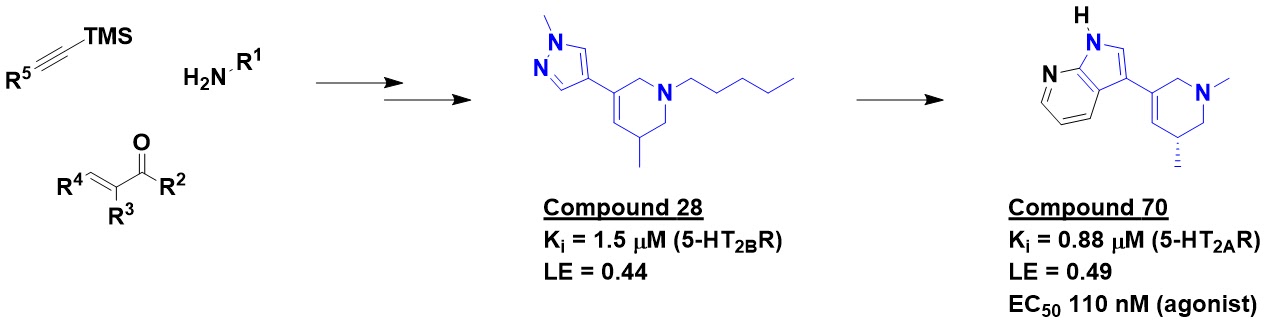
LSD contains a tetrahydropyridine (THP) moiety, which is relatively rare in screening libraries. The researchers developed convergent routes to THPs in which they could independently and efficiently vary multiple substituents. Using this chemistry, they constructed a virtual library of 4.3 billion compounds, all with molecular weights ≤ 400 Da and cLogP ≤ 3.5.
 
At the time the research began, there were no structures of 5-HT2AR, so the researchers built a homology model based on the closely related 5-HT2BR, which differs by only four amino acid residues in the orthosteric pocket where LSD binds. This model was then screened against a subset of the THP library, those ≤ 350 Da. Despite screening some 7.45 trillion complexes (sampling an average of 92 conformations and 23,000 orientations per molecule), the process took only nine hours on a 1000-core CPU cluster. The result was 300,000 hits in nearly 15,000 families. To ensure novelty, only compounds quite different from known ligands were further considered, and 17 “richly functionalized” THPs were synthesized and tested in radioligand assays. Four were active, including racemic compound 28. Searching the 4.3 billion compound library for analogs ultimately led to compound 70 and a related, slightly more potent molecule lacking the methyl substituent on the amine. A cryo-EM structure subsequently validated the predicted binding mode.
 

The paper spends considerable time characterizing these two compounds. Both are agonists and somewhat selective for 5-HT2AR over 5-HT2BR and 5-HT2CR. They are highly selective over 318 other GPCRs and 45 off-targets. GPCRs can signal through arrestin and/or G-protein, and while LSD works (mainly) through the arrestin pathway, the new molecules work (mainly) through the G-protein route. Importantly, the compounds showed anti-depressive and anti-anxiety effects in mouse models. Although you can’t ask mice if they are tripping, the molecules did not cause “head-twitch responses” and other behavioral effects seen with LSD, suggesting that they may not have hallucinogenic properties.
 
This is a lovely piece of work, and a few observations relevant to FBLD stand out. First, the best molecules are actually rule-of-three compliant, despite the fact that larger molecules were included in the virtual screen. Indeed, the top two molecules are actually smaller than the initial hits. This suggests that choosing more richly functionalized molecules may not have been the most efficient approach. We’ve written previously about V-SYNTHES, which entails stepwise selection and growing of fragments; it would be interesting to retroactively test whether this type of approach would have more quickly gotten to compound 70.
 
Finally, this approach can easily be extended to other scaffolds for which syntheses are readily available. Six years ago we wrote about the synthetic accessibility of dihydroisoquinolines, and last year Practical Fragments published our fifth “fragment library roundup.” The marriage of clever chemistry with virtual screening seems to have a bright future.

19 September 2022

Crystallography first, then virtual screening: application to PKA

Fragment-based screening is often funnel-shaped: a virtual screen might identify dozens or hundreds of potential hits that are tested in various assays, eventually leading to a few chosen for crystallography. But a paper we highlighted back in 2016 argued that many assays miss genuine hits, and crystallography should be moved to the front of the line. A paper just published in J. Med. Chem. by Serghei Glinca and collaborators at CrystalsFirst, BioSolveIT, Enamine, and elsewhere provides a proof of concept.
 
The researchers started with a set of 19 crystal structures of fragments bound to Protein Kinase A (PKA) from a campaign we wrote about in 2020. Four diverse fragments were chosen for further study. Importantly, the affinities of these fragments had not been measured; selection was based on the diversity of chemical structures and binding modes.
 
Next, the crystal structures of the four fragments were used as starting points for four virtual screens using 208,293 Enamine REAL Space fragments (see here for more on these). These were docked using BioSolveIT’s FlexX algorithm, and 50 from each of the four screens were then computationally grown. Just over half a million of these elaborated molecules were then docked, and after clustering, triaging, and visual selection, 106 were chosen for synthesis, of which 93 were delivered and 75 were soluble at 200 mM in DMSO.
 
The soluble fragments were tested in a functional assay, and 30 of these showed inhibition. Most were weak (double digit micromolar or higher) but fragment EN093 (derived from Frag2) was a low micromolar inhibitor. All of the initial fragments were very weak inhibitors, with at best millimolar activity.

The 75 soluble compounds were also tested in a thermal shift assay (each at 2.5 mM), revealing 29 hits, of which 19 were also active in the functional assay. These included EN093. Interestingly, only one of the initial fragments (not Frag2) showed any activity in the thermal shift assay.
 
To assess how well the docking performed, 13 of the most active compounds were tested in co-crystallization experiments, yielding 6 high-quality bound structures. These confirmed the virtual screens, with the rmsd for EN093 being 0.74 Å.
 
Impressively, the whole study, including compound synthesis and crystallographic validation, took just 9 weeks.
 
This “Crystal Structure First” is conceptually similar to the V-SYNTHES approach we discussed earlier this year, with the difference being that while V-SYNTHES is entirely virtual, Crystal Structure First starts with an actual structure. As the researchers state, “using crystallographically validated fragments and bound ligands for template-based docking can be thought of as introducing a ‘magnet’ to help find the needle in an ever-growing haystack in a more targeted way.”
 
This is a nice case study, and intuitively it makes sense to start with an experimentally determined structure. Indeed, the increasing number of publicly available fragment structures should be a boon for this approach. That said, it is interesting that most of the molecules made and tested are quite weak, and only two have ligand efficiencies equal to or greater than 0.3 kcal/mol per heavy atom. As we suggested earlier this year, crystallography may find ligands that are just too weak to be useful. Perhaps adding a functional screen before computational elaboration could lead to even more and better binders.

20 June 2022

KinaFrag: a free, searchable database of kinase fragments

Four of the six approved fragment-derived drugs are kinase inhibitors, and three of these bind in the active site. Despite these successes, there are plenty of opportunities for new kinase-directed drugs, particularly those targeting cancer resistance mutations. In a recent Brief Bioinform. article, Guang-Fu Yang and colleagues at Central China Normal University describe a new tool to facilitate these discoveries.
 
The researchers started by trawling multiple databases such as kinase.com, DrugBank, ChEMBL, and the Protein Data Bank for kinase inhibitors. The results were combined and collated to yield a set of 7783 kinase-inhibitor fragment complexes, with more than 3000 unique fragments. Most of these bind in the “front cleft” of the active site, where the adenine of ATP normally binds, but several hundred also sit in the so-called back pocket or the intervening area.
 
What’s nice is that all this information is available on a free website called KinaFrag. You can download the structures yourself, but the site can also be browsed or searched. Fragments are annotated with links to various databases; here’s an example.
 
 
There are some bugs. While I was able to search by physicochemical parameters such as molecular weight and number of hydrogen bond donors, I could not get the substructure search to work. I’d be curious as to whether readers could do so.
 
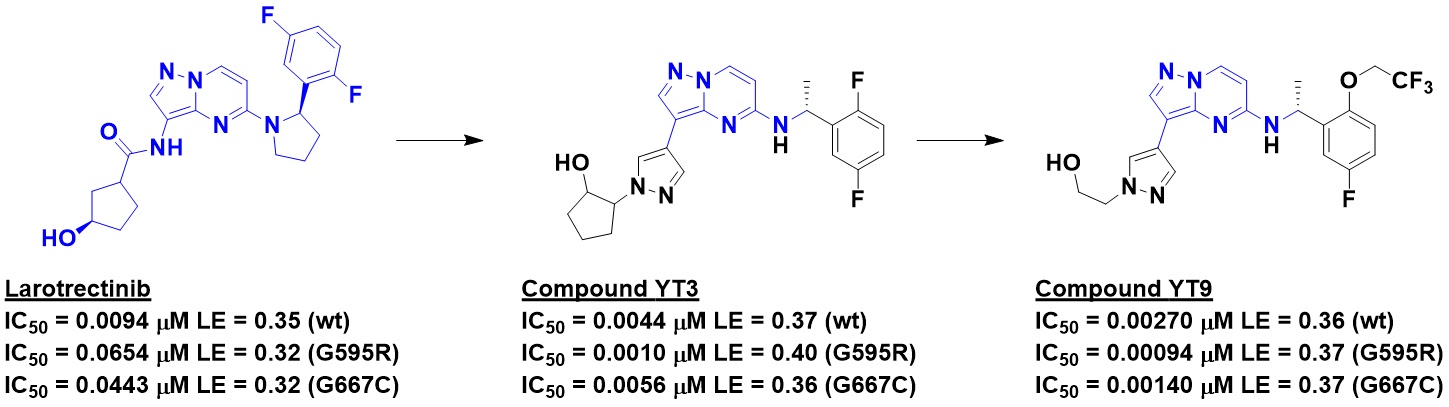
To demonstrate the utility of KinaFrag, the researchers describe a case study in which they started with the anticancer drug larotrectinib, which inhibits TRK family kinases. However, the molecule is less effective against several mutations observed in the clinic. Examining the bound structure revealed that the mutations introduce steric clashes. Retaining the hinge-binding fragment while performing virtual screening of fragments from KinaFrag led to molecules such as YT3, potent against both wild type TRKA and two resistance mutants, and further optimization resulted in YT9. 
 

Not only was YT9 active against the wild type and mutant forms of TRKA, it showed good oral bioavailability and pharmacokinetics in rats. Encouragingly, the molecule slowed tumor growth in both wild type and mutant TRKA mouse xenograft models.
 
One could debate whether this is an example of FBLD; the discovery of YT9 could also be considered a classic case of scaffold hopping. But semantics aside, this is a nice example of thinking in terms of fragmenting molecules. More broadly, KinaFrag looks like a useful tool for work on kinases – especially if the substructure search works.

13 June 2022

Fragments vs HIV-1 Protease: Pocket-to-Lead

The drugging of HIV-1 protease is a classic structure-based design success story, as discussed in a guest post by Glyn Williams from the early days of the SARS-CoV-2 pandemic. The peptide origins of approved inhibitors such as saquinavir are obvious, and the residual structural features can present problems for oral bioavailability. Although there have been fragment screens against the enzyme, the hits do not seem to have been pursued, perhaps in part to the number of approved drugs. But viruses never stop mutating, and developing new chemical matter is prudent. In a recent J. Med. Chem. paper, Yuki Tachibana and colleagues at Shionogi describe a fragment-based approach.
 
The researchers started by performing a virtual screen, but none of the hits were active when tested in a biochemical assay. The active site of HIV-1 protease contains four hydrophobic subsites, and none of the virtual hits filled all four of them. Thus, the researchers chose to focus on fragments that could make some of the interactions while providing growth vectors to additional subsites. They call this a “pocket-to-lead” strategy.
 
Fragment 5 docked nicely into the active site; the hydroxyl group makes interactions with the catalytic aspartic acid residues, while the phenyl ring tucks into the S2 pocket. Growing into the S2’ and S1’ pockets led to molecules such as compound 9, which showed weak but detectable activity. (Astute readers will notice that the stereochemistry around the hydroxyl moiety has changed; both diastereomers are active.) A crystal structure of compound 9 bound to HIV-1 protease confirmed the predicted binding mode

 
Examination of the crystal structure revealed that the parafluorobenzyl substituent was not completely filling the S1’ pocket, and was also in a strained conformation. Replacing this with an alkyl substituent led to low micromolar compound 12. Finally, growing into the S1 subsite led to compound 14, a low nanomolar inhibitor with sub-micromolar antiviral activity.
 
This is a nice example of structure-guided, computationally-enabled fragment-based lead discovery that bears some similarity to the V-SYNTHES method we highlighted earlier this year. As the researchers note, the cyclic lactam found in fragment 5 had been used previously in HIV-1 protease inhibitors. It might have been possible to get to something similar to compound 14 from that earlier molecule. But regardless, compound 14 is emphatically non-peptidic. Whether it will lead to superior drugs remains to be seen, but the paper does say that further optimization is underway.

18 April 2022

Fragments win in a virtual screen against Notum

Wnt proteins are implicated in a variety of diseases, from Alzheimer’s to colorectal cancer. The enzyme Notum shuts down signaling by removing a palmitoyl group from Wnt. Last year Practical Fragments highlighted several series of Notum inhibitors identified from biochemical and crystallographic fragment screens. The researchers behind those efforts, including Paul Fish and Fredrik Svensson (University College London), have now published a successful virtual screen against the enzyme in J. Med. Chem.
 
Starting with 1.5 million compounds available from ChemDiv, the researchers chose 534,804 based on a variety of computational filters including molecular weight (200-500 Da), number of hydrogen bond donors (<=2) and ClogD (-4 to 5). A virtual screen of these (using Glide) produced 1330 high-scoring hits, of which 1088 were chosen for purchase. Of these, 952 were available, a much higher percentage than the ZINC15-reliant paper we wrote about earlier this year.
 
All 952 compounds were tested in a biochemical assay, and the 44 that gave >50% inhibition at 1 µM were then tested in dose-response format. This yielded 31 compounds with IC50 values < 500 nM. These could be subdivided into four structurally related clusters and eight singletons. Further triaging removed compounds likely to cause assay interference as well as those similar to known Notum inhibitors. This left two clusters and two singletons.
 

Compound 1f was the most potent member of a series of 9 related (and possibly covalent) inhibitors. Although these strongly inhibited the enzyme in the biochemical assay, they were essentially inactive in a cell-based assay. They were also highly insoluble and showed low cell permeability, and were thus dropped.
 
Compound 2a was one of two related molecules that were also quite potent when initially tested. Unfortunately, when the molecules were resynthesized they turned out to be significantly weaker and were also not very soluble, so this series was also halted.
 
The singleton compound 3 turned out to be a covalent inhibitor; the catalytic serine formed an ester with the molecule. The mechanism is more fully described in this open-access J. Med. Chem. paper.
 
That leaves the second singleton. Compound 4d was not just active in the biochemical assay, it also showed sub-micromolar cell activity. SAR, guided by crystallography, ultimately led to low nanomolar inhibitors. The pKa of compound 4d was measured to be 7.9, which is less acidic than many previously reported Notum inhibitors and thus more likely to be cell permeable. This turned out to be the case experimentally, and the compound was also stable in mouse liver microsomes. Pharmacokinetics in mice were promising for several compounds, but unfortunately brain penetration – which the researchers were hoping for – was negligible. (This could be an advantage for peripheral diseases.)
 
This is a nice example of lead discovery in academia. Like last week’s post, it also illustrates that fragments themselves can be quite potent. Indeed, although the researchers were looking for molecules up to 500 Da in their virtual screen, all of the best hits were fragment-sized. Another illustration that small is beautiful.

07 March 2022

Virtual screening succeeds against the SARS-CoV-2 main protease

Today marks exactly two years since Practical Fragments first mentioned SARS-CoV-2. Since then, COVID-19 has killed more than 6 million people worldwide. Multiple effective vaccines have been developed and approved, along with a couple small-molecule drugs, but the virus is here to stay, and more drugs will be needed. This brings us to an open-access paper published in J. Am. Chem. Soc. by Jens Carlsson (Uppsala University) and a large group of international collaborators.
 
The so-called main protease (Mpro, or 3CLp) has been an antiviral target since the earliest days of the pandemic; the work we highlighted two years ago focused on a crystallographic screen against this enzyme. The new paper describes two virtual screening approaches.
 
The first started with a library of 235 million virtual compounds, mostly from Enamine’s “readily available for synthesis” (REAL) collection. Each compound was docked in thousands of different orientations against the active site of Mpro using DOCK3.7. Despite the staggering numbers (more than 223 trillion complexes!), the screen took just a day on 3500 CPU cores. The top 300,000 compounds were clustered based on similarity, and 100 molecules were synthesized. Nineteen of these showed binding by SPR, and three also inhibited the enzyme. Crystal structures were obtained for two of these, and both bound similarly to the predicted binding modes.
 
Compounds 1 and 3 each contain a hydantoin moiety that makes multiple hydrogen bonds to the protein, and merging elements led to low micromolar compounds such as compound 15. Further optimization ultimately delivered compound 19.
 

Compound 19 was potent in SPR and biochemical assays. Though it binds noncovalently, it had comparable cellular activity to nirmatrelvir, the recently approved covalent inhibitor of Mpro. Compound 19 showed nanomolar cell potency against SARS-CoV-1 and MERS-CoV and good selectivity against ten human proteases. The in vitro stability and permeability of compound 19 are also promising.
 
In addition to this de novo virtual screen, the researchers performed a second screen starting from one of the fragments identified crystallographically at Diamond Light Source. Of 93 molecules purchased and experimentally tested, 21 showed binding by SPR and 5 of these also inhibited the enzyme, with the most potent compound showing low micromolar activity.
 
There are several lessons from this paper. First, despite searching hundreds of millions of compounds, the best hits had only modest activity. This is perhaps surprising given the high fragment hit rates observed against Mpro in crystallographic and NMR screens, though it is worth noting that those fragments were even weaker binders.
 
Second, the hit rate from the naïve virtual screen was similar to that from the experimentally derived fragment screen. The researchers suggest that perhaps docking “may be more proficient in ranking diverse chemotypes rather than differentiating between closely related elaborations of the same scaffold.” In other words, virtual screens seem better at evaluating diverse starting points rather many similar molecules.
 
Third, despite the fact that the de novo virtual screen was not explicitly fragment-based, compound 1 does actually adhere to the rule of three. From there, addition of just six atoms improved affinity by >600-fold while also improving ligand efficiency.
 
Finally, this work is a testament to the utility of combining massive virtual screening with readily synthesizable compounds: the researchers note that it took less than four months to progress from compound 1 to nanomolar inhibitors.
 
This work relied heavily on rapid chemical synthesis done in Ukraine. Indeed, the two most popular fragment suppliers are both largely based in that country. Over the years many of us have come to know Ukrainian scientists not just as trusted colleagues but also as friends. I wish them and their families safety, and strength.