Showing posts with label ligand lipophlicity efficiency. Show all posts

25 August 2011

Journal of Computer-Aided Molecular Design 2011 Special FBDD Issue

The most recent issue of J. Comput. Aided Mol. Des. is entirely devoted to fragment-based drug discovery. This is the second special issue they’ve dedicated to this topic, the first one being in 2009.

Associate Editor Wendy Warr starts by interviewing Sandy Farmer of Boehringer Ingelheim. There are many insights and tips here, and I strongly recommend it for a view of how fragment-based approaches are practiced at one large company. A few quotes give a sense of the flavor.

On corporate environment:
In most cases, the difference between success and failure has little to do with the process and supporting technologies (they work!), but rather much more to do with the organizational structure to support FBDD and the organizational mindset to accept the different risk profile and resource model behind FBDD.
On success rates:
We have found that FBDD has truly failed in only 2-3 targets out of over a dozen or so.
On cost:
FBDD must be viewed as an investment opportunity, not a manufacturing process. And the business decisions surrounding FBDD should factor that in. FBDD is more about the opportunity cost (of not doing it) than the “run” cost (of doing it).
On expertise:
Successful FBDD still requires a strong gut feeling.
On small companies:
In the end, FBDD will always have a lower barrier to entry than HTS for a small company wanting to get into the drug-discovery space.

The key to success for such companies is to identify or construct some technology platform.
There’s a lot of other really great content in the issue, much of which has been covered in previous posts on fragment library design, biolayer interferometry, LLEAT, and companies doing FBLD. The other articles are described briefly below.

Jean-Louis Reymond and colleagues have two articles for mining chemical structures, one analyzing their enumerated set of all compounds having up to 13 heavy atoms (GDB-13), the other focused on visualizing chemical space covered by molecules in PubChem. They have also put up a free web-based search tool (available here) for mining these databases.

Roland Bürli and colleagues at BioFocus describe their fragment library and its application to discover fragment hits against the kinase p38alpha. A range of techniques are used, with reasonably good correlation between them.

Finally, M. Catherine Johnson and colleagues present work they did at Pfizer on the anticancer target PDK1 (see here and here for other fragment-based approaches to this kinase). NMR screening provided a number of different fragment hits that were used to mine the corporate compound collection for more potent analogs, and crystallography-guided parallel chemistry ultimately led to low micromolar inhibitors.

03 August 2011

Ligand efficiency metrics poll results

Poll results are in, and not surprisingly, ligand efficiency (LE) comes out on top, with 86% of respondents using the metric. What was a surprise to me is how many folks use ligand lipophilic efficiency (LLE) (46%). Coming in a distant third at 15% is LLEAT, but given that this metric was just reported it has a pretty strong showing, and I wouldn't be surprised to see this increase. Binding efficiency index (BEI) comes in fourth with 12% of the vote, and Fsp3 is tied with "other" with 8% of the vote. The other metrics only received one or two votes each.
Since people could vote on multiple metrics, there were more responses than respondents. Subtracting those who voted for "none" leaves 124 data points, suggesting that the average researcher is using 1.9 of these metrics (though unfortunately we don't have information on the median user).

Finally, for the 5 of you who selected "other", what else is out there that we've left out?

20 June 2011

Ligand Lipophilicity Efficiency AT Astex Therapeutics

Our last post discussed the growing plague of molecular obesity, and how numerous metrics have been designed to control it. In a paper published online in J. Comput. Aided Mol. Des. Paul Mortenson and Chris Murray of Astex describe a new one: LLEAT.

Although ligand efficiency (LE) is probably the most widely used and intuitive metric, it does not take into account lipophilicity. Other indices do, notably ligand lipophilicity efficiency (LLE) and ligand-efficiency-dependent lipophilicity (LELP), but these both have drawbacks for evaluating fragments. LLE (defined as pIC50 – log P) is not normalized for size; for a fragment to have an (attractive) LLE ≥ 5 it would need an exceptionally low log P or an exceptionally high affinity. LELP, defined as log P / ligand efficiency, is also potentially misleading since a compound could have an acceptable LELP value even with a low ligand efficiency if the log P is also very low.

To address these problems, Mortenson and Murray have tried to strip out the non-specific binding a lipophilic molecule experiences when going from water to a binding site in a protein. They define this modified free energy of binding as:

ΔG* = ΔG - ΔGlipo
        ≈ RT ln (IC50) + RT ln (P)
        ≈ ln (10) * RT (log P - pIC50)

In order to put values coming out of this metric on the same scale as those from ligand efficiency, they add a constant, such that:

LLEAT = 0.11 – ΔG* / (number of heavy atoms)

Thus, just as in ligand efficiency, the goal is for molecules to have LLEAT ≥ 0.3 kcal/mol per heavy atom.

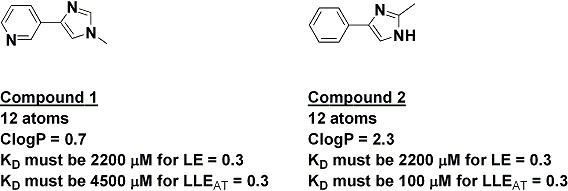
The index has some interesting implications. For example, the two fragments below have the same number of heavy atoms, and thus if they had the same activity they would have the same ligand efficiency; on this measure alone, neither would be preferred as a starting point for further work. However, because of their very different lipophilicities, fragment 2 would need to be 45 times more potent than fragment 1 in order to have the same LLEAT of at least 0.3.

A similar analysis can be done during optimization. For example, adding either a phenyl or a piperazinyl substituent should produce a 20-fold boost in potency in order to maintain ligand efficiency at 0.3, since both have 6 atoms. However, in order to maintain LLEAT at 0.3, the phenyl would need to produce a 460-fold boost in potency while the piperazinyl would need to improve potency only 3-fold. This is consistent with what other folks have reported qualitatively, but it’s nice to have a simple quantitative measure.

Although some people may groan at yet another index, and no metric is perfect, I like the fact that this one is intuitive and has the same range of “acceptable” values as ligand efficiency. What do you think – is it useful?