Showing posts with label clinical compounds. Show all posts

25 May 2026

Fragments in the clinic: VVD-214

Just over two years ago we highlighted a new clinical candidate targeting WRN, a covalent inhibitor then called VVD-133214. An open-access paper published near the end of last year in J. Med. Chem. from Shota Kikuchi, David Weinstein, and colleagues at Vividion describes in detail the optimization of the covalent fragment hit to the clinical compound. (Shota presented some of this work at the 2024 DDC meeting.) This paper is also an interesting contrast to non-covalent fragment-finding approaches against this target we wrote about earlier this month.
 
The 2024 post described the chemoproteomic screening that identified compound 1a, which covalently binds to C727 in WRN. An early observation was that some molecules were cooperative with ATP while others were competitive. Given the high concentration of ATP in cells, the researchers prioritized the former category, which led to compound 1f. (Note that while I’m showing only the kinact/KI values, the researchers used biochemical and cell-based assays to drive SAR).
 

The vinyl sulfone warhead is unusual amongst covalent clinical compounds, so the researchers sought to characterize it. The rate of reaction with glutathione for compound 1f is comparable to the approved drug osimertinib: reactive, though acceptable. To try to lower the reactivity and also prevent isomerization of the double bond, the researchers introduced a methyl group. Compound 2a not only showed increased stability but also improved activity against WRN and sub-micromolar activity in a cell-based assay. A crystal structure of a later molecule revealed interactions with a hydrophobic patch on the protein, explaining the improvement in potency. Importantly, the other enantiomer was much less potent.
 
Other rings were tried, unsuccessfully, to replace the pyrimidine and the phenyl moieties. However, changing the cyclopentyl ring to a tert-butyl moiety (compound 5d) further improved the potency to the point where the compound could be tested in vivo, where it proved to be active in a mouse xenograft study. Mass spectrometry experiments revealed prolonged occupancy of C727 out to 24 hours after compound dosing even though the compound itself had been cleared, consistent with a long half-life of the WRN protein. The researchers note that high target engagement (TE) at 24 hours was predictive of tumor growth inhibition, which streamlines optimization since it is easier to run a one-day TE experiment than a multi-week efficacy study.
 
Further optimization of ADME properties ultimately led to VVD-214, which was active in a mouse xenograft study and showed good oral bioavailability and pharmacokinetics in mouse, rat, dog, and monkey. This compound was also profiled in a chemoproteomic assay and found to be quite selective for the C727 of WRN.
 
There are several important lessons in this paper. First, the initial fragment is larger than prescribed by the rule of three, consistent with an analysis of covalent inhibitors last year. Second, much of the SAR was empirical; crystallography was not used until relatively late in the campaign. When a crystal structure was finally solved of VVD-214 bound to WRN it revealed no polar contacts between the ligand and the protein, only hydrophobic interactions, which is rare for fragments, let alone drugs. Perhaps because of the lack of polar interactions, it was impossible to measure the inhibition constant (KI), and saturating the warhead to make it unreactive completely abolished activity. In other words, the binding is largely driven by reactivity, but specific reactivity for WRN rather than generic chemical reactivity.
 
In 2024 just two WRN inhibitors had entered the clinic, the other being a noncovalent molecule called HRO761. We quoted the Vividion team as saying that “this presents a rare opportunity to compare two small molecule oncology drugs targeting the same protein by different mechanisms.” Since then, HRO761 has been quietly discontinued, as has another noncovalent drug, IDE275. Meanwhile, development of VVD-214 is ongoing, and another covalent compound, MOMA-341, which we mentioned here, has also begun human testing. (To be fair, so has yet another non-covalent molecule NDI-219216. And the binding mechanism of a sixth WRN drug, EIK1005, is undisclosed.) While it’s still early in the match, covalent drugs seem to be punching above their weight. May the best drug(s) prevail - Practical Fragments is rooting for them all.

09 February 2026

Multivalent fragments in the clinic: Muvalaplin

It’s been a couple years since Practical Fragments last updated our “fragments in the clinic” list. Before doing so it makes sense to highlight some of those we’ve missed. Let’s start with an open-access Nature paper from Laura Michael and collaborators at Lilly and Monash University published in 2024. Truth be told I’ve been waiting for a longer discovery paper, but I’ll go with what’s available now.
 
The researchers were interested in lipoprotein(a), or Lp(a), which has been linked to cardiovascular diseases. Lp(a) forms when low-density lipoprotein (LDL) binds to apolipoprotein(a), or apo(a). This is a two step process, in which the ten subtypes of so-called Kringle IV (KIV) domains in apo(a) bind to lysine residues on LDL, followed by disulfide bond formation between apo(a) and LDL. Blocking the first step in this process should reduce levels of Lp(a).
 
Here's the only description of the initial screen: “Biochemical and biophysical compound screens using purified apo(a) KIV7-8 protein identified interacting small molecules. Optimization of the initial binding molecules led to…LSN3353871.” Whatever the details, LSN3353871 is unequivocally a rule-of-three compliant fragment. It is also a very ligand-efficient binder with high nanomolar affinity for the KIV8 domain. LSN3353871 disrupted the formation of Lp(a) in vitro at low micromolar levels and decreased levels of Lp(a) in cynomolgus monkeys when dosed orally.
 
As noted above, the apo(a) protein contains multiple KIV domains, and a classic method for improving potency is by making dimeric ligands that can bind to two domains simultaneously. The researchers did just this in the form of LSN3441732, which binds to apo(a) and disrupts formation of Lp(a) in vitro at picomolar concentrations.
 
If dimeric ligands are better than monomeric ones, why not go for multimeric ligands? The trimeric molecule LY3473329, or muvalaplin, was synthesized and crystallographically shown to bind to three copies of KIV8. It blocked formation of Lp(a) in vitro and reduced Lp(a) levels in cynomolgus monkeys.
 
Kringle domains are found not just in apo(a) but also in plasminogen, the zymogen form of plasmin, which is responsible for degrading blood clots. Fortunately, subtle differences between the Kringle domains in apo(a) and human plasminogen provide selectivity for the former protein, especially for multivalent ligands such as muvalaplin, and a phase 1 clinical study showed that Lp(a) could be lowered without affecting plasmin activity.
 
This is a nice application of applying fundamental multivalent principles to develop a potent molecule. It is also another example of a molecule that may not look like a drug but works like one: despite containing four basic nitrogen atoms, three carboxylic acid moieties, and sporting a molecular weight above 700 Da, muvalaplin is orally bioavailable. It is currently in a phase 3 trial in up to 10,450 patients. Cardiovascular disease is the leading cause of death in the developed world, and Practical Fragments wishes luck to everyone involved in these studies.
 
In the meantime, watch for more Practical Fragments posts on new entries to our fragments in the clinic list, which will be updated later this year.

21 April 2025

Twentieth Annual Fragment-Based Drug Discovery Meeting

Last week’s CHI Drug Discovery Chemistry (DDC) meeting was held as usual in San Diego. More than 850 people attended, 96% in person, with 70% from industry and 28% from outside the US. I personally attended more than three dozen talks over the four days and will just touch on some broad themes.
 
Noncovalent approaches
Steve Fesik (Vanderbilt) gave two talks, the first of which was focused on “FBDD tips for success.” This opinionated and entertaining romp revealed lessons learned across several projects on difficult targets such as KRAS. Another holy grail oncology target is MYC, which is largely disordered. A two-dimensional NMR screen against the protein failed to yield any hits, but a screen of the MYC:MAX heterodimer provided hits which have been optimized to high nanomolar potency and are able to block DNA binding.
 
The second talk was focused on E3 ligases, a target class Steve has been pursuing for the past decade. Steve is particularly interested in E3 ligases such as CBL-C, TRAF4, and KLHL12 that are differentially expressed in certain tissues. In the case of KLHL12, which is not found in heart tissue, an NMR-based screen led to fragment hits that were ultimately optimized to mid-nanomolar binders and could be turned into bivalent degraders for Bcl-xL and β-catenin.
 
When asked about his second favorite fragment-finding method after protein-detected NMR, Steve mentioned SPR. The throughput for SPR has historically been modest, but John Quinn (Genentech) described the new Carterra Ultra, which is capable of screening 96 proteins simultaneously while retaining good sensitivity. John screened 3000 fragments at 500 µM against multiple proteins in just two weeks, which provided an immediate assessment of both protein ligandability and fragment selectivity. Interestingly, and in contrast to some other analyses, shapelier fragments had similar hit rates to flatter fragments.
 
Several talks focused on fragment-to-lead success stories, some of which we’ve covered on Practical Fragments, such as RIP2 kinase inhibitors that started from flat fragments and were evolved to more three-dimensional leads as described by Mark Elban (GSK). John Taylor discussed pan-RAS inhibitors discovered at Cancer Research Horizons, the subject of an upcoming post. Andrew Judd (AbbVie) described the discovery of ABBV-973, a potent STING agonist that could be useful for certain types of cancer. And Justyna Sikorska described the discovery of a non-covalent WRN inhibitor at Merck. This is a nice complement to Vividion’s covalent WRN inhibitor, which we wrote about here and which was presented by Shota Kikuchi. Interestingly, structural biology was not enabled until late in this project.
 
One of the earliest arguments for fragment linking was the concept of avidity, and this underlies the basis of a technology discussed by Tom Kodadek and Isuru Jayalath at University of Florida Scripps. The idea is to immobilize fragments onto TentaGel beads, each the size of a red blood cell. These can be screened against multivalent proteins using either simple plate-based assays or FACS, the idea being that even if an individual protein-ligand interaction is weak, a multimeric protein can interact with several ligands on a single bead for enhanced binding. The researchers validated the concept with streptavidin, and also used it to find millimolar binders to the proteasome subunit Rpn13.
 
Last year we wrote about using photoaffinity crosslinking with fully functionalized fragments (FFFs) to identify non-covalent ligands to thousands of proteins in cells, and this was the subject of several talks. Chris Parker (Scripps) has mapped more than 7000 binding sites and described the discovery of an inhibitor against the inflammatory target SLC15A4. Interestingly, the molecule binds what appears to be a disordered region, though Chris speculated that it adopts a more defined structure in cells.
 
Belharra has gone all in on using FFFs, and Jarrett Remsberg and Andrew Wang described the construction of a diverse >11,000-membered FFF library, 88% of which consists of enantiomers. This has been screened against 13 different oncology and immunology cell lines to identify enantioselective or chemoselective hits against >4000 proteins including STAT3, IRF3, and AR.
 
Covalent approaches
The FFF approach uses covalent bond formation to trap a noncovalent ligand, but of course covalent ligands are all the rage these days, as we noted just last week. Dan Nomura (UC Berkeley) described the identification of stereoselective covalent ligands against a disordered region of cMYC that seem to work by destabilizing the protein in cells. Similarly, covalent ligands against the largely disordered AR-V7 also seem to destabilize the protein. It will be interesting to explore the mechanism of these molecules to see whether the proteins are more ordered inside cells.
 
Jin Wang (Baylor College of Medicine) described a chemoproteomic approach called Fragment Probe Protein Enrichment (FraPPE) which entails linking covalent fragments to a desthiobiotin tag. Labeled proteins are then pulled down, proteolyzed, and analyzed by mass spectrometry. In contrast, competition methods such as those described last year pull down labeled peptides after proteolysis. The advantage of FraPPE is that it can capture multiple peptides from each pulled-down protein, leading to fewer false negatives.
 
Of course, not every application of covalent discovery involves chemoproteomics. Joe Patel, who co-organized FBLD 2016, described the Nexo Therapeutics platform. They’ve built from scratch a library of >12,000 fragments, a third of which contain stereocenters. Each member is rule-of-three compliant before adding the warhead, meaning that the final molecules can be larger, which as we noted earlier this month is probably a good idea. To date Nexo has successfully screened more than a dozen targets using intact protein mass spectrometry.
 
The Nexo library targets not only cysteines but other residues as well, and Maurizio Pellecchia (UC Riverside) described using sulfonyl fluorides and fluorosulfates to target histidine residues. He and his group screened a library of 600 fluorosulfate-containing fragments (MW 250-350 Da) against the oncology target MCL1 and found several that stabilized the protein towards thermal denaturation. Crystallography confirmed covalent bond formation.
 
Most covalent fragments are electrophilic so that they can react with nucleophilic protein residues, but as we noted in 2022 it is possible to do the reverse. Megan Matthews (University of Pennsylvania) described how she used chemoproteomics to discover the mechanism of action for hydralazine, a drug that has been used since 1949 to treat hypertension. This fragment-sized (MW 160 Da!) molecule irreversibly alkylates a histidine residue within the active site of the enzyme ADO, a target that has also been implicated in gliobastoma.
 
Plenary Keynotes
The approval of the covalent BTK inhibitor ibrutinib in 2013 arguably marks the start of the modern era of covalent drug discovery, and Chris Helal described Biogen’s efforts against this target using reversible inhibitors, irreversible inhibitors, and degraders. Chris traced the origin of their phase-2 BIIB091 to a collaboration with Sunesis that used Tethering, so perhaps we should include this molecule in our list of fragment-derived clinical compounds.
 
Phil Baran of Scripps, who last spoke at the conference in 2020, gave the secondary plenary keynote. After stating that “medicinal chemists are the backbone of society,” he then detailed multiple examples of how they’ve been doing things wrong. Fortunately, he provided useful chemistry solutions, with “useful” defined as reactions that are operationally simple, have wide scope, and require only readily available reagents. Rather than deploying tedious protecting group installations and deprotections, Phil uses radical chemistry to directly generate carbon-carbon bonds between or within complicated molecules. His goal is to make the chemistry so simple and practical as to be boring, and he illustrated the point by showing his teenage daughter successfully running a reaction.
 
I’ll end here, but please leave comments. And mark your calendar for April 13-16 next year, when DDC returns to San Diego.

27 January 2025

The thousandth Practical Fragments post!

As the title states, this is the 1000th post at Practical Fragments. This blog was conceived in 2008 over drinks at the Third Annual CHI Fragment-based Drug Discovery Conference. (Don’t miss the twentieth in April!) Teddy Zartler said he was planning on starting a blog and asked if I wanted to join. In July of 2008 Teddy wrote the first post, and every month since then has seen at least a couple new ones. I thought it would be fun to look back briefly on the past 16+ years.
 
Methods
The very first Practical Fragments post asked what screening methods people use, and this eventually led to five polls on the topic, the latest of which published just a few months ago. In our first formal poll, in 2011, the average respondent used 2.4 techniques. Today that number has grown to 5 due to the increased recognition that different methods have different strengths and weaknesses.
 
By far the biggest winner among methods has been X-ray crystallography; it jumped from sixth place in 2011 to first place in both 2019 and 2024. Crystal structures have long been prized in drug discovery, but the dramatic increases in throughput and automation over the last decade mean more structures are more available to more users.
 
Computational methods too have improved spectacularly. In 2009 we highlighted an in silico screen of around 67,000 fragments which yielded ten micromolar inhibitors. Today, screening multibillion compound libraries is becoming routine, and artificial intelligence is likely to enable even more opportunities.
 
Pitfalls
One of the reasons that it took so long for FBLD to develop was the myriad artifacts that can haunt screens run at high concentrations. For example, compound aggregation was not widely recognized until the first decade of this century, and even today too many papers are published without checking for this pathological phenomenon.
 
Similarly, pan-assay interference compounds, or PAINS, were not defined until 2010. Scientists at large companies have long known to steer clear of certain chemotypes. Now academics and folks in startups are more aware of problematic substructures, even if Dr. Saysno objects.
 
Long-time readers may recall a series of posts on “PAINS-shaming,” where we highlighted (lowlighted?) papers that lacked appropriate selectivity or mechanistic studies. Occasionally this led to productive discussions, as in this example where an author and journal editor contributed to the comments. But with the increasing use of metrics measuring social media engagement to rank articles I’ve decided that blogging about them may inadvertently reward shoddy science. If you’re looking for most of the things that can go wrong in a screen, check out this open-access review by Ben Davis and me.
 
Covalent craze
One prominent mechanism of PAINS is indiscriminate covalent modification of proteins. For many years drug hunters actively avoided covalent modifiers for fear of off-target modifications and their potentially toxic effects. Indeed, the first several mentions of covalent compounds at Practical Fragments were in the “things to avoid” category. We discussed reversible covalent modifiers in 2012 and 2013, but it wasn’t until 2014 that we wrote about intentionally irreversible fragments.
 
How times have changed! The success and safety of targeted covalent kinase inhibitors has fueled enthusiasm for covalent drugs in general, creating opportunities for fragment-based approaches. Indeed, as we discussed here, both reversible and irreversible fragment-based screens were used in the discovery of the first approved drug targeting the previously intractable target KRAS, and these learnings have been applied at multiple companies to produce an impressive armamentarium against what Darryl McConnell has called “the beating heart of cancer.”
 
To find KRAS inhibitors, researchers screened pure proteins against libraries of covalent fragments. One of the most exciting recent developments in chemoproteomics has been screening covalent fragment libraries in intact cells or cell lysates to find hits against thousands of proteins in their native environment. We first wrote about this approach in 2016, and last year we highlighted the first drug to enter the clinic from covalent screening in cells.
 
And all this is just the beginning: each of our past four annual “review of reviews” posts has featured between three and six papers focused on covalent fragment-based drug discovery.
 
Clinical compounds
My first blog post in 2008 was a brief mention of a C&EN story on FBLD, in which I noted that “an FBLD drug that reaches the market by 2011 would be a ‘psychological’ victory for the whole FBLD community.” Although I claim no prescience, I was happy to see vemurafenib approved in August of 2011.
 
Indeed, I would argue that FBLD-derived drugs are the most meaningful output and validation of the field. Our first systematic tabulation in 2009 counted just 17 that had entered clinical trials, and today there are more than 60. Like investigational drugs in general, the majority of these have stumbled, but at least eight have been approved by the US FDA, and more are working their way through clinical trials. While eight might seem like a modest number, the number of patients they’ve helped is orders of magnitude greater.
 
Closing thoughts
There are far more themes in a thousand posts than I could summarize in a single one: metrics, induced proximity, and newer methods such as cryo-EM all come to mind. But as this post has already surpassed 1000 words, I’ll wrap it up.
 
One minor frustration has been the sparsity of comments; it sometimes feels as if I’m blogging into the void. That said, I’m pleased that some posts may have led to new research, such as this. And blogging can be its own reward: I sometimes find myself using the “Search This Blog” function on the top right-side of the page when I’m trying to remember a paper from years ago.
 
Since Teddy left the FBLD field several years ago I’ve been writing most of the content, with occasional guest posts (such as this from Glyn Williams). At the current rate it might take a couple decades for Practical Fragments to reach 2000 posts, if we even get there. But for now, I’d like to thank each of you for reading. I hope you enjoy it and that is has, at least occasionally, made your scientific pursuits more practical.

13 January 2025

Berotralstat: an overlooked fragment-derived drug

At the end of 2023 I mentioned that a paper by Dean Brown listed berotralstat as a fragment-derived drug. Readers will notice this molecule does not appear on our “fragments in the clinic” list. Did we miss it? After reading a (2021!) J. Med. Chem. paper by Pravin Kotian and colleagues at BioCryst, I believe the answer is yes.
 
Hereditary angioedema (HAE) is a rare genetic disease caused primarily by deficiencies in a protein that inhibits a serine protease called plasma kallikrein, or PKal. Drugs had already been developed to replace the inhibitor protein, but these need to be injected or infused. Since PKal is an enzyme, the researchers sought to make a small molecule inhibitor that could be taken as a pill.
 
BioCryst had developed an earlier drug called BCX4161, which is potent but has poor oral bioavailability. To find a better molecule, the researchers turned to the rich literature around serine protease inhibitors, which led them to make compound 2, a fragment of previously reported inhibitors of other serine proteases. The protonated benzylamine was expected to bind in the S1 pocket of the enzyme, and indeed the molecule did show weak but measurable activity.
 

Fragment growing led to compound 4, with double-digit micromolar activity. Building off the new phenyl ring led to more potent molecules such as compound 13, with low micromolar activity. Further structure-based design eventually led to BCX7353, or berotralstat. The paper provides good descriptions of the design rationale. For example, the fluorine was added to improve permeability, and the nitrile was added to improve the ADME profile. Modeling was used both to improve potency as well as to gain selectivity over other serine proteases. This proved to be successful: berotralstat is a subnanomolar inhibitor of PKal and at least several thousand-fold selective over trypsin and other serine proteases such as thrombin and FXa.
 
The pharmacokinetic properties of berotralstat in rats and monkeys were also good, and according to clinicaltrials.gov the molecule first entered the clinic in 2015. In December of 2020 the FDA approved berotralstat for prophylactic treatment of HAE attacks.
 
This is a nice story, and I agree with Dean that the discovery of berotralstat was “based on a legacy clinical candidate and fragment approaches.” The earlier molecule BCX4161 contained a benzamidine moiety, which was in part responsible for the poor oral bioavailability. Replacing this with a benzylamine fragment from the literature is a classic fragment strategy, and compound 2 is fully compliant with the rule of three.
 
So how was it missed? The abstract only states that berotralstat was discovered “using a structure-guided drug design strategy.” Indeed, the word “fragment” appears precisely once in the paper, albeit in a very telling sentence: “We evaluated these fragments in our PKalpur inhibitor assay…”
 
From a timeline perspective, the approval of berotralstat makes it the fifth approved fragment-derived drug, after pexidartinib and before sotorasib. I’ll include it in the next update of clinical compounds, along with my standard disclosure that “the list is almost certainly incomplete.” What else are we missing?

29 April 2024

Covalent fragments in the clinic: VVD-133214

Back in 2016 we highlighted a paper describing chemoproteomic screening of covalent fragments. That technology formed the basis of Vividion, which was acquired by Bayer in 2021. Now, a paper just published in Nature by Matthew Patricelli, Todd Kinsella, and collaborators at Vividion, Roche, and Universitat Autònoma de Barcelona describes one of the fruits to come from this platform.
 
The work stems from another promising recent approach to find oncology targets, synthetic lethality: searching for proteins that are essential in certain types of cancer cells but dispensable for normal cells, which might mean reduced toxicity. WRN is a DNA helicase that can clean up secondary DNA structures caused by expanded TA-dinucleotide repeats found in cancer cells with microsatellite instability (MSI), which is caused by mutations in DNA repair genes. Previous research had shown that knocking out WRN caused double-stranded DNA breaks and cell death in MSI-high (MSI-H) cancer cells but not normal cells, which do not have so many expanded TA-dinucleotide repeats. This has set off an industry-wide search for WRN inhibitors.
 
The researchers screened several thousand fragment electrophiles against cell lysates and found that some, such as VVD-109063, modified C727 of WRN. Although this cysteine is located some distance from the ATP binding site, functional activity studies with the pure protein found that the molecule was an inhibitor.
 
Optimization of VVD-109063 and related molecules found inconsistencies between results in lysates and intact cells. Some engaged C727 better in intact cells than lysates, others worse. Differences in cell permeability were ruled out by the fact that a cysteine on an unrelated protein was liganded to a similar extent in cell lysates and intact cells. The researchers speculated that, because cell lysates are diluted, they have lower ATP concentrations, and sure enough some molecules were less active in the presence of ATP while others were more active.
 
The team decided to focus on the second class. Optimization ultimately resulted in the clinical candidate VVD-133214. (Unfortunately details are not given; the paper does say these will be provided elsewhere).

 
A crystal structure of VVD-133214 confirmed covalent binding to C727, with the molecule in a hydrophobic pocket in a flexible “hinge region” of the protein. This causes a conformational rearrangement into a “closed” form, which presumably affects the catalytic activity of the helicase. Surprisingly, there are no hydrogen bonds between WRN and VVD-133214. This is highly unusual: a paper we discussed in 2021 found >90% of fragment-derived leads had at least one polar contact.
 
The kinact/Ki value is reported as being 4848 M-1s-1, which is on the low side for clinical-stage irreversible inhibitors. Like sotorasib, its potency seems driven by kinact, with the Ki being greater than > 15 µM. Consistent with this low inherent affinity, the molecule was inactive against the C727A mutant enzyme.
 
Much of the paper focuses on the biology, which is interesting but beyond the scope of this post. Suffice it to say that VVD-133214 is cytotoxic in MSI-H cells, where it causes G2 arrest and DNA damage, but inactive in microsatellite stable (MSS) cells. Oral dosing led to tumor regression in several MSI-H mouse models, including patient-derived xenografts.
 
This is a nice paper, though I look forward to a full account of the medicinal chemistry. In particular, vinyl sulfones are generally considered quite reactive, and I know of only one other clinical-stage molecule with this warhead. Presumably the cyclopropyl substituent was added at least in part to sterically block access to the electrophile.
 
Also, while the paper refers to VVD-133214 as “clinical-stage,” it appears neither on clinicaltrials.gov nor on Vividion’s website. The Roche website lists RG6457 as a phase 1 WRN covalent inhibitor partnered with Vividion, so perhaps this is the same molecule.
 
The paper ends by mentioning another clinical-stage WRN inhibitor from a different company, this one noncovalent. It notes that “this presents a rare opportunity to compare two small molecule oncology drugs targeting the same protein by different mechanisms,” and that using both could be useful in combating resistance. Practical Fragments wishes luck to these – and other drugs targeting WRN – helping patients quickly.

26 February 2024

Fragments in the clinic: 2024 edition

It has been more than a year since our last list of fragment-derived clinical compounds. Since then capivasertib has been approved, bringing the number of marketed drugs to seven. There have also been a few other changes.
 
As always, this table includes compounds whether or not they are still in development (indeed, some of the companies no longer even exist). Because of this, the Phase 1 section contains a higher proportion of compounds that are no longer progressing. The full list contains 59 molecules, up slightly from 2022, with just under 40% approved or in active trials.
 
Drugs reported as still active in clinicaltrials.gov, company websites, or other sources are in bold, and the 37 that have been discussed on Practical Fragments are hyperlinked to the most relevant post. The list is almost certainly incomplete, particularly for Phase 1 compounds. If you know of others please leave a comment.

DrugCompanyTarget
Approved!

AsciminibNovartisBCR-ABL1
Capivasertib
AstraZeneca/Astex/CR-UKAKT
ErdafitinibAstex/J&JFGFR1-4
PexidartinibPlexxikonCSF1R, KIT
Sotorasib
Amgen KRASG12C
VemurafenibPlexxikonB-RAFV600E
VenetoclaxAbbVie/GenentechSelective BCL-2
Phase 3

LanabecestatAstex/AstraZeneca/LillyBACE1
Navitoclax (ABT-263)AbbottBCL-2/BCLxL
Pelabresib (CP-0610)
ConstellationBET
VerubecestatMerckBACE1
Phase 2

ASTX029AstexERK1,2
ASTX660AstexXIAP/cIAP1
AT7519AstexCDK1,2,4,5,9
AT9283 AstexAurora, JAK2
AUY-922Vernalis/NovartisHSP90
AZD5991AstraZenecaMCL1
DG-051deCODELTA4H
eFT508eFFECTORMNK1/2
IndeglitazarPlexxikonpan-PPAR agonist
LY2886721LillyBACE1
LY3202626LillyBACE1
LY3372689LillyOGA
LY517717Lilly/ProthericsFXa
LYS006Novartis
LTA4H
MAK683NovartisPRC2 EED
MK-8189
Merck
PDE10A
OnalespibAstexHSP90
PF-06650833PfizerIRAK4
PF-06835919PfizerKHK
PLX51107PlexxikonBET
S64315Vernalis/Servier/NovartisMCL1
VK-2019
Cullinan Oncology / Wistar
EBNA1
Phase 1

AG-270
Agios/Servier
MAT2A
ABBV-744AbbottBD2-selective BET
ABT-518AbbottMMP-2 & 9
ABT-737AbbottBCL-2/BCLxL
AT13148AstexAKT, p70S6K, ROCK
AZD3839AstraZenecaBACE1
AZD5099AstraZenecaBacterial topoisomerase II
BI 1823911Boehringer IngelheimKRASG12C
BI 691751Boehringer IngelheimLTA4H
CFTX-1554Confo TherapeuticsAT2 receptor
ETC-206D3MNK1/2
GDC-0994Genentech/ArrayERK2
HTL0014242Sosei HeptaresmGlu5 NAM
HTL0018318Sosei HeptaresM1-receptor partial agonist
HTL9936Sosei HeptaresM1-receptor partial agonist
IC-776Lilly/ICOSLFA-1
LP-261LocusTubulin
LY2811376LillyBACE1
MivebresibAbbVieBRD2-4
MRTX1719MiratiPRMT5•MTA
NavoximodNew Link/GenentechIDO1
PLX5568PlexxikonRAF
SGX-393SGXBCR-ABL
SGX-523SGXMET
SNS-314SunesisAurora
TAK-020
Takeda
BTK


20 November 2023

Capivasertib: the seventh approved fragment-derived drug

On Thursday last week the FDA approved capivasertib for certain breast cancer patients. This marks the seventh fragment-derived drug to be approved. It is also the first approved drug targeting the kinase AKT.
 
Practical Fragments first wrote about capivasertib, then called AZD5363, way back in 2013, where we described the decade-long odyssey from fragment to drug. Interestingly that fragment, 7-azaindole, was also the starting point for two other approved drugs, pexidartinib and vemurafenib. As we noted at the time, “high-affinity molecules were obtained relatively quickly, but these still required a huge amount of effort to achieve selectivity, oral bioavailability, and other properties.”
 
What happened next is a poster child to counter one of the false beliefs Christopher Austin noted as being widespread outside industry: “Once an investigational therapy gets into humans for the first time, regulatory approval and marketing are all but assured.”
 
Capivasertib entered the clinic in 2010 in the first of more than 30 studies listed on ClinicalTrials.gov to date. One challenge was finding patients that would benefit sufficiently to offset a long list of side effects, including diarrhea and glucose fluctuations. In the end, the current approval is in combination with fulvestrant for “adult patients with hormone receptor (HR)-positive, human epidermal growth factor receptor 2 (HER2)-negative locally advanced or metastatic breast cancer with one or more PIK3CA/AKT1/PTEN-alterations, as detected by an FDA-approved test, following progression on at least one endocrine-based regimen in the metastatic setting or recurrence on or within 12 months of completing adjuvant therapy.”
 
Needless to say, these were not the first patients tested. Use of genetic testing to match patients with a drug likely to help them is not routine even today, let alone in 2010. Managing side effects also required figuring out how much of the drug to dose and how often. But additional combination trials are ongoing. Perhaps, as with venetoclax, capivasertib will eventually prove to be useful for a wider range of patients.
 
The first marketed fragment-derived drug, vemurafenib, sprinted from program initiation to approval in just six years. Capivasertib took twenty. As we previously noted, success in drug discovery is not necessarily fast or inevitable. Every year more than 40,000 people die of breast cancer in the US alone, but the death rate has slowly been declining. Hopefully the introduction of capivasertib will continue to reduce this.
 
Congratulations to all the researchers at AstraZeneca, Astex, and the Institute for Cancer Research for participating and persisting in this 20-year marathon to bring a new treatment to people with cancer.

21 November 2022

Fragments in the clinic: 2022 edition

In the US we're about to celebrate Thanksgiving. One of the things I'm thankful for is the discovery of new medicines, so this seems like an appropriate time to update our tally of fragment-derived drugs.
 
As always, this table includes compounds whether or not they are still in development (indeed, some of the companies no longer even exist). Because of this, the Phase 1 section contains a higher proportion of compounds that are no longer progressing. The full list contains 58 molecules, up from 52 last year, with more than 40% approved or in active trials: not bad given that only about 10% of drugs that make it into the clinic are ultimately approved.
 
Drugs reported as still active in clinicaltrials.gov, company websites, or other sources are in bold, and the 36 that have been discussed on Practical Fragments are hyperlinked to the most relevant post. The list is almost certainly incomplete, particularly for Phase 1 compounds. If you know of others please leave a comment.

DrugCompanyTarget
Approved!

AsciminibNovartisBCR-ABL1
ErdafitinibAstex/J&JFGFR1-4
PexidartinibPlexxikonCSF1R, KIT
Sotorasib
Amgen KRASG12C
VemurafenibPlexxikonB-RAFV600E
VenetoclaxAbbVie/GenentechSelective BCL-2
Phase 3

Capivasertib
AstraZeneca/Astex/CR-UKAKT
LanabecestatAstex/AstraZeneca/LillyBACE1
Navitoclax (ABT-263)AbbottBCL-2/BCLxL
Pelabresib (CP-0610)
ConstellationBET
VerubecestatMerckBACE1
Phase 2

ASTX029AstexERK1,2
ASTX660AstexXIAP/cIAP1
AT7519AstexCDK1,2,4,5,9
AT9283 AstexAurora, JAK2
AUY-922Vernalis/NovartisHSP90
AZD5991AstraZenecaMCL1
DG-051deCODELTA4H
eFT508eFFECTORMNK1/2
IndeglitazarPlexxikonpan-PPAR agonist
LY2886721LillyBACE1
LY3202626LillyBACE1
LY3372689LillyOGA
LY517717Lilly/ProthericsFXa
LYS006Novartis
LTA4H
MAK683NovartisPRC2 EED
OnalespibAstexHSP90
PF-06650833PfizerIRAK4
PF-06835919PfizerKHK
PLX51107PlexxikonBET
S64315Vernalis/Servier/NovartisMCL1
VK-2019
Cullinan Oncology / Wistar
EBNA1
Phase 1

AG-270
Agios/Servier
MAT2A
ABBV-744AbbottBD2-selective BET
ABT-518AbbottMMP-2 & 9
ABT-737AbbottBCL-2/BCLxL
AT13148AstexAKT, p70S6K, ROCK
AZD3839AstraZenecaBACE1
AZD5099AstraZenecaBacterial topoisomerase II
BI 1823911Boehringer IngelheimKRASG12C
BI 691751Boehringer IngelheimLTA4H
CFTX-1554Confo TherapeuticsAT2 receptor
ETC-206D3MNK1/2
GDC-0994Genentech/ArrayERK2
HTL0014242Sosei HeptaresmGlu5 NAM
HTL0018318Sosei HeptaresM1-receptor partial agonist
HTL9936Sosei HeptaresM1-receptor partial agonist
IC-776Lilly/ICOSLFA-1
LP-261LocusTubulin
LY2811376LillyBACE1
MivebresibAbbVieBRD2-4
MRTX1719MiratiPRMT5•MTA
NavoximodNew Link/GenentechIDO1
PLX5568PlexxikonRAF
SGX-393SGXBCR-ABL
SGX-523SGXMET
SNS-314SunesisAurora
TAK-020
Takeda
BTK


11 July 2022

Fragments in the clinic: HTL9936

Of the 50+ fragment-derived drugs that have entered the clinic, only two (both from Sosei Heptares) target transmembrane proteins, reflecting the difficulty of structure-based design for this hard-to-crystallize class of proteins. The story behind one of them was published late last year in Cell by Malcom Weir, Andrew Tobin, and a large group of collaborators.
 
The researchers were interested in the M1 muscarinic acetylcholine receptor, which is involved in memory and learning. By activating the receptor the hope is to be able to treat symptoms associated with Alzheimer’s disease. The M1 receptor has been a long-standing target for this disease, but previous drugs have caused side effects ranging from salivation and sweating to gastrointestinal distress and seizures. The M1 receptor is one of five closely related subtypes, and some of the side effects have been attributed to hitting the M2 and M3 receptors. However, the M1 receptor itself may also not be entirely innocent, so the goal was to develop a partial agonist, the idea being that this may be more effective in the brain, where the M1 receptor is highly expressed, while sparing other tissues where the M1 receptor is rarer.
 
The campaign began with a virtual screen of 1.6 million molecules (with molecular weights up to 400 Da) against a homology model of the human M1 receptor bound to a known agonist. This led to the purchase of 322 compounds, of which 16 were active in a cell-based functional assay, including compound 4. Fragment growing led to compound 6 and ultimately to HTL9936, which is selective for M1 over M2, M3, and M4 receptors. It also showed no significant agonism against a panel of 62 GPCRs even at 10 µM concentration.
 

Sosei Heptares pioneered the use of mutagenesis to stabilize specific conformational states of GPCRs, and this process was used to produce co-crystals with HTL9936 to understand its binding mode. Like other reported agonists, which were also characterized crystallographically, HTL9936 binds in the orthosteric site of the M1 receptor, but the increased size of the homopiperidine ring relative to other ligands provides selectivity over other receptors such as M2.
 
HTL9936 was tested in mice, rats, dogs, and cynomolgus monkeys, and in general showed good safety and brain penetration. The molecule even showed cognitive benefits in a mouse model of neurodegeneration and in aged beagles. It did cause an increase in heart rate and blood pressure in dogs, and there was a single convulsive episode, but only at a very high dose.
 
The paper also summarizes the results of human clinical trials which demonstrated that HTL9936 is well tolerated up to 100 mg doses, though at higher doses sweating, salivation, and changes in heart rate and blood pressure were observed. A small trial in healthy elderly people did not show any improvement in memory tasks, though functional magnetic resonance imaging studies did show that the molecule activated regions of the brain associated with cognition.
 
And that’s where the story ends. The Sosei Heptares website does not list HTL9936, though a different M1 receptor agonist (HTL0018318) is described. This paper also illustrates the long gap that can occur between research and publication: ClinicalTrials.gov lists three Phase 1 studies for HTL0009936, one of which began in 2013, and all of which ended by early 2017. Like most approaches to Alzheimer’s disease that have been tested, perhaps targeting the M1 receptor is a dead end. But reaching that conclusion requires highly selective chemical probes. Kudos to the team at Sosei Hetpares for their efforts.

08 March 2021

Fragments in the clinic: LYS006

Practical Fragments’ first list of fragment-derived clinical compounds, published in 2009, listed just 17 molecules. The current count is approaching 50. One of the original compounds, DG-051, targeted the enzyme leukotriene A4 hydrolase (LTA4H). That molecule did not advance, but in a recently published J. Med. Chem. paper Christian Markert and colleagues at Novartis describe the discovery of a superior clinical compound.
 
LTA4H catalyzes the rate-determining step in the biosynthesis of leukotriene B4, a pro-inflammatory lipid implicated in multiple diseases. The researchers performed a differential scanning fluorimetry (DSF) screen of the enzyme against a library of 1800 fragments, 350 of which had been selected by in silico screening. This exercise yielded 14 hits that stabilized the protein against thermal denaturation, including compounds 1 and 2. Crystallography revealed that they both bind in the hydrophobic substrate pocket.
 

Merging compounds 1 and 2 led to compound 3, with low nanomolar potency. However, this lipophilic amine had poor stability in rat liver microsomes and also inhibited hERG and a couple CYP450s. Adding a carboxylic acid (compound 13) fixed these problems, though the molecule did bind to the dopamine transporter and had low solubility. Interestingly, the two enantiomers of compound 13 have very similar affinities, and crystallography revealed they could each bind in a similar fashion. Further optimization of the lipophilic tail ultimately led to LYS006. The crystal structure of this molecule overlays nicely with the initial fragments.
 
Much of the paper is devoted to characterization of LYS006, which appears to be a remarkably selective molecule. It does not bind or inhibit > 150 GPCRs, hERG, CYP450s, or a panel of metalloproteases. Oral bioavailability and pharmacokinetics are good in mouse, rat, and dog, and the molecule achieves essentially complete target inhibition at low nanomolar plasma levels. Moreover, LYS006 showed efficacy in preclinical efficacy studies. The drug is currently in four phase 2 clinical trials for ulcerative colitis, inflammatory acne, NASH, and hidradenitis suppurativa. (One of these began in 2018, yet only now are we finding out the origins of LYS006; this illustrates the difficulty of maintaining an up-to-date list of fragment-derived drugs.)
 
This is a beautiful drug discovery story with several lessons. First, like AZD5363 and many other examples, enzymatic potency was achieved relatively quickly; the bulk of the effort was focused on improving other properties. Second, the final molecule is not necessarily “surprising”: it contains the same biaryl-ether pharmacophore found in previous clinical compounds. Yet fragments along with careful medicinal chemistry allowed the researchers to obtain a best-in-class inhibitor.
 
Finally, this effort is a useful reminder that persistence can pay off: although LTA4H has been the target of drug discovery for decades, no inhibitors have yet been approved. Hopefully LYS006 will succeed.

24 February 2020

Fragments in the clinic: ABBV-744

Bromodomains, which recognize acetylated lysine residues, are popular cancer targets due to their role in gene regulation. A plethora of potent inhibitors have been reported, many of them derived from fragments, and some have even gone into the clinic. The story behind one of these, ABBV-744, was recently published in Nature by Yu Shen and colleagues at AbbVie.

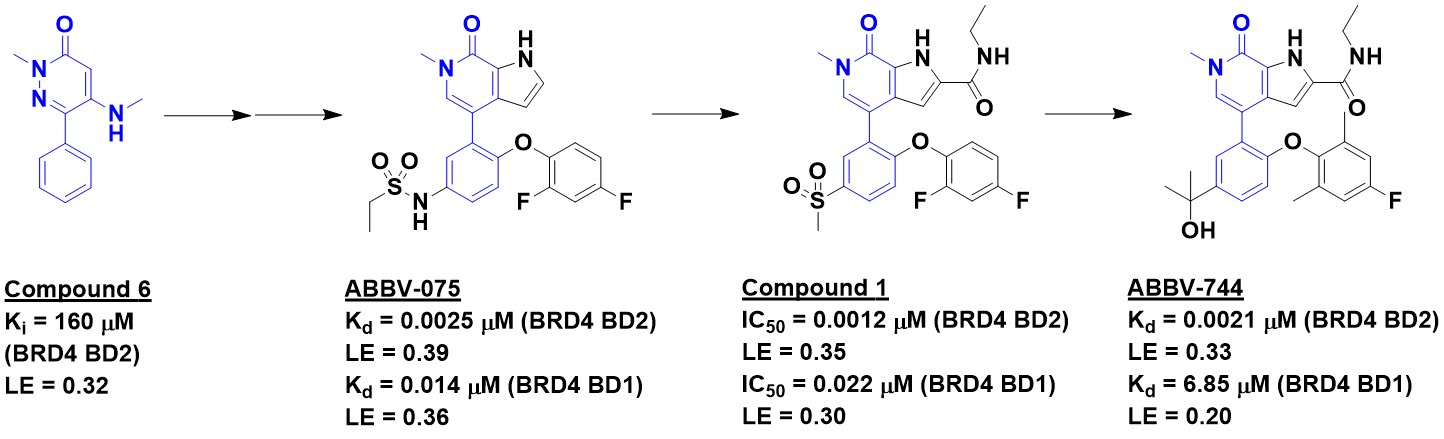
The story starts with a protein-detected NMR screen (highlighted here), which ultimately led to ABBV-075 (highlighted here). This molecule binds tightly to the four BET-domain family members (BRD1, BRD3, BRD4, and BRDt). However, ABBV-075 causes gastrointestinal toxicity as well as a reduction in platelets when tested in mice. Indeed, these effects are seen when BRD4 alone is genetically silenced in mice, suggesting on-target toxicity. However, each of the BET proteins has two separate bromodomains, called BD1 and BD2, and the researchers thought that a selective inhibitor of the BD2 domain might be better tolerated.

Screening about 2500 compounds from the ABBV-075 program revealed that compound 1 was still quite potent against the BD1 domain of BRD4 but lost activity against the BD2 domain. Further optimization ultimately led to ABBV-744, which is at least two orders of magnitude more selective against the BD2 domains of all four BET-domain proteins over the respective BD1 domains. It also shows no activity against a panel of kinases and other bromodomains, and is orally bioavailable. A crystal structure of the molecule bound to either BD1 or BD2 reveals that the key interactions seen in ABBV-075 are maintained, but that the added amide moiety makes interactions only available in BD2, while the larger diphenylmethyl ether moiety is better accommodated in BD2 due to a slightly larger pocket (containing a valine rather than an isolueucine residue).


ABBV-744 is active against multiple acute myeloid leukemia and prostate cancer cell lines, and the paper thoroughly explores the biology of a selective BD2 inhibitor. Most striking is that in a mouse xenograft model, ABBV-744 shows similar activity at 1/16 of its maximum tolerated dose (MTD) as ABBV-075 shows at its MTD. Even at doses well above efficacious exposure levels, ABBV-744 shows only limited platelet reduction and no gastrointestinal toxicity in mice. As mentioned at FBLD 2018, this molecule has entered clinical development, while ABBV-075 has quietly been dropped from AbbVie’s pipeline.

This is a lovely example of biology-guided medicinal chemistry that is reminiscent of the BCL-family inhibitors, which started with less specific molecules and culminated with the approval of BCL2-selective venetoclax. Although the fragment origins of ABBV-744 are clear, they are not mentioned in the paper and – like the KRAS inhibitors and AZD5991 – could be easily overlooked. In all these cases small starting points have delivered potentially huge drugs, and Practical Fragments wishes everyone involved the best of luck.

15 April 2019

Fourteenth Annual Fragment-based Drug Discovery Meeting

CHI’s Drug Discovery Chemistry (DDC) meeting took place last week in San Diego. I think this was the largest yet, with >825 attendees, a third from outside the US, and nearly 70% from industry. The initial DDC meeting in 2006 had just four tracks, of which FBDD is the only one that remains. This one had nine tracks and four one-day symposia, so it was obviously impossible to see everything. Like last year, I’ll just stick to broad themes.

Success Stories
As always, clinical compounds received deserved attention. Among two I’ve covered recently, Paul Sprengeler described eFFECTOR’s MNK1/2 inhibitor eFT508, while Wolfgang Jahnke discussed Novartis’s allosteric BCR-ABL1 inhibitor ABL001. As previously mentioned, ABL001 is a case study in persistence: the project started in stealth mode and was put on hold a couple times until seemingly intractable problems could be overcome.

Another story of persistence, albeit with a less happy outcome, was presented by Erik Hembre, who discussed Lilly’s BACE1 program. Teddy wrote about their first fragment-derived molecule to enter the clinic, LY2811376, back in 2011. Unfortunately this molecule showed retinal toxicity in three-month animal studies, so the researchers further optimized their molecule to LY2886721, which made it to phase 2 studies before dropping out due to elevated liver enzymes. Reasoning that a more potent molecule would require a lower dose and thus lower the risk of toxicity, the researchers used structure-based drug design to get to picomolar LY3202626, which also made it to phase 2 before being scuttled due to the apparent invalidation of BACE1 as an Alzheimer’s disease target.

Talks on BCL2 and MCL1 inhibitors from Vernalis, AstraZeneca, and Servier all involved fragments in some capacity, but unfortunately they were in the protein-protein interaction track which was held concurrently with the FBDD session I was chairing. Suffice it to say you can expect to hear more about the phase 1 compounds AZD5991 and S654315.

A few earlier-stage success stories included Till Maurer’s discussion of the Genentech USP7 program (see here), Santosh Neelamkavil on Merck’s Factor XIa inhibitors, and Rod Hubbard on Vernalis DYRK1A, PAK1, and LRRK2 inhibitors. We have previously written about how displacing “high-energy” water molecules can be useful, and this tactic was used by Sven Hoelder at the Institute of Cancer Research for their BCL6 inhibitors. Last week we highlighted halogen bonds, which proved important for transforming molecules that simply bind to MEK1 to molecules that bind and inhibit the protein, as described by AstraZeneca’s Paolo Di Fruscia.

Methods
The MEK1 story Paolo told began with a very weak (0.45 mM) fragment that the team was able to advance to 300 nM in the absence of structure, though they did eventually obtain a crystal structure that supported further optimization. On the topic of crystallography, Marc O’Reilly discussed the Astex MiniFrag approach, which we recently wrote about here. Only a couple of these fragments contain a bromine atom, but Marc did mention that, of the 10,051 X-ray complexes solved at Astex, a number show halogen bonds, including some to the hinge region in kinases.

At FBLD 2018 Astex’s Chris Murray showed the first cryo-EM structure of a fragment bound to a protein, and Marc confirmed that they have now obtained structures of fragments bound to two targets, with fragments as small as 120 Da and resolution as good as 2.3 Å. They are increasing automation, with turnaround times of less than 24 hours in some cases. Santosh also mentioned that Merck is applying cryo-EM to fragments.

Frank McCormick (UCSF) highlighted multiple fragment-finding methods used to discover inhibitors against RAS family proteins, which are responsible for more than a million cancer deaths each year. In addition to stalwarts such as crystallography and NMR, these include less common methods such as Tethering and the second harmonic generation (SHG) approach for detecting conformational changes used by Biodesy. RAS was reported as a cancer driver almost forty years ago, but only now are the first direct inhibitors entering the clinic – a testimony to both the challenging nature of the target and how far we’ve come.

SHG and Tethering were also highlighted elsewhere: Charles Wartchow described how SHG identified 392 hits from a collection of 2563 fragments against an E3 ligase bound to a target protein at Novartis, while Michelle Arkin described her use of Tethering at UCSF to find molecules that could stabilize a complex of 14-3-3 bound to a specific client protein (see here).

An effective sponsored talk was presented by Björn Walse of SARomics Biostructures and Red Glead Discovery, who described weak affinity chromatography (WAC). Once they saw the schedule for DDC, they looked for a target that would be presented shortly before their presentation, and chose the protein USP7 as a test case. Beginning in January, they screened a library of 1200 fragments to obtain 34 hits, of which 7 confirmed in a thermal shift assay. This led to an SAR-by-catalog experiment, and 11 of the 31 fragments tested showed activity, as did a Genentech positive control compound.

All methods can generate false positives and false negatives (see for example here and here), some of which were described in an excellent talk by Engi Hassaan of Philipps University. Engi discussed how improving the sensitivity of an STD assay by decreasing salt concentration identified more fragments that had previously been found by crystallographic screening. She also presented a case study of how introducing a tryptophan residue into a small protein to facilitate purification led to problems down the road when the tryptophan side chain blocked a key pocket in the crystal lattice. Gregg Siegal (ZoBio) also highlighted a case where a fragment bound to the dimer interface in a crystal structure, whereas in solution the fragment bound to the active site, as observed by NMR.

Finally, among computational methods, Pawel Sledz (University of Zurich) gave a nice overview of the SEED and AutoCouple methods, while Paul Hawkins (OpenEye) described rapid searching of more than 10 billion chemical structures using ROCS (rapid overlay of chemical features). SkyFragNet is looking closer with each passing year.

There is much more to say, so please feel free to comment. Several good events are still coming up this year, and mark your calendar for 2020, when DDC returns to San Diego April 13-17!