29 April 2013

Fragment merging for renin

Renin, an aspartic protease involved in regulating blood pressure, is one of those drug targets that has been around forever; it took decades before the first direct inhibitor was approved. In a recent paper in J. Med. Chem., Daniel Baeschlin and colleagues at Novartis (where the approved drug was discovered) describe how they’ve taken a fragment-merging approach to look for additional inhibitors of this target.

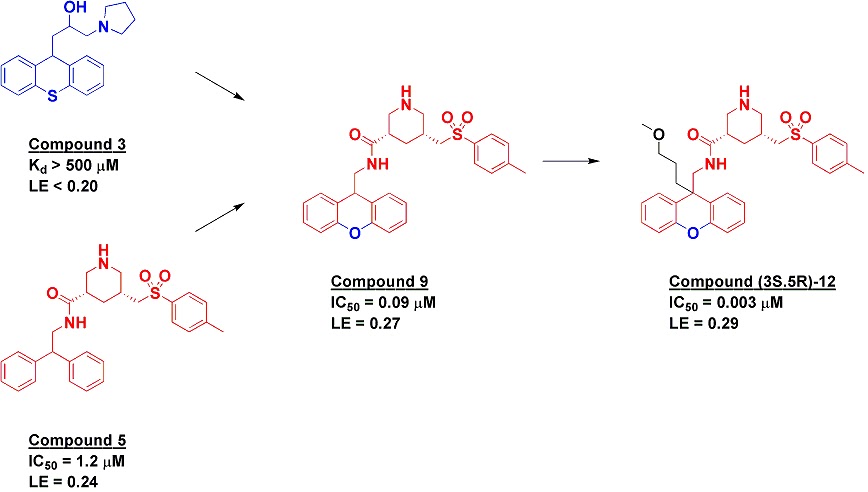
The researchers started by assembling a small (113 compound) fragment library designed to target aspartic proteases. This was screened against renin by NMR, resulting in hits such as compound 3. Although these were too weak to yield dissociation constants or IC50 values by NMR or biochemical screens, the researchers were able to obtain crystal structures of at least two of these fragments bound to renin, including compound 3. Interestingly, although the amino alcohol moiety of this compound was designed to target the catalytic aspartic acids, this turned out not to be the case. Instead the binding appears to be largely driven by hydrophobic contacts between the tricyclic moiety of the fragment and the so-called S3-S1 pocket of the protein.


Along with the fragment effort, the researchers also undertook an HTS screen, resulting in the discovery of compound 5, which itself had come from a 950-compound library targeted towards aspartic proteases. Crystallography revealed that this molecule binds with the diphenylmethane moiety in a similar position as the tricycle of fragment 3, and indeed when a rigid tricyclic framework was grafted onto compound 5 the resulting compound 9 showed a satisfying boost in potency. Further optimization led to a pure enantiomer of compound 12 with low nanomolar potency, good selectivity, moderate oral bioavailability and efficacy in rats, though it did also show some time-dependent CYP3A4 inhibition.

This is really a structure-based design paper, and there is obviously much more detail than would be appropriate here. What caught my eye is that it is a nice example of fragment-assisted drug discovery, in which fragment information is used as one aspect of an overall lead discovery program. In this case a cynic could argue that the only bit that came from the fragment was the tricylic motif. However, given the limitless number of analogs that could be made, such information can be both unexpected and valuable.

23 April 2013

Poll: how many atoms are too few?

Last year we asked how large a fragment you would include in your library, but the related question, how low will you go, is also interesting (see poll to right).

Azaindole, with 9 non-hydrogen atoms, has been the starting point for more than one clinical compound, and 5-atom acetohydroxamic acid also figures rather prominently in fragment history, but would you include something this small? How seriously should we take the Rule of 1?

22 April 2013

Poll Results - Number of Fragments in the Screen

The poll is closed!  So, the question was
I think it is fair to say that the average number of fragments per fragment mixture for NMR pooling is 6.  I typically say five is the goal and if you can squeeze in more good on ya!  I don't think the limitation is chemical shifts, I think it is solubility.  I would love to hear what others think is the limitation.

20 April 2013

Eight Annual Fragment-Based Drug Discovery Meeting (part 2)

The last major fragment event of 2013, CHI’s FBDD, wrapped up earlier this week in San Diego. As with last year this summary is not meant to be comprehensive (and you can also read Teddy’s impressions here.)

The FBDD track is just one of six within the CHI Drug Discovery Chemistry Conference. One indication of the success of the field is its appearance in several of the other tracks: attendees were likely to hear about fragments without going to the FBDD track at all.

In the GPCR track, Robert Cooke from Heptares discussed the application of fragments to the β1-adrenergic receptor (see also here). In the kinase track, Hongtao Zhao presented in silico fragment work (see also here). And in the protein-protein interaction track, David Fry from Roche described a deconstruction of the p53-HDM2 inhibitor RG7112 into its component fragments to see whether the molecule could have been identified from FBLD. RG7112 consists of a central core with four appendages, and although the mono-substituted core was too weak to detect, some of the cores with two substituents could be identified and bound to the protein in the same manner as the parent compound. However, these did tend to be super-sized fragments, with molecular weights in the 300-350 Da range.

Protein-protein interactions were also a theme of Richard Taylor, from the company UCB. They built a sizable fragment library of about 23,000 (mostly commercial) compounds designed to cover molecular frameworks found in known drugs. UCB has invested heavily in SPR technology, and with a stable of four Biacore 3000 instruments could rapidly screen this entire library against a dozen protein-protein interaction targets. Not surprisingly, given the difficulty of this target class, the hit rate was much lower than in conventional fragment screens, averaging just about 1%. What was interesting is that only 964 fragments hit any target – at less than 5%, this is much lower than the roughly 33% hit rate seen in other fragment libraries. Most of these fragments were reasonably specific, though; 908 hit ≤ 8 targets. It will be interesting to see whether anything can be learned about “privileged” protein-protein interaction fragments from this set.

Of course, extracting general trends from collections of fragments is not necessarily straightforward. Teddy has already brought up the difficulties of describing molecular shape; as he pointed out in his presentation, Fsp3 is not the best measure of “three-dimensionality” for several reasons. For example, even toluene has an Fsp3 = 0.14, and while Pete Kenny correctly points out that aromatic molecules do have volume, most chemists would think of this as a very “flat” compound. Principal moment of inertia (PMI) is better, but is harder to calculate. Happily, as Justin Bower described in his presentation, the Beatson Institute is allowing other researchers to use their 3DFIT software to calculate PMI and other properties.

One of the criticisms of 3D fragments is that, as Rod Hubbard pointed out, they can be a “pain in the neck” for chemistry. One solution that researchers at Vernalis took was to do analog work on a simpler molecule, then scaffold-hop back to the original fragment once the SAR was sufficiently understood to justify investment in more challenging chemistry.

Finally, the question of what to do with fragment hits that don’t reproduce in different assays was the topic of at least one breakout discussion and was also extensively discussed by Peter Kutchukian, who presented an analysis of 134 fragment screens using a variety of techniques against 34 different targets at Novartis. Some of this was presented at FBLD 2012, but one interesting finding was that hits from biophysical screens (such as SPR, NMR, or DSF) tended to cluster separately from hits in biochemical assays. Given the number of ways to find fragments, pursuing hits that confirm in both a biochemical and a biophysical method may help to weed out artifacts, though at the risk of increasing false negatives.

Feel free to chime in with your thoughts and impressions, whether or not you were there. And if you are kicking yourself for not attending, next year’s meeting is scheduled to return to San Diego from April 22-25.

17 April 2013

What's the Fire behind the Smoke?

Dan and I are here at the CHI FBDD conference, with of course other luminaries.  I am not going to get into details about all the talks, Dan does that much better than I anyways.  I wanted to set up some future blog posts by sharing what I think are some trends.

1.  3D fragments are real and very useful.  However, fSP3 is a horrible way to measure 3D-arity.  Principal Moment of Inertia (PMI) is a much better way to determine this.  This was mentioned in a brilliant talk (watered down from full-fledged rant) by me.  But much better explained by Justin Bower of the Beatson Institute. 

2.  Solubility, Solubility, and Solubility.  Experimentally determined solubility is a much better indicator of fragment quality (for a library) than cLogP, for example. 

3.  The Voldemort Rule (or the rule that shall not be named).  Arbitrary "rules" created as a marketing tool have no place in a discipline that has over a decade of results and empirical evidence.  While Dan is not ready to put a stake in its heart, I am.  Rod Hubbard is.  Who else wants to join Zartler-Dore's Army?
Look for more updates, thoughts, comments, and general frivolity as follow up to the conference.

14 April 2013

Fragments in the clinic: AZD5363

As illustrated earlier this year, kinases have been a fertile field for fragments. In a recent issue of J. Med. Chem., Jason Kettle and colleagues at AstraZeneca describe the discovery of AZD5363, a protein kinase B (PKB) inhibitor currently in multiple phase I clinical trials for solid tumors.

The story actually starts a decade ago, with a collaboration between Astex and the Institute of Cancer Research. The two organizations were interested in PKB (also known as Akt1), which has a central role in the PI3K signaling cascade. Virtual, biochemical, and crystallographic screens identified small fragments such as substituted pyrazoles and 7-azaindole (which astute readers will recognize as the starting point for vemurafenib) that bind to the so-called hinge region of PKB. Structure-guided fragment-growing ultimately led to compound 2.


This compound, while potent against PKB, was unselective against the related protein kinase A (PKA), so further crystallographically-enabled medicinal chemistry led to CCT128930, with 30-fold selectivity against PKA. This compound had limited oral bioavailability, so further optimization led to compound 3.

In 2005, Astex partnered this program with AstraZeneca, which is presumably where the current paper picks up. Although compound 3 had good pharmacokinetics and was selective against PKA, it inhibited the kinase ROCK2, which regulates blood pressure; it was also a modest hERG inhibitor. Extensive SAR explorations around the hinge-binding element, the amine, and the aromatic group were not productive, but substitution off the benzylic position was tolerated. Adding a basic substituent dramatically reduced hERG binding, but at the cost of oral bioavailability. However, adding a variety of neutral, polar substituents led ultimately to AZD5363, which has no detectable hERG inhibition, good selectivity against ROCK2, and improved solubility and cell activity.

This paper nicely illustrates some of the challenges in drug discovery: high-affinity molecules were obtained relatively quickly, but these still required a huge amount of effort to achieve selectivity, oral bioavailability, and other properties. Indeed, only three heavy atoms differentiate compound 3 from AZD5363, but it took a heroic effort to get there.

Finally, it is worth noting that this research was done at Alderley Park, which attendees of Fragments 2009 will remember fondly. Sadly, AstraZeneca has announced that they will be closing this site. There are many very talented scientists there, and Practical Fragments wishes all of them the best of luck.

12 April 2013

Upcoming Fragment Conference

Next week is the big fragment conference in the US (after a successful european one).  There are lots of interesting things going on.  Dan and I will be co-teaching a short course on fragments on Monday afternoon.  The conference then starts with Protein-Protein Interactions Optimizing Hit to Leads (with the best talk title: To Affinity and Beyond: From Screened Fragments To Optimized Leads With SPR and ITC), followed by Library and computational talk in the afternoon.  Day 2 starts with the ever popular breakfast roundtables, led by Dan, Rod Hubbard, Kevin Burgess, and myself.  The last session of the day will be the case studies.  There are a variety of events happening during the conference (and there are other tracks simultaneously) that Dan and I will update you on right here.  So, if you are going to be in SD we hope to see you. 

09 April 2013

Fast, competitive thermodynamic data

The importance of thermodynamics in drug discovery is often debated, with advocates arguing that ligands binding primarily through enthalpic interactions may be superior to those whose binding is driven by entropy. Some publications support these claims, though the data are rather sparse. This is at least partly because thermodynamic measurements are typically done using isothermal titration calorimetry (ITC), which consumes sizable amounts of protein and is not exactly high throughput. In a recent issue of J. Med. Chem., Jose Caaveiro, Kouhei Tsumoto, and their colleagues at the University of Tokyo and GE Healthcare Japan describe a new screening method that could speed things up.

The approach, which is essentially a competition screen, is called single-injection thermal extinction, or SITE. In a conventional calorimetric assay, a ligand is added to the protein in a calorimeter, and the measured heat change upon binding is used to calculate enthalpy. In SITE, a protein is first incubated with the fragment to be tested in the calorimeter, and a known positive control binder is then added. If the fragment binds at the same site as the known binder, addition of the positive control will cause a smaller change in temperature, and this difference should reflect the enthalpy of binding of the fragment compared to the positive control.

To validate the system, the researchers tested the steroid-processing enzyme ketosteroid isomerase (KSI). They first ran an SPR screen of 2000 fragments at 0.2 mM. To weed out false positives, they used two different types of SPR chips, and looked closely at the binding curves; the paper has a nice summary of some of the pathologies that can occur. A total of 129 hits were identified, of which 44 were then tested in SITE and characterized more fully with SPR.

Interestingly, most of the most potent compounds – as assessed by SPR – also gave the strongest signals in SITE, suggesting that these compounds are binding largely through enthalpic interactions. A few of the best compounds were further characterized by conventional ITC, and these did in fact have better enthalpic efficiencies than the positive control (they had better ligand efficiencies too).

It would be interesting to know how SITE behaves with allosteric inhibitors or ligands that bind to different sites on the protein. And of course, the jury is still out on whether enthalpic binders really do make superior leads, and even whether it is possible to use thermodynamics prospectively in lead optimization. But with a 9-fold drop in protein consumption and an increase in speed, this technique may make it easier to get the data to answer these questions.

03 April 2013

Everything that can go wrong

Anyone who ventures into fragment screening will encounter problems. Maybe your compound isn’t what you think it is. Or it’s contaminated with something that mucks up your assay. Or it degrades – possibly during the experiment.

Maybe you haven’t removed the PAINS from your screening collection, and you get results like this. Or perhaps you forgot to add detergent, and your hits are all aggregators.

Even if all your compounds are pure and beautiful little three-dimensional works of molecular art, things can go wrong in screening. As part of our occasional “Getting misled” series, we’ve highlighted problems that can arise in NMR and crystallography (here, here, and here). But that doesn’t mean that practitioners of SPR, ITC, thermal shifts, or other assays can relax.

As the old saying goes, forewarned is forearmed, so Ben Davis (of Vernalis) and I have put together a brief review of the many things that can go wrong in fragment-based lead discovery campaigns; thanks also to readers who shared their horror stories. It has just been published as a Digest in Bioorg. Med. Chem. Lett. To maximize readership, Elsevier has agreed to make this open access, at least through 2013. We hope this will be useful for folks starting out in the field, as well as for other researchers, journal editors, and reviewers trying to assess and build on the literature.

Of course, I’m sure we’ve left out lots of things that can go wrong, so feel free to comment here!

01 April 2013

One metric to rule them all

Most readers are familiar with ligand efficiency and LLE, and many folks are using LLEAT as well. However, as we’ve previously noted, a whole cottage industry has been busily devising new metrics, and it sometimes becomes hard to keep them all straight.

To help bring some order to the chaos, researchers at Mordor State College (home of the Sauron Atoms) have developed what they call the Wholly Transcendent Function, or WTF. This metric takes into account binding affinity, number of heavy atoms, ClogP, and molecular topology, but it also includes information about metabolic stability, toxicity, blood-brain barrier penetration, hERG binding, CYP inhibition, and potential for becoming a blockbuster, all encoded into a single number between 0 and 1.

Unfortunately, collecting all the data necessary to calculate WTF is quite a quest, but the gaps are readily filled by guesswork, producing a metric that can banish unnecessary complexity. Moreover, the researchers are confident that improved computational estimates will one day make even more accurate predictions readily available.

25 March 2013

Leave Them Asking for More

ret·ro·spec·tive  (rtr-spktv) adj.
1. Looking back on, contemplating, or directed to the past.
2. Looking or directed backward.
3. Applying to or influencing the past; retroactive.
I would add: 4. Looking back on the past, to influence the future.

In this vein, a recent paper by Ferenczy and Keserű in J. Med Chem looks back on hit-lead optimizations derived from fragment starting points.  In this very interesting paper, they look at 145 fragment programs and evaluate the properties of the original hit and then again as it progresses into the lead.  Of the 145 programs, these were aimed at 83 proteins of which 76 are enzymes, 6 are receptors, and 1 is an ion channel.  These programs evolved into leads, tools, and clinical candidates.  The authors set out to answer three questions: 1. do fragments eliminate the risk of property inflation, 2. how do ligand efficiency metrics support fragment optimizations, and 3. what is the impact of detection method, optimization strategy, and company size on the optimization.

Table 2 shows the median the calculated properties for the hits and optimized compounds.  The pIC50 improved by roughly three orders of magnitude, but ligand efficiency (LE) stayed roughly the same.  Log P increased but SILE did not.  SILE was a metric I was not familiar with and is calculated by pIC50/(HAC)^0.3.  SILE is a size-independent metric of ligand efficiency.  I won't attempt to reproduce all the graphs they generated; get the paper.  Some interesting data points: the median fragment hit had 15 heavy atoms (see related poll here), the median size of leads is 28 heavy atoms, and good fraction of hit-lead pairs changed less than 5 heavy atoms (which of course is well known from here). So, what is the answer for their first question?  If you are looking at something like LE, then these hit-lead pairs maintain the efficiency.  If you are looking at logP, then the answer is no, the hit-lead pairs get greasier.  I would really like to see more granularity here (see What's Missing below).  Their major comment here is that SILE and LELP (work by the author's previously reviewed by Dan) are the two best metrics to monitor as hit-lead optimization is underway.  Increases in both metrics correlate with increases in FBDD programs. 
 
They then looked at the  screening method.  The breakout of primary screening (in their definition the first one listed when multiple methods were used) was 38% biochemical, 25% NMR, 18% X-ray, and 11% virtual.  This is an interesting contrast to these results; SPR is not the dominant screening technique (8% tied with MS).  So, does this mean, >40% of practitioners are using SPR, but as a secondary screen?
Table 4 then does a pairwise comparison of the metrics based upon primary screen origin of the fragment (see What's Missing below).  Biochemical screens yield the most potent hits (4.75) while NMR (3.53) has the least potent.  X-ray has the smallest hits( 13 heavy atoms) while virtual screening the largest (17 HA).  I don't think any of this is surprising; the authors point out that hit properties exhibit a significant dependence on the method used. It is noted that optimization tends to diminish differences in hit properties.  Again, I think this is not surprising; thermodynamics and medchem are all the same no matter how big or small the molecule.  They do point out that biochemical based hits preserve their advantage after optimization, primarily relative to NMR.  They posit that the difference is that more potent compounds need less "stuff" to become sufficiently potent, and thus have a better mix of medchem for potency and other property optimization.  Weaker starting points need more bulk, more atoms, to become equipotent with biochemical starting points, they suggest.  Lastly, they show that structural-based optimization efforts are better than those without structural information.  The structural information comes from X-ray primarily (52%) and NMR (10%).  Interestingly, they reference this poll from the blog on whether you need structural information to prosecute fragments.  [As an aside, since I wrote that blog post and it was reference in a paper, do I get to add it to my resume?]

Finally, they break the originating labs into three categories: academic (18%), small/medium enterprises (SME)( 37%), and Big Pharma (45%).  The SME results are superior to those achieved by the academics and Big Pharma.  Their explanation is that SME's tend to be more platform focused and predominantly ensure "structural" enablement of targets.  75% (40/53) optimizations at SMEs used protein structural information, while "only" 62% of those at Big Pharma did.  They do not rule out the differences in target selection at those two different groups of companies.  I would like to propose an alternative hypothesis (tongue-not-entirely-in-cheek): Big Pharma has "old crusty" chemists who don't understand fragments and thus just glom on hydrophobic stuff to increase potency because "that's how we always do it" while SME have innovative chemists.  And of course academia is just making tool compounds and crap.


One thing that I would like to emphasize is that Ro3, metrics, and so on should not be used as hard cutoffs.  As shown in Figure 11, even compounds that are outside the "preferred" space can reach the clinic.  The best way to view them is akin to the Pirate Code; they are more guidelines than rules. 
 
What is Missing?  The supplemental information (which the authors are willing to kindly share) does not break out the targets into specific classes.  However, they do list each target, so it should be easy to add this a data column.  More importantly, they do not break out hit-lead pairs into those that were optimized for use as tools, clinical candidates, and leads (and which of the leads died).  Tools are never supposed to look like leads (but you are lucky if they do), so their inclusion here can be biasing the results.  Although, it is likely that the of the 145 not very many of the examples are strictly tools; it would be nice to know though.   
I am struck by the information denseness of Table 4 and wish that instead of pairwise comparisons, they had instead simply list the hit-lead metrics for each methodology.  I think there is gold to be mined in Table 4 and just like real gold is hard to find.
 
I have not addressed every single point made by the authors.  I, for one, am hoping that they will continue their analyses (especially with an eye to some of What is Missing).  I hope that there will be a significant amount of discussion around these points.  I will make sure we hit on this at the breakfast roundtable at the upcoming CHI FBDD event in SD (I even have the same pithy title as last year!)

18 March 2013

Rad fragments

One of the selling points of FBLD is that it can find starting points against challenging targets such as protein-protein interactions. A major reason these targets are so tricky is that they often have large, flat interfaces with few pockets for small molecules to bind. An example is the interaction between the tumor suppressor BRCA2 and the recombinase RAD51, which is mediated in part by the phenyl ring of a phenylalanine residue – a very small moiety even by the standards of fragments. In a paper published recently in ChemBioChem, Marko Hyvönen and colleagues at the University of Cambridge describe how they’ve found fragments that bind to this site.

The researchers started with a microbial RAD51 homolog that had been humanized by mutagenesis; the human protein itself is unstable and difficult to work with. They performed a thermal screen with 1249 fragments. Thermal denaturation has been criticized for producing noisy data, and indeed, 96 fragments produced complex, uninterpretable results. However, the two best fragments both contained an indole core and were confirmed to bind by STD-NMR.

Competition experiments confirmed that these two fragments competed with a short peptide containing the critical phenylalanine, indicating that they bound at the desired spot. ITC revealed that they had dissociation constants around 2 mM. Their binding modes were also confirmed crystallographically.

The researchers then used one of these fragments as a probe in a round of STD-NMR experiments, in which they examined 42 fragments to see whether any of these could compete away the first fragment. This led to two new hits, both slightly more potent than the initial ones.

One of these new fragments was then used as a probe in another round of STD-NMR experiments with 120 fragments chosen as analogs or by in-silico screening. This led to four additional fragments, some of which had sub-millimolar affinities and good ligand efficiencies. All 6 of the new fragments from the two STD-NMR screens were characterized crystallographically and found to bind at the same site as the original indole fragments, though with some subtle differences that could be exploited for further elaboration.

This is a nice, thorough example of fragment discovery in academia. As the authors conclude:

Investment in a platform of orthogonal biophysical assays and screens is crucial for progression into a programme of medicinal chemistry. The elaboration of poorly validated hits not only has a high likelihood of failure, but without a variety of robust assays in place, the risk of being misled by badly behaving compounds increases.

Of course, these are still relatively weak fragments, but I’ve heard one of the authors speak at a conference in which he stated that they’ve been able to advance these to nanomolar leads with cell activity. Stay tuned!

11 March 2013

With the proper tool, I could move the world

As noted before, bromodomains are a "hot" area of drug discovery.  Dan mentioned last year that PFI-1 was being released as a tool compound by the SGC.  In this paper, Fish et al. describe its discovery (Supplemental Information here).  They started their discovery with potential fragment-sized acetyl-lysine mimics (DMSO need not apply!), like others have described.  In particular, 3,4-dihydro-3-methyl-2(1H)-quinazolinones like Cpd 7 and its bromoequivalent.  These two compounds had sub-30uM potency and thus LE>0.45.  The efforts of Conway et al. and Chung et al. were highly instructive to the Pfizer group.  Crystallography was a key driver of confirming the binding modes seen by Conway are possible and that the quinazolinones are a viable acetyl-lysine mimic. 

The crystallography pointed out that the bromine is pointing towards solvent and thus the appropriate place to start doing chemistry.  Based upon the structures, a "bent" substituent at the 6 position appeared to be promising; sulfonamides were chosen for this role.    Compounds 9 and 11 were also noted as attractive, novel compounds in their own right.  These were used for very limited library construction.  The compounds derived from 9 were profiled first.  While better than the parent bromide, subsequent structural analysis showed that they were not making good interactions with the sites intended (WPF shelf).  The sulfonamides derived from 11 on the other hand showed significantly improved activity.  The SAR was relatively insensitive to the substitution of the aryl group, due to the optimized placement on the shelf and the reversed sulfonamide.  
PFI-1 has 0.22uM activity against BRD4 and it was nominated as the probe molecule.  They further investigated its binding via X-ray.  They also looked at it in a much broader array of assays: broader pharmacological selectivity, a cell-based inflammatory end-point assay, and rodent pharmacokinetics.  It had < 50% inhibition against 15 targets at 10uM (GPCR, ion channels, enzymes) and < 20% inhibition against 50 kinases. It fits the criteria for a good probe.

As the authors state, it was designed in a little over 250 molecules from an efficient fragment starting point covering only two design cycles.  I think this is an excellent example of probe design/discovery. 


07 March 2013

Fragments 2013

Fragments 2013, the 4th RSC-BMCS fragment-based drug discovery meeting, took place this week at STFC Rutherford Laboratory in Oxfordshire, UK. These biennial meetings started in 2007; you can read impressions of Fragments 2009 here and here. With 14 speakers, 49 posters, multiple exhibitors, close to 200 attendees, and a pre-conference training course, this post can touch on just a few topics. Some of the talks and poster summaries are available here.

One of the first things I noticed was the number of new faces, always a good indicator for the health of a field. I was also struck by the number of attendees from big pharma, including a couple companies that had draconian travel policies in 2012. Hopefully this portends a thaw from the last few years.

False positives or false negatives?
A recurring theme was the (ir)reproducibility of fragment-finding methods. Practical Fragments recently discussed this here, and it seems many other folks are also finding that orthogonal methods can produce non-overlapping sets of hits. For example, Ursula Egner from Bayer Healthcare described two different targets screened using multiple methods. For thrombin, her team found the following from a library of 1891 fragments:
27 hits with IC50 ≤ 650 μM using high-concentration activity screening
75 hits with IC50 ≤ 2 mM using SPR
58 hits that stabilized the protein more than 2σ above baseline against thermal melting
Of these, only 2 were found by all three techniques, and of 114 fragments soaked into crystals, only 15 gave structures.
Another (unnamed) protease gave similar results with a library of 2031 fragments:
17 hits from high-throughput screening
48 hits from SPR
38 hits from thermal shift
None of the hits were found in all three assays!
In this case soaking was not possible, and of the 93 co-crystallization trials only 8 produced structures, of which none came from the thermal shift assays (also true for thrombin).
Al Gibbs from Jannsen R&D found similar results in a retrospective analysis of hits against ketohexokinase (see also here). Of 786 fragments tested, there were:
54 hits in an activity assay (mass-spectrometry based)
75 hits from SPR
44 hits that produced crystal structures
Of all these, only 2 were in common. There was also no correlation between affinity or solubility and the ability to obtain a crystal structure.
However, these observations were not universal. Rod Hubbard noted that of the 32 targets screened over the past 10 years at Vernalis, there tended to be good overlap between hits from SPR and NMR, and that these tended to produce X-ray crystal structures, though crystallography had plenty of false negatives too. He did single out thermal melt assays as being particularly unreliable, as have others.

How to reconcile these varied experiences? Rod stressed that assays required very careful optimization, and that subtle changes could dramatically improve the number and quality of hits. Indeed, the thrombin example above used different cutoffs for the activity and SPR screens, and the ketohexokinase crystals were soaked at pH 4.5 while other assays were run at pH 7.5. Tony Giannetti noted that his group at Genentech tries to closely match their SPR screening conditions with those that the crystallographers use.

All this does raise the question of what to do when your orthogonal assays don’t agree: do you go with less validated hits, risking false positives, or throw away potentially valuable fragments? There probably is no one right answer. If you have plenty of hits that confirm in all your assays you should probably stick with those, but if you’re working on a tougher target you may need to dig into the noise, but be especially wary of misleading, ultimately meaningless babble. Of course, the potential for false positives means you want to take even more care in your fragment library design.

Library design
On the topic of “three-dimensional” fragments, a concern raised as far back as 2009 is that they may have a lower hit-rate than “flatter”, more aromatic fragments. Dirk Ullman noted that over the course of 29 screens he and his colleagues at Evotec have obtained 15,687 fragment hits, with any given fragment rarely hitting more than 4 different targets. Reassuringly, Oliver Barker presented a poster in which he found that while these hits were slightly biased towards having fewer tertiary and quaternary carbons as well as a lower Fsp3, this was a very modest trend, probably not statistically significant.

Teddy’s recent poll asking how much diversity readers want in their fragment libraries found that though the majority of respondents (60%) wanted maximum diversity, target-focused libraries can be effective too. Paul Bamborough described how, in addition to a generic fragment screening library, he and his colleagues at GlaxoSmithKline also built a collection of 936 fragments geared for kinases (described here) and, more recently, 1326 fragments targeted to bromodomains. These have yielded much better hit rates than have their diverse fragment sets.

The targeted libraries also provide a nice example of fragment-assisted drug discovery: they were designed based on molecules derived from high-throughput screening, and the data generated by screening the fragments against several bromodomains have in turn informed the design of 25,000 new lead-like molecules for HTS and several billion DNA-encoded molecules.

There was plenty else of note, including some nice fragment-to-lead stories (such as this) and others that should be appearing in the literature soon, but I’ll end here. What were your impressions?
04 March 2013

Poll Results--HAC vs. MW

Our poll asking what denominator people use for the ligand efficiency metrics.  This idea for this poll came from these posts at In The Pipeline.  Of the 38 respondents, 8 "don't need no steenkin' metrics".  Of the remaining 30 answers, 27 people use heavy atom count, 1 uses both, and only 2 use molecular weight. 

So, in terms of everyday atoms, I think people can agree that heavy atom count makes the most sense.  But, Derek is still trying to figure out what to do with heavy halogens.  Do halogens need to be treated differently?  My thoughts are that they don't in the hit generation (HG) stage, but in lead optimization stage they would.   I have always thought that ligand metrics are most germane to the HG stage and less useful once you are trying to optimize things like PK/PD properties.  If a heavy halogen, makes it from hit confirmation, hit expansion, and into lead optimization, it is most likely doing something, so why penalize it?  

Am I thinking about this too naively? 

01 March 2013

Purifying hydrophilic fragments

Lipophilicity is a topic that comes up periodically. Lipophilic molecules are increasingly viewed as problematic from a drug development standpoint. Even if the correlation studies indicting lipophilicity are not as strong as they appear, at the end of the day we would prefer most of our drugs to be nicely water soluble.

That said, many of the molecules we make are on the greasy side. GDB-17, Jean-Louis Reymond’s recent computational enumeration of small molecules with 17 or fewer heavy atoms, reveals that most potential molecules tend to be much more polar than similarly sized compounds that have actually been made. One likely reason for this is that purifying highly water-soluble molecules is difficult; it’s hard to wash away inorganic reagents, and they often stick to the normal silica gel that chemists use to purify conventional molecules. Reverse-phase HPLC is useful, but can be tedious and low throughput.

In a recent issue of Drug Discovery Today, Andrew Hobbs and Robert Young of GlaxoSmithKline provide practical tips on using reverse-phase flash chromatography as an alternative to HPLC. They report working at scales from milligrams to tens of grams and are able to separate some very polar molecules. There’s a lot of good stuff in this paper on choosing columns, solvents, and loading techniques. A lot of these details get pretty nuanced, so it’s nice to have them in one place. If you’re trying to isolate hydrophilic molecules, definitely check it out.

20 February 2013

Fragmenting natural products – sometimes PAINfully

Many drugs have their origins in natural products. But as any synthetic organic chemist will tell you, natural products often have complex architectures that can take years of effort and dozens of chemists to make in the lab. Thus, many of the compounds made in industry look quite different from natural products, particularly in the past few decades. High failure rates in drug discovery have led folks to return to natural products or similar compounds, such as those from diversity oriented synthesis (DOS). In a recent issue of Nature Chemistry, Herbert Waldmann and colleagues at the Max-Planck Institute in Dortmund examine whether natural products can serve as starting points for new fragments.

The researchers started by computationally deconstructing 183,769 natural products into 751,577 component fragments. After various filters (size, lipophilicity, reactivity, etc.) they arrived at 110,485 fragments sorted by similarity into 2000 clusters. The resulting fragments differ in their overall calculated properties from commercial fragments. This is all highly reminiscent of the Emerald (nee deCODE) “fragments of life”, though surprisingly that work is not referenced.

One challenge of designing new fragments is that you may not be able to buy them. In this case, nearly half of the clusters did have a compound that could be purchased – though perhaps this somewhat defeats the purpose of trying to explore novel chemical space. At any rate, 193 fragments were either bought or synthesized. These were tested in functional assays against p38a MAP kinase and several protein phosphatases. A number of hits were identified, and in the case of p38a, nine kinase-fragment co-crystal structures were solved. Some of these were similar to previously reported fragments, but others were more unusual. Together with the crystal structures, these fragments provide new ideas for a well-studied target.

Looking at the structures of some of the phosphatase inhibitors, however, I started to worry. One strong point of the paper is that it is very complete: the chemical structures of all 193 tested fragments are provided in the supplementary information. Unfortunately, the list contains some truly dreadful members; 17 of the worst are shown here, with the nasty bits shown in red. All of these are PAINS that will nonspecifically interfere with many different assays.


Compounds 15, 44, 49, 159, 166, 173, 174, and 175 are catechols; compounds 89 and 151 (yes, they are the same molecule – guess they really liked this one), 165, 166, 167, and 168 are quinones; compounds 55, 89/151, and 166 are hydroquinones; compound 20 is a Michael acceptor; compound 76 is an epoxide; and compound 184 is a redox cycler. In other words, these fragments are a depressing example of life imitating art (or at least satire).

To be blunt: none of these molecules should appear in a screening library today.

I don’t want to pick on these researchers; it is after all laudable that they fully disclosed the structures of their molecules.

However, I am concerned that other people may build libraries containing some of these fragments, or worse, that opportunistic vendors will start selling “natural-product derived fragments.” Indeed, most of these molecules are commercially available. It is disappointing that so many nuisance compounds would find their way into research published in a Nature family journal, and I think it is important to call it out. Only by publicizing the problems that can arise will people be made aware of the dangers.

18 February 2013

FAK This

FAK, also known as PTK2, is a well known oncology target.  Current known inhibitors can be broken into three different binding classes:   Cpds I-IV are hinge binders, the chloropyramine targets the FAK-VEGF interface, and Y15 targets the Y397 site. Cpds V and VI were recently reported as novel allosteric inhibitors of FAK.

In this paper, a group led by researchers at Merck Serono, report their discovery of a new core from an "accelerated knowledge-based fragment growing approach".  

They used a commercially available fragment library (defined as:  MW, <200 solubility="">1 μg/mL; number of hydrogen bond donors and acceptors, ≤3) was screened against the immobilized kinase domain of FAK by SPR, which allowed them to determine kinetics for most of the fragments.  Compound I (Magenta) was found to be a 43 μm inhibitor.  The X-ray structure showed it to make excellent contacts with the protein.  Addition of the spinach shown in green, afforded an order of magnitude increase in potency.  In order to facilitate better elaboration, they chose to use 7-azaindole as the scaffold.
Then, going through traditional SAR and medchem, they end up with this table.  The best compound is a single digit nanomolar inhibitor with cell-based activity. One important aspect of this work is that the lead series can induce a rare helical loop DFG conformation.  In their conclusion, they state 
it was easier to improve kinase inhibition than kinase selectivity.

The first thing that stands out here is the solubility limit.  For a 250 Da fragment, 1μg/mL corresponds to 4 μM.  To me that sounds incredibly low; is it a typo?  They don't mention who those fragments are from.  I would love to know out of sheer curiousity.   Secondly, although they talk about their accelerated fragment growing approach, they don't actually explain what they mean by that?  To the best of my reading, I don't think they have introduced anything novel here.  


12 February 2013

Fragment linking for LDHA: Ariad’s turn

Last year we highlighted a paper from AstraZeneca in which researchers there used a fragment-linking approach to tackle an enzyme important for cancer metabolism, lactate dehydrogenase A (LDHA). Turns out they weren’t alone – researchers at Ariad had also been working on the same target, as Stephan Zech reported at FBLD 2012. They have now published some of this work in J. Med. Chem.

Anna Kohlmann and colleagues at Ariad started with a fairly small library, just 735 fragments from Maybridge. These were screened using STD-NMR at 2-3 mM per fragment, resulting in 38 hits, about half of which contained carboxylic acids – not surprising given that the substrate and cofactor are both negatively charged. Most of the fragments could be competed by the cofactor NADH, and although they bound too weakly to show any inhibition in an enzymatic assay, they did show binding by SPR. Crystal soaking led to a co-crystal structure of compound 1, which binds in the substrate and part of the cofactor site (where the nictotinamide moiety of NADH normally binds).


Fragment growing led to compounds 2 and 5, both with enhanced affinity. Interestingly, crystallography revealed that compound 5 binds in a distant part of the cofactor binding site, where the adenosine moiety of NADH normally binds. Elaboration of this molecule didn’t do much for affinity but did suggest a linking strategy, resulting in molecules such as compound 9, with nanomolar potency and detectable cell-based activity.

Apropos to Darwin Day, this is an interesting example of convergent evolution: two companies applying fragment-linking to discover molecules that bear some similarity to one another (Ariad compound 8 in blue, AstraZeneca compound 26 in red).


Near the end of the paper, the researchers also carefully investigated some of the other previously reported “inhibitors” of LDHA and found that they are in fact aggregators. This is not surprising given their structures, which look like something that might appear in an April Fool’s post. Unfortunately these molecules were reported in prominent journals such as Chem. Biol. and Proc. Nat. Acad. Sci. USA; the later, published in 2010, has already been cited at least 100 times. Publicly revealing them to be artifacts is a beautiful example of the self-correcting nature of science. I hope we’ll see more of it.

04 February 2013

Beware correlation inflation

Drug discovery today is replete with rules and metrics: the Rule of 5, the Rule of 3, (though perhaps not 1), not to mention ligand efficiency and friends. The hope is that these encapsulate physical trends that will guide drug hunters towards better compounds. However, there is a danger that rules will become strait-jackets; plenty of drugs, after all, lie well outside the Rule of 5 (Ro5). In a paper recently published in J. Comput. Aided Mol. Des., Peter Kenny (of FBDD-Lit fame) and Carlos Montanari argue that the correlations underlying many rules may not be as robust as they appear. The article is full of the trenchant prose we’ve come to expect of Kenny, so I’ll quote liberally.

The background:

Those who have followed the drug discovery literature over the last decade or so will have become aware of a publication genre that can be described as ‘retrospective data analysis of large proprietary data sets’ or, more succinctly, as ‘Ro5 envy’.

The problem:

Although data analysts frequently tout the statistical significance of the trends that their analysis has revealed, weak trends can be statistically significant without being remotely interesting.

This is especially likely to occur when data are “binned” into a smaller number of categories before being analyzed, thereby hiding variation and making correlations appear stronger than they really are. Since many published analyses use proprietary, unavailable data, Kenny and Montanari constructed model “noisy” data sets and looked for correlations in the primary data and the binned data. They found that correlations in the binned data were inflated. Perhaps counter-intuitively, the effect actually gets more pronounced the larger the data set.

Having described the problem, Kenny and Montanari go on to question some recent high-profile papers correlating, for example, lipophilicity with pharmacological promiscuity, or the percentage of sp3-hybridized carbons (Fsp3) with solubility (see also here). In the latter case, all the data were publicly available, and a reanalysis with the primary data as opposed to binned data caused the correlation coefficient (r) to drop from 0.972 to 0.247!

Graphical representation of data comes under heavy scrutiny too. In particular, the common practice of subdividing data points into small numbers of categories (often red, yellow, and green) can make these categories appear discrete when the underlying data are better described as a continuum.

The overall message is that weak correlations may lead to misguided strategies:

To restrict values of properties such as lipophilicity more stringently than is justified by trends in the data is to deny one’s own drug-hunting teams room to maneuver while yielding the initiative to hungrier, more agile competitors.

There is something to this, though acting on it is not without risk. As the old saying goes, nobody gets fired for buying IBM. Most drug discovery efforts fail, but if you fail making conventional compounds, you’re less likely to come under fire than if you fail by doing something outside the accepted norm.

But whatever you do, it’s worth remembering:

The human liver remains an effective antidote to the hubris of the drug designer.