Showing posts with label molecular complexity. Show all posts

19 January 2026

How best to assess molecular shapeliness?

The shape of a molecule influences its properties. While this is true on a per-compound level, things get a little more controversial when discussing molecules in general. Back in 2009 researchers argued that “three dimensional” molecules have better drug-like properties, though this assertion has been challenged, repeatedly. But how do you assess the shape of a molecule in the first place? In a recent (open-access) Drug Discov. Today paper, Iwan de Esch and collaborators at Vrije Universiteit Amsterdam compare the main metrics.
 
The researchers focus on three metrics: fraction of sp3-hybridized carbons (FCsp3), which we wrote about here; plane of best fit (PBF), which we wrote about here; and principal moment of inertia (PMI), which we wrote about here. FCsp3, which ranges from 0 to 1, is simple to calculate based on the chemical structure alone, while the other two metrics rely on the three-dimensional shape of the molecule, requiring calculations and indeed choices since many molecules can assume multiple conformations. PBF is measured in angstroms with a minimum of 0 Å and no maximum; a protein, for example, could easily have a PBF above 10 Å. PMI is represented by two normalized PMI ratios, and these are often added to give a number (3D Score or ΣNPR) between 1 and 2.
 
The researchers calculated FCsp3, PBF, and ΣNPR for a set of nearly half a million commercially available fragments which we discussed here; PBF and ΣNPR were calculated based on the single lowest energy conformation for each molecule. As noted above, PBF is somewhat size-dependent. For example, adamantane and buckminsterfullerene have PBF scores of 0.79 and 1.76 Å but identical ΣNPR scores. Nonetheless, the researchers found a correlation between these two metrics, and this correlation increased when PBF was divided by the root of the molecular volume to attempt to normalize for size.
 
In contrast, no correlation was found between FCsp3 and PMI, making the former “a poor descriptor for predicting 3D molecular shape.” Is there a simple alternative? FCsp3 only considers carbon atoms, so the researchers proposed FHAsp3, which includes nitrogen, oxygen, and sulfur atoms. Perhaps not surprisingly, this didn’t improve the correlation.
 
Three years ago we wrote about “spacial scores,” which were developed to assess molecular complexity. The researchers calculated normalized spacial scores (nSPS) for their set of compounds, but these also showed no correlation to PMI.
 
The researchers conclude that, “once corrected for size, PBF captures three-dimensionality similarly to ΣNPR values. However, unlike a PMI analysis, it is not capable of further distinguishing between rod- and disc-shaped molecules, giving PMI a higher resolution in capturing shape diversity.” Interestingly, this is the opposite conclusion of an analysis Teddy wrote about in 2014. My take is that, if you want to assess shapeliness, steer clear of FCsp3, but both PBF and PMI are fine.

10 February 2025

Flatland: still a nice place to be

In 2009 we highlighted a paper reporting that approved drugs have a higher fraction of sp3-hybridized carbon atoms than discovery-phase compounds. Perhaps focusing on molecules with a high Fsp3, the ratio of sp3-hybridzed carbons to total carbons, would lead to greater success. Or not: a new analysis in Nat. Rev. Chem. by Ian Churcher (Janus Drug Discovery), Stuart Newbold, and Christopher Murray (both at Astex) finds that the relationship has not held up.
 
The 2009 “Escape from Flatland” paper was widely discussed at conferences and has been cited more than 3000 times. But according to the authors of the new study, most of these citations are from papers describing new synthetic methodologies rather than from papers discussing medicinal chemistry.
 
And not all the attention has been positive. As we noted in 2013, Pete Kenny and Carlos Montanari reanalyzed the data and found that an apparent correlation between Fsp3 and solubility disappeared when plotting all discrete data points instead of binned data.
 
More recently, we highlighted a paper that found no significant difference between the shapeliness of drugs, as assessed by their principal moment of inertia (PMI), and the shapeliness of small molecules in the ZINC database.
 
The new paper looks at Fsp3 values for drugs approved during various time periods. Among 980 drugs approved up to 2009, the average Fsp3 was 0.458. However, of the 431 drugs approved after 2009, the average Fsp3 has dropped to 0.392. The researchers speculate that this (statistically significant) decrease may be due to an increase in the number of kinase inhibitors, which are usually highly aromatic, as well as an increase in the use of metal-catalyzed cross coupling reactions.
 
In my analysis of the 2009 paper, I asked whether higher Fsp3 ratios would lead to lower hit rates, and indeed this seems to be the case, as shown in a paper we discussed in 2020. Thus, if you pursue difficult targets, you may increase your chances of finding hits by screening molecules with lower Fsp3 ratios. Also, multiple studies, including one published just last month, have found no correlation between the shapeliness of a fragment (as defined by deviation from planarity, or DFP) and the shapeliness of the resulting lead, so there appears to be no penalty to starting with a flattish fragment. 
 
The researchers conclude that their “analysis of drug development trends over the last 15 years suggests that Fsp3 may not have been a useful metric to optimize.” Importantly, the supplementary information includes a list of >1400 approved drugs and >1500 investigational drugs along with associated properties, so you can do your own analyses.
 
In the end, generalizations will only get you so far, and may even lead you astray. At least for now, there are few shortcuts in the long slog of experimental studies necessary to discover a drug.

16 October 2023

Spacial Scores: new metrics for measuring molecular complexity

Molecular complexity is one of the theoretical underpinnings for fragment-based drug discovery. Mike Hann and colleagues proposed two decades ago that very simple molecules may not have enough features to bind tightly to any proteins, whereas highly functionalized molecules may have extraneous spinach that keeps them from binding to any proteins. Fragments, being small and thus less complex, are in a sweet spot: just complex enough.
 
But what does it mean for one molecule to be more complex than another? Most chemists would agree that pyridine is more complex than methane, but is it more complex than benzene? To decide, you need a numerical metric, and there are plenty to choose from. The problem, as we discussed in 2017, is that they don’t correlate with one another, so it is not clear which one(s) to choose. In a new (open access) J. Med. Chem. paper, Adrian Krzyzanowski, Herbert Waldmann and colleagues at the Max Planck Institute Dortmund have provided another. (Derek Lowe also recently covered this paper.)
 
The researchers propose the Spacial Score, or SPS. This is calculated based on four molecular parameters for each atom in a given molecule. The term h is dependent on atom hybridization: 1 for sp-, 2 for sp2-, 3 for sp3-hybrized atoms, and 4 for all others. Stereogenic centers are assigned an s value of 2, while all other atoms are assigned a value of 1. Atoms that are part of non-aromatic rings are also assigned an r value of 2; those that are part of an aromatic ring or linear chain are set to 1. Finally, the n score is set to the number of heavy-atom neighbors.
 
For each atom in a molecule, h is multiplied by s, r, and n2. The SPS is calculated by summing the individual scores for all the atoms in a molecule. Because there is no upper limit, and because it is nice to be able to compare molecules of the same size, the researchers also define the nSPS, or normalized SPS, which is simply the SPS divided by the number of non-hydrogen atoms in the molecule. Although SPS can be calculated manually, the process is tedious and the researchers have kindly provided code to automate the process. Having defined SPS, the researchers compare it to other molecular complexity metrics, including the simple fraction  of sp3 carbons in a molecule, Fsp3, which we wrote about in 2009. 
 
The researchers next calculated nSPS for four sets of molecules including drugs, a screening library from Enamine, natural products, and so-called “dark chemical matter,” library compounds that have not hit in numerous screens. The results are equivocal. For example, the nSPS for dark chemical matter is very similar to that for drugs. On the other hand, natural products tend to have higher nSPS scores than drugs, as expected. Interestingly, the average nSPS score for compounds in the GDB-17 database, consisting of theoretical molecules having up to 17 atoms, is also quite high.
 
The researchers assessed whether nSPS correlated with biological properties, and found that compounds with lower nSPS tended to have lower potencies against fewer proteins, as predicted by theory. That said, this analysis was based on binning compounds into a small number of categories, and as Pete Kenny has repeatedly warned, this can lead to spurious trends.
 
The same issue of J. Med. Chem. carries an analysis of the paper by Tudor Oprea and Cristian Bologa, both at University of New Mexico. This contextualizes the work and confirms that drugs do not seem to be getting more complex over time, as measured by nSPS. This may seem odd, though Oprea and Cristian note that by “normalizing” for size, nSPS misses the increasing molecular weight of drugs.
 
This observation also raises other questions, such as the fact that SPS explicitly excludes element identity. Coming back to benzene and pyridine, both have identical SPS and nSPS, which does not seem chemically intuitive. One could quibble more: why square the value of n in the calculation of SPS? Why allow s to be only 1 and 2, as opposed to 1 and 5?
 
In the end I did enjoy reading this paper, and I do think having some metric of molecular complexity might be valuable. I’m just not sure where SPS will fit in with all the existing and conflicting metrics, and how such metrics can lead to practical applications.

15 May 2023

Chlorine: more magic than methyl

More than a decade ago we highlighted a paper that discussed “magic methyl” groups, which can boost the affinity of a ligand for a protein by more than 100-fold. Since then we’ve noted examples where these have been used to optimize fragments. But methyl groups are just one option for fragment growing. In a recent J. Med. Chem. paper, Debora Chiodi (Scripps) and Yoshihiro Ishihara (Vividion) take a close look at chlorine – and suggest that the halogen is even more magic than methyl. (See here for Derek Lowe’s summary.)
 
Chlorine is the sixth most common element found in drugs, after carbon, hydrogen, oxygen, nitrogen, and sulfur. In terms of size it is comparable to a methyl group, but more lipophilic. It is also more electronegative, and can significantly change the electronics of a molecule. Finally, unlike methyl groups, chlorine atoms often stabilize molecules against metabolism. But what about potency?
 
The researchers examined all 50,000 papers containing matched-pair SAR published in eight medicinal chemistry journals between 2010 and 2022, a process they characterize as “painstakingly manual.” All papers in which a hydrogen to chlorine swap increased the activity by at least ten-fold were then selected for further analysis. This cutoff was used based on tradeoffs of lipophilic ligand efficiency (LLE or LipE): you want a sizable increase in potency to compensate for the fact that adding a chlorine to a molecule increases logP by nearly 1.
 
In total, the researchers found 633 articles in which the potency increased by at least 10-fold, 131 where the potency increased by at least 100-fold, and 21 where the potency increased by a whopping 1000-fold or more, far better than any methyl.
 
Case studies in the paper attribute potency improvements to multiple factors, including better van der Waals interactions, decreasing the basicity of a molecule, direct hydrogen bonds to the chlorine, and halogen bonding, in which the chlorine makes favorable interactions with a carbonyl oxygen. Moreover, chlorine can also improve membrane permeability (via increased lipophilicity) and pharmacokinetics. Indeed, many of the most dramatic improvements in activity are measured not against isolated enzymes but in whole cells.
 
Thus, unlike a methyl group which merely increases lipophilicity or changes the conformation of a molecule, chlorine provides several opportunities for enhanced interactions. As the researchers summarize, “the chlorine atom is able to combine the beneficial effects of a fluorine atom (e.g., electronegativity/electron-withdrawing ability, metabolic stability, increased acidity), a methyl group (e.g., lipophilicity, van der Waals interactions, steric effect), and even a bromine atom (e.g., halogen bonding), and is arguably the most versatile among these substituents.”
 
Of course, the researchers were looking for beneficial effects: chlorine is not a universal panacea. Increased lipophilicity is usually something you want to avoid in the later stages of lead optimization, and adding chlorine atoms often reduces solubility. The researchers mention examples in which adding a chlorine atom to a molecule decreased potency by more than 100-fold.
 
As for lessons, adding chlorine atoms to fragment hits is probably a good early step, as in this 2017 example. The researchers also highlight halogen-enriched fragment libraries (which we wrote about here). A ligand with an affinity of 100 µM will be easier to find than a millimolar binder, but systematically adding halogens to different positions on a molecule increases the number of fragments to include in a library. On that topic, please make sure to take our survey on libraries, which closes at the end of May.

30 December 2021

Review of 2021 reviews

As the year winds down SARS-CoV-2 continues its relentless drive through Greek letters and the planet. But there is hope: vaccines seem to be holding, for those who have access, and two oral drugs have been granted emergency use authorization by the US FDA, one of which (PF-07321332) is covalent and looks remarkably effective. As is our custom, Practical Fragments ends the year by highlighting conferences and reviews.
 
Conferences started the year online only (CHI’s Sixteenth Annual Fragment-based Drug Discovery), moved to hybrid (CHI’s Nineteenth Annual Discovery on Target) and sadly returned to virtual (Pacifichem 2021).
 
This year produced more than twenty FBLD-related reviews, and these are grouped thematically: NMR and crystallography, computational methods, targets, library design, and covalent fragments. The most general is the sixth installment in a series of annual reviews in J. Med. Chem. covering fragment-to-lead success stories from the previous year. Iwan de Esch (Vrije Universiteit Amsterdam) took the lead (pardon the pun) on the most recent review, which details 21 examples from 2020. In addition to the centerpiece table showing fragment, lead, and key parameters, this open-access paper also includes an analysis on the molecular complexity of fragment hits.
 
NMR and crystallography
Consistent with its central role in FBLD, several reviews covered NMR. Ben Davis (Vernalis), one of the leading practitioners, discusses fragment screening in Methods Mol. Biol. The chapter is written for a non-specialist, so you won’t see detailed pulse sequences. Instead, Ben provides a very accessible and practical guide covering everything from sample preparation through data analysis and validation.
 
A more detailed description of solution NMR in drug discovery by Li Shi and Naixia Zhang (Shanghai Institute of Materia and Medica) is published (open access) in Molecules. With 180 references, this review covers considerable ground, including various ligand-detected and protein-detected methods for screening as well as for hit-to-lead and mechanistic studies. The paper also includes a nice summary of in-cell (!) NMR.
 
The Pacifichem meeting had several talks on fluorine NMR, and speaker Will Pomerantz, together with Caroline Buchholz, has published a thorough, open-access review in RSC Chem. Biol. Will has been a leading developer of protein-observed 19F NMR, so naturally this topic is well-covered, but there is plenty on ligand-observed 19F NMR as well as a good background section and musings on the future of the field.
 
And if you’re looking for a detailed how-to guide for NMR-based fragment screening, Harald Schwalbe and colleagues describe the platform they’ve built at the Center for Biomolecular Magnetic Resonance (BMRZ) at Johann Wolfgang Goethe-University Frankfurt in J. Vis. Exp. This open-access paper also describes quality control experiments of the iNEXT library, which we’ve discussed here.
 
Switching gears to crystallography, J. Vis. Exp. carries a paper by Frank von Delft and collaborators describing the XChem platform at the Diamond Light Source. This high-throughput fragment screening platform has delivered a 95% success rate on more than 150 screens, with hit rates varying from 1-30%. In addition to technical details, this open-access article also provides tips on successfully getting your screening proposal through peer review.
 
XChem has inspired similar efforts at other synchrotrons, including the Fast Fragment and Compound Screening (FFCS) platform at the Swiss Light Source. This is concisely described by May Sharpe and Justyna Wojdyla in Nihon Kessho Gakkaishi (open-access and published in English).
 
Private companies are also moving into high-throughput crystallography. Debanu Das and collaborators describe the platform at Accelero Biostructures, which is capable of screening ~500 fragments in two days. Screens against three nucleases are described in some detail in an open-access article in Prog. Biophys. Mol. Biol.; these and other components of the DNA damage response are the focus of XPose Therapeutics, Accelero’s sister company.
 
Computational methods
In addition to the experimental methods reviewed above, a couple papers describe computational approaches. In Drug Disc. Today: Tech., FragNet alum Moira Rachman and collaborators from UCSF, Universitat de Barcelona, and elsewhere focus on “fragment-to-lead tailored in silico design.” This is a nice review of the recent literature and emphasizes the fact that much of the heavy design lifting is still done by medicinal chemists – at least for now.
 
Predicting the energies of modified fragments has long been a challenge, and one promising approach is free energy perturbation, in which one ligand is “perturbed” into another and the relative energy differences calculated. Barbara Zarzycka and colleagues at Vrije Universiteit Amsterdam provide a concise review for aficionados in Drug Disc. Today: Tech.
 
Targets
Three reviews cover applications of FBLD to various target classes. Kinases have been particularly successful, with four of the six approved fragment-derived drugs targeting these enzymes. In Trends Pharm. Sci., Ge-Fei Hao and collaborators, mostly at Central China Normal University, review the state of the art. In addition to background and several case studies, the paper includes a nice table showing structures and summaries of clinical-stage kinase inhibitors.
 
Epigenetics has been another fruitful area, and in J. Med. Chem. Miguel Vaidergorn, Flavio da Silva Emery (both University of São Paulo) and Ganesan (University of East Anglia) detail the “successful union of epigenetic and fragment based drug discovery (EPIDD + FBDD).” This thorough summary (with 165 structures!) of the literature is particularly detailed when it comes to bromodomains, four inhibitors of which have entered the clinic with the help of fragments. The researchers point out that EPIDD and FBDD both began around the same time, and in fact the oncology drug vorinostat could be described as “a unique case of solvent-based drug discovery.”
 
RNA has long been a target of FBLD, and in ChemMedChem Mads Clausen (Technical University of Denmark) and collaborators review the state of the art. The various established and emerging methods to find fragment hits are covered in depth, and there is also a nice discussion as to whether RNA-focused fragment libraries will be useful.
 
Library design and molecular properties
In Expert Opin. Drug Discov. Zenon Konteatis (Agios) asks “what makes a good fragment in fragment-based drug discovery?” His answers provide a concise summary touching on the rule of three, molecular complexity, “three-dimensionality”, and other topics.
 
The topic of three-dimensional fragments is covered in several other reviews. In Drug Disc. Today: Tech., Iwan de Esch and collaborators at Vrije Universiteit Amsterdam and University of York assess 25 so-called 3D libraries reported in the literature, mostly since 2015. The researchers manually drew all 897 fragments so they could calculate various properties. While most of the molecules are rule-of-three compliant, just under half could be called 3D by both plane of best fit (PBF) and principal moment of inertia (PMI). PBF and PMI measurements correlated with one another, while Fsp3 correlated with neither measurement, leading to the conclusion that “Fsp3 is a poor measure of 3D shape.”
 
Shapely or not, sp3-rich fragments are interesting from a diversity point of view, and in Chem. Sci. Max Caplin and Dan Foley (University of Canterbury) discuss synthetic methods for advancing these. This is an excellent open-access review of the recent literature around C-H bond functionalization and well worth reading for the chemists in the audience.
 
3D fragments are often chiral, and the importance of chirality in drug discovery is the focus of a paper in ACS Med. Chem. Lett. by Ilaria Silvestri and Paul Colbon (University of Liverpool). The researchers note an opportunity for chemical suppliers: only 245 of 9751 heterocyclic building blocks offered by Sigma-Aldrich are chirally pure.
 
“Library design strategies to accelerate fragment-based drug discovery” is the topic of a Chem. Eur. J. review by Nikolaj Troelsen and Mads Clausen (Technical University of Denmark). The researchers provide a highly accessible overview of different libraries appropriate for different fragment-finding methods, including covalent approaches.
 
Covalent fragments
This year saw the approval of sotorasib, the first covalent fragment-derived drug, so it is no surprise that several papers focus on this topic. Sara Buhrlage, Jarrod Marto, and colleagues at Dana-Farber Cancer Institute provide a thorough introduction to “chemoproteomic methods for covalent drug discovery” in Chem. Soc. Rev. The review covers both isolated protein screening as well as proteome-wide methods and includes multiple case studies.
 
Nir London and colleagues at The Weizmann Institute of Science focus on “covalent fragment screening” in Ann. Rep. Med. Chem. This is an excellent review of the recent literature and also includes an analysis of six commercial covalent fragment libraries.
 
And finally, in RSC Chem. Biol. (open access), Nathanael Gray and collaborators mostly at Dana-Farber Cancer Institute discuss strategies for “fragment-based covalent ligand discovery”, including computer-aided approaches, as well as target classes and new modalities such as PROTACs. They end by asking whether sotorasib was “a lucky, one-off case” or “a preview of continued and increased impacts that these approaches will have on drug discovery as the improved methods, larger libraries, and increased focus start to bear fruit.”
 
I’m betting on the latter.
 
And that’s it for 2021. Thanks for reading, special thanks for commenting, and here’s hoping we’ll be able to meet in person in 2022.

01 June 2021

New fragments suggested by machine learning

Machine learning has become a hot new thang in drug discovery, attracting massive attention and investment. While easy to parody, artificial intelligence techniques are becoming increasingly powerful. A new paper in J. Chem Inf. Mod. by Angelo Pugliese and colleagues at the Beatson Institute applies the methodology to generate a new fragment library.
 
Machine learning entails collecting large amounts of data, passing that through various neural networks, and obtaining recommendations. In this case, the researchers wanted to generate “privileged fragments” that would hit in multiple assays. (Of course, the idea would be to make genuinely privileged fragments, such as 4-azaindole, rather than PAINS.) The researchers used a training set of 66 fragments that hit in at least three of 25 screens done at the Beatson, for which the average hit rate was 2.18%.
 
First though, the researchers needed to teach their model how to generate chemically valid fragments in the first place (for example, fewer than 5 bonds to carbon). To do this they used both SMILES (simplified molecular-input line-entry system) and chemical fingerprints from a set of 486,565 commercially available fragments. They then combined this model with the privileged fragments. Extensive details are provided; as they go well beyond my expertise I won’t even attempt to summarize them. (For example, “the classifier for the smi2smi model comprised sequential 64-unit and 32-unit dense ReLU layers followed by a single sigmoid output neuron.”) At the end of the exercise, and after triaging by medicinal chemists, the researchers came up with a set of 741 fragments.
 
What are their overall properties? For one thing, generated fragments tend to be more planar (as assessed by PBF) and have lower Fsp3 values than the nearly half-million fragments used for training. The researchers acknowledge that this could reflect the historical composition of the Beatson fragment library, although as we argued here it could also be true that flatter fragments just give higher hit rates.
 
Molecular complexity is a fundamental but poorly defined aspect of fragment-based lead discovery, and the researchers have come up with their own metric, called feature complexity (FeCo), which incorporates information on rotatable bonds, numbers of halogens, hydrogen bond donors and acceptors, charged groups, aromatic rings, and hydrophobic elements, all normalized by the number of heavy atoms. Hopefully this will be explored more fully in a dedicated publication.
 
What do the individual fragments actually look like? Five examples are shown in the paper, and nearly 200 more are provided in the supporting information. Below are seven chosen arbitrarily from that list (sampling every 30 structures).
 

Of course, the question remains as to whether these fragments will truly turn out to be privileged. As might be expected given the vastness of chemical space, only 78 of the 741 are commercially available. The researchers note that they are acquiring some of these, and it will be interesting to see how they perform in the screens to come.

13 April 2020

Fragment chemistry roundup part 3

Last week’s post discussed three papers describing new chemistries for building fragment libraries. The theme continues this week with three more.

The first, in ACS Med. Chem. Lett. from Philip Garner (Washington State University Pullman), Philip Cox (AbbVie), and colleagues describes the synthesis of a library of pyrrolidine-based fragments in just three steps. A chiral auxiliary, which is subsequently removed, enables an asymmetric cycloaddition reaction to generate pyrrolidine rings containing three defined stereocenters. Using this method, the researchers made 48 fragments from simple starting materials.


As one might predict looking at the structures, the fragments have low lipophilicity (average AlogP = 0.12) and high levels of saturation (Fsp3 = 0.47), though with an average MW = 225 they are a bit portly.

The fragments are also quite shapely, as assessed both by principal moments of inertia (PMI) or plane of best fit (PBF). The researchers acknowledge that this shapeliness increases the fragments’ molecular complexity, and they also note the difficulty of quantifying this, “as current estimates do not take into consideration 3D, let alone the multidimensional descriptors of chemical space.” Thus, they may have lower hit rates. Hopefully we’ll see screening data from this set at some point in future.

Diversity oriented synthesis (DOS) has only been occasionally applied to fragments, perhaps in part due to issues Teddy raised in his Safran Zunft Challenge. In an (open access) Bioorg. Med. Chem. Lett. paper, Nicola Luise and Paul Wyatt (University of Dundee) describe a set of 22 fragments in 12 scaffolds starting from just 3 precursors; a few examples are shown.


Although the embedded pyrazine, pyridine, and pyrimidine moieties are found in many drugs, some of the bicyclic cores are novel or rarely found in commercial sets.

In both these papers, the chemistry is sufficiently straightforward that a hit could rapidly lead to numerous analogs, which is a selling point for including them in a library. But in advancing other fragments a common problem is that the analog you most want to make is synthetically difficult. A crystal structure may reveal that an otherwise useful synthetic handle is making intimate contacts with the protein, while a hard-to-functionalize aliphatic ring is situated next to an attractive subpocket. A clear example of this is the phase 2 IAP inhibitor ASTX660 from Astex, whose fragment starting point consisted of a piperidine linked to a piperazine.

Perhaps building on this experience, Rachel Grainger, Chris Johnson, and collaborators from Astex, University of Cambridge, and Novartis have published in Chem. Sci. a high-throughput experimentation method to functionalize cyclic amines. The researchers used nanomole-scale reactions run in 1536-well plates to explore and optimize photoredox-mediated cross-dehydrogenative heteroarylation.


After optimizing conditions, the researchers moved to larger (milligram) scale to couple 64 different protected amines against heteroarene 3a and 48 heteroarenes against N-Boc-morpholine, thereby obtaining a variety of interesting molecules, many of which contain polar functionalities. Finally, they used flow chemistry to generate more than a gram of product 5g, demonstrating scalability. The paper ends with a half dozen examples of fragments taken from recent reviews, noting how the cross-dehydrogenative coupling could be used to elaborate them.

Progress often comes from expanded possibilities. By facilitating new chemistries, this paper lowers the barriers for drug hunters to make the most promising molecules. And taken together, all six of these papers advance the field of fragment chemistry.

03 February 2020

Fragments vs RIP2: from flat fragment to shapely selectivity

Last week we highlighted the utility of shapely fragments. However, as the latest review of fragment-to-lead success stories again shows, starting with a “flat” fragment does not condemn a lead to flatland. This is illustrated in a recent J. Med. Chem. publication by Adam Charnley and colleagues at GlaxoSmithKline.

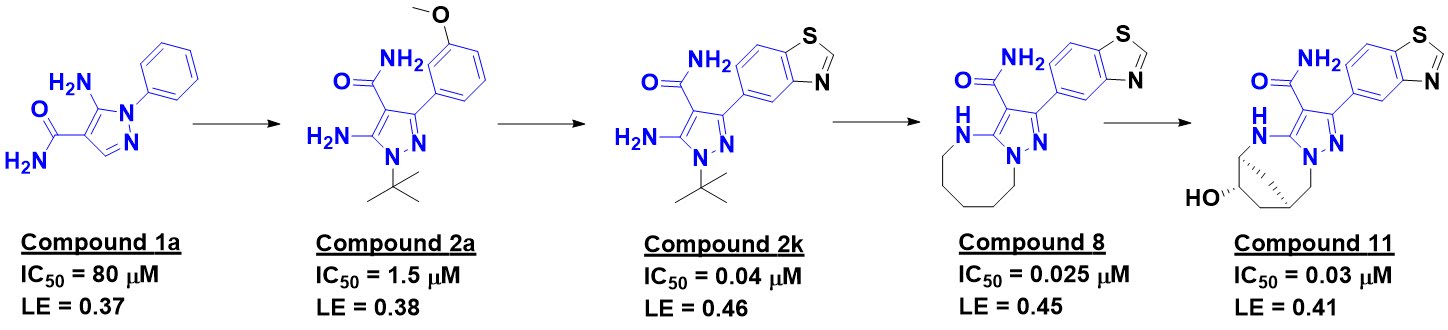
The researchers were interested in receptor interacting protein 2 kinase (RIP2), which is implicated in various inflammatory diseases. A fluorescence polarization screen of 1000 fragments at 400 µM yielded 49 hits with inhibition constants ranging from 5-500 µM. Thirty of these confirmed in a thermal shift assay, and 20 were characterized crystallographically bound to the enzyme. Hit-to-lead chemistry was pursued for five series; the most successful started with compound 1a.


The crystal structure revealed that the carboxamide of compound 1a makes interactions with the hinge region of the kinase, with the phenyl group in the back pocket. A search of related molecules available in-house led to compound 2a, with a satisfying boost in potency. Interestingly, the crystal structure of this molecule bound to RIP2 revealed that the binding mode of the pyrazole moiety had flipped to keep the phenyl ring in the back pocket (compound 1a in cyan, 2a in gray). Enlarging the phenyl group to better fill the pocket led to compound 2k.


This molecule had relatively poor selectivity against several other kinases, but introducing a ring as in compound 8 improved the situation. Crystallography suggested that installing a bridged ring would pick up further interactions with the protein, and although the resulting molecule did not have better affinity, selectivity improved. Finally, a hydroxyl group was introduced (compound 11) to try to pick up interactions with a non-conserved serine residue. This addition did not improve biochemical activity, and in fact a crystal structure revealed that the hydroxyl group was pointing towards solvent, but the activity in human whole blood improved. Importantly, compound 11 was remarkably selective for RIP2: just 1 of 366 other kinases tested at 1 µM showed >70% inhibition.

This is a lovely fragment-to-lead success story that reiterates several important lessons. First, a generic (in this case commercial) and nonselective fragment can lead to novel, selective series. Second, as has been seen multiple times, fragment binding modes can flip unexpectedly, especially during early optimization. Finally, despite the relative flatness of fragment 1a (Fsp3 = 0, though the two aromatic rings are slightly twisted), it could be optimized to a more shapely lead, and the increased complexity is likely responsible for the impressive selectivity. Left unreported is the stability and pharmacokinetics of compound 11: the hydroxyl and all those sp3-hybridized carbons are likely metabolic hotspots. As is so often the case in lead discovery, what solves one problem can too often create another.

27 January 2020

Three dimensional fragments revisited

A long-running debate in the fragment world centers on the utility of “three dimensional” fragments. Proponents argue that these (often aliphatic) fragments may be more novel, have better physicochemical properties, and have more vectors for elaboration than “flatter” (mostly aromatic) molecules. Skeptics retort that hit rates are likely to be lower for these more complex molecules, and good luck making analogs. Two papers published late last year add more data to the debate.

The first paper, published in J. Med. Chem. by William Pomerantz and collaborators at the University of Minnesota and Eli Lilly, describes the results of a fragment screen against the bromodomain BRD4(D1), a popular member of the BET family. The 467 fragment library was enriched for shapely fragments as assessed by plane of best fit (PBF), which is the “average distance of a non-hydrogen atom from a plane drawn through the compound such as to minimize the average.” For example, "flat" benzene has a PBF of 0 while the cofactor NADPH has a PBF of 1.53.

The library was screened using ligand-observed (CPMG) NMR, and 34 hits were confirmed using protein-observed fluorine (PrOF) NMR. All of these were competitive with the known ligand (+)-JQ1, consistent with binding at the acetylated lysine recognition site. The average PBF of the hits was 0.44, essentially the same as the library itself (0.46). This is higher than the average PBF (0.36) of all fragments crystallized with BRD4 in the protein data bank.

Structures of all the hits are provided, and some of them are indeed quite unusual. The researchers characterized a substituted thiazepane crystallographically and were able to optimize this to a 32 µM binder with good ligand efficiency. This fragment was also selective against a handful of other bromodomains.

The researchers had previously screened BRD4(D1) under identical conditions with a more traditional, “flatter” library with an average PBF of 0.26. Interestingly, in that case the hits were less shapely than the library as a whole, with an average PBF of 0.17. The confirmed hit rate was also higher: 20% vs 7%. That said, the fragments in the traditional library tended to be smaller (averaging 180 Da vs 241 Da), so the molecular complexity of this library was likely to be lower, which could account for the higher hit rate.

The second paper, published in Bioorg. Med. Chem. Lett. by Ulrich Grädler and collaborators at Merck KGaA, EMD Serono, Edelris, and Proteros, focuses on cyclophilin D (CypD), which has been implicated in cardiovascular disease and multiple sclerosis. Unlike BRD4, this is a tough target: an HTS screen of 650,000 compounds in a biochemical assay yielded just 178 hits, none of which confirmed. Undeterred, the researchers screened 2688 fragments by SPR at 2 mM, resulting in 58 confirmed hits, all quite weak (millimolar). Crystallography was attempted on most of them, yielding six structures, including such shapely specimens as compounds 3 and 7.


Compound 3 binds in the lipophilic S2 pocket of CypD, overlapping with the aniline moiety of previously reported compound 2. Fragment merging led to compound 14, with nearly 40-fold improved affinity over compound 2. A similar strategy merging compound 3 with fragment 8 led to low micromolar compound 27, two orders of magnitude more potent than the starting fragments. Perhaps most impressively, fragment linking compound 3 with compound 7, a shapely fragment which binds in the S1’ pocket, led to submicromolar compound 39, with affinity more than 10,000-fold higher than either fragment.

So in the end, fanciers of shapely fragments and detractors alike can feel vindicated by these papers. Hit rates might be lower for three dimensional fragments, but the resulting hits are likely to be less precedented. In the case of CypD, a shapely fragment led to three different series for a target that had resisted HTS. Of course, there is still some way to go: no cell, permeability, or stability data are provided for any of the molecules, and medicinal chemists may blanch at the seven stereocenters in compound 39. But these are interesting starting points, and it will be fun to see where they end up.

26 February 2018

Computationally-enabled fragment growing without a structure

Advancing fragments without high-resolution structural information remains a challenge scientists often choose not to take on, according to our poll last year. But for many appealing targets, such as membrane proteins, structural information is difficult to obtain. In a new paper in J. Med. Chem., Peter Kolb and collaborators at Philipps-University Marburg and Vrije Universiteit Brussel describe a computational strategy.

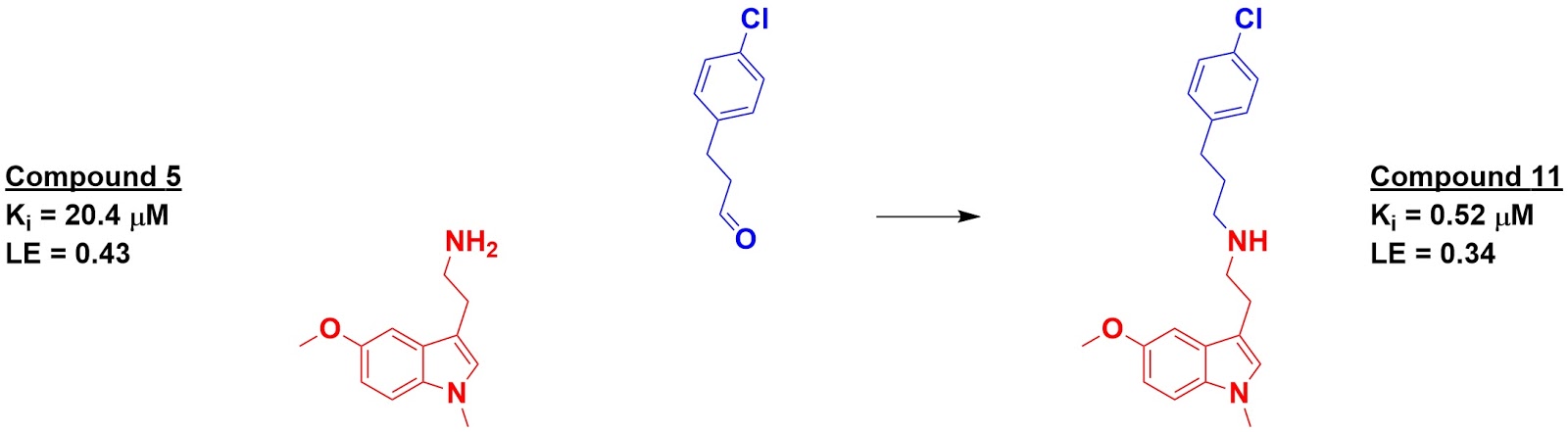
The approach, called “growing via merging”, starts with a core fragment that binds to a target, in this case the β2-adrenergic receptor (β2AR). Ideally this interaction is structurally characterized, but if not a model can suffice. Here, the researchers started with five fragments they had previously discovered. All of these had in common a lipophilic core with a primary or secondary amine appendage; this is a known pharmacophore for β2AR, so modeling could be used to orient the fragments.

Next, this core fragment is derivatized in silico with other fragments using a selection of 58 common reactions. Since all five fragments contained an amine, reductive amination was used here. A set of nearly 19,000 fragment-sized aldehydes and ketones was extracted from the ZINC database and computationally transformed into amines – as if they were reacted with one of the core fragments. These were then docked into the receptor, and those that did not overlap with the core fragments and also placed the amine near the amine of the core fragment were kept for further analysis.


The top 500-scoring fragments were then “reacted” – again in silico – with the core fragments and again docked. Eight of these were actually synthesized and tested for binding, of which four had higher affinity than the initial fragments. The best, compound 11, showed a 40-fold boost in affinity over its starting fragment.

This is an appealing approach, and it will be interesting to see how generalizable it proves. The β2AR is a somewhat forgiving test case due to prior work on the target and the fact that the ligand’s amine interaction with a critical asparate residue helps to orient the core fragment. Laudably though, the computational toolbox (called PINGUI, for Pyton in silico de novo growing utilities) is open access. Please leave a comment and share your experiences if you’ve tried it.

19 February 2018

More hits from a complex library?

One of the cornerstones underpinning fragment-based lead discovery is molecular complexity: fragments are less complex than larger molecules, and are thus likely to bind to more sites on more proteins. In theory, then, you want relatively simple fragments, and in fact Astex has actually formalized this with the concept of the “minimal pharmacophore”, in which each fragment contains a single pharmacophore (such as a hydrogen bond donor next to a hydrogen bond acceptor). But this is not the only way to build a fragment library; in 2016 we noted a paper out of the University of Dundee describing fragment libraries built with “caps” for easy derivatization. In a new paper in ChemMedChem, Paul Wyatt, Peter Ray, and collaborators at the University of Dundee and GlaxoSmithKline describe a screen with this “functional group complexity” (FGC) library.

The researchers were interested in the protein InhA, a drug target for Mycobacterium tuberculosis, the organism causing the eponymous disease. A relatively small library of 1360 fragments was assembled from six different sources, loosely defined by the authors:
  • 573 commercial fragments
  • 170 “3D” fragments from the 3DFrag consortium
  • 326 of the designed FGC fragments
  • 46 commercial fragments chosen based on known InhA inhibitors
  • 124 “inventory” fragments
  • 121 “project” fragments
These were screened against InhA in pools of 8, with each fragment present at 0.5 mM, using STD NMR, resulting in a fairly high hit rate of 11% (149 fragments). The commercial fragments and FGC fragments both gave a marginally higher hit rate (12.6%, 72 fragments and 13.2%, or 46 fragments respectively) while the 3D fragments gave a considerably lower hit rate (5.9%, or 10 fragments).

Previous work had suggested that more potent molecules seemed to reduce the STD signals for the NADH cofactor, so these molecules (32 fragments) were prioritized. The 13 FGC fragments represented a hit rate of 4%, nearly double the 2.4% for the library as a whole.

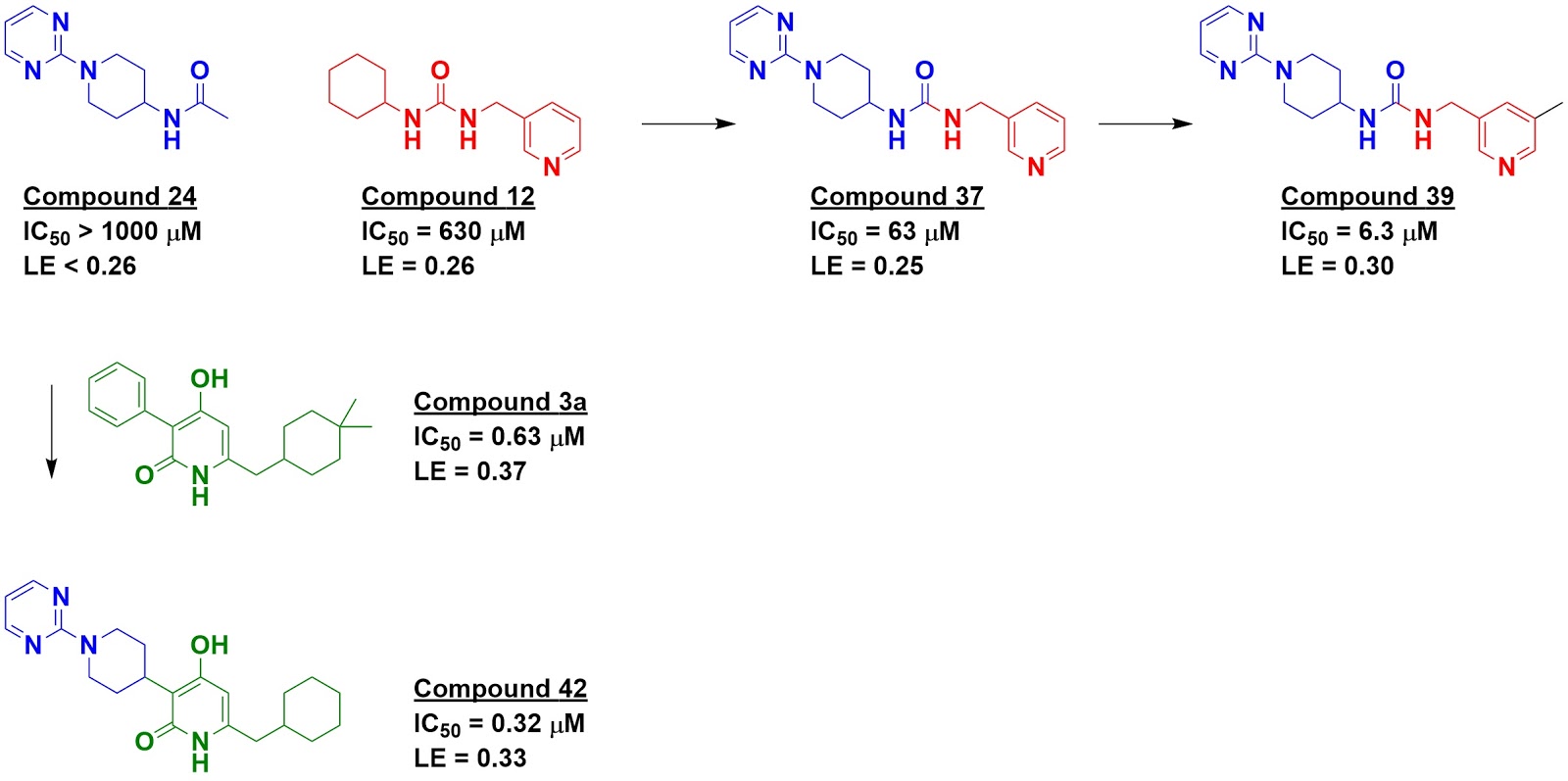
All 149 of the initial fragments were tested in a biochemical assay at 0.5 mM, but only 4 gave measurable inhibition – too few to draw conclusions. Five compounds were characterized crystallographically bound to InhA, including two of the FGC fragments. This information was used to merge two fragments, compound 24 (an FGC fragment) and compound 12 (a commercial fragment), yielding a mid-micromolar inhibitor. Adding a “magic methyl” gave a satisfactory ten-fold boost in potency. Fragment 24 was also merged with a previously reported molecule, compound 3a, to produce compound 42.

These results suggest that more heavily functionalized fragments don’t necessarily have a lower hit rate, albeit for a small library and a single target. And as we noted last year, molecular complexity is difficult to define; it is not immediately obvious that FGC fragment 24 is actually more complex than commercial fragment 12. The old cliché still holds: more data are needed.

23 October 2017

Poll results: does your primary fragment library contain racemates?

Our latest poll asked just this question. We received 72 responses, and the results are shown here.

Almost half of respondents said they include racemates in their library, as recommended by Claudio Dalvit and Stefan Knapp in the paper that inspired this poll. Another 40% said they had some racemates and some pure enantiomers in their library, which presumably reflects the fact that some enantiomers are more readily available than others.

Only about 10% of respondents said that all chiral fragments in their library are pure enantiomers.

And perhaps most surprisingly, only a single respondent said he or she doesn’t screen chiral fragments at all.

Personally I like racemates because they present an easy follow up experiment: if the two enantiomers have different activity, you are more likely looking at genuine activity as opposed to some sort of artifact

Of course, these poll results don’t tell how many chiral compounds are in the typical library. One source told me that his organization's 5000 molecule collection does contain chiral fragments - but only about 20 of them. It will be interesting to see whether we start to see more chiral fragments appear in fragment success stories.

11 September 2017

Chiral fragments – and poll!

Chirality underpins all life. Nineteen of the twenty amino acids contain at least one stereocenter, as do all nucelosides, sugars, and most metabolites. The very first fragment I ever found was chiral, but that is not typical, at least judged by those that show up in publications. Only 5 of the 27 fragment to lead success stories published in 2015 started with a fragment containing a chiral center. This probably reflects what people choose to screen and pursue. Chiral centers can lead to challenging chemistry, and chiral centers also add to molecular complexity.

All of which brings us to the topic of our new poll: do you include chiral fragments in your primary screening collection? If so, do you include both enantiomers? Please vote in the poll to the right.

If you do include chiral fragments, do you screen racemic mixtures? Crystallography can sometimes reveal which enantiomer is active if the quality of the structure is good enough, but woe betide anyone screening racemic mixtures by ITC! In a new paper in Magn. Res. Chem., Claudio Dalvit (University of Neuchatel) and Stefan Knapp (Goethe University Frankfurt) show that fluorine NMR can also be used to screen racemic mixtures.

As Teddy wrote more than five years ago, 19F NMR is “just like 1H NMR”. Most applications of 19F rely on detecting the line broadening that occurs when a fluorine-containing fragment binds to a protein. However, the chemical shift of the fluorine atom(s) can also change, particularly if the ligand forms hydrogen bonds to the protein. This “chemical shift perturbation” can be large enough to be detectable.

In the absence of protein, 19F NMR shows the same signal for different enantiomers, so a racemic ligand containing a single trifluoromethyl group gives a single sharp peak. However, upon addition of a protein that binds one enantiomer, the signal splits into two; one remains sharp and retains essentially the same chemical shift, while the other becomes broader and moves. The researchers show this both theoretically and experimentally with a racemic fragment that binds to the bromodomain BRD4. Adding a high-affinity ligand that binds to the same site displaces the fragment, causing the two signals to again converge.

Unfortunately there is no X-ray structure of the ligand bound to the protein, and the two pure enantiomers were not tested individually. And of course, unlike crystallography, 19F NMR does not reveal which enantiomer in a racemic mixture binds. Still, enantioselective binding can itself be indicative of specific binding, as opposed to various artifacts, and the researchers recommend that “racemates should always be included in the generation of the fluorinated fragment libraries.” What do you think?

20 February 2017

Many measures of molecular complexity

Molecular complexity is a fundamental concept underlying fragment-based lead discovery: fragments, being simple, can bind to more sites on proteins and thus give higher hit rates than larger, more complex molecules. The ultimate example of this is water, which – at 55 M concentration – binds to lots of sites on proteins. But although the concept is easy to describe, it is much harder to quantify: everyone can agree that palytoxin is more complex than methane, but by how much? And if complexity could be measured, could it help in optimizing libraries? This is the subject of a review by Oscar Méndez-Lucio and José Medina-Franco at the Universidad Nacional Autónoma de México published recently in Drug Discovery Today.

There are many ways to measure molecular complexity. Two of the simplest to calculate are the fraction of chiral centers (FCC) and the fraction of sp3 carbons (Fsp3). These range from 0 to 1, and larger numbers imply a higher number of unique molecules with the same formula.

More complicated methods to measure complexity abound, but many of these require specialized software. Two that are publicly available are PubChem complexity and DataWarrior complexity. In PubChem, complexity incorporates the number of elements as well as structural features such as symmetry, though stereochemistry is not explicitly considered, and aromaticity is scaled such that both benzene and cyclohexane have the same complexity – a sharp contrast to FCC and Fsp3. DataWarrior uses its own metric, though I couldn’t find the definition. (Ironically, though the software itself is open source, the paper describing it is not.)

So, do more complex molecules have lower hit rates? The researchers looked at several public databases of screening data for dozens of assays against thousands of molecules. Using each of the four metrics, they classified molecules as “simple,” “intermediate,” or “complex”. For FCC and Fsp3, simple compounds did appear to be more promiscuous, in line with theory and with previous findings. However, for PubChem and DataWarrior, the trends were not clear – and even reversed in some cases. The researchers note that the median complexity of molecules in each dataset may vary, and as Pete has also observed simple binning strategies can be misleading.

Do these different definitions of complexity even measure the same thing? The researchers plotted each pair-wise measurement of complexity for >400,000 molecules – for example, Fsp3 vs DataWarrior. Not only are there no universal correlations, those that do exist are conflicting. "For example," the authors write, “compounds with high FCC values are associated with low PubChem complexity values, whereas the same molecules have high DataWarrior complexity." 

Teddy has previously invoked Justice Potter Stewart and his famous “I know it when I see it” expression, and I think that just about sums up where things stand in terms of molecular complexity. From a practical standpoint this probably doesn’t matter; a complex molecule is not even necessarily more difficult to make, as evidenced by the ease of oligonucleotide and peptide synthesis. Still, it would be nice if someone could come up with a reliable measurement for such a fundamental property – or even demonstrate whether or not such measures are possible.

01 December 2014

Fragments finger a PHD finger

As Teddy recently observed, epigenetics is big, and fragments have played an important role against several targets. One class of proteins that has received less attention is the group of PHD fingers, which recognize methylated lysine residues. The pygo-BCL9 complex contains a PHD finger that binds to a specific methylated lysine residue on histones, and has been implicated in cancer. Marc Fiedler, Mariann Bienz and colleagues at the MRC Laboratory in the UK describe their efforts against this target in a new paper in ACS Chem. Biol.

The researchers started with a virtual screen of 225,000 commercially available compounds. They purchased 313 of the top hits and tested them for binding with protein-detected NMR (1H-15N-HSQC). This produced only three very weak hits – a hit rate of 0.001%. Three additional virtual screens produced a couple dozen more, but all of these were weak; the best had an affinity around 3.5 mM and a ligand efficiency around 0.12 kcal/mol/atom. Co-crystallography proved unsuccessful, probably in part due to the low solubility of the compounds.

Enter fragments. The researchers screened the Maybridgerule of three” 1000-compound library in pools of 5 compounds, each at 1 mM, under the same protein-detected NMR conditions they used previously. Numerous pools appeared to show binding but deconvolution proved unsuccessful for all but two. Strikingly, the two hits – both benzothiazoles – are almost identical, differing only in a single atom substituent (fluorine vs chlorine).

Although the best fragment hit was also weak (Kd = 3.1 mM), it had a much higher ligand efficiency (0.31 kcal/mol/atom). More importantly, it was sufficiently soluble (20 mM!) that it could be cocrystallized with the protein, resulting in a high resolution structure. This revealed that the fragment binds in a narrow cleft – a conclusion independently reached by examining the NMR chemical shift perturbations (CSPs) of protein amino acid residues in the presence of compound.

Testing various analogs did not identify anything significantly more potent, but changing the benzothiazole core to a benzimidazole changed the pattern of CSPs. Additional NMR studies and modeling suggested that these molecules bind not in the narrow cleft but rather in the pocket where methylated lysine binds, and competition studies with a short peptide supported this hypothesis.

This is a nice example of applying fragments against an important emerging target class. It is also a beautiful illustration of molecular complexity in action: as the authors note, the hit rate from fragment screening was around 200-fold higher than the virtual screen, and provided better hits to boot. As with most fragment screens there is still a long way to go to get to a potent compound, but it looks like this group is on the right path.

10 November 2014

Plenty of room at the bottom (of chemical space)

One of the key selling points of fragment-based lead discovery is that small fragments can search chemical space much more efficiently than larger compounds, since there are fewer possibilites. Nonetheless, the numbers are still daunting: more than 166 billion molecules with up to 17 non-hydrogen atoms. The question of how many of these are commercially available has come up before. In a paper just published online in Prog. Biophys. Mol. Biol., Chris Murray and colleagues at Astex take a new look at this – and related – questions.

Rather than considering all possible molecules, the researchers focused on six-membered rings with one or two small substituents of no more than six non-hydrogen atoms. Six-membered rings are found in many drugs, so this is a useful area of chemical space on which to focus. The researchers first considered “topologies,” simple two-dimensional representations of molecules. In the coarsest version, benzene, cyclohexane, pyridine, and piperidine would all have identical topologies: a six-membered ring with no substituents.

The researchers looked at how many topologies having up to 16 atoms were listed in the available chemicals directory (ACD) of 2.7 million commercial molecules. Even using the coarse definition where all non-hydrogen atoms were considered equivalent, less than half of 16-atom topologies are commercially available. At finer resolution (for example, differentiating carbon from nitrogen), the numbers dropped even more: less than 4% of the 2223 16-atom topologies with a pyridazine core were available.

However, things get better the smaller the molecule. When considering only molecules with 11 non-hydrogen atoms, all of the coarsest topologies are available, as are more than 70% of pyridazines. From this, the researchers concluded:
We need to focus on fragments with lower heavy atom counts and… improve the sensitivity of our screening methods to make sure that we can identify the binding of these smaller fragments.
The rest of the paper discusses how they applied this approach, and what lessons they learned.

The researchers assert that X-ray crystallography (upon which Astex was founded) is the most sensitive screening method. That may elicit some debate, but is defensible given the presence of extremely weak binders (water, buffer components, detergents) in many crystal structures. They also argue that while NMR may allow detection of fragments with lower solubilities, this may not be a good thing.

Of the 1633 fragments that were in the Astex library between 2001 and 2007, 22% came up as X-ray hits (ie, they showed up in at least one crystal structure). Strikingly, fragments with 11 or 12 atoms were enriched far above their representation in the overall library, while fragments with 17 or more atoms were underrepresented. This is a beautiful confirmation of the “molecular complexity” hypothesis, the idea that there is a sweet spot where molecules are large enough to make productive interactions with a target but not so complex that negative interactions become dominant.

These results led the researchers to redesign their library to focus on fragments having fewer than 17 non-hydrogen atoms, which entailed considerable custom synthesis. The resulting library has 1371 fragments, of which 47% have shown up as X-ray hits. The average size of hits is the same as that of the overall library (12.2 vs 12.4 non-hydrogen atoms and 172 vs 176 Da, respectively), though the hits are slightly more lipophilic (cLogP = 1.1 vs 0.9).

What about “three-dimensionality?” This is a topic that has been discussed quite a lot (herehere, herehere, and here, for starters), so it is nice to have some solid data. One problem is how to define three-dimensionality: simple metrics such as Fsp3 don’t account for the fact that aromatic compounds such as 2,6-substituted biphenyls can be very non-planar. Many people use PMI, but the Astex researchers chose deviation from planarity (DFP). This method puts a hypothetical plane through the molecule that minimizes the deviation of all non-hydrogen atoms from the plane; the average deviation from the plane for each molecule is calculated in Ångstroms. So, for example, benzene has DFP = 0.0 Å, while cycloleucine has DFP = 0.54 Å. In this study, the researchers used a single conformation for each molecule, but since these fragments have on average only 1.3 rotatable bonds this is probably a reasonable simplification.

Roughly 40% of the Astex library has a DFP < 0.05 Å, but these “flat” fragments were enriched to ~50% among hits. Not surprisingly, kinase hits tended to be even more two-dimensional (>60%), but even protein-protein interaction (PPI) hits were, if anything, slightly more planar than the overall collection, which is consistent with another recent study. Indeed, there seems to be nothing special at all about PPI hits, more than half of which were also found against non-PPI targets. The researchers argue that 3D-fragments are inherently more complex and thus less likely to show up as hits, which supports Teddy’s Safran Zunft challenge.

One of the arguments in favor of three-dimensionality is that such molecules may have better physicochemical properties, and the researchers examine the DFP for fragments and resulting leads. It turns out that there is a weak correlation between the shapeliness of a fragment and that of the resulting lead, but there are many exceptions (such as this one).

Some of these data have been publicly presented, but this paper should broaden the discussion. Coming back to the title of this post, the conclusion is that fragments should be made as small as detectable with your assay. And flat is the new black.

29 September 2014

FBLD 2014

FBLD 2014, the fifth in an illustrious series of conferences, took place in Basel, Switzerland last week. Organizers Wolfgang Jahnke (Novartis), Michael Hennig (Roche), and Rod Hubbard (University of York & Vernalis) put together a fantastic event. With 35 talks, 45 posters, and more than 200 delegates, I won’t attempt to give more than a few impressions here. In addition to Teddy’s (and others’) Tweets, Derek Lowe put up several posts (see here, here, and here); please share your thoughts below.

Harren Jhoti delivered a lively and wide-ranging opening keynote summarizing the past 15 years of FBLD as viewed from Astex. Among many other innovations, researchers there are responsible for the Rule of 3, which has been the subject of some debate. Harren emphasized that the “Voldemort Rule” should not be a strait-jacket. Like the Kobayashi Maru, rules are there to be broken, though you need to be something of a James T. Kirk to do so effectively.

Astex has produced what is likely the largest collection of protein-fragment crystal structures, and Harren noted that many proteins appear to have fragment binding sites outside the active site: across 25 different proteins, the average number of total sites is slightly greater than 2. Astex is increasingly targeting these sites for allosteric lead discovery.

The theme of crystallography carried through the conference. As Armin Ruf (Roche) exhorted, “more crystals, more structures.” One challenge is that not all crystal forms are suitable for fragments, and it is not always clear from the outset which forms will work. Armin described their chymase project in which an initial crystal form gave 8 fragment structures, but additional crystal forms allowed them to obtain 6 more. Without the different crystal forms these later fragments would have been crystallographic false negatives, yet the potential of different crystal forms to reveal more hits is under-appreciated: Armin noted that the majority of recent fragment papers reported using only a single crystal form.

The importance of crystallography was emphasized again by Nick Skelton (Genentech), who discussed their NAMPT program (which we covered here). In this project, which utilized dozens of crystal structures, a single atom change to a fragment could completely and unpredictably alter the binding mode.

Obtaining a good crystal is not necessarily easy, though. Andreas Lingel (Novartis) described their efforts to produce a form of B-RAF that would diffract to higher resolution and allow fragment soaks (as opposed to co-crystallization). They tried reducing the “surface entropy” by mutating glutamate and lysine residues to alanine, but only one of a dozen or so mutants expressed well and gave superior crystals. Although this turned out to be useful, the team is still at a loss to explain why the specific mutants are effective.

Continuing the theme of crystallography, Matt Clifton (Beryllium) described what looks to be a significant advance for the protein MCL-1. (This is a collaboration with the Broad Institute, and we previously noted some of their progress here.) The researchers have developed a maltose-binding protein (MBP) fusion of this oncology target that diffracts to 1.9 Å in the absence of any ligand. (MBP fusions are used to help crystallize challenging proteins.) Since they developed this construct in May of this year, the researchers have already solved more crystal structures than had been reported publicly to date, and uncovered some interesting findings. For example, the initial fragment that Steve Fesik’s group found binds in a similar manner to one of his more potent later leads, as does one of the AbbVie fragments; however another AbbVie fragment binds in a somewhat different fashion than the elaborated lead.

The subject of how to effectively sample chemical space was another theme, and to this end Alison Woolford (Astex) proposed the concept of a “minimal pharmacophore”: the minimal interactions necessary to drive fragment binding. Researchers at Astex have systematically cataloged several dozen of these, which include such simple entities as amines, acids, aromatic chlorides, and more abstract concepts such as a 1-bond donor-acceptor (think pyrazole). Alison showed an interesting graph with targets on the y-axis and minimal pharmacophores on the x-axis which revealed some obvious patterns such as the preference of donor-acceptor minimal pharmacophores by kinases, but there were unexpected features as well. In a sense, this is an empirical realization of early docking studies, but it also has interesting implications for library design. For example, Alison suggested avoiding fragments with more than one minimal pharmacophore, as these will not be able to effectively sample as many different sites on a protein: with two pharmacophores, a fragment would be limited to binding sites having matching recognition elements to both rather than just one. This idea ties in with the concept of molecular complexity, but from a more chemocentric point of view.

On the subject of chemistry, Dalia Hammoudeh (St Jude’s Hospital) gave a lovely talk on her experiences developing allosteric inhibitors of DHPS, an antibiotic target. Among other fragment hits from the Maybridge library, one was ostensibly 4-trifluoromethylbenzylamine, but turned out to actually be the Schiff base of this with the corresponding aldehyde. Yet another reminder to always carefully check what you think you have.

Practical Fragments has previously discussed the Genentech MAP4K4 program (here and here), and Terry Crawford gave a nice summary. One of the challenges they faced was that their initial leads had excellent brain penetration, leading to animal toxicity. This forced them to increase size and polar surface area. Although it was problematic in this case, this emphasizes how small and drug-like fragment-derived leads can be. Indeed Vicki Nienaber, who was a prime mover behind the original FBLD 2008 meeting, has devoted much of her efforts at Zenobia to CNS targets.

Finally, Derek Lowe (Vertex) gave a rollicking history of the drug industry, ending with his view of where fragments fit in. He noted that chemists – Valinor not withstanding – play a central role, and in that sense the field is a departure from the general trend of the past decade or so. It still remains to be seen how many of the 30+molecules FBLD has delivered to the clinic will come out the other side, but at least for now the field is thriving. As Chris Lipinski stated last year, “if I had to single out one technology that really took me by surprise and has been very successful, it has been fragment screening.”