Showing posts with label fragment merging. Show all posts

11 May 2026

Noncovalent fragments vs WRN

Werner syndrome helicase, or WRN, is an interesting target both for its biological mechanism and its flexible structure. Two years ago we highlighted work out of Vividion describing the discovery of a clinical-stage covalent WRN inhibitor. In a Nat. Commun. paper published earlier this year, Sandra Gabelli, Daniel Wyss, and collaborators at Merck and Proteros describe their noncovalent efforts against this target.
 
Inhibiting WRN kills cancer cells that are already defective for certain DNA repair pathways. It is an example of a “synthetic lethal” approach to drug discovery that expands the number of cancer targets by focusing on oncogenic cells rendered vulnerable by pre-existing mutations. As an ATP-dependent helicase, WRN acts as a molecular machine to unwind DNA. This requires the multidomain protein to undergo dramatic conformational changes, which makes finding ligands challenging: how do you know which conformation(s) to target? Moreover, WRN enzymatic assays are particularly prone to false positives; a paper published in 2024 demonstrated that some previously disclosed inhibitors are at best nonspecific, and at worst downright artifacts. Thus, the researchers chose to use biophysics to identify fragments.
 
A library of 1020 fluorine-containing fragments was screened in pools of up to 21 compounds using 19F NMR T2 CPMG experiments. The 31 primary hits were re-screened as pure compounds in this assay as well as three more ligand-detected NMR assays, leading to seven hits taken into crystallography, of which three yielded structures. A separate SPR screen of 500 non-fluorinated fragments followed by confirmation by NMR led to three additional fragments characterized crystallographically. None of the validated fragments from either screen showed functional activity in an enzymatic assay.
 
The fragments bound in three different sites on the protein, which itself underwent significant conformational changes to accommodate the fragments. Fragments 1 and 2 bound in the same site and could be partially superimposed on one another, and these were used to generate a virtual library, of which 17 compounds were made and tested. Compound 4 had the best affinity as assessed by SPR and was also active in a functional assay.

Crystal structures of some of the other compounds bound to WRN were also determined, and these showed significant protein domain rearrangements, even when the compounds themselves were structurally similar. The researchers include a nice movie (link to download here) and suggest that “these structures capture only a few states of WRN as it translocates along the DNA and conducts its helicase and exonuclease functions.”
 
This paper nicely illustrates the challenges of finding ligands, particularly noncovalent ones, against conformationally flexible proteins. We’ll revisit this topic next week.

26 January 2026

Fragment merging – and flipping – on the leucine zipper of MITF

Transcription factors can be difficult drug targets, particularly those whose primary structure is a “leucine zipper” in which two α-helices gently coil around each other. Their three-dimensional structure provides few pockets suitable for binding small molecules. In a new (open-access) paper in Nat. Commun., Deborah Castelletti, Wolfgang Jahnke, and a large group of multinational collaborators at Novartis and elsewhere present progress toward one of these, microphthalmia-associated transcription factor (MITF), which has been implicated in melanoma.
 
Most of MITF is believed to be disordered, but the DNA-binding domain (DBD) homodimerizes as a basic helix-loop-helix leucine zipper. Unlike related transcription factors, the helices in MITF contain a small kink that keeps them from heterodimerizing and also creates a small “kink pocket.”
 
The researchers expressed the DNA-binding domain of MITF and screened it using 19F NMR against the LEF4000 library, which we described here. This yielded just 9 hits that confirmed in protein-observed NMR, a hit rate the researchers note “is amongst the lowest that we have observed across multiple FBS campaigns,” consistent with expectations for a difficult target. Two chemical series, represented by compounds 1 and 2, were prioritized, and analogs from the Novartis compound collection were screened to find more-potent compounds 3 and 4.
 

Crystallography revealed that compounds 3 and 4 both bound in the kink pocket. Excitingly, the binding modes are similar and overlapping, inviting fragment merging. This proved successful, yielding a compound that bound 100-fold more tightly than either fragment. Further optimization ultimately led to compounds 7 and 8, with low or sub-micromolar affinity as assessed by isothermal titration calorimetry (ITC).
 
The bound structures of compounds 7 and 8 were determined by crystallography. Compound 7 (gray, left) superimposes nicely onto compounds 3 (cyan) and 4 (magenta), showing successful fragment merging. Compound 8 (green, right), however, is flipped 180 degrees compared to compound 7, despite having similar structure and affinity. Although surprising, this is not too uncommon; we’ve written about previous flippers here, here, and here.

The MITF homodimer is asymmetric, with one helix kinked and the other straight. NMR experiments and molecular dynamics show that both compounds 7 and 8 slow the interconversion between kinked and straight forms, though it is unclear whether this has functional implications. The compounds do not seem to affect DNA binding, and with at best high nanomolar affinity towards MITF no cell data are reported with the molecules.
 
Nonetheless, the successful identification of ligands against a leucine zipper is exciting. The binding pocket is small; as shown in the figure above, the best compounds already stick out on either side of the helices. Further affinity improvements may be difficult, though perhaps covalent approaches could help. Alternatively, perhaps these molecules could be starting points for induced proximity strategies such as PROTACs. It will be fun to watch this story develop.

10 November 2025

Searching monstrously large chemical space with FrankenROCS

Back in 2023 we highlighted a computational fragment linking/merging approach which was used to find high nanomolar inhibitors of the SARS-CoV-2 macrodomain (Mac1), a COVID-19 target. However, those molecules contained carboxylic acids, often associated with poor cell permeability. In a new open-access Sci. Adv. paper, James Fraser and collaborators at UCSF, Relay Therapeutics, Enamine, and Chemspace describe a related approach to find new, non-charged inhibitors.
 
The new approach, called FrankenROCS, “takes pairs of fragments as input to query a database using the rapid overlay of chemical structure (ROCS) method of comparing 3D shape and pharmacophore distribution;” the goal is to find larger molecules that most closely resemble the initial fragment pairs. As with the previous publication, the team started with more than 200 crystallographic fragment hits published in 2021. A set of 7,181 pairs of adjacently-bound fragments were searched against 2.1 million compounds commercially available from Enamine. The top 1000 were inspected, and 39 were purchased and soaked into crystals of Mac1. This led to 10 successful structures, of which AVI-313 did not contain a carboxylic acid. This molecule had weak but measurable activity in an HTRF competition assay.
 
Two million compounds is a lot but pales in comparison to Enamine’s “make-on-demand” REAL space, which at the time this research was done consisted of more than 22 billion molecules. The REAL space molecules are constructed from 960,398 building blocks that can be combined using 143 reactions. We previously described an approach called V-SYNTHES to screen Enamine’s REAL space. FrankenROCS takes a different active-learning approach called Thompson Sampling, which dates back nearly a century.
 
Imagine two sets of 1000 building blocks, R1 and R2, which could be coupled to generate 1,000,000 molecules. Rather than searching all possibilities, each R1 building block is linked to three random R2 building blocks, and each R2 building block is linked to three random R1 building blocks. These are virtually screened, and the R1 or R2 building blocks from those with the highest scoring compounds are used for further iterations. In theory, after tens of thousands of iterations, the best compounds will have been identified.
 
The researchers fed 97 fragment pairs from the 2021 paper into Thompson Sampling FrankenROCS to find molecules that would best overlay with the fragment pairs.  Ultimately 32 compounds were purchased, six of which were successfully crystallized with Mac1. Unfortunately, the most potent was a weaker inhibitor than AVI-313 and contained a carboxylic acid. The researchers speculate that the inability to find better molecules in larger chemical space may have stemmed from limitations of the scoring function, a problem we’ve previously discussed.
 
The researchers returned to focus on AVI 313, making substitutions at multiple positions, ultimately synthesizing 148 compounds, 121 of which could be characterized crystallographically. Importantly, several compounds had low micromolar activity, even without a carboxylic acid. The crystal structures show the binding site to be somewhat flexible, as evidenced by side chain and main chain movements to accommodate some of the binders.

This is a nice, thorough investigation, and the 137 protein-compound crystal structures deposited into the protein data bank provide useful training data for next-generation computational approaches. Moreover, the fact that immeasurably weak fragments can be advanced to low micromolar, ligand-efficient hits is yet another reason for the research community to figure out how to make crystallographic fragment screening data more widely available, as we exhorted here.

22 September 2025

Fragment merging without crystallography for CGRP receptor antagonists

Migraines are the third leading cause of disability worldwide. Although the pathology is complex, blocking the interaction of calcitonin gene-related peptide (CGRP) with its receptor, thereby decreasing vasodilation, has proven successful in the clinic. However, some of the early small molecule antagonists were discontinued due to hepatotoxicity. In a recent J. Med. Chem. paper, Naohide Morita, Isao Azumaya, and collaborators at Kissei Pharmaceutical and Toho University describe a new class of inhibitors.
 
CGRP binds at the interface of a heterodimeric receptor comprised of the calcitonin receptor-like receptor (CLR) and receptor activity-modifying protein 1 (RAMP1). To find hits, the researchers screened a library of 2500 fragments (which could be up to 350 Da) at 500 µM against the extracellular CLR/RAMP1 domains using SPR. This yielded 565 hits, which were clustered based on similarity, and 250 were chosen for dose-response studies, leading to 38 confirmed hits. Competition studies with a known CGRP antagonist whittled this number down to just four, with compound 1 being chosen for further study due to ease of analog synthesis.
 
Compound 1 was confirmed as a binder using isothermal titration calorimetry (ITC). Unfortunately, co-crystallography with CLR/RAMP1 was unsuccessful, so the researchers turned to docking using information from known small molecule inhibitors. This work suggested that compound 1 binds to the CGRP receptor but does not interact with RAMP1, a conclusion further supported by mutagenesis studies.
 
To find fragments that bind RAMP1, the researchers performed a second fragment screen, again using SPR. This time the fragments were chosen from those in the first set that had not been tested in dose-response studies, supplemented with several hundred more selected based on structures of known CGRP antagonists. Of 784 fragments screened, 114 were taken into dose-response studies, leading to 8 hits. Compound 2 was the most potent, and mutagenesis studies suggested it interacted with RAMP1.
 
Crystallography of compound 2 was also unsuccessful, but docking, supported by NMR studies, suggested a possible binding mode. Compounds 1 and 2 were merged to yield compound 3, which had a satisfying 2000-fold improvement in potency compared to compound 1. Compound 3 also showed cell activity.


Compound 3 contains three stereocenters, so the researchers sought to simplify the molecule. They also needed to improve potency and metabolic stability. Multiparameter optimization ultimately led to compound 15, with picomolar(!) affinity for the receptor, subnanomolar activity in cells, and good pharmacokinetic properties. A standard model for migraine is inhibition of facial blood flow in marmosets, and compound 15 was active. The compound was also clean in tests for hepatotoxicity.
 
Although no further development of compound 15 is reported, this is a nice case study in fragment merging. As the researchers note, it is also one of just a handful of examples that succeeded in the absence of crystallographic data (we wrote about another one here). Hopefully this will further embolden researchers to pursue fragment merging and linking without direct structural information.

12 May 2025

From fragment to macrocyclic Ras inhibitors

At the Drug Discovery Chemistry meeting last month chemist John Taylor described efforts against the oncology target RAS. This story was recently published in J. Med. Chem. by John, Charles Parry, and a team of some three dozen collaborators at CRUK Scotland Institute, Novartis, and Frederick National Laboratory for Cancer Research.
 
Practical Fragments has highlighted multiple Ras efforts, including the development and approval of sotorasib, which inhibits the G12C mutant of KRAS. Sotorasib binds in the so-called switch II region, next to the site where the nucleotides GDP and GTP bind. Before the discovery of this site, researchers had identified fragments that bind to a different site, switch I-II. 
 
Most of the ligands that bind to either site only inhibit the off-form of Ras proteins, in which the proteins are bound to GDP. One mechanism of resistance for cancer cells is to increase the amount of protein in the active, or GTP-bound state. Thus, the researchers focused on the oncogenic G12D mutant of KRAS bound to a GTP analog and screened it against 656 fragments using SPR. Ligand-detected NMR confirmed five of the hits, including compound 5.
 

Two dimensional 1H-15N HSQC NMR revealed that compound 5 binds in the switch I-II pocket; merging this with a literature fragment generated compound 6. SAR studies led to compound 11, which was characterized crystallographically bound to the protein. The structure suggested trying to make a salt bridge with an aspartic acid residue, leading to compound 13, with sub-micromolar affinity for the inactive form of the protein. A crystal structure of a related compound suggested the possibility of macrocylization, and this turned out to be successful, with compound 21 being the most potent. (All values shown here are determined by NMR or SPR on the G12D KRAS mutant bound to either GDP or the GTP analog GMPPMP.)
 
A number of different macrocycles were made and tested, and all of them were more potent against the inactive than the active form of KRAS. Crystal structures suggested that a glutamic acid side chain adopts a conformation in the the GTP-bound form of KRAS that impedes ligand interactions.
 
Interestingly though, building off the molecules in another direction led to the opening of a small subpocket that had not previously been reported in the literature. Exploiting this “interswitch” region led to compound 36, with a nearly 10-fold preference for the active form of KRAS.
 
Most of the macrocycles in both series were able to block nucleotide exchange in a biochemical assay, meaning they could prevent the exchange of GDP for GTP. A few of the compounds were tested in cell-based assays and could block binding between RAF and multiple Ras isoforms, including two mutants of KRAS as well as wild-type KRAS, HRAS, and NRAS.
 
Unfortunately, and not surprisingly given their high polar surface areas, the compounds had low permeability, high efflux, and high clearance in vitro. Mouse studies on one compound confirmed these liabilities in vivo.
 
Although the compounds could not be advanced, this is still a nice fragment to lead story. The fact that a new pocket could be identified despite so much previous effort on this target is a good reminder that no matter how much you know, there is always room for surprises.

03 February 2025

Stitching together fragments with Fragmenstein

As we noted just last week, crystallography has unleashed a torrent of protein-ligand complexes, especially fragments. Historically a single structure might be used for fragment growing, but so many structures present an embarrassment of riches, with sometimes dozens of fragments that bind in the same region. Merging or linking these fragments can be done manually, as seen here and here, but how to do so when the binding modes are partially overlapping is not always intuitive. In a new open-access J. Cheminform. paper, Matteo Ferla and colleagues at University of Oxford and elsewhere describe an open-source solution called Fragmenstein.
 
We briefly described Fragmenstein in 2023, where it was used to combine pairs of low-affinity fragments bound to the Nsp3 macrodomain of SARS-CoV-2 to generate sub-micromolar inhibitors. The current paper describes the platform in detail.
 
Fragmenstein starts by taking two (or more) structures of fragments bound to a protein and virtually combining them. This is done by collapsing rings to their individual centroids, stitching these together along with their substituents, and then re-expanding the ring(s) so the substituents will be close to where they were in the initial fragments. This process produces a surprising array of molecules beyond the obvious. For example, if one fragment contains a phenyl ring and the other fragment contains a furan ring, the stitched molecule might just contain the phenyl (if the two rings bind in nearly the same position), a benzofuran (merging the rings), a phenyl ring linked to a furan by one or more atoms, or even a spiro compound if the rings are perpendicular to one another.
 
In silico approaches sometimes suggest molecules that are synthetically challenging to make, but Fragmenstein can also be used to find purchasable analogs.
 
Next, the new molecules are energetically minimized, first by themselves and then while docked into the protein. In contrast to other docking programs, which might allow molecules to sample thousands of different conformations and sites in a protein, Fragmenstein maintains the new molecule in a similar position and orientation to the initial fragments, with the assumption that these have already identified energetically favorable interactions.
 
The researchers successfully applied Fragmenstein retrospectively to several targets. The COVID Moonshot (which we discussed here) crowd-sourced molecule ideas for the SARS-CoV-2 main protease based on structures of bound fragments. Of 87 ligands that had been crystallographically characterized and were designed based on two fragments, Fragmenstein successfully (RMSD < 2 Å) predicted the binding mode for 69%.
 
Fragmenstein can even be used for covalent ligands, as shown for the target NUDT7, which we wrote about here. Merging two fragments led to compound NUDT7-COV-1, and the RMSD between the Fragmenstein model and the crystal structure was an impressive 0.28 Å.
 
Of course, as the researchers acknowledge, the number of possible analogs might be daunting, and deciding which to make or buy is not necessarily straightforward. Also, Fragmenstein assumes that the fragments themselves are making productive interactions with the protein, which may not be the case, as we suggested here. Still, the tool is open-source and worth trying, especially if you are swimming in crystal structures.

13 January 2025

Berotralstat: an overlooked fragment-derived drug

At the end of 2023 I mentioned that a paper by Dean Brown listed berotralstat as a fragment-derived drug. Readers will notice this molecule does not appear on our “fragments in the clinic” list. Did we miss it? After reading a (2021!) J. Med. Chem. paper by Pravin Kotian and colleagues at BioCryst, I believe the answer is yes.
 
Hereditary angioedema (HAE) is a rare genetic disease caused primarily by deficiencies in a protein that inhibits a serine protease called plasma kallikrein, or PKal. Drugs had already been developed to replace the inhibitor protein, but these need to be injected or infused. Since PKal is an enzyme, the researchers sought to make a small molecule inhibitor that could be taken as a pill.
 
BioCryst had developed an earlier drug called BCX4161, which is potent but has poor oral bioavailability. To find a better molecule, the researchers turned to the rich literature around serine protease inhibitors, which led them to make compound 2, a fragment of previously reported inhibitors of other serine proteases. The protonated benzylamine was expected to bind in the S1 pocket of the enzyme, and indeed the molecule did show weak but measurable activity.
 

Fragment growing led to compound 4, with double-digit micromolar activity. Building off the new phenyl ring led to more potent molecules such as compound 13, with low micromolar activity. Further structure-based design eventually led to BCX7353, or berotralstat. The paper provides good descriptions of the design rationale. For example, the fluorine was added to improve permeability, and the nitrile was added to improve the ADME profile. Modeling was used both to improve potency as well as to gain selectivity over other serine proteases. This proved to be successful: berotralstat is a subnanomolar inhibitor of PKal and at least several thousand-fold selective over trypsin and other serine proteases such as thrombin and FXa.
 
The pharmacokinetic properties of berotralstat in rats and monkeys were also good, and according to clinicaltrials.gov the molecule first entered the clinic in 2015. In December of 2020 the FDA approved berotralstat for prophylactic treatment of HAE attacks.
 
This is a nice story, and I agree with Dean that the discovery of berotralstat was “based on a legacy clinical candidate and fragment approaches.” The earlier molecule BCX4161 contained a benzamidine moiety, which was in part responsible for the poor oral bioavailability. Replacing this with a benzylamine fragment from the literature is a classic fragment strategy, and compound 2 is fully compliant with the rule of three.
 
So how was it missed? The abstract only states that berotralstat was discovered “using a structure-guided drug design strategy.” Indeed, the word “fragment” appears precisely once in the paper, albeit in a very telling sentence: “We evaluated these fragments in our PKalpur inhibitor assay…”
 
From a timeline perspective, the approval of berotralstat makes it the fifth approved fragment-derived drug, after pexidartinib and before sotorasib. I’ll include it in the next update of clinical compounds, along with my standard disclosure that “the list is almost certainly incomplete.” What else are we missing?

19 August 2024

Fragments vs β-glucocerebrosidase

The protein β-glucocerebrosidase, also called GCase and GBA, is a lysosomal enzyme that cleaves glucosylceramide. People with inactivating mutations in both copies of GCase develop Gaucher’s Disease, which can be treated with a recombinant form of GCase. Heterozygous mutations increase risk for Parkinson’s Disease and for dementia with Lewy bodies, and though the mechanism is unclear, stabilizing the enzyme and/or boosting activity of residual GCase might help. This approach is described in a recent J. Med. Chem. paper by Nick Palmer and colleagues at Astex Pharmaceuticals.
 
The researchers started with a crystallographic screen of 440 fragments, resulting in a whopping 91 hits. In parallel, 1800 fragments (including the aforementioned 440) were screened using ligand-observed NMR, SPR, and thermal shift assays, and hits were confirmed crystallographically to yield another 15 structures. Astex has previously reported that multiple ligand binding sites are common in proteins, and GCase is no exception, with the 106 ligands binding to 13 distinct sites.
 
With this embarrassment of riches, prioritization became critical. Sites formed by crystal packing and shallow solvent-exposed sites were deprioritized, along with those near the active site, since ligands binding there might inhibit the enzyme. SPR was not well-suited to measuring ligand affinities due to non-specific binding, and ligand-observed NMR was similarly complicated due to multiple binding sites. However, isothermal titration calorimetry (ITC) proved to be effective, and this technique was used to narrow in on two binding sites.
 
Site A was particularly attractive: it had 31 fragment hits, one of which has a respectable dissociation constant of 12 µM. Screening of analogs did not lead to anything better, but merging this fragment with another Site A fragment led to compound 15. Interestingly, crystallography revealed that this molecule binds not at Site A but at Site B. Although the affinity is low, the ligand efficiency is respectable. The fragment also makes several polar interactions and has multiple vectors for growing the molecule.
 
 
Testing analogs of compound 15 led to compound 16, and growing led to compound 17, with low micromolar affinity. Further structure-based design ultimately led to compound 22, with low nanomolar affinity. The molecule increased GCase activity in a cellular assay, albeit at a fairly high (mid-micromolar) concentration. The molecule was found to be cell permeable with no efflux, so the source of the disconnect between affinity and cell activity is unclear.
 
This lovely example of structure-guided fragment-based ligand design holds several lessons. First, as noted above, finding fragments is often the easy part; selecting among them and figuring out what to do next can be challenging. Second, especially at the earliest stages of optimization, fragments can change not just their binding mode but their binding site entirely.
 
Finally, figuring out which sites will be best for high-affinity allosteric ligands isn’t necessarily straightforward. Of the 105 fragment hits at 13 sites, only four bound in Site B, yet this site turned out to be more fruitful than Site A, which had many more bound fragments. The researchers note that Site B had previously been identified as ligandable by FTMap, supporting the utility of computational approaches.
 
The researchers conclude, “we hope that our findings will be of use to the wider community.” Certainly from a best practices perspective the paper succeeds. And although the most advanced molecules described do not meet all the criteria for robust chemical probes, and it is unclear whether they will work with mutant proteins, they could still be useful to better understand the complicated biology of GCase.

03 June 2024

Throwing the kitchen sink at IL-1β

Last year we highlighted a paper out of Novartis describing a fragment-to-lead story for interleukin-1 beta (IL-1β), a pro-inflammatory cytokine implicated in numerous diseases. The approved antibody drug canakinumab targets IL-1β, but a small molecule would provide easier oral dosing as well as better access to tissues such as the central nervous system. A new paper in J. Med. Chem. by Anna Vulpetti, Konstanze Hurth, and their Novartis colleagues describes the multiple approaches they've taken. (Anna also presented this work at Fragments 2024.)
 
The paper starts by summarizing the fragment work we described here. Notably, of nearly 4000 fragments screened, only a single super-sized fragment was validated, and it was quite weak. The researchers were able to optimize this to a molecule that inhibits binding of IL-1β to its receptor with an IC50 = 1.1 µM.
 
Starting from the initial fragment hit, the researchers performed virtual screens to find alternative binders. Of 281 selected for testing by 19F NMR or TR-FRET, two hits were obtained, one with an affinity of around 230 µM and the other worse than 1 mM. These molecules were similar to each other, and merging them led to a 43 µM binder. All molecules exceeded conventional fragment size, with the smallest containing 24 non-hydrogen atoms. We’ve previously discussed the possible need for larger fragments for difficult targets such as protein-protein interactions.
 
In addition to FBLD, the researchers also performed DNA-encoded library (DEL) screens using 15 libraries containing >1.6 billion molecules. This led to one family of hits, one member of which inhibited binding of IL-1β to its receptor with an IC50 = 8.3 µM. This molecule contains an aldehyde moiety, a reversible covalent electrophile. Subsequent experiments confirmed that the aldehyde reacts with a lysine residue on IL-1β, and the researchers were able to improve the potency to 1.2 µM. This molecule is even larger than the hit derived from fragments, with >50 non-hydrogen atoms. Interestingly, the molecule binds at a different site on the protein from the initial fragment hit.
 
Finally, the researchers screened a library of macrocyclic peptides in an mRNA display system. The macrocycles consisted of 10-14 amino acid residues, and the library was impressively large, containing “<1013 unique cyclic peptides.” This effort yielded a 14 µM inhibitor. Strikingly, crystallography revealed that the molecule binds at a site distinct from either the fragment- or DEL-derived hits.
 
This paper is a tour de force addressing a difficult target. Although the researchers conclude that the protein is “ligandable,” the physicochemical properties of all the hits will need to be improved, along with the affinities, in order to make useful chemical probes, let alone drugs. On the other hand, the fact that the ligands bind to different sites and yet can all inhibit the protein-protein interaction is encouraging, offering multiple opportunities for optimization.

25 March 2024

Fragments vs DHODH

Rapidly proliferating cancer cells require a steady supply of nucleic acids, and cutting that off is a potential therapy. The enzyme dihydroorotate dehydrogenase (DHODH), which is important for pyrimidine synthesis, is thus an interesting drug target. In a recent ACS Med. Chem. Lett. paper, Lindsey DeRatt, Scott Kuduk, and colleagues at Janssen describe their approach.
 
The researchers had previously used virtual screening and structure-based drug design to develop compound 1, which is potent in both biochemical and cell-based assays. However, the molecule is highly effluxed by P-glycoprotein, which can limit both oral bioavailability and brain penetration. Thus, they turned to fragments.
 
An SPR screen (about which sadly no details are provided) yielded compound 2, and crystallography revealed that the amide carbonyl makes a similar contact to tyrosine 356 (Y356) as does the carbonyl in the triazolone moiety of compound 1. Merging these led to compound 4, which was considerably more potent than compound 2 but much less so than compound 1. However, further optimization led eventually to compound 25. Although less potent in an enzymatic assay than compound 1, compound 25 is equally effective in cells. It also has excellent pharmacokinetics in mice and – importantly – a considerably lower efflux ratio.
 

Interestingly, when the researchers solved the crystal structure of a related molecule bound to DHODH, they found that the carbonyl no longer interacts with Y356 but is instead flipped 180º and interacts with a different residue. The researchers conclude by stating that they are designing new molecules to reengage Y356, which could further improve potency.
 
Several lessons emerge from this brief paper. First, the flipped urea moiety is another reminder that fragments do not always maintain their orientations, as also seen here, here, and here. Second, information from the fragment was used not to improve potency but rather to address other aspects of an existing lead series, as seen here and here. And finally, one could argue that the only critical feature of the fragment remaining in the final molecule is the NH of the urea. But the fragment did cause the researchers to examine their molecules from a different perspective, resulting in a better series. Perhaps you could call this an example of fragment-assisted drug discovery. As is so often the case, fragments can inspire new ideas that may otherwise be overlooked.

08 January 2024

Electrophilic MiniFrags vs HDAC8

In fragment-based lead discovery, small is good – at least down to a certain point. While most fragments consist of between 7 and 20 non-hydrogen atoms, some investigators have built libraries of much smaller fragments with at most 7 or 8 heavy atoms. We’ve written about MiniFrags and MicroFrags, which are typically screened crystallographically at high concentrations to find hot spots. In a new open-access J. Med. Chem. paper, Franz-Josef Meyer-Almes, György Keserű, and collaborators at the Budapest University of Technology and Economics, the University of Applied Sciences Darmstadt, and the University of Veterinary Medicine Vienna have applied the concept to covalent fragments.
 
The researchers started with a set of 84 fragments, all heterocycles functionalized with one of six warheads, which we wrote about here. They systematically methylated nitrogen atoms on some of these to generate 58 more fragments containing obligate positive charges, such as compound B6+ below. The intrinsic reactivity of the fragments was assessed by reacting them with the biologically relevant thiol glutathione (GSH).
 
Methylating the heterocycles made them more electrophilic and thus more reactive. For example, only 16 of the 84 non-methylated fragments had a half-life (t1/2) < 48 hours against GSH, in contrast with 30 of the 58 methylated fragments. In fact, 17 of the methylated fragments had t1/2 < 10 minutes.
 
Next, all 142 fragments were screened at 250 µM for 2 hours at 30 ºC in a biochemical assay against histone deacetylase 8 (HDAC8), an enzyme important for cell cycle progression. Hits were confirmed in dose-response experiments after 1 hour pre-incubation. Consistent with the glutathione data, only 12 of the non-methylated compounds showed IC50 < 50 µM, while 54 of the 58 methylated compounds were active. One of the fragments, B6+, had a kinact/KI value of 4006 M-1s-1, not far from that found in approved covalent drugs.
 
HDAC8 contains ten cysteine residues, and sites of modification were determined using both site-directed mutagenesis as well as tryptic digestion followed by mass spectrometry. In total, seven residues could be labeled by one or more fragments. The most reactive cysteine, C153, is close to the binding site of a previously reported inhibitor (compound 1), and the researchers tried merging reactive fragments such as B6+ onto this molecule. The best molecule, compound 3, had a kinact/KI value of 1566 M-1s-1. However, the drop from B6+ alone suggests that the non-covalent affinity component of compound 1 may have been lost.
 

This is an interesting approach, and as the researchers note, activity assays available for covalent fragments are higher-throughput than the crystallographic screens required for MiniFrags and MicroFrags. On the other hand, there are limitations. For one thing, the obligate positive charge on the methylated fragments could overwhelm other properties, and could even lead to denaturation of proteins at high concentrations, rendering screens uninformative. These fragments are also less likely to be cell permeable.
 
Finally, as we wrote ten years ago, characterizing irreversible covalent fragments presents a challenge in deconvoluting intrinsic reactivity from specific binding. Computational mapping of hot spots on HDAC8 using FTMap revealed that some correlate with modified cysteine residues. But other modified cysteine residues are in surface-exposed flexible loops with no nearby pockets, and hits against these are likely not advanceable. The fact that some of the fragments modify as many as five cysteine residues on HDAC8 suggests they may be too reactive.
 
Still, the systematic characterization of this library is useful experimentally and for training models. It will be interesting to see it deployed against additional protein targets.

13 November 2023

An update on the COVID Moonshot

On March 18, 2020, a group called the COVID Moonshot released crystal structures of 71 fragments bound to the SARS-CoV2 Mpro protein. The same day, they launched an online crowdsourcing initiative seeking ideas for how to advance these fragments, none of which had activity in an enzymatic assay. The results of this experiment in open science have just been published in Science, appropriately open-access.
 
Within the first week, the group received more than 2000 submissions. Ultimately more than 20,000 molecules were submitted, and all of these were evaluated in “alchemical free-energy calculations.” These are computationally intensive, requiring ~80 GPU hours per compound, so the consortium used the volunteer-based distributed computing network Folding@home. Compounds were evaluated not just for potency but also synthetic accessibility, and those that passed were synthesized at Enamine and tested in various functional assays.
 
In addition to accepting submissions for how to advance fragments, a core group of researchers proposed their own ideas. Interestingly, at least in the early stages of the project, this elite group did no better at coming up with more potent or synthetically accessible molecules, despite being intimately involved with the project. This finding validates the open-sourcing of ideas from the larger scientific community.
 
Ultimately more than 2400 compounds were synthesized, and more than 500 crystal structures were determined. All experimental results were posted online to help guide the synthesis of additional compounds. Speed was consistently prioritized, not just with high-throughput crystallography but also high-throughput chemistry and "direct-to-biology" screening of crude reaction mixtures.
 
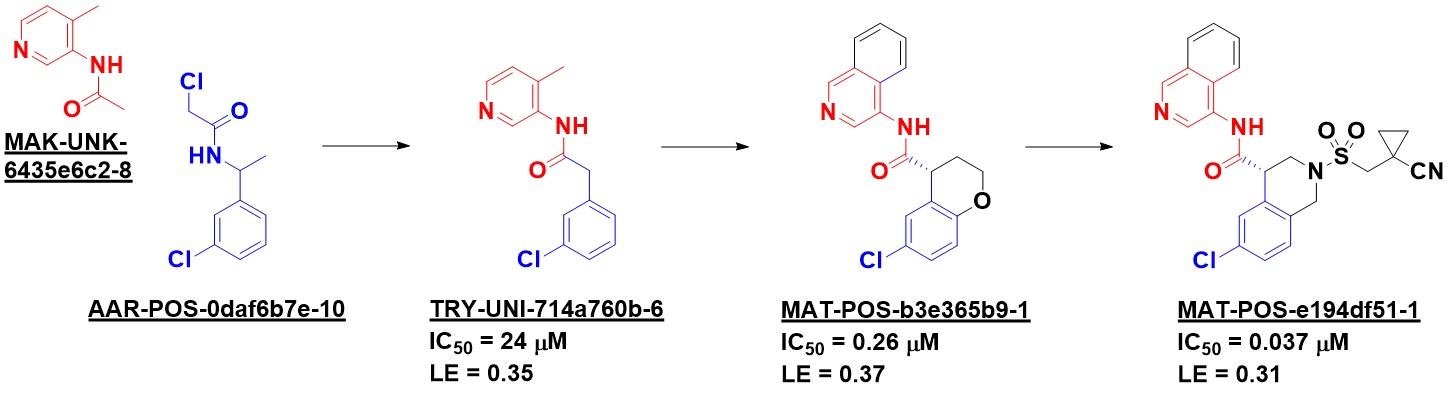
The paper highlights one lead series, which originated from a community submission (TRY-UNI-714a760b-6, itself fragment-sized) inspired by merging overlapping fragments. This mid micromolar inhibitor was ultimately optimized to MAT-POS-e194df51-1, with mid-nanomolar activity in both biochemical and cell assays. (Despite a chloroacetamide in one of the original fragments and a nitrile in the final molecule, which is the warhead found in the approved covalent Mpro inhibitor nirmatrelvir, MAT-POS-e194df51-1 is non-covalent.) 
 

The molecule is potent against known SARS-CoV-2 variants, including recent ones such as Omicron. A crystal structure of the final molecule also overlays remarkably well onto the initial fragments.
 
The paper notes that there is still considerable work to do, particularly optimizing the pharmacokinetics to lower clearance and improve bioavailability. These efforts can take vast sums of time and money, and the lead series has been adopted by the Drugs for Neglected Diseases initiative for further development. Although a handful of drugs are already approved against SARS-CoV-2, there is room for improvement: Derek Lowe posted a vivid personal account of his experience on nirmatrelvir here.
 
When we wrote about the COVID Moonshot in March of 2020, we correctly predicted that vaccines would be approved before drugs from this effort emerged. Fortunately, our warning that “there will be a SARS-CoV-3” has not proven correct – yet. But open science endeavors such as the COVID Moonshot will help us prepare for this eventuality. We may not have made it to the moon yet, but perhaps we’ve learned how to leave Earth’s orbit.

26 June 2023

Fragment merging in silico, two ways

Roughly speaking there are three ways to advance fragments to leads: growing, linking, or merging. Growing is the most common, but as the number of crystal structures of bound fragments continues to increase so too does the opportunity for fragment merging, in which elements of two fragments are combined into a new molecule. In a new (open access) J. Chem. Inf. Mod. paper, Charlotte Deane and collaborators at University of Oxford, Informatics Matters, Vernalis, and LifeArc compare two in silico methods.
 
Fragment merging, as described in the paper, “is used for fragments that bind in partially overlapping space by designing compounds that incorporate substructural features from each.” Each fragment may have extraneous bits that are not kept in the merged molecule. Indeed, sometimes only a small portion of one of the fragments is incorporated into the final molecule. (Both these concepts are shown in an example we recently wrote about here.)
 
When chemists merge two fragments, they consider the synthetic tractability of the merged molecules. Computers, on the other hand, sometimes propose compounds that are either unreasonable or would require a doctoral-thesis worth of effort to make. One solution is to invert the problem: rather than trying to assess whether specific in-silico-generated molecules can be made, possible merged molecules can be searched against a large virtual library of synthetically accessible molecules for similar compounds (see for example here).
 
A key question for this approach is the definition of similar. The most common method for finding similar molecules is by reducing them to molecular “fingerprints,” such as the presence or absence of a chlorine atom. The more fingerprints two molecules have in common, the more similar they are; this is the approach used for Tanimoto similarity.
 
An alternative approach is to use a “graph database” in which molecules are represented as nodes and edges, with nodes being substructures and edges being connections between the substructures. This approach was described by researchers from Astex as the Fragment Network.
 
Which of these approaches works better?
 
In the new paper, the researchers built a virtual library of more than 120 million commercially available molecules. They then selected four proteins with published crystallographic fragment hits. Between 9 and 19 individual fragments were chosen for merging for each protein, forming 55 to 134 potentially mergeable pairs. These were then computationally merged and queried against the database using either similarity searching or the Fragment Network.
 
Both search methods yielded comparable numbers of possible hits, ranging from just under 23,000 to nearly 169,000 per protein. These were then computationally filtered to find those molecules most likely to bind to the proteins, resulting in 56 to 952. Interestingly though, the specific molecules varied considerably depending on which search method was used. In fact, molecules from the Fragment Network mostly occupied different regions of chemical space than those found using similarity searching. Moreover, in many cases fragment pairs yielded merged compounds from one method but not the other. The number of predicted interactions with the protein targets also differed, and these differences extended not just to specific interactions but also to functional diversity.
 
The researchers did not purchase and test compounds themselves, but they did run the analysis against two published examples of fragment merging (one of which we wrote about here) and found that both the Fragment Network and similarity searching could find molecules related to experimentally validated binders.
 
The question of which approach works better remains open, so the researchers suggest using both. They do note that running a Fragment Network search is computationally less demanding, in this case taking an average of 2 to 14 minutes of CPU time vs 40 minutes for the similarity search. These differences become even more significant when searching billion-compound libraries.
 
Importantly, the researchers provide the code to generate your own Fragment Network, so you can try this at home. I look forward to seeing how the two techniques perform prospectively.

01 May 2023

Fragments vs metallo-beta-lactamases

With all the attention on COVID-19 over the past few years, it’s easy to forget about bacteria. But they haven’t forgotten about us. Indeed, antibiotic resistance genes are continuing to spread throughout the microbial world. One class of genes encode the metallo-beta-lactamases (MBLs), which hydrolyze beta-lactam antibiotics. In a recent J. Med. Chem. paper, Mihirbaran Mandal, Li Xiao, and colleagues at Merck describe their efforts against these enzymes. (Mihirbaran spoke about this work at the CHI DDC meeting a few weeks ago.)
 
The researchers started by turning to the literature and previous internal efforts. Tetrazole-containing molecules had been identified as MBL inhibitors, and a virtual screen led to the selection of 76 compounds for testing, of which 29 inhibited the enzyme NDM-1, one of several known MBLs. These included fragment-sized compound 13, and a subsequent screen also identified compound 14.

 
Crystal structures of both these molecules revealed that they bind in the active site. The tetrazole makes interactions with one of the catalytic zinc ions, while the proximal sulfonamide moiety in compound 14 makes interactions with both zinc ions by displacing a bridging hydroxide ion. Merging compounds 13 and 14 led to compound 18, with nanomolar activity against NDM-1 as well as two other MBLs.
 
Despite its metal-chelating sulfonamide moiety, compound 18 was inactive against 34 mammalian metalloenzymes tested. It also didn’t inhibit any of 114 potential off-targets in a Eurofins screen. As expected, the molecule alone had no bactericidal activity, but it did enhance the activity of the beta-lactam antibiotic imipenem in MBL-expressing bacteria. Increasing the polarity of the molecule by adding a hydroxyl moiety to a solvent-exposed region and converting a phenyl to a pyridyl ring resulted in compound 23. While less active against isolated MBL enzymes, this molecule was more effective at inhibiting bacterial growth in the presence of imipenem, possibly due to accumulation in the periplasmic space.
 
Compound 23 is clean against off-targets such as hERG, ion channels, and various CYP enzymes. It has reasonable pharmacokinetic properties in mice when dosed intravenously. In a preliminary mouse efficacy study, the compound reduced levels of bacteria in spleen and kidney when dosed with imipenem.
 
This is a nice example of structure-based design starting from fragment-sized molecules. With an abundance of nitrogen atoms and a ClogP < 0, compound 23 looks unusual. Nonetheless, the researchers write that “further evolution of this class of molecules… eventually led to the discovery of several clinical candidates.” I look forward to seeing these described.

24 April 2023

RSC Medicinal Chemistry special FBDD issue

The Royal Society of Chemistry puts out RSC Med. Chem., and last year they asked David Rees (Astex), Anna Hirsch (Helmholtz Institute for Pharmaceutical Research Saarland), and me whether a special themed issue on FBDD would be useful for the community. Naturally we said yes, and the results have now been published. You can read our introduction here.
 
Unlike olden days, when special issues were bound between covers, this is a virtual special issue, with papers published over a period of several months. Indeed, we already wrote about two of them last year: one on combining DNA-encoded libraries (DEL) with FBLD and one on inhibitors of PRMT5/MTA. (Both of these were also topics at the CHI FBDD meeting earlier this month.) In the next few paragraphs we highlight the rest.
 
AstraZeneca has been doing FBDD since 2002, and has gained hard-won wisdom, some of which was shared in a 2016 review we wrote about here. After years of screening, their fragment library had started to deteriorate, so they rebuilt it entirely, as described by Simon Lucas and colleagues. Some of the starting fragments came from their previous library, but they also considered molecules from their larger collection. Rather than focusing on the rule of three, they developed their own multiparameter optimization function, “FragScore,” which incorporates logD7.4, heavy atom count, number of rotatable bonds, and number of hydrogen bond donors. All compounds were inspected to make sure they would be synthetically tractable, and quality was assessed by SPR, NMR, redox activity, and solubility. The final set consists of 2741 fragments, with a subset of 1152 maximally diverse and attractive fragments for ligandability assessments or screening hard-to-make proteins. They also gathered 16,806 near neighbors for hit follow-up. So far the effort has paid off, with all four of the targets screened thus far yielding progressible hits. If you’re building or renovating a fragment library, you should read this paper.
 
Continuing on the theme of libraries, Bradley Doak, Martin Scanlon, and colleagues at Monash University describe their “MicroFrag” library, a set of 91 tiny (5-8 non-hydrogen atom) compounds similar to MiniFrags and FragLites. A crystallographic screen (at 1 M concentration!) of the MicroFrag library against the difficult E. coli target DsbA yielded a 52% hit rate, compared with a 2% hit rate with a conventional fragment library. Importantly, the MicroFrag screen identified the two main hot spots previously discovered from the conventional fragment library, along with ten others that may be less actionable. Interestingly, a crystallographic screen of 15 organic solvents at even higher concentrations (50-80%) was less informative: the primary hot spot did not distinguish itself from others. In the case of MicroFrags, not only did this hotspot bind the largest number of fragments, but all the molecular interactions seen for larger fragments were observed.
 
Fluorine NMR takes advantage of its own specialized library, the subject of a paper by Chojiro Kojima (Osaka University), Midori Takimoto-Kamimura (CBI Research Institute) and collaborators from several institutions. The researchers describe the construction of a 220-member library divided into pools of 10-21 compounds. This library was screened against four diverse proteins, yielding between 3 and 16 hits. The three hits against FKBP were characterized in more detail, including two-dimensional NMR and isothermal titration calorimetry. The researchers also discuss using 19F STD experiments to determine the binding mode of bound fragments.
 
Fluorine is not the only halogen of interest for library design. We’ve previously described the halogen-enriched fragment library (HEFLib, here and here), which consists of chlorine, bromine, and iodine-containing molecules. Frank Boeckler and collaborators at Eberhard Karls Universität Tübingen and the Max Planck Institute describe screening this library against the Y220C mutant of p53 in an expansion of work they first described back in 2012. Of 14 hits identified by thermal shift or STD NMR, ten confirmed by two-dimensional 1H-15N-HSQC NMR. Four of these bound in the cleft created by the Y220C oncogenic mutation. Two other fragments turned out to be covalent binders, though they reacted with more than one cysteine residue. Although all the fragments have low affinities, they could potentially serve as starting points for optimization.
 
An ongoing debate is whether there is an advantage to screening more “three dimensional” fragments as opposed to planar aromatic fragments. If your taste tends towards the former, the synthetic chemistry can get tricky. According to an analysis we highlighted last year, the piperidine ring is the third most common scaffold found in drugs. Now, Peter O’Brien (University of York) and an international group of collaborators report efficient synthetic routes to all 20 cis- and trans-piperidines substituted with a methyl group and a methyl ester. A virtual library of 80 compounds in which the secondary amine is capped with simple substituents such as methyl or acetyl groups was found to be quite shapely, particularly compared with the disubstituted pyridyl starting materials. Moreover, the fragments are still reasonably sized, with no more than 15 non-hydrogen atoms and ClogP values < 2.
 
Machine learning is gaining prominence everywhere, not least in drug discovery. In 2021 we highlighted an “autoencoder” designed for constructing fragment libraries biased towards “privileged” fragments more likely to generate hits. However, the method required considerable programming savvy. Now Angelo Pugliese (BioAscent) and collaborators at the Beatson Institute have implemented their model in the open-source KNIME platform, making it accessible to a wider range of researchers. As an example they use the method to construct a GPCR-focused fragment library, with the structures of all the members provided in the supporting information.
 
On the subject of fragment libraries, please make sure to vote in our 6-question poll on library design (right side of page; you may need to scroll up).
 
Not all the papers in this special issue involve library design. Marko Hyvönen, David Spring, and collaborators at University of Cambridge and National University of Singapore describe allosteric inhibitors of the kinase CK2α, which has been implicated in cancer cell survival. We highlighted some of their work against this target in 2017, in which they used fragment linking to find high nanomolar inhibitors of the enzyme. In the new paper, the researchers describe additional fragment binders at the so-called αD pocket, distant from the ATP-binding site. Virtual screening for analogs led to a fragment with mid-micromolar activity in biochemical and cell assays, and fragment merging led to low micromolar inhibitors.
 
This is a nice collection of papers, and for those of you without easy literature access make sure to check them out soon: for the next six months all of them are free to read after free RSC registration. Enjoy!

09 January 2023

From fragments to inhibitors of the SARS-CoV-2 Nsp3 macrodomain

Two years ago we highlighted what was likely the largest crystallographic fragment screen against any target, the macrodomain (Mac1) of the nonstructural protein 3 (Nsp3) of SARS-CoV-2. Mac1 dampens the cellular immune response to viral infection by removing ADP-ribose from various proteins. Separate mutational studies suggested this enzyme could be a good target for treating COVID-19.
 
The 234 fragment hits identified in 2021 could serve as good starting points. This has proven to be true, as demonstrated in a paper just published (open access) in Proc. Nat. Acad. Sci. USA by Brian Shoichet, James Fraser, and collaborators at University of California San Francisco, University of Oxford, Diamond Light Source, Enamine, and Chemspace. Despite the wealth of fragment hits, none of them were particularly potent; the best had an IC50 value of 180 µM in a homogenous time-resolved fluorescence (HTRF) competition assay. In the new paper, the researchers leveraged computational methods to advance these fragments.
 
First, they explored a fragment-linking approach termed Fragmentstein. This entailed choosing pairs of fragments that bound in close proximity to one another, merging or linking them, docking them to ensure the new molecule would bind in a similar manner to the component fragments, and then searching make-on-demand libraries in Enamine’s REAL database. Four pairs of fragments were evaluated, and 13 of 16 designed compounds were synthesized. Eight of these confirmed crystallographically, and two showed low micromolar activity in the HTRF assay. Interestingly, both of these came from the same fragment pair, ZINC922 and ZINC337835. The best molecule was a mixture of diastereomers, and one of the pure stereoisomers turned out to be submicromolar.
 
The potency of this fragment is all the more impressive given the low affinity of the initial fragments, which could only be crystallographically characterized using PanDDA, a method to find low-occupancy ligands that we wrote about here. Unfortunately, the compound has low cell permeability, likely due to the carboxylic acid moiety.
 
In addition to the linking approach via Fragmentstein, the researchers also conducted two virtual docking campaigns with more than 400 million molecules with molecular weights between 250-350 amu. Of 124 molecules purchased and tested, 47 confirmed crystallographically and 13 confirmed by HTRF, with IC50 values from 42 to 504 µM. (Ten of the 13 HTRF hits were also crystallographic hits. The researchers suggest the difference in confirmation rate is due at least in part to compound concentrations, which were 10-40 higher in the crystallographic screens.) In general the crystal structures confirmed the computationally predicted binding modes, particularly for fragments with measurable activity. Structure-based optimization of some of these fragments led to multiple low micromolar inhibitors, such as LRH-0021. Despite the carboxylic acid, this molecule is cell permeable.

This paper nicely illustrates how even very weak fragments can lead to multiple and very different series of inhibitors. The researchers acknowledge that the molecules are still at an early stage of development; indeed, they note that there are currently no good cellular assays to even assess the effect of Mac1 inhibition. Laudably, all the structures are deposited in the Protein Data Bank, which should provide a useful resource not just for further efforts on this protein but for understanding molecular interactions more generally.

12 December 2022

Fragments vs PRMT5/MTA: the runners-up

In January this year we highlighted the discovery of MRTX1719, Mirati’s clinical-stage inhibitor of the PRMT5/MTA complex which is being tested in patients with solid tumors bearing a homozygous MTAP deletion. In a recent article, Chris Smith, Svitlana Kulyk, and collaborators at Mirati and ZoBio discuss some of the other series that came from this campaign. (This article is part of a RSC Med. Chem. special issue on FBDD; more on that early next year.)
 
The researchers note that they chose FBLD “based on timelines” and the fact that they had the capability to “rapidly run a fragment screen.” FBLD is sometimes relegated to second place after other approaches fail, so it is refreshing to see the technique, pushed to the forefront, succeed. Details of the fragment screen are described in the earlier paper; this paper focuses on fragment optimization and elaboration.
 
Of the top 24 fragment hits, five yielded co-crystal structures with PRMT5/MTA. All bound in a similar region and participated in a hydrogen-bond network with the protein as well as van der Waals interactions with MTA. Fragment 2 was structurally unique and was ultimately advanced to MRTX1719, while the other four fragments contained a 2-amino substituent next to an aromatic nitrogen, and these are the focus of this paper. The researchers paid close attention to lipophilic ligand efficiency (LLE) to ensure that increases in potency were being driven by polar interactions rather than hydrophobic interactions that might negatively impact the physicochemical properties of the molecules.
 
Fragment 1 was the most potent, with high nanomolar affinity. Unfortunately, the molecule was not very synthetically tractable. Nonetheless, by merging this fragment with a previously reported PRMT5 inhibitor the researchers were able to obtain low nanomolar compound 9. Interestingly, crystallography revealed that while the fragment maintained its binding mode, the bit taken from the previous molecule bound quite differently than expected.

Fragment 3 was the most lipophilic of the hits, so before diving into serious chemistry the researchers sought to optimize the fragment. This led to compound 13, with lower clogP and improved LLE (as well as LE). Fragment growing quickly led to 150 analogs, with compound 27 showing low nanomolar potency.
 

Fragments 4 and 5, which differ only in the position of a methyl group, were the weakest of the five hits. Like fragment 3 they were also synthetically tractable, and the researchers were able to make 50 analogs, with compound 36 coming in at mid-nanomolar with improved LLE.
 
The paper is a nice case study in fragment- and structure-based design. The use of LLE as an explicit SAR driver is notable, as is the optimization of fragments before beginning growing efforts. The importance of chemical tractability is reflected in the fact that the most potent fragment did not ultimately lead to the clinical compound. It would have been nice to see more discussion on what factors led to the prioritization of the series derived from fragment 2: cell activity, DMPK properties, or other considerations. But at the end of the day the message is that fragments can provide multiple starting points for lead optimization.